Summative
Assessment
HADEEQA WALEED
EDUCATIONIST
Summative Assessment
• Summative assessment focus on what the student has
learned at the end of a unit of instruction or at the end of a
grade level (e.g. standard one, National Test) ( Johnson &
Jenkins, 2009).
• Summative assessment purpose is to let the teachers and
students know the level of accomplishment attained. The
final exam is classic example (Woolfolk et al 2008).
• A Summative Assessment/Evaluation At The End
Of A Sequence Of Instruction/Unit/Class/Program
/Semester Is Designed To Make Judgments About
Student Achievement, (E.G., Final Drafts, Tests,
Exam, Assignments, Projects, Performances)
• ▪ It Determines The Extent To Which Objectives Of
Instruction Have Been Attained And Used For
Assigning Grades And Marks And To Provide
Feedback To Students
• Summative Assessments (“Assessment Of
Learning”) To Measure How Much Our
Students Have Learned Up To A Particular
Point In Time
• Conducted At The End Of The Course
Unit/Semester (Final Exams)
• This Type Of Assessment Is A Successful End
Product Of The Pre-stated Objectives.
Example Of Summative
Assessment
• Rubrics
• ▪ Exams
• ▪ Final exams
• ▪ Term papers
• ▪ Exams
• ▪ Projects
• ▪ Portfolios
• ▪ Student evaluation
• ▪ Instructor self-evaluation
Advantages
• Necessary for determining student grades and Placement
• Promote teacher and student accountability
• Provides a means of evaluating instructional activities
• Encourages student activity engagement with course
material
• Objective measure of performance
• Freedom from active participation in discussion
Disadvantage
• Tendency for over-reliance on summative measures
• May promote cheating due to high level nature of
assessment
• Has been faulted for promoting “learning for the test
• Do not provide information for correcting errors
• May promote cheating due to high stakes nature of
assessment
• Has been criticized for promoting “teaching to the test”
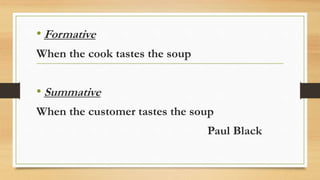
• Formative
When the cook tastes the soup
• Summative
When the customer tastes the soup
Paul Black

Summative assessment

  • 1.
  • 2.
    Summative Assessment • Summativeassessment focus on what the student has learned at the end of a unit of instruction or at the end of a grade level (e.g. standard one, National Test) ( Johnson & Jenkins, 2009). • Summative assessment purpose is to let the teachers and students know the level of accomplishment attained. The final exam is classic example (Woolfolk et al 2008).
  • 3.
    • A SummativeAssessment/Evaluation At The End Of A Sequence Of Instruction/Unit/Class/Program /Semester Is Designed To Make Judgments About Student Achievement, (E.G., Final Drafts, Tests, Exam, Assignments, Projects, Performances) • ▪ It Determines The Extent To Which Objectives Of Instruction Have Been Attained And Used For Assigning Grades And Marks And To Provide Feedback To Students
  • 4.
    • Summative Assessments(“Assessment Of Learning”) To Measure How Much Our Students Have Learned Up To A Particular Point In Time • Conducted At The End Of The Course Unit/Semester (Final Exams) • This Type Of Assessment Is A Successful End Product Of The Pre-stated Objectives.
  • 5.
    Example Of Summative Assessment •Rubrics • ▪ Exams • ▪ Final exams • ▪ Term papers • ▪ Exams • ▪ Projects • ▪ Portfolios • ▪ Student evaluation • ▪ Instructor self-evaluation
  • 6.
    Advantages • Necessary fordetermining student grades and Placement • Promote teacher and student accountability • Provides a means of evaluating instructional activities • Encourages student activity engagement with course material • Objective measure of performance • Freedom from active participation in discussion
  • 7.
    Disadvantage • Tendency forover-reliance on summative measures • May promote cheating due to high level nature of assessment • Has been faulted for promoting “learning for the test • Do not provide information for correcting errors • May promote cheating due to high stakes nature of assessment • Has been criticized for promoting “teaching to the test”
  • 8.
    • Formative When thecook tastes the soup • Summative When the customer tastes the soup Paul Black