Gas Laws
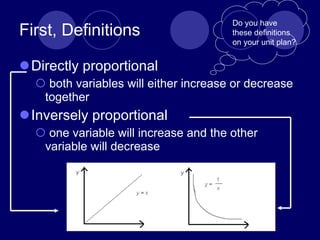
First, Definitions Directly proportional both variables will either increase or decrease together Inversely proportional one variable will increase and the other variable will decrease Do you have these definitions on your unit plan?
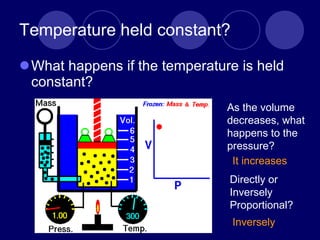
Temperature held constant? What happens if the temperature is held constant? As the volume decreases, what happens to the pressure? It increases Directly or Inversely Proportional? Inversely
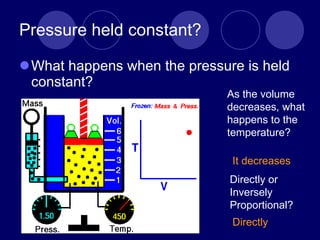
Pressure held constant? What happens when the pressure is held constant? As the volume decreases, what happens to the temperature? It decreases Directly or Inversely Proportional? Directly
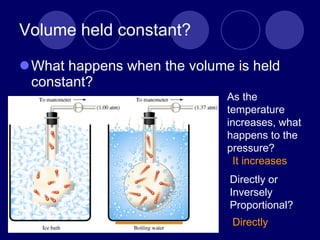
Volume held constant? What happens when the volume is held constant? As the temperature increases, what happens to the pressure? It increases Directly or Inversely Proportional? Directly
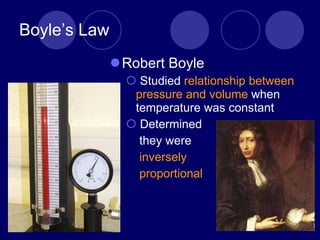
Boyle’s Law Robert Boyle Studied  relationship between pressure and volume  when temperature was constant Determined they were inversely proportional
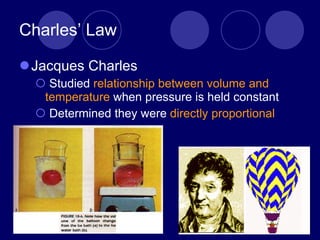
Charles’ Law Jacques Charles Studied  relationship between volume and temperature  when pressure is held constant Determined they were  directly proportional
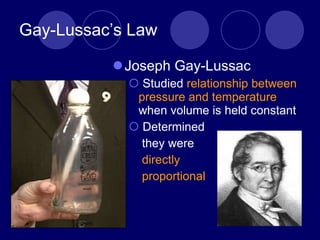
Gay-Lussac’s Law Joseph Gay-Lussac Studied  relationship between pressure and temperature  when volume is held constant Determined they were directly proportional
Ideal vs. Real Gas Ideal gases are gases whose particles  take up no space  and  have no intermolecular attractive forces Can you give an example of an ideal gas? Probably not….they do not exist in the real world! Expressed by the question  PV = nRT Do you have these definitions on your unit plan?
Ideal vs. Real Gas Real gases are gases whose particles  take up space  and  have intermolecular attractive forces Do you have these definitions on your unit plan?

Gas laws

  • 1.
  • 2.
    First, Definitions Directlyproportional both variables will either increase or decrease together Inversely proportional one variable will increase and the other variable will decrease Do you have these definitions on your unit plan?
  • 3.
    Temperature held constant?What happens if the temperature is held constant? As the volume decreases, what happens to the pressure? It increases Directly or Inversely Proportional? Inversely
  • 4.
    Pressure held constant?What happens when the pressure is held constant? As the volume decreases, what happens to the temperature? It decreases Directly or Inversely Proportional? Directly
  • 5.
    Volume held constant?What happens when the volume is held constant? As the temperature increases, what happens to the pressure? It increases Directly or Inversely Proportional? Directly
  • 6.
    Boyle’s Law RobertBoyle Studied relationship between pressure and volume when temperature was constant Determined they were inversely proportional
  • 7.
    Charles’ Law JacquesCharles Studied relationship between volume and temperature when pressure is held constant Determined they were directly proportional
  • 8.
    Gay-Lussac’s Law JosephGay-Lussac Studied relationship between pressure and temperature when volume is held constant Determined they were directly proportional
  • 9.
    Ideal vs. RealGas Ideal gases are gases whose particles take up no space and have no intermolecular attractive forces Can you give an example of an ideal gas? Probably not….they do not exist in the real world! Expressed by the question PV = nRT Do you have these definitions on your unit plan?
  • 10.
    Ideal vs. RealGas Real gases are gases whose particles take up space and have intermolecular attractive forces Do you have these definitions on your unit plan?