Presentation
on
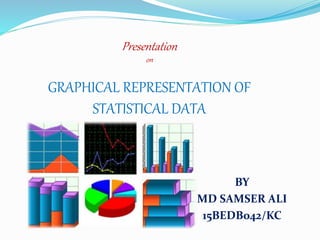
GRAPHICAL REPRESENTATION OF
STATISTICAL DATA
BY
MD SAMSER ALI
15BEDB042/KC
Meaning Of Graphical Representation Of Data
 A picture is said to be more effective than words for describing a
particular thing.
 A graphic representation is the geometrical image of a set of data .
 It is a mathematical picture.
 It enables us to think about a statistical problem in visual terms.
 It is an effective and economic device for the presentation ,
understanding and interpretation of the collected data.
IMPOTANCE OF GRAPHICAL REPRESENTATION
 It is used to make the data understandable to common
man.
 It helps in easy and quick understanding of data.
 Data displayed by graphical representation can be
memorised for a long time.
 Can be compared at a glance.
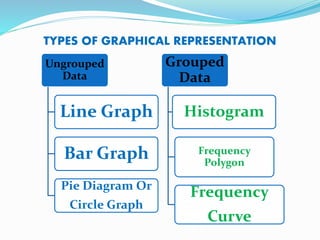
TYPES OF GRAPHICAL REPRESENTATION
Ungrouped
Data
Line Graph
Bar Graph
Pie Diagram Or
Circle Graph
Grouped
Data
Histogram
Frequency
Polygon
Frequency
Curve
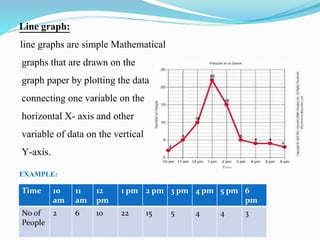
Line graph:
line graphs are simple Mathematical
graphs that are drawn on the
graph paper by plotting the data
connecting one variable on the
horizontal X- axis and other
variable of data on the vertical
Y-axis.
EXAMPLE:
Time 10
am
11
am
12
pm
1 pm 2 pm 3 pm 4 pm 5 pm 6
pm
No of
People
2 6 10 22 15 5 4 4 3
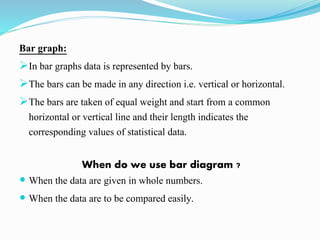
Bar graph:
In bar graphs data is represented by bars.
The bars can be made in any direction i.e. vertical or horizontal.
The bars are taken of equal weight and start from a common
horizontal or vertical line and their length indicates the
corresponding values of statistical data.
When do we use bar diagram ?
 When the data are given in whole numbers.
 When the data are to be compared easily.
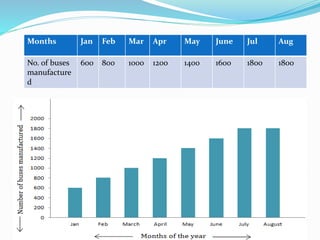
How To Make A Bar Graph ?
Months Jan Feb Mar Apr May June Jul Aug
No. of buses
manufacture
d
600 800 1000 1200 1400 1600 1800 1800
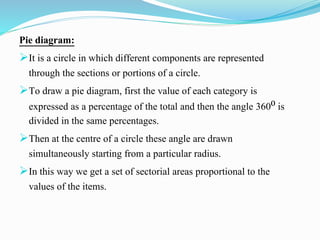
Pie diagram:
It is a circle in which different components are represented
through the sections or portions of a circle.
To draw a pie diagram, first the value of each category is
expressed as a percentage of the total and then the angle 360⁰ is
divided in the same percentages.
Then at the centre of a circle these angle are drawn
simultaneously starting from a particular radius.
In this way we get a set of sectorial areas proportional to the
values of the items.
When do we use pie diagram?
 When the data are given in percentage.
 When different aspect of a variable are to be displayed.
 When the data are to be compared normally.
HOW TO MAKE A PIE DIAGRAM ?
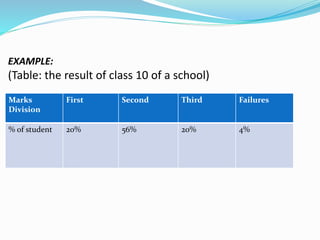
EXAMPLE:
(Table: the result of class 10 of a school)
Marks
Division
First Second Third Failures
% of student 20% 56% 20% 4%
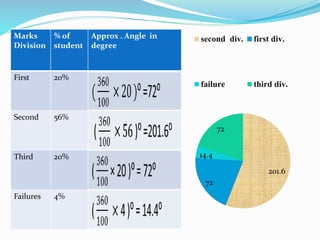
201.6
72
14.4
72
second div. first div.
failure third div.
Marks
Division
% of
student
Approx . Angle in
degree
First 20%
Second 56%
Third 20%
Failures 4%
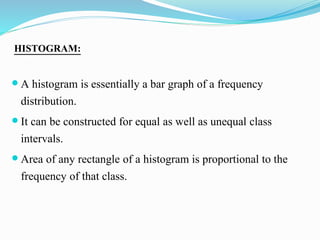
HISTOGRAM:
 A histogram is essentially a bar graph of a frequency
distribution.
 It can be constructed for equal as well as unequal class
intervals.
 Area of any rectangle of a histogram is proportional to the
frequency of that class.
When do we use histogram ?
When data are given in the form of frequencies.
When class interval has to be displayed by a diagram.
When we need to calculate the Mode of a distribution
graphically.
How to make Histogram ?
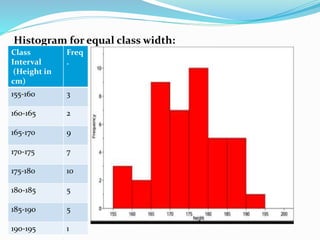
Histogram for equal class width:
Class
Interval
(Height in
cm)
Freq
.
155-160 3
160-165 2
165-170 9
170-175 7
175-180 10
180-185 5
185-190 5
190-195 1
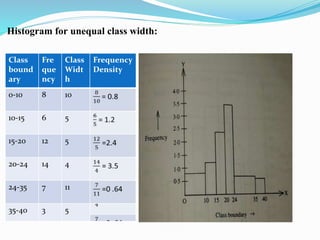
Histogram for unequal class width:
Class
bound
ary
Fre
que
ncy
Class
Widt
h
Frequency
Density
0-10 8 10
10-15 6 5
15-20 12 5
20-24 14 4
24-35 7 11
35-40 3 5
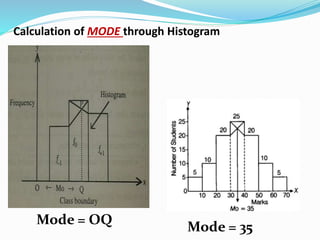
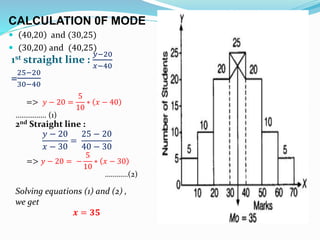
Calculation of MODE through Histogram
Mode = OQ
Mode = 35
1st straight line :
𝑦−20
𝑥−40
=
25−20
30−40
CALCULATION 0F MODE
 40,20 and (30,25)
 (30,20) and (40,25)
=> 𝑦 − 20 =
5
10
∗ 𝑥 − 40
……………. (1)
2nd Straight line :
𝑦 − 20
𝑥 − 30
=
25 − 20
40 − 30
=> 𝑦 − 20 = −
5
10
∗ 𝑥 − 30
…………(2)
Solving equations (1) and (2) ,
we get
𝒙 = 𝟑𝟓
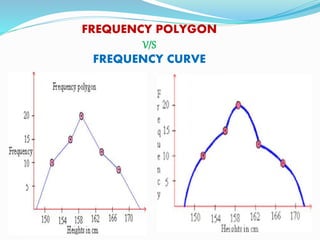
FREQUENCY PLOGON:
A frequency polygon is essentially a line graph .
 We can get it from a histogram, if the mid points of the upper bases
of the rectangles are connected by straight lines.
 But it is not essential to plot a histogram first to draw it.
 We can construct it directly from a given frequency distribution.
When do we use Frequency polygon?
o When data are given in the form of frequencies.
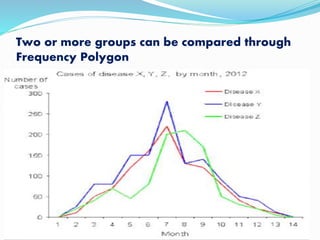
oWhen two or more groups have to be displayed in one
diagram.
o When two or more groups are to be compared.
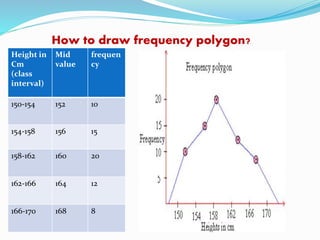
How to draw frequency polygon?
Height in
Cm
(class
interval)
Mid
value
frequen
cy
150-154 152 10
154-158 156 15
158-162 160 20
162-166 164 12
166-170 168 8
Two or more groups can be compared through
Frequency Polygon
FREQUENCY CURVE:
 Frequency curve is another type of graphical representation of data.
 When then top points of a frequency polygon are joined not by
straight lines but by curved ones.
 Frequency polygon is drawn using scale while while Frequency
curve is drawn using free hand.
When the number of class intervals are very large i.e.,width of the
class intervals are very small and the total number of sample values
be increased indefinitely.
When do we use frequency curve ?
FREQUENCY POLYGON
V/S
FREQUENCY CURVE
CONCLUSION
So we can conclude that statistical data may be
presented in a more attractive form with the help
of some graphic aids i.e., pictures and diagrams
which carries a lot of communication power and
the task of understand and interpretation of data
becomes simple, accurate and practicable.
Graphical Representation of Statistical data

Graphical Representation of Statistical data

  • 1.
  • 2.
    Meaning Of GraphicalRepresentation Of Data  A picture is said to be more effective than words for describing a particular thing.  A graphic representation is the geometrical image of a set of data .  It is a mathematical picture.  It enables us to think about a statistical problem in visual terms.  It is an effective and economic device for the presentation , understanding and interpretation of the collected data.
  • 3.
    IMPOTANCE OF GRAPHICALREPRESENTATION  It is used to make the data understandable to common man.  It helps in easy and quick understanding of data.  Data displayed by graphical representation can be memorised for a long time.  Can be compared at a glance.
  • 4.
    TYPES OF GRAPHICALREPRESENTATION Ungrouped Data Line Graph Bar Graph Pie Diagram Or Circle Graph Grouped Data Histogram Frequency Polygon Frequency Curve
  • 5.
    Line graph: line graphsare simple Mathematical graphs that are drawn on the graph paper by plotting the data connecting one variable on the horizontal X- axis and other variable of data on the vertical Y-axis. EXAMPLE: Time 10 am 11 am 12 pm 1 pm 2 pm 3 pm 4 pm 5 pm 6 pm No of People 2 6 10 22 15 5 4 4 3
  • 6.
    Bar graph: In bargraphs data is represented by bars. The bars can be made in any direction i.e. vertical or horizontal. The bars are taken of equal weight and start from a common horizontal or vertical line and their length indicates the corresponding values of statistical data. When do we use bar diagram ?  When the data are given in whole numbers.  When the data are to be compared easily.
  • 7.
    How To MakeA Bar Graph ?
  • 8.
    Months Jan FebMar Apr May June Jul Aug No. of buses manufacture d 600 800 1000 1200 1400 1600 1800 1800
  • 9.
    Pie diagram: It isa circle in which different components are represented through the sections or portions of a circle. To draw a pie diagram, first the value of each category is expressed as a percentage of the total and then the angle 360⁰ is divided in the same percentages. Then at the centre of a circle these angle are drawn simultaneously starting from a particular radius. In this way we get a set of sectorial areas proportional to the values of the items.
  • 10.
    When do weuse pie diagram?  When the data are given in percentage.  When different aspect of a variable are to be displayed.  When the data are to be compared normally.
  • 11.
    HOW TO MAKEA PIE DIAGRAM ?
  • 12.
    EXAMPLE: (Table: the resultof class 10 of a school) Marks Division First Second Third Failures % of student 20% 56% 20% 4%
  • 13.
    201.6 72 14.4 72 second div. firstdiv. failure third div. Marks Division % of student Approx . Angle in degree First 20% Second 56% Third 20% Failures 4%
  • 14.
    HISTOGRAM:  A histogramis essentially a bar graph of a frequency distribution.  It can be constructed for equal as well as unequal class intervals.  Area of any rectangle of a histogram is proportional to the frequency of that class.
  • 15.
    When do weuse histogram ? When data are given in the form of frequencies. When class interval has to be displayed by a diagram. When we need to calculate the Mode of a distribution graphically.
  • 16.
    How to makeHistogram ?
  • 17.
    Histogram for equalclass width: Class Interval (Height in cm) Freq . 155-160 3 160-165 2 165-170 9 170-175 7 175-180 10 180-185 5 185-190 5 190-195 1
  • 18.
    Histogram for unequalclass width: Class bound ary Fre que ncy Class Widt h Frequency Density 0-10 8 10 10-15 6 5 15-20 12 5 20-24 14 4 24-35 7 11 35-40 3 5
  • 19.
    Calculation of MODEthrough Histogram Mode = OQ Mode = 35
  • 20.
    1st straight line: 𝑦−20 𝑥−40 = 25−20 30−40 CALCULATION 0F MODE  40,20 and (30,25)  (30,20) and (40,25) => 𝑦 − 20 = 5 10 ∗ 𝑥 − 40 ……………. (1) 2nd Straight line : 𝑦 − 20 𝑥 − 30 = 25 − 20 40 − 30 => 𝑦 − 20 = − 5 10 ∗ 𝑥 − 30 …………(2) Solving equations (1) and (2) , we get 𝒙 = 𝟑𝟓
  • 21.
    FREQUENCY PLOGON: A frequencypolygon is essentially a line graph .  We can get it from a histogram, if the mid points of the upper bases of the rectangles are connected by straight lines.  But it is not essential to plot a histogram first to draw it.  We can construct it directly from a given frequency distribution.
  • 22.
    When do weuse Frequency polygon? o When data are given in the form of frequencies. oWhen two or more groups have to be displayed in one diagram. o When two or more groups are to be compared.
  • 23.
    How to drawfrequency polygon? Height in Cm (class interval) Mid value frequen cy 150-154 152 10 154-158 156 15 158-162 160 20 162-166 164 12 166-170 168 8
  • 24.
    Two or moregroups can be compared through Frequency Polygon
  • 25.
    FREQUENCY CURVE:  Frequencycurve is another type of graphical representation of data.  When then top points of a frequency polygon are joined not by straight lines but by curved ones.  Frequency polygon is drawn using scale while while Frequency curve is drawn using free hand.
  • 26.
    When the numberof class intervals are very large i.e.,width of the class intervals are very small and the total number of sample values be increased indefinitely. When do we use frequency curve ?
  • 27.
  • 28.
    CONCLUSION So we canconclude that statistical data may be presented in a more attractive form with the help of some graphic aids i.e., pictures and diagrams which carries a lot of communication power and the task of understand and interpretation of data becomes simple, accurate and practicable.