Language Maintenance and Shift
Muhammad Azam
Research Scholar
COMSATS Institute of Information
Technology Lahore, Pakistan
Introduction
• What happens when people with different mother
tongues meet each others?
• 1. They simply maintained their mother tongue.
That’s called “Language Maintenance”
• 2. They shift to the new L2 as their main (or only)
language. It is “ Language Shift”
Introduction
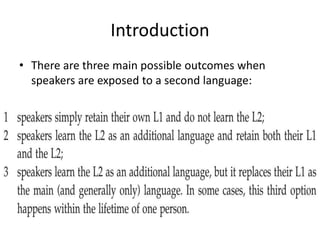
• There are three main possible outcomes when
speakers are exposed to a second language:
Introduction
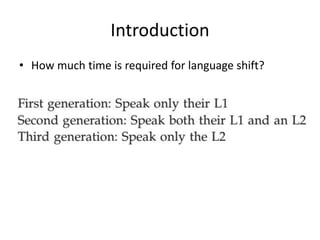
• How much time is required for language shift?
Introduction
• However, a ‘three generation shift‘ is not the only
possible pattern. Paulston (1994) cites the Greeks in
Pittsburgh as experiencing a four generation shift.
She attributes this slower shift to the use of a
standardized, prestigious written language; access to
an institution teaching Greek language and literacy
(i.e. Greek churches in Pittsburgh); and arranged
marriages with one partner being a monolingual
Greek speaker from Greece.
Introduction
• A five stage shift from minority language
monolingualism to majority language monolingualism
was found by Von Gleich and Wölck (1994) in Peru:
– (1) mono-lingualism in Quechua (Quichua),
– (2) bilingualism but Quechua stronger than Spanish,
– (3) bilingualism with Quechua and Spanish approximately
balanced,
– (4)bilingualism but Spanish dominant over Quechua,
– (5) mono-lingualism in Spanish.
Introduction
• Amongst Panjabi, Italian, Gaelic and Welsh
communities in Britain, there are occasional ‘fourth
generation’ individuals who sometimes wish to
revive the language of their ethnic origins.
• The pressure to become part of a larger whole seems
to result in a counter-balancing need to have secure
roots within a smaller and more domestic
community.
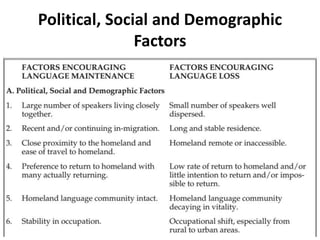
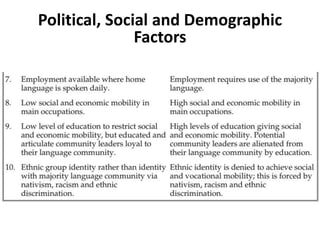
Political, Social and Demographic
Factors
Political, Social and Demographic
Factors
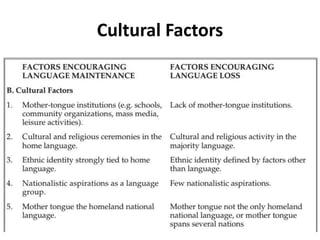
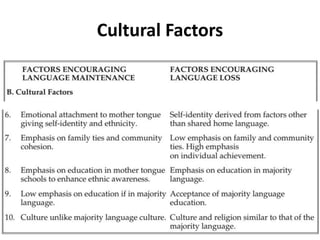
Cultural Factors
Cultural Factors
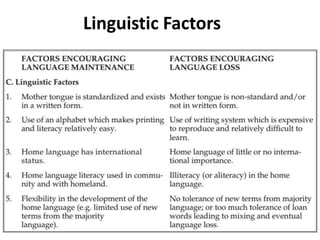
Linguistic Factors

Language maintenance and shift

  • 1.
    Language Maintenance andShift Muhammad Azam Research Scholar COMSATS Institute of Information Technology Lahore, Pakistan
  • 2.
    Introduction • What happenswhen people with different mother tongues meet each others? • 1. They simply maintained their mother tongue. That’s called “Language Maintenance” • 2. They shift to the new L2 as their main (or only) language. It is “ Language Shift”
  • 3.
    Introduction • There arethree main possible outcomes when speakers are exposed to a second language:
  • 4.
    Introduction • How muchtime is required for language shift?
  • 5.
    Introduction • However, a‘three generation shift‘ is not the only possible pattern. Paulston (1994) cites the Greeks in Pittsburgh as experiencing a four generation shift. She attributes this slower shift to the use of a standardized, prestigious written language; access to an institution teaching Greek language and literacy (i.e. Greek churches in Pittsburgh); and arranged marriages with one partner being a monolingual Greek speaker from Greece.
  • 6.
    Introduction • A fivestage shift from minority language monolingualism to majority language monolingualism was found by Von Gleich and Wölck (1994) in Peru: – (1) mono-lingualism in Quechua (Quichua), – (2) bilingualism but Quechua stronger than Spanish, – (3) bilingualism with Quechua and Spanish approximately balanced, – (4)bilingualism but Spanish dominant over Quechua, – (5) mono-lingualism in Spanish.
  • 7.
    Introduction • Amongst Panjabi,Italian, Gaelic and Welsh communities in Britain, there are occasional ‘fourth generation’ individuals who sometimes wish to revive the language of their ethnic origins. • The pressure to become part of a larger whole seems to result in a counter-balancing need to have secure roots within a smaller and more domestic community.
  • 8.
    Political, Social andDemographic Factors
  • 9.
    Political, Social andDemographic Factors
  • 10.
  • 11.
  • 12.