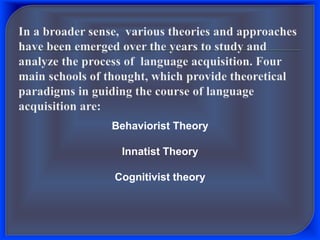

Behaviorist Theory
Innatist Theory
Cognitivist theory
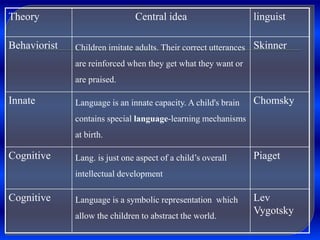
Theory Central idea linguist
Behaviorist Children imitate adults. Their correct utterances
are reinforced when they get what they want or
are praised.
Skinner
Innate Language is an innate capacity. A child's brain
contains special language-learning mechanisms
at birth.
Chomsky
Cognitive Lang. is just one aspect of a child’s overall
intellectual development
Piaget
Cognitive Language is a symbolic representation which
allow the children to abstract the world.
Lev
Vygotsky
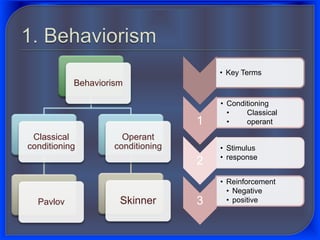
• Key Terms
1
• Conditioning
• Classical
• operant
2
• Stimulus
• response
3
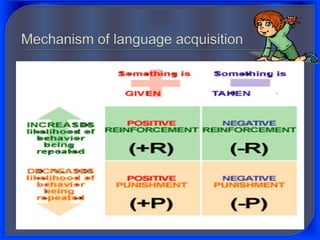
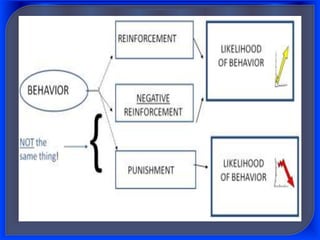
• Reinforcement
• Negative
• positive
Behaviorism
Classical
conditioning
Pavlov
Operant
conditioning
Skinner
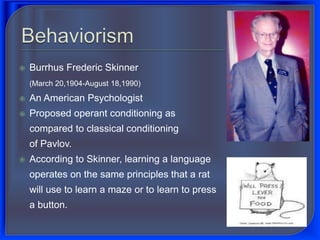
 Burrhus Frederic Skinner
(March 20,1904-August 18,1990)
 An American Psychologist
 Proposed operant conditioning as
compared to classical conditioning
of Pavlov.
 According to Skinner, learning a language
operates on the same principles that a rat
will use to learn a maze or to learn to press
a button.
 B.F Skinner proposed this theory as an explanation for Language
acquisition in human.
 All behavior is learned and that humans enter the world with no
innate abilities. He famously said,
"Give me a child, and I'll shape him into anything.”
 B. F SKINNER’S entire system is based on operant
conditioning (learning's a function of change in overt behavior)
 The organism, in everyday activities, is in the process of
“operating” on the environment.
 Behaviorists view the process of language acquisition as a building
process that results from interaction with the environment.
 It is also called imitation theory which is based on an empirical or
behavioral approach.
 Children start out as clean slates and language learning is a process
of getting linguistic habits printed on these slates.
 Language is a ‘conditioned behavior’: the stimulus response process
 Stimulus Response Feedback Reinforcement
• People’s behaviors are directly observable, rather than the
mental systems underlying these behaviors.
• Children are born with a mind that is like a blank state. This
state is called Tabula Rasa
• Language is a verbal observable behavior .
• Chunking theory: Language is learned in parts, then linked
together
• 1st words 2nd phrases 3rd sentences
• Reinforcement will generalize similar stimulus
generalizations
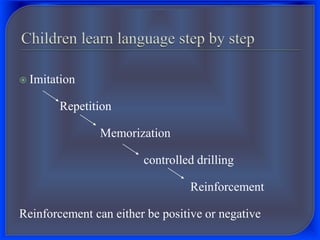
 Imitation
Repetition
Memorization
controlled drilling
Reinforcement
Reinforcement can either be positive or negative
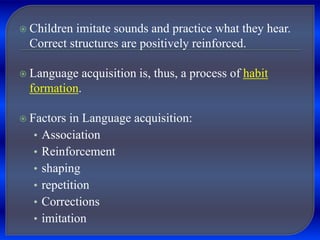
 Children imitate sounds and practice what they hear.
Correct structures are positively reinforced.
 Language acquisition is, thus, a process of habit
formation.
 Factors in Language acquisition:
• Association
• Reinforcement
• shaping
• repetition
• Corrections
• imitation
 Imitation is important in phonological development.
 Children develop regional accents suggesting they imitate the sounds
from people around them.
Negatives
 Children don’t pick up grammatical structures immediately as some
children show an incorrect use of grammar. For example they may
say ‘wented’ instead of went. Showing they have not imitated this of
others.
 Kids normally only use the words they understand so if they imitate
of others they would copy all words spoken by another person.
 If the kid is deaf, it cannot copy another person therefore uses sign
language suggesting this theory does not provide an account for all
kids.
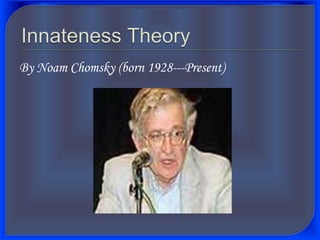
By Noam Chomsky (born 1928---Present)
 Limitations of Behaviorist view of language acquisition
led in 1960’s to the alternative ‘generative’ account of
language.
 Main Argument: Children must be born with an innate
capacity for language development.
 Main Figure: Noam Chomsky
 Children are born with an innate propensity for language
acquisition, and that this ability makes the task of
learning a first language easier than it would otherwise
be.
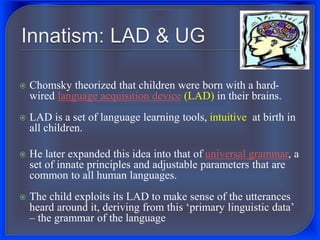
 Chomsky theorized that children were born with a hard-
wired language acquisition device (LAD) in their brains.
 LAD is a set of language learning tools, intuitive at birth in
all children.
 He later expanded this idea into that of universal grammar, a
set of innate principles and adjustable parameters that are
common to all human languages.
 The child exploits its LAD to make sense of the utterances
heard around it, deriving from this ‘primary linguistic data’
– the grammar of the language
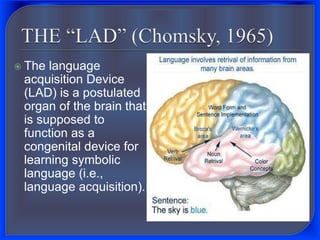
 The language
acquisition Device
(LAD) is a postulated
organ of the brain that
is supposed to
function as a
congenital device for
learning symbolic
language (i.e.,
language acquisition).
 The L.A.D is a pre programmed box.
 L.A.D is a function of the brain that is specifically for learning
language. It is an innate biological function of human beings just
like learning to walk.
 LAD explain human acquisition of the syntactic structure of
language.
 It encodes the major principles of a language and its grammatical
structures into the child’s brain.
 It enables the children to analyze language and extract the basic
rules.
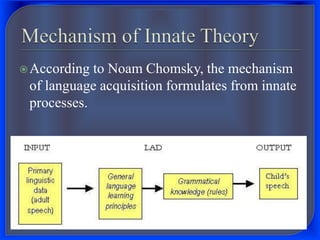
According to Noam Chomsky, the mechanism
of language acquisition formulates from innate
processes.
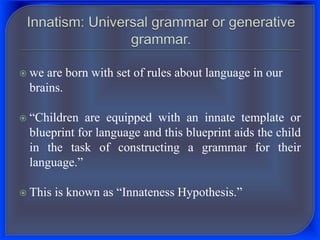
 we are born with set of rules about language in our
brains.
 “Children are equipped with an innate template or
blueprint for language and this blueprint aids the child
in the task of constructing a grammar for their
language.”
 This is known as “Innateness Hypothesis.”
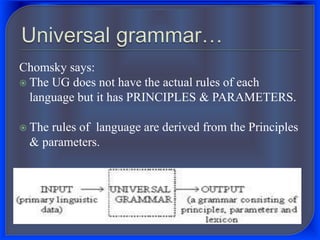
Chomsky says:
 The UG does not have the actual rules of each
language but it has PRINCIPLES & PARAMETERS.
 The rules of language are derived from the Principles
& parameters.
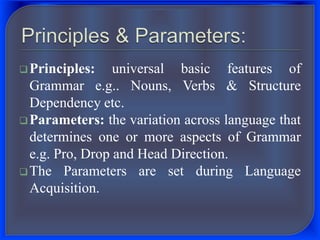
Principles: universal basic features of
Grammar e.g.. Nouns, Verbs & Structure
Dependency etc.
Parameters: the variation across language that
determines one or more aspects of Grammar
e.g. Pro, Drop and Head Direction.
The Parameters are set during Language
Acquisition.
Chomsky posited that there is a critical age
for learning a language as is true for the
overall development of the human body.
 Note: linguist Lenneberg suggested that the crucial period of
language acquisition ends around 4-5 years
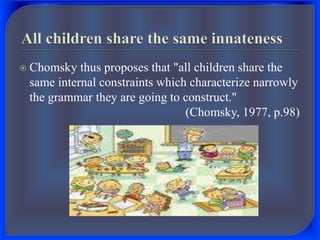
 Chomsky thus proposes that "all children share the
same internal constraints which characterize narrowly
the grammar they are going to construct."
(Chomsky, 1977, p.98)
 “Language learning is not really something that the
child does; it is something that happens to the child
placed in an appropriate environment much as the
child’s body grows and matures in a predetermined way
when provided with appropriate nutrition and
environmental stimulation.”
-Noam Chomsky
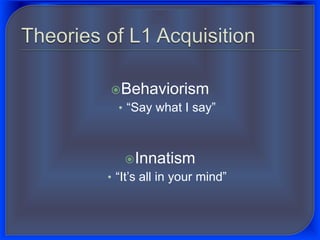
Behaviorism
• “Say what I say”
Innatism
• “It’s all in your mind”
NEXT
HASSAN

Linguistic oriented theories

  • 2.
  • 3.
    Theory Central idealinguist Behaviorist Children imitate adults. Their correct utterances are reinforced when they get what they want or are praised. Skinner Innate Language is an innate capacity. A child's brain contains special language-learning mechanisms at birth. Chomsky Cognitive Lang. is just one aspect of a child’s overall intellectual development Piaget Cognitive Language is a symbolic representation which allow the children to abstract the world. Lev Vygotsky
  • 4.
    • Key Terms 1 •Conditioning • Classical • operant 2 • Stimulus • response 3 • Reinforcement • Negative • positive Behaviorism Classical conditioning Pavlov Operant conditioning Skinner
  • 5.
     Burrhus FredericSkinner (March 20,1904-August 18,1990)  An American Psychologist  Proposed operant conditioning as compared to classical conditioning of Pavlov.  According to Skinner, learning a language operates on the same principles that a rat will use to learn a maze or to learn to press a button.
  • 6.
     B.F Skinnerproposed this theory as an explanation for Language acquisition in human.  All behavior is learned and that humans enter the world with no innate abilities. He famously said, "Give me a child, and I'll shape him into anything.”  B. F SKINNER’S entire system is based on operant conditioning (learning's a function of change in overt behavior)  The organism, in everyday activities, is in the process of “operating” on the environment.
  • 7.
     Behaviorists viewthe process of language acquisition as a building process that results from interaction with the environment.  It is also called imitation theory which is based on an empirical or behavioral approach.  Children start out as clean slates and language learning is a process of getting linguistic habits printed on these slates.  Language is a ‘conditioned behavior’: the stimulus response process  Stimulus Response Feedback Reinforcement
  • 8.
    • People’s behaviorsare directly observable, rather than the mental systems underlying these behaviors. • Children are born with a mind that is like a blank state. This state is called Tabula Rasa • Language is a verbal observable behavior . • Chunking theory: Language is learned in parts, then linked together • 1st words 2nd phrases 3rd sentences • Reinforcement will generalize similar stimulus generalizations
  • 9.
  • 12.
     Children imitatesounds and practice what they hear. Correct structures are positively reinforced.  Language acquisition is, thus, a process of habit formation.  Factors in Language acquisition: • Association • Reinforcement • shaping • repetition • Corrections • imitation
  • 13.
     Imitation isimportant in phonological development.  Children develop regional accents suggesting they imitate the sounds from people around them. Negatives  Children don’t pick up grammatical structures immediately as some children show an incorrect use of grammar. For example they may say ‘wented’ instead of went. Showing they have not imitated this of others.  Kids normally only use the words they understand so if they imitate of others they would copy all words spoken by another person.  If the kid is deaf, it cannot copy another person therefore uses sign language suggesting this theory does not provide an account for all kids.
  • 14.
    By Noam Chomsky(born 1928---Present)
  • 15.
     Limitations ofBehaviorist view of language acquisition led in 1960’s to the alternative ‘generative’ account of language.  Main Argument: Children must be born with an innate capacity for language development.  Main Figure: Noam Chomsky  Children are born with an innate propensity for language acquisition, and that this ability makes the task of learning a first language easier than it would otherwise be.
  • 16.
     Chomsky theorizedthat children were born with a hard- wired language acquisition device (LAD) in their brains.  LAD is a set of language learning tools, intuitive at birth in all children.  He later expanded this idea into that of universal grammar, a set of innate principles and adjustable parameters that are common to all human languages.  The child exploits its LAD to make sense of the utterances heard around it, deriving from this ‘primary linguistic data’ – the grammar of the language
  • 17.
     The language acquisitionDevice (LAD) is a postulated organ of the brain that is supposed to function as a congenital device for learning symbolic language (i.e., language acquisition).
  • 18.
     The L.A.Dis a pre programmed box.  L.A.D is a function of the brain that is specifically for learning language. It is an innate biological function of human beings just like learning to walk.  LAD explain human acquisition of the syntactic structure of language.  It encodes the major principles of a language and its grammatical structures into the child’s brain.  It enables the children to analyze language and extract the basic rules.
  • 20.
    According to NoamChomsky, the mechanism of language acquisition formulates from innate processes.
  • 21.
     we areborn with set of rules about language in our brains.  “Children are equipped with an innate template or blueprint for language and this blueprint aids the child in the task of constructing a grammar for their language.”  This is known as “Innateness Hypothesis.”
  • 22.
    Chomsky says:  TheUG does not have the actual rules of each language but it has PRINCIPLES & PARAMETERS.  The rules of language are derived from the Principles & parameters.
  • 23.
    Principles: universal basicfeatures of Grammar e.g.. Nouns, Verbs & Structure Dependency etc. Parameters: the variation across language that determines one or more aspects of Grammar e.g. Pro, Drop and Head Direction. The Parameters are set during Language Acquisition.
  • 24.
    Chomsky posited thatthere is a critical age for learning a language as is true for the overall development of the human body.  Note: linguist Lenneberg suggested that the crucial period of language acquisition ends around 4-5 years
  • 25.
     Chomsky thusproposes that "all children share the same internal constraints which characterize narrowly the grammar they are going to construct." (Chomsky, 1977, p.98)
  • 26.
     “Language learningis not really something that the child does; it is something that happens to the child placed in an appropriate environment much as the child’s body grows and matures in a predetermined way when provided with appropriate nutrition and environmental stimulation.” -Noam Chomsky
  • 27.
    Behaviorism • “Say whatI say” Innatism • “It’s all in your mind”
  • 28.

Editor's Notes

  • #9 Example : Parent shows the child an apple and says, “Apple.” The child responds, attempting to say apple. The parent praises the child and gives the child the apple.
  • #12 Children often make grammatical mistakes that they couldn't possibly have heard:  Cookies are gooder than bread.  Bill taked the toy.  We goed to the store, Don't giggle me