
MOHAMED KHETTOUCH
Teacher of English- Med V High
School – Goulmima- Errachidia
OUTLINE
INTRODUCTION
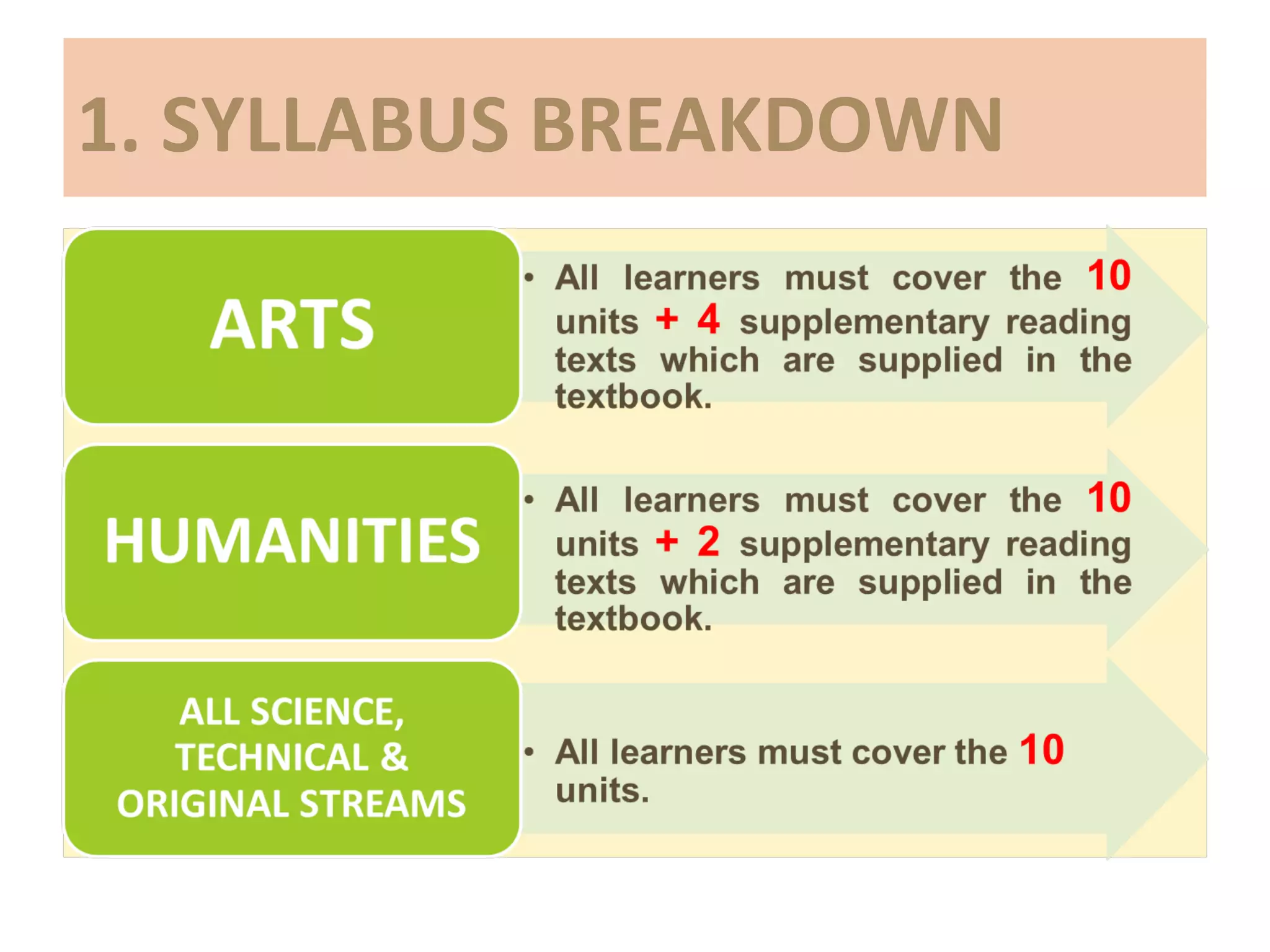
1.SYLLABUS BREAKDOWN
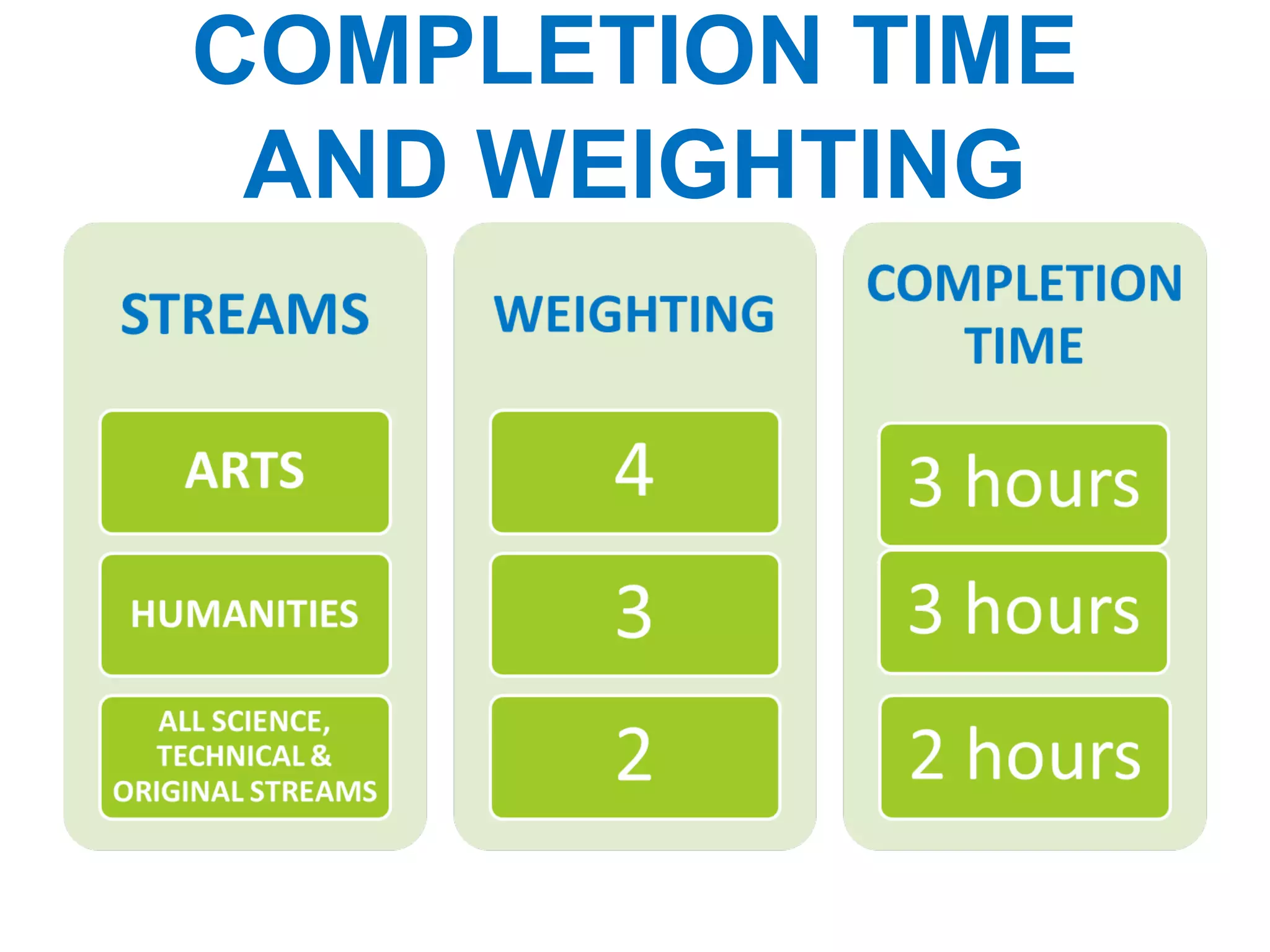
2.COMPLETION TIME AND WEIGHTING
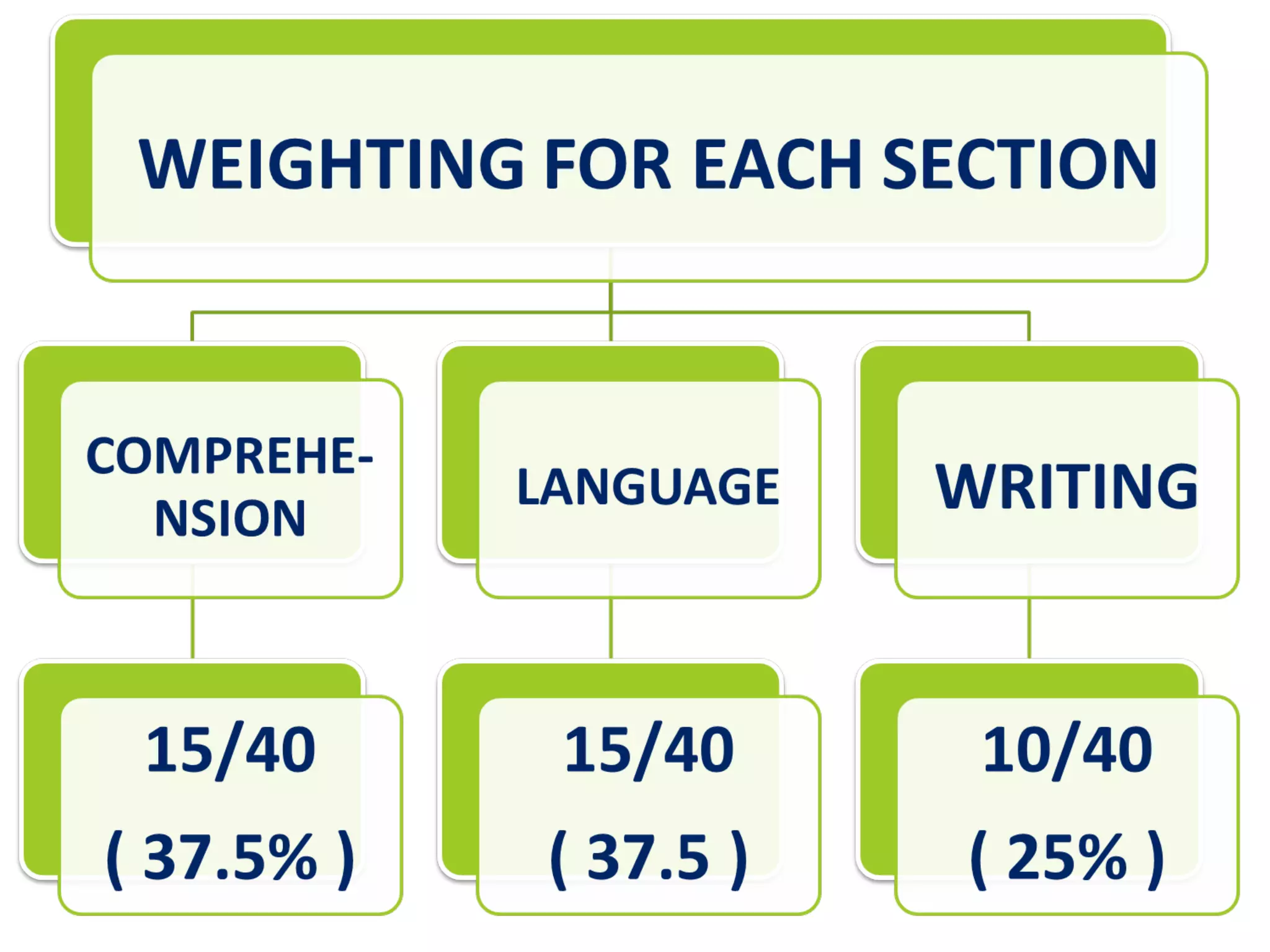
3.EXAM SECTIONS AND WEIGHTING.
4.SECTIONS, TEST TECHNIQUES AND RUBRICS
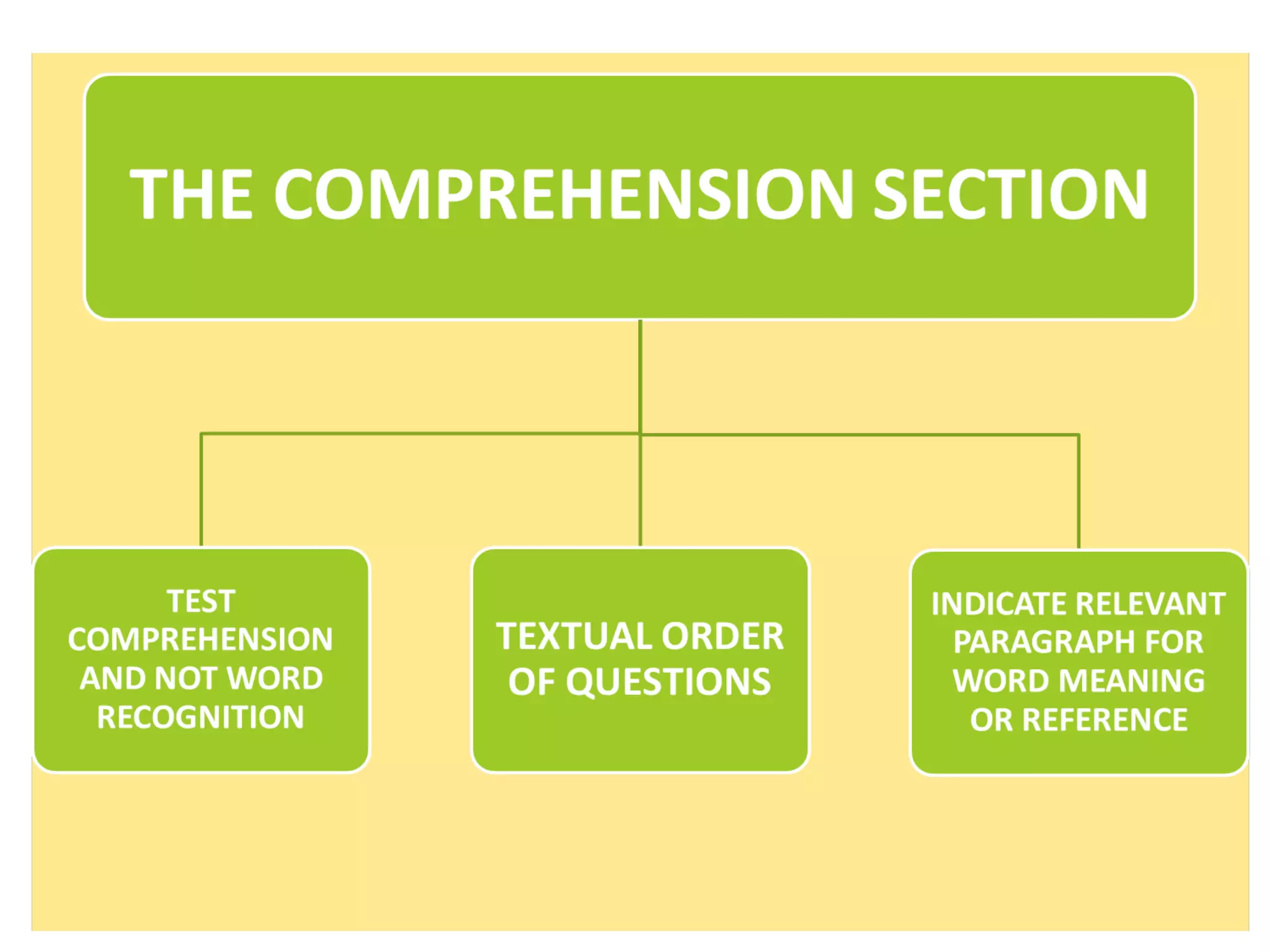
4.1. THE COMPREHENSION SECTION
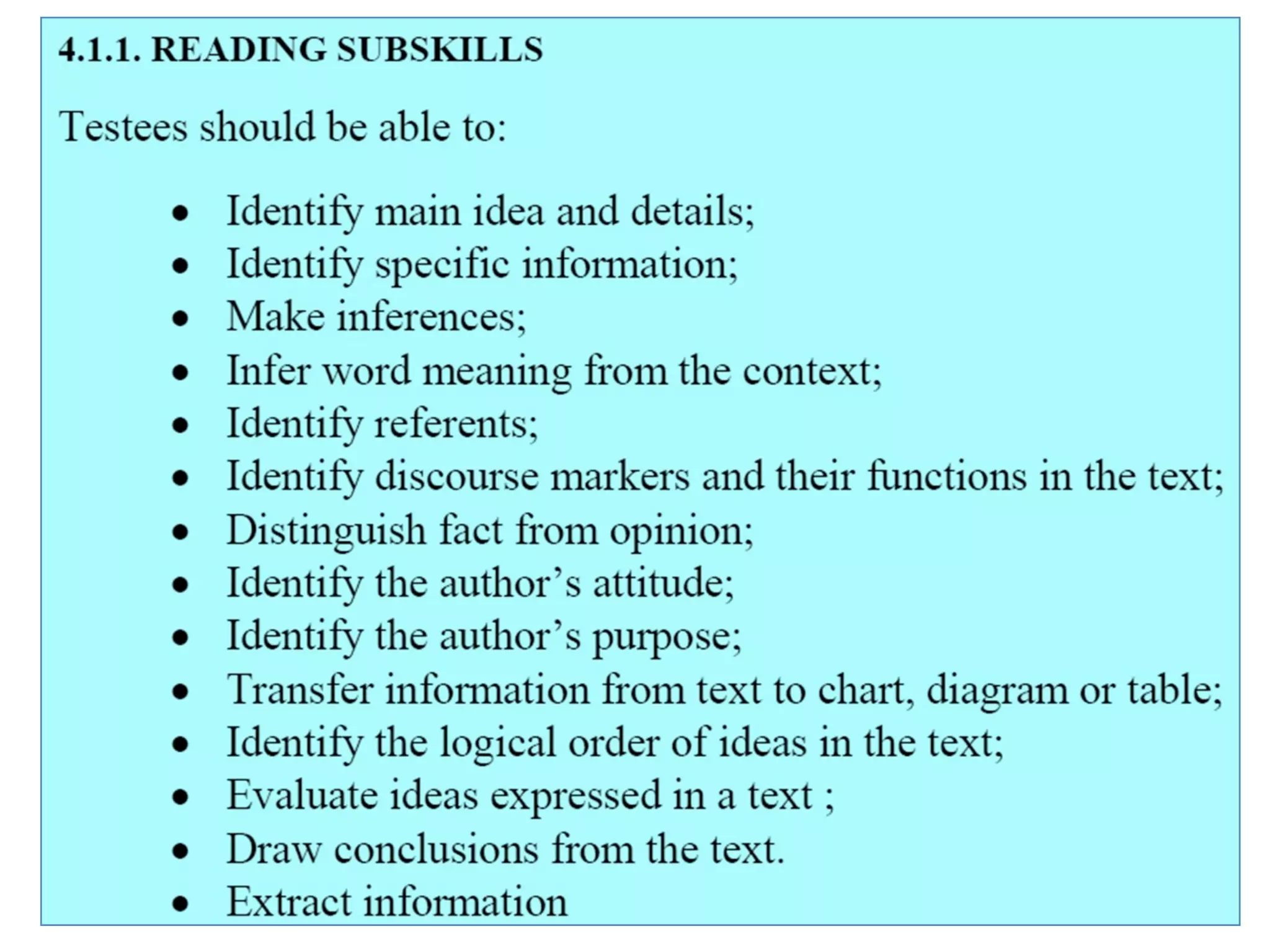
4.1.1. READING SUBSKILLS
4.1.2. TEXT TYPES AND TOPICS
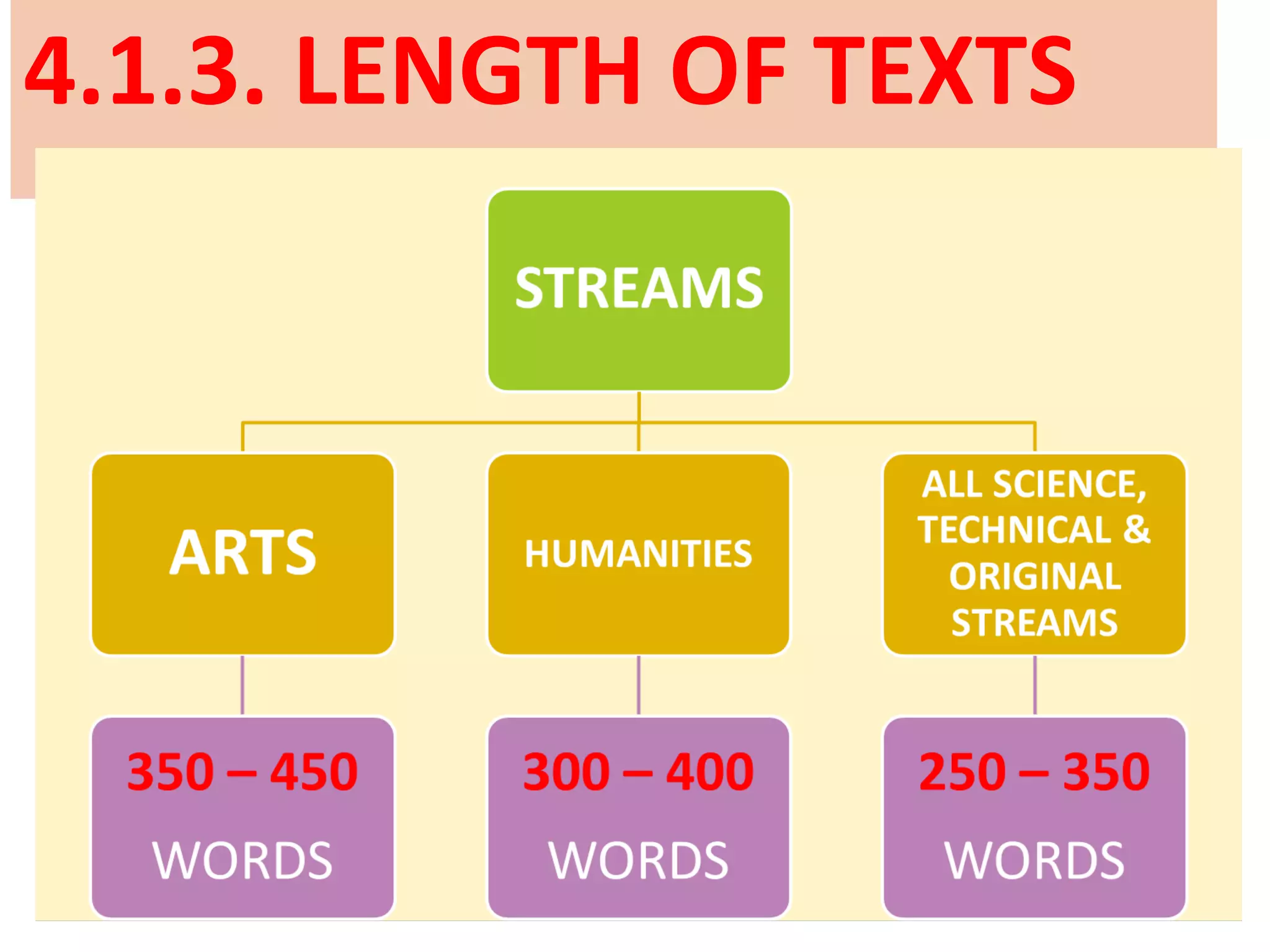
4.1.3. LENGTH OF TEXTS
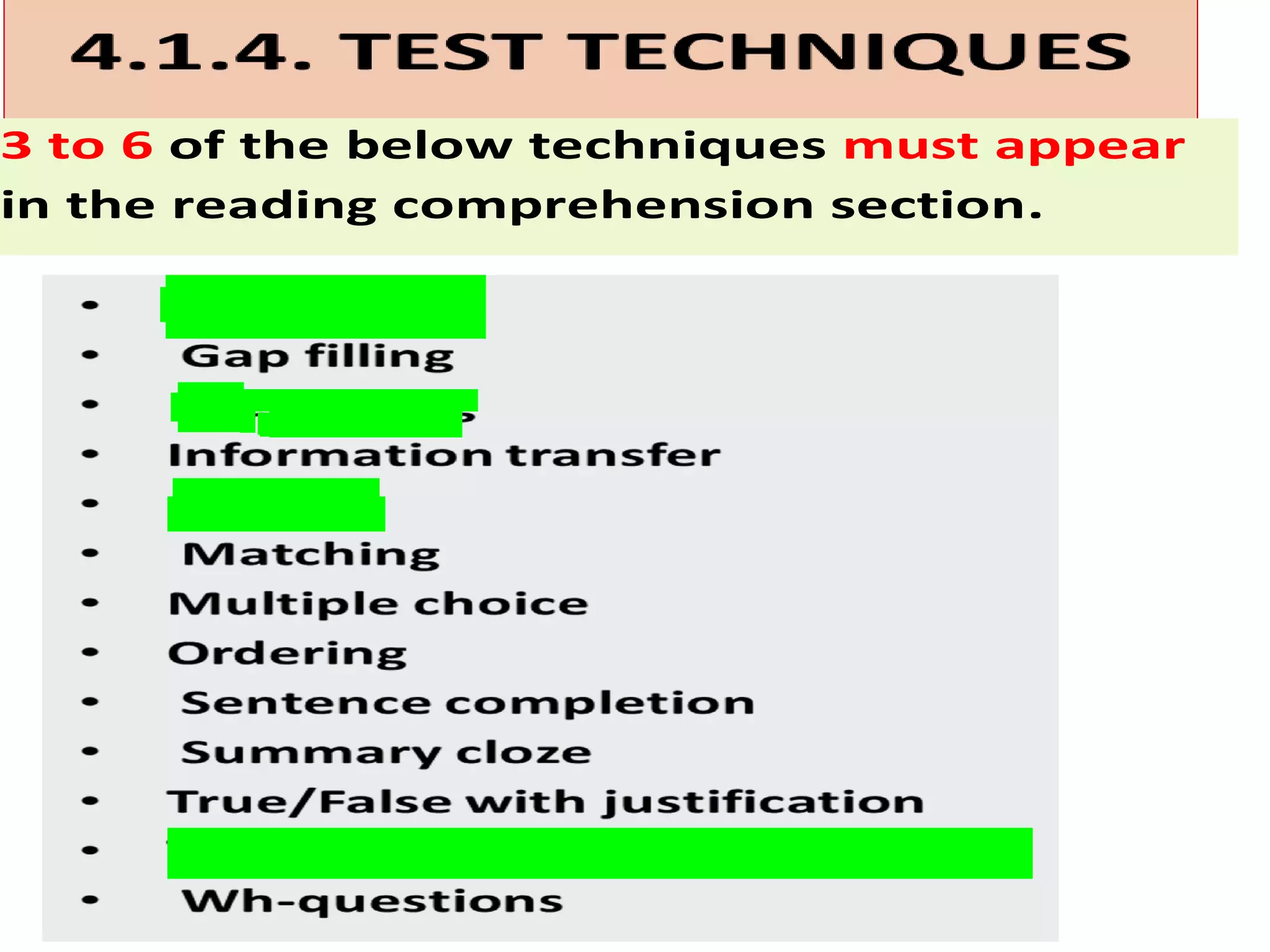
4.1.4. TEST TECHNIQUES
4.1.5. DISTRIBUTION OF BITS
4.1.6. RUBRICS
4.1.7. SCORING
4.2. THE LANGUAGE SECTION
4.2.1. DISTRIBUTION AND WEIGHTING
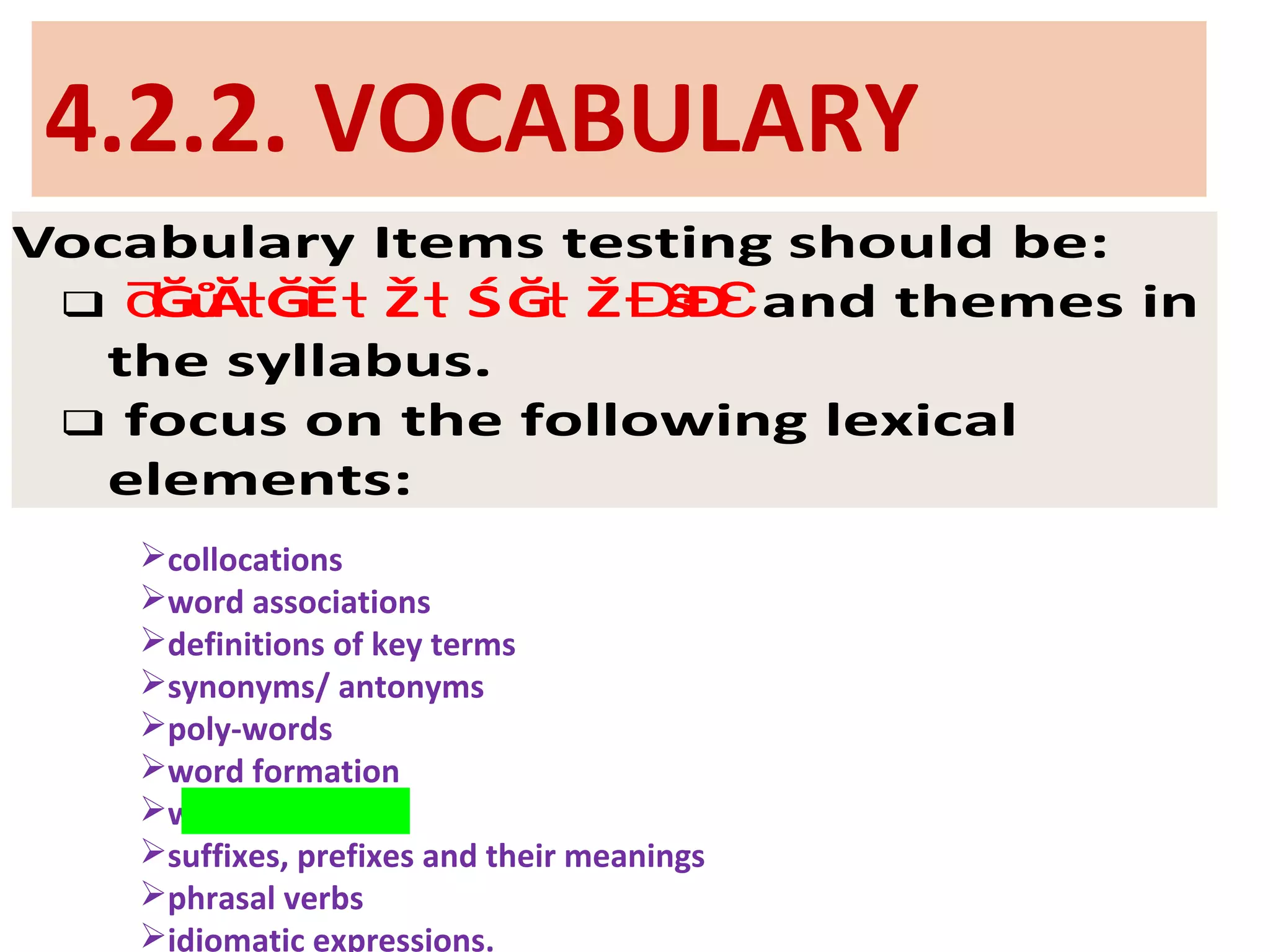
4.2.2. VOCABULARY
OUTLINE ( Cont. )
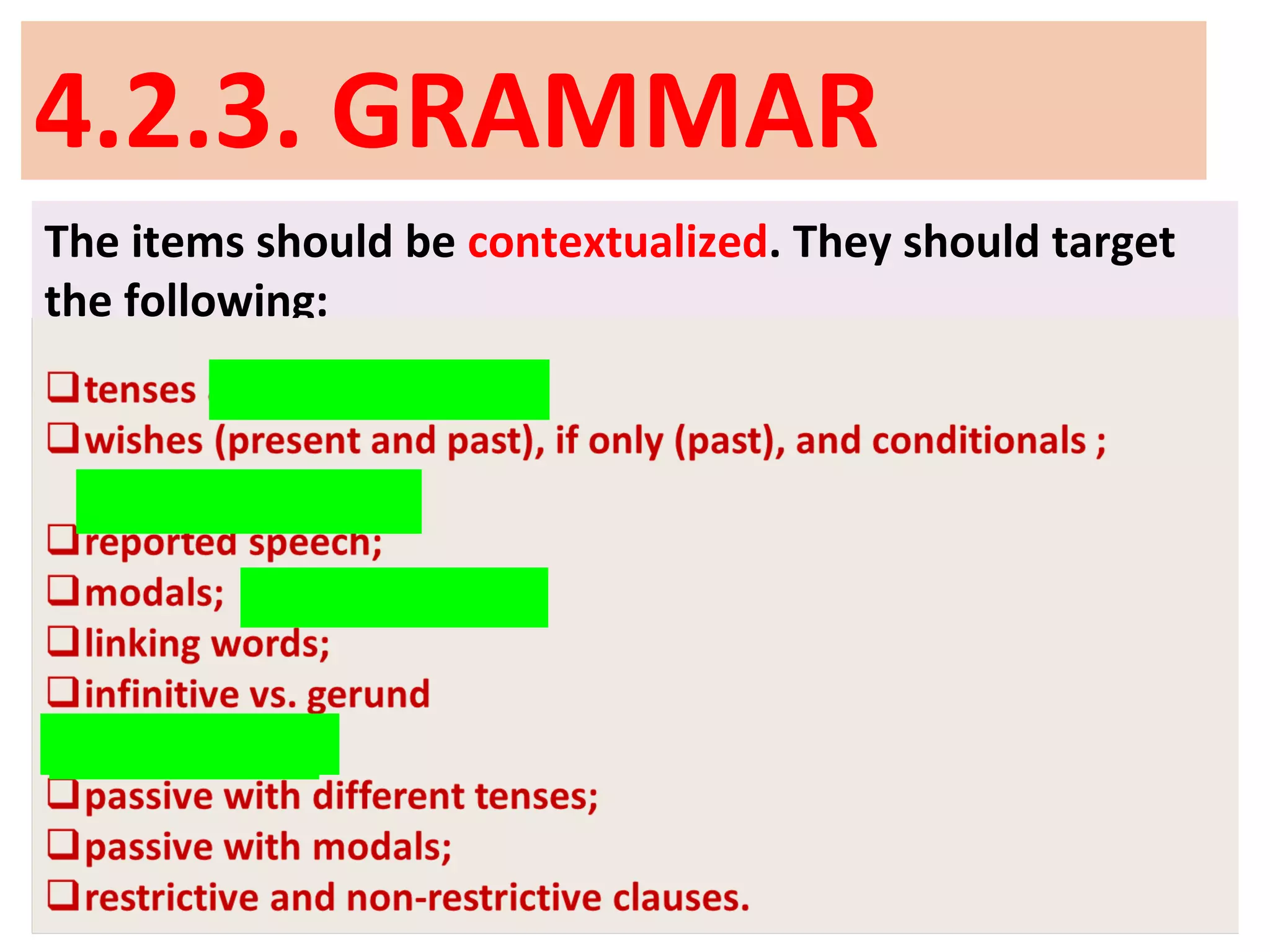
4.2.3. GRAMMAR
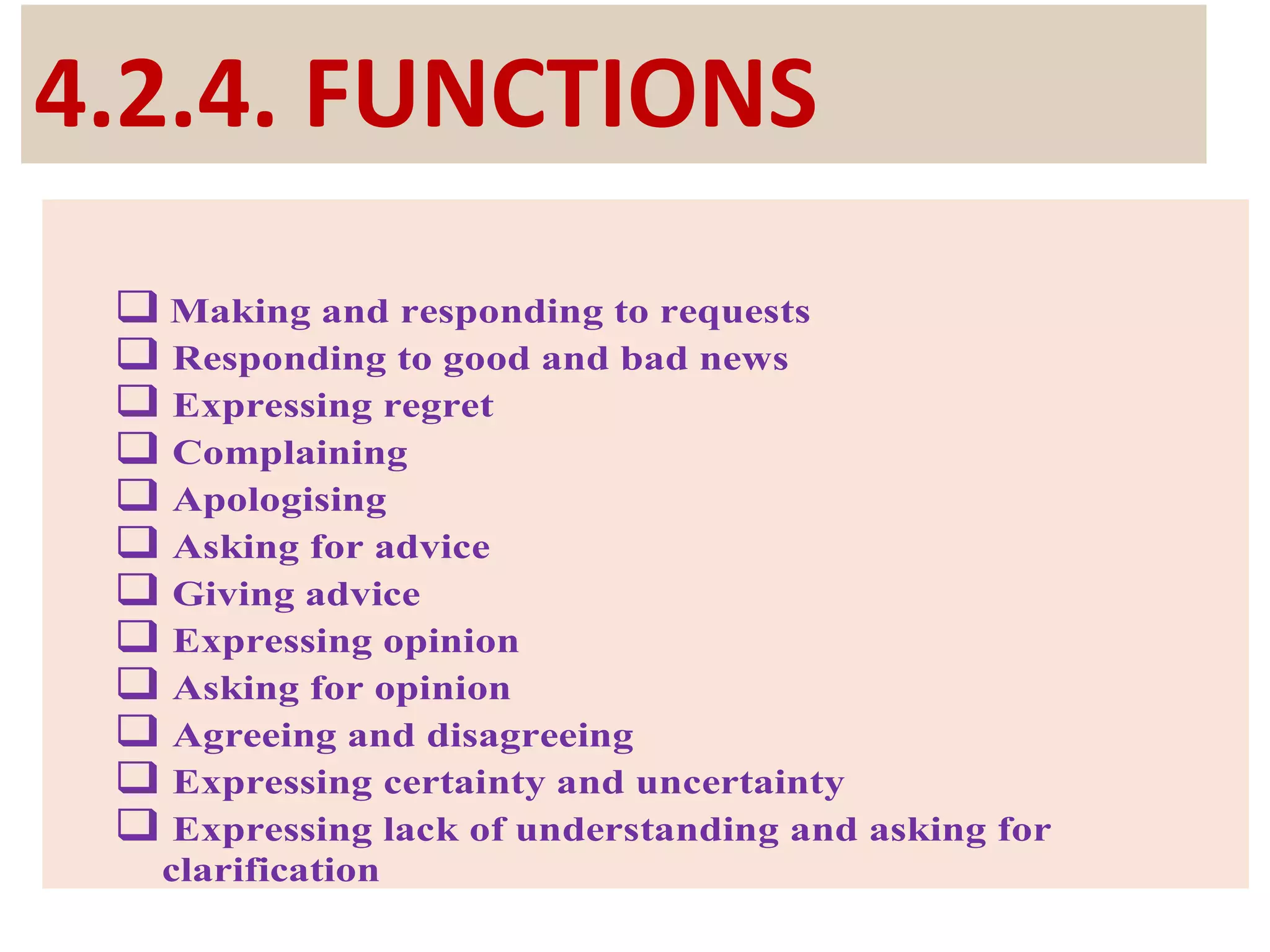
4.2.4. FUNCTIONS
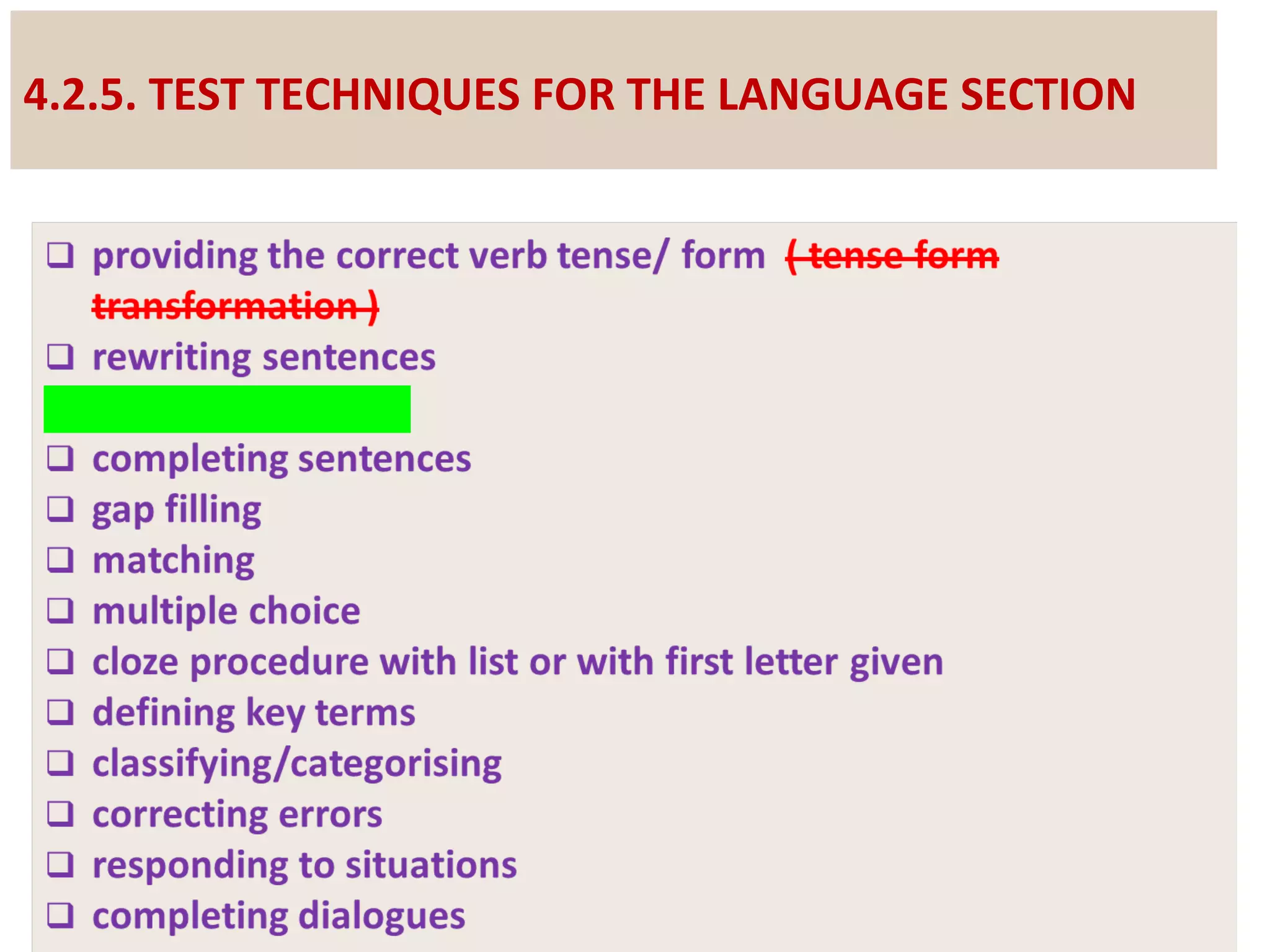
4.2.5. TEST TECHNIQUES FOR THE LANGUAGE SECTION
4.2.6. RUBRICS
4.2.7. DISTRIBUTION OF BITS
4.2.8. SCORING
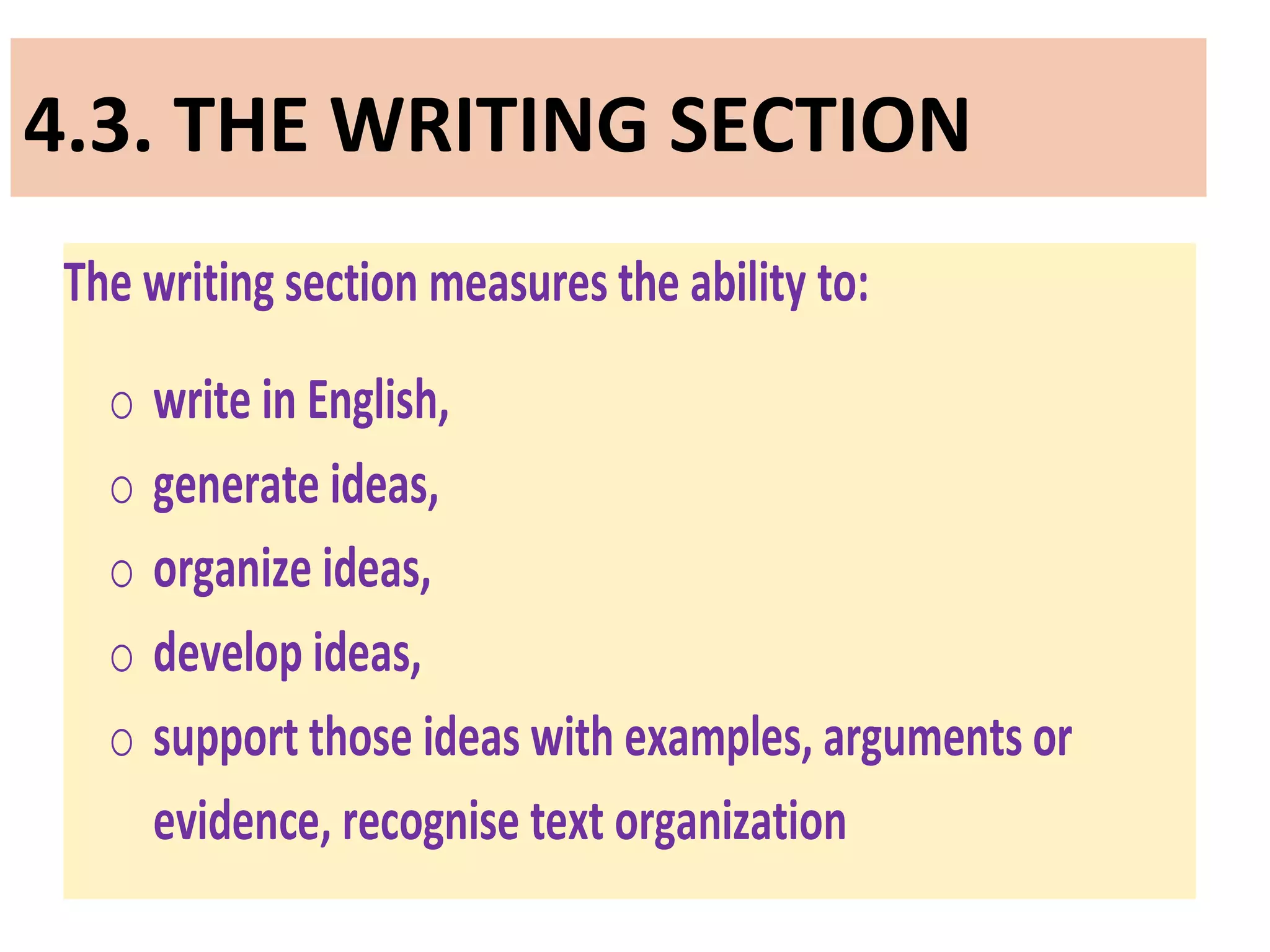
4.3. THE WRITING SECTION
4.3.1. WRITING SUB-SKILLS AND ACTIVITIES
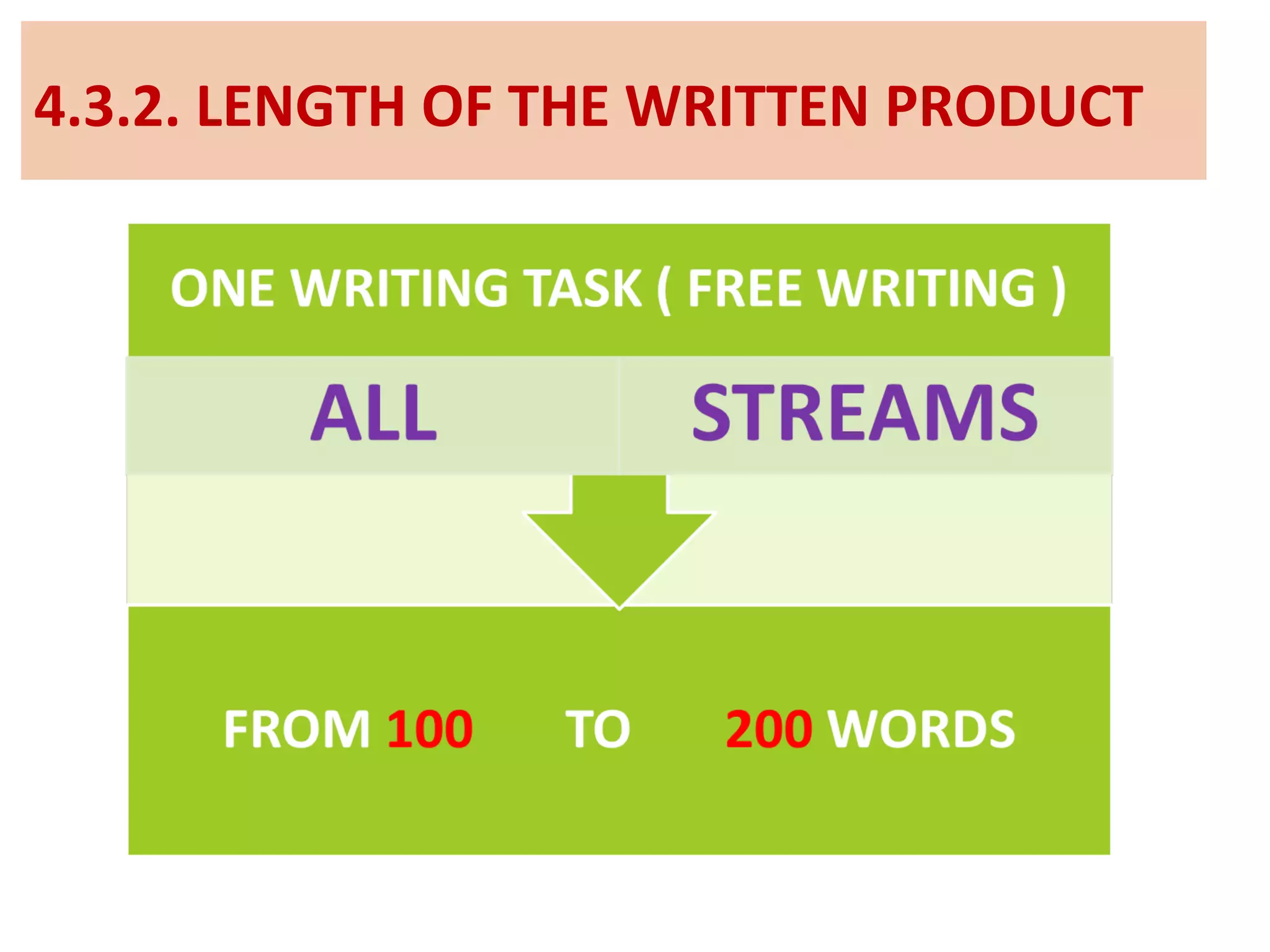
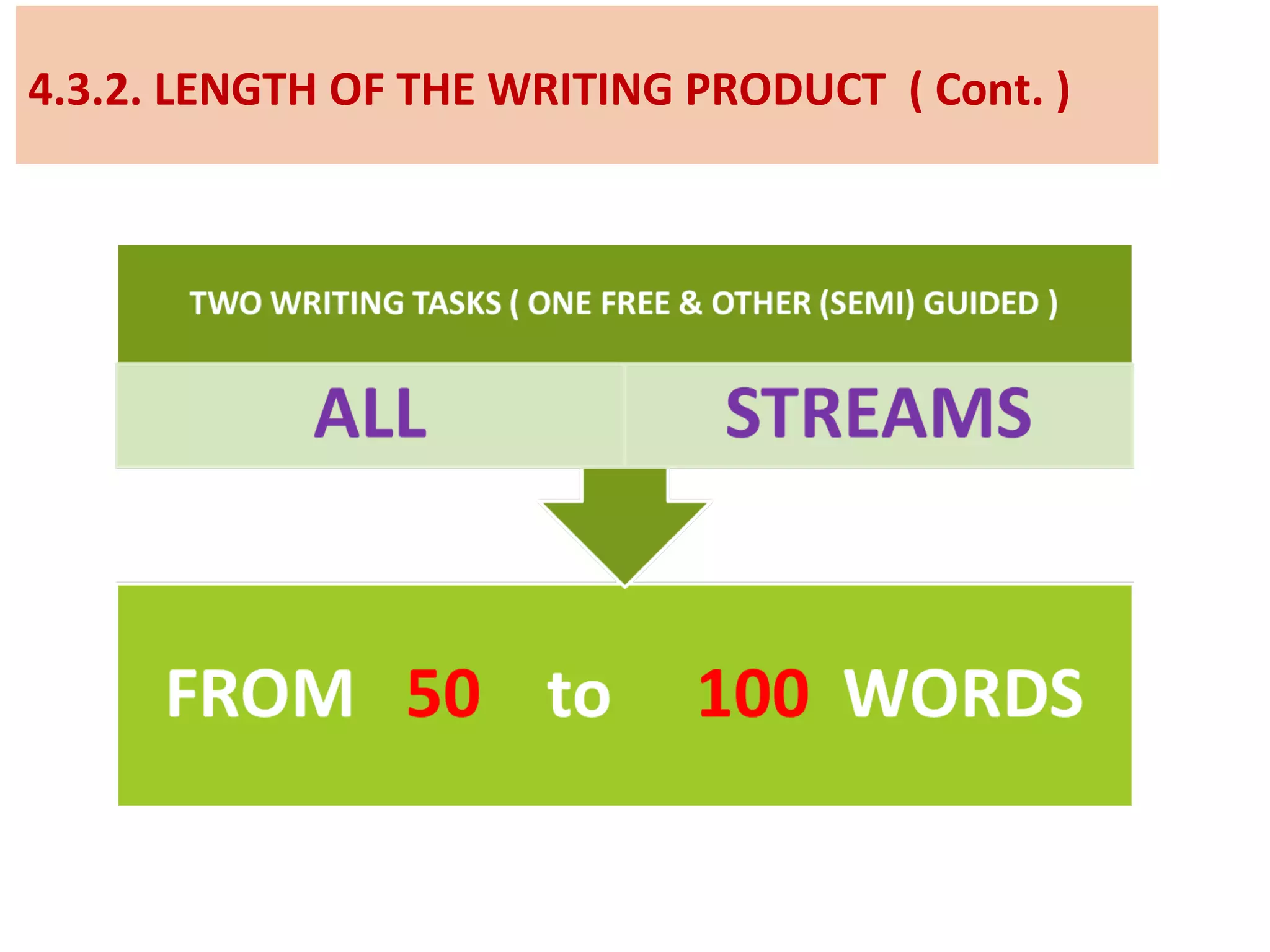
4.3.2. LENGTH OF THE WRITTEN PRODUCT
4.3.3. SCORING AND CRITERIA
CONCLUSION
INTRODUCTION
WHAT KIND OF TEST IS
THE BACCALAUREATE ENGLISH EXAM ?
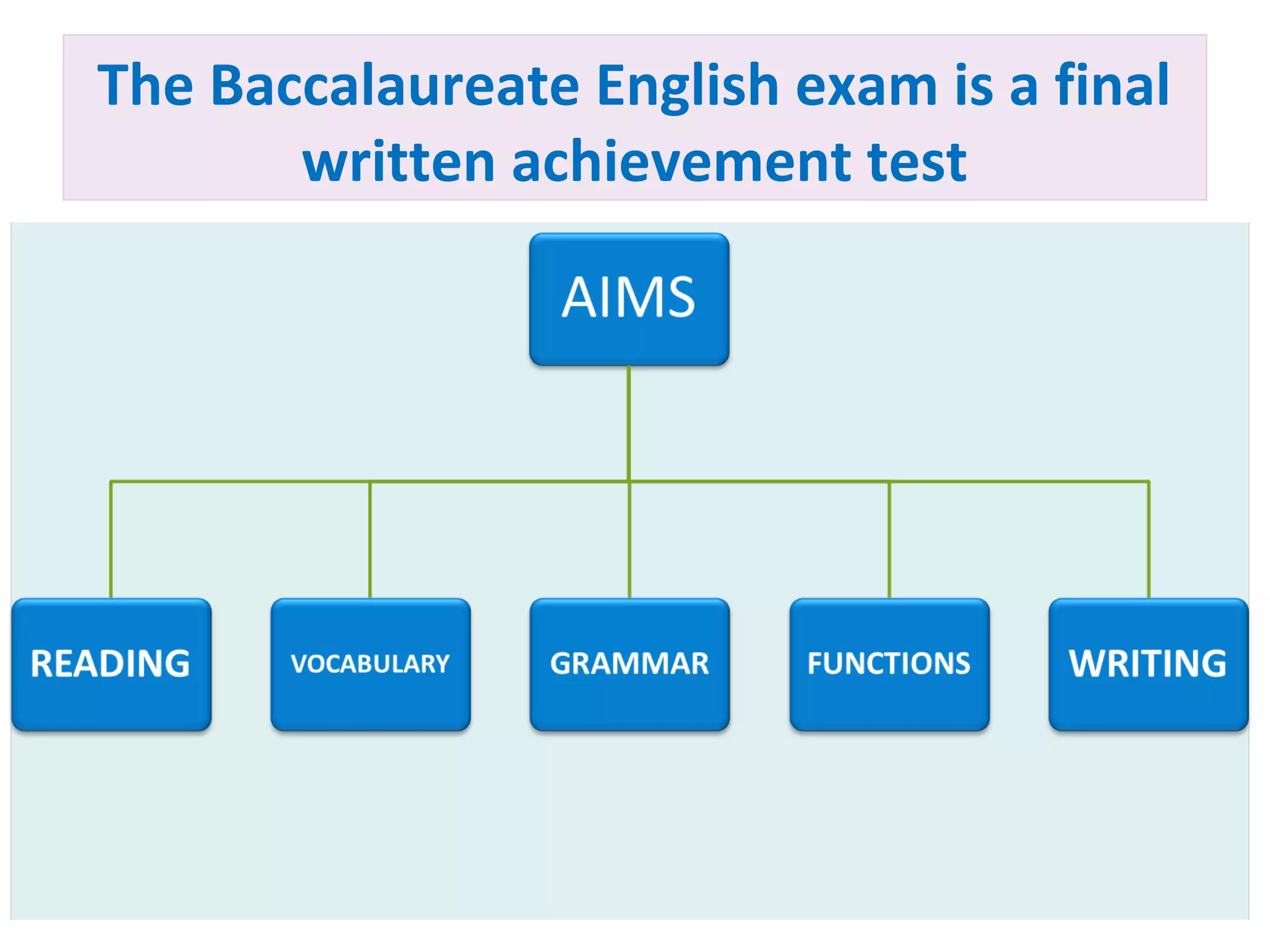
WHAT ARE ITS AIMS ?
The Baccalaureate English exam is a final
written achievement test
1. SYLLABUS BREAKDOWN
2. COMPLETION TIME AND WEIGHTING
COMPLETION TIME
AND WEIGHTING
3. EXAM SECTIONS AND WEIGHTING
4.SECTIONS, TEST TECHNIQUES AND RUBRICS
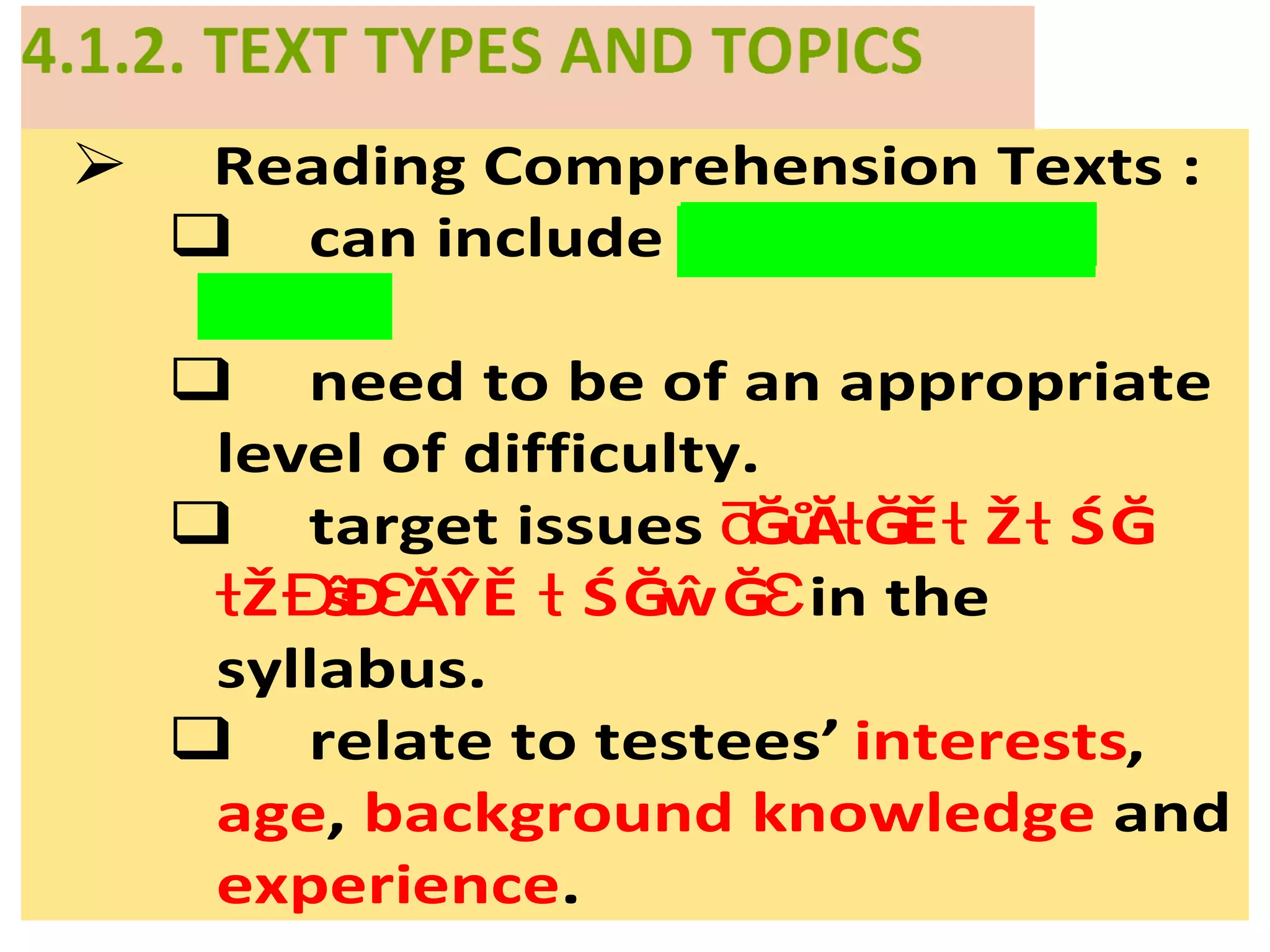
 Reading Comprehension Texts :
 can include ŽŶĞŽ ŵŽ Ğƌ ƌ
.Ğƚ džƚƐ
 need to be of an appropriate
level of difficulty.
 target issues ĞůĂ ĞĚ Ž ŚĞƌ ƚ ƚ ƚ
in theŽ ŝĐ ĂŶĚ ŚĞŵĞƚ Ɖ Ɛ ƚ Ɛ
syllabus.
 relate to testees’ interests,
age, background knowledge and
experience.
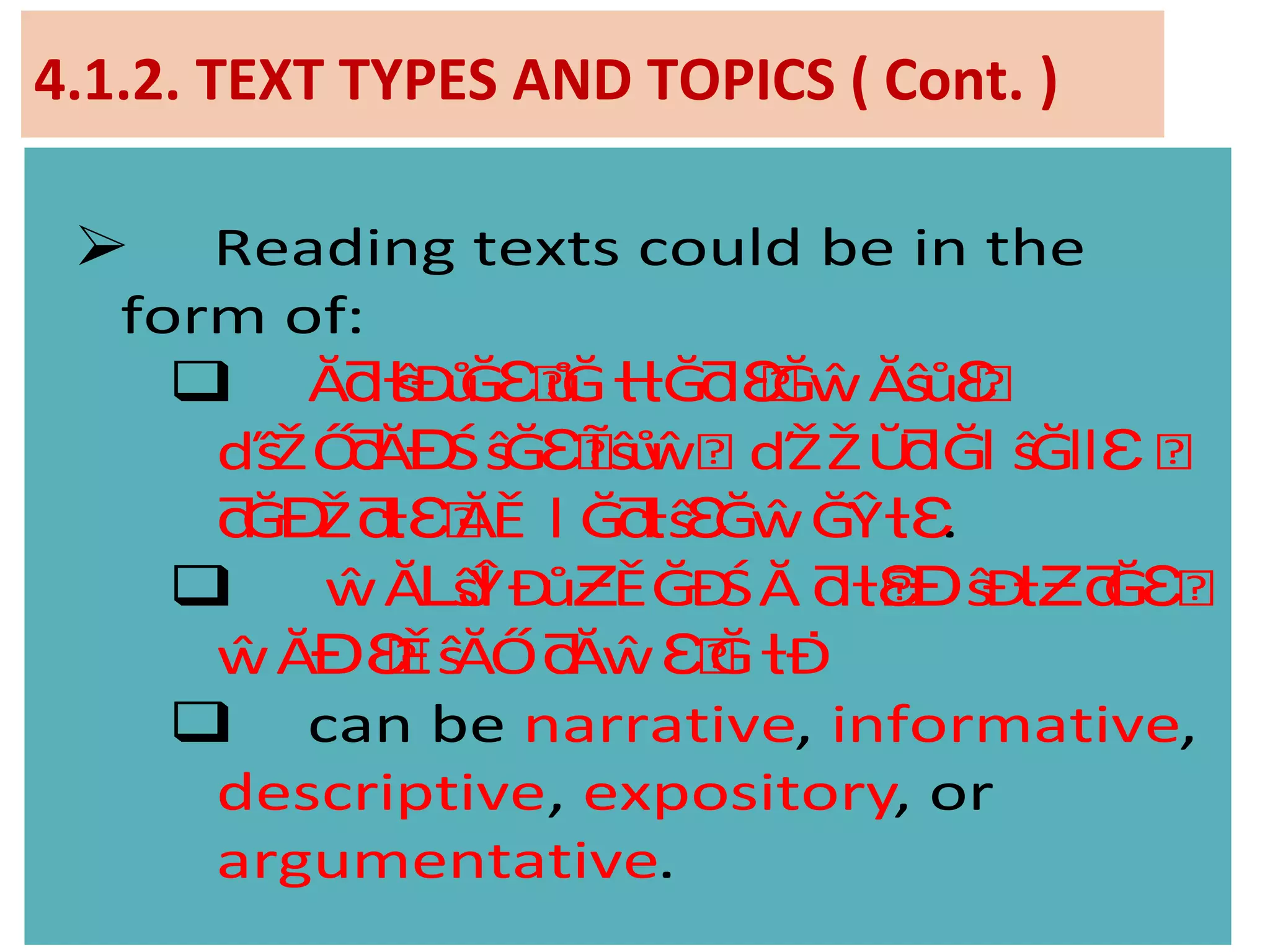
 Reading texts could be in the
form of:
 Ă ŝĐůĞ ͕ůĞ Ğ ͕ĞŵĂŝů ͕ƌƚ Ɛ ƚƚ ƌƐ Ɛ
ďŝŽŐ Ă ŚŝĞ ͕Ĩŝůŵ͕ Ŭ Ğ ŝĞ ͕ƌ Ɖ Ɛ ƌ ǀ ǁƐ
.Ğ Ž ͕ĂĚ Ğ ŝ ĞŵĞŶƌ Ɖ ƌƚƐ ǀ ƌƚ Ɛ ƚƐ
 ŵĂ ŝŶĐů ĚĞĐŚĂ ͕ ŝĐ Ğ ͕LJ Ƶ ƌƚƐƉ ƚƵƌ Ɛ
ŵĂ ͕ĚŝĂŐ Ăŵ ͕Ğ ĐƉƐ ƌ Ɛ ƚ ͘
 can be narrative, informative,
descriptive, expository, or
argumentative.
4.1.2. TEXT TYPES AND TOPICS ( Cont. )
4.1.3. LENGTH OF TEXTS
3 to 6 of the below techniques must appear
in the reading comprehension section.
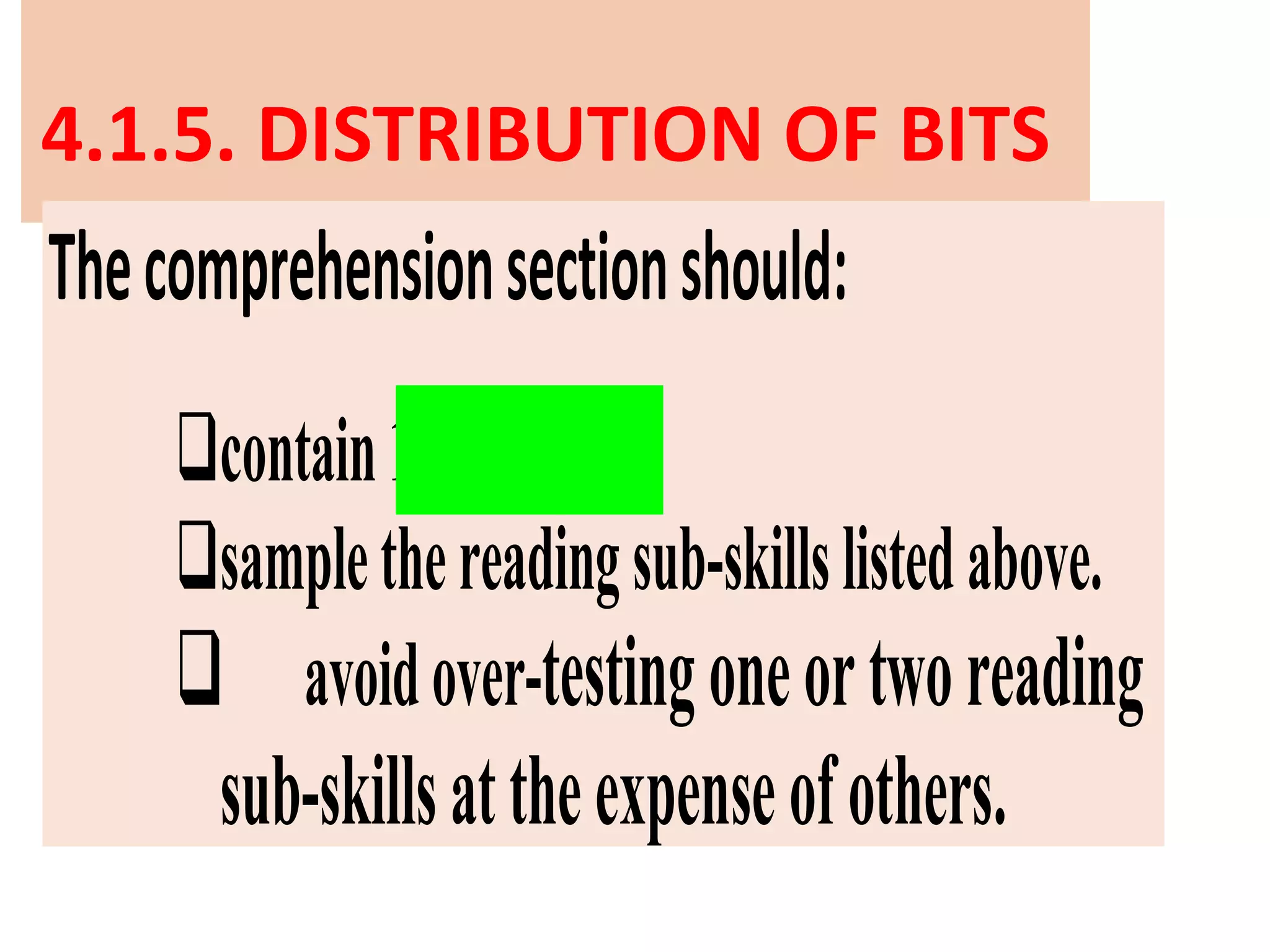
4.1.5. DISTRIBUTION OF BITS
Thecomprehensionsectionshould:
contain10to24bits.
samplethereadingsub-skillslistedabove.
 avoidover-testingoneortworeading
sub-skillsattheexpenseofothers.
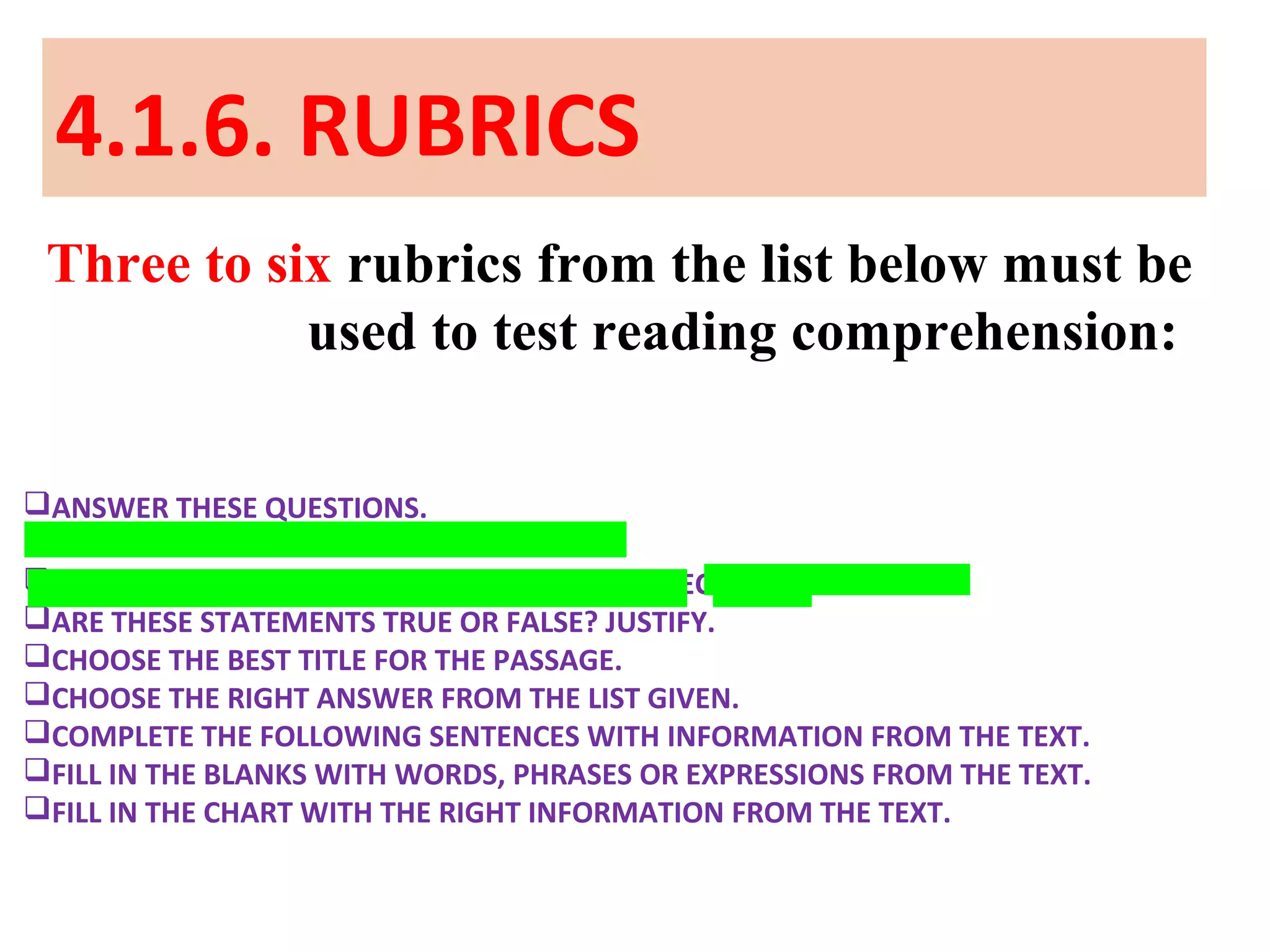
4.1.6. RUBRICS
Three to six rubrics from the list below must be
used to test reading comprehension:
ANSWER THESE QUESTIONS.
ARE THESE STATEMENTS TRUE OR FALSE?
ARE THESE STATEMENTS TRUE OR FALSE? CORRECT THE FALSE ONES.
ARE THESE STATEMENTS TRUE OR FALSE? JUSTIFY.
CHOOSE THE BEST TITLE FOR THE PASSAGE.
CHOOSE THE RIGHT ANSWER FROM THE LIST GIVEN.
COMPLETE THE FOLLOWING SENTENCES WITH INFORMATION FROM THE TEXT.
FILL IN THE BLANKS WITH WORDS, PHRASES OR EXPRESSIONS FROM THE TEXT.
FILL IN THE CHART WITH THE RIGHT INFORMATION FROM THE TEXT.
4.1.6. RUBRICS ( Cont. )
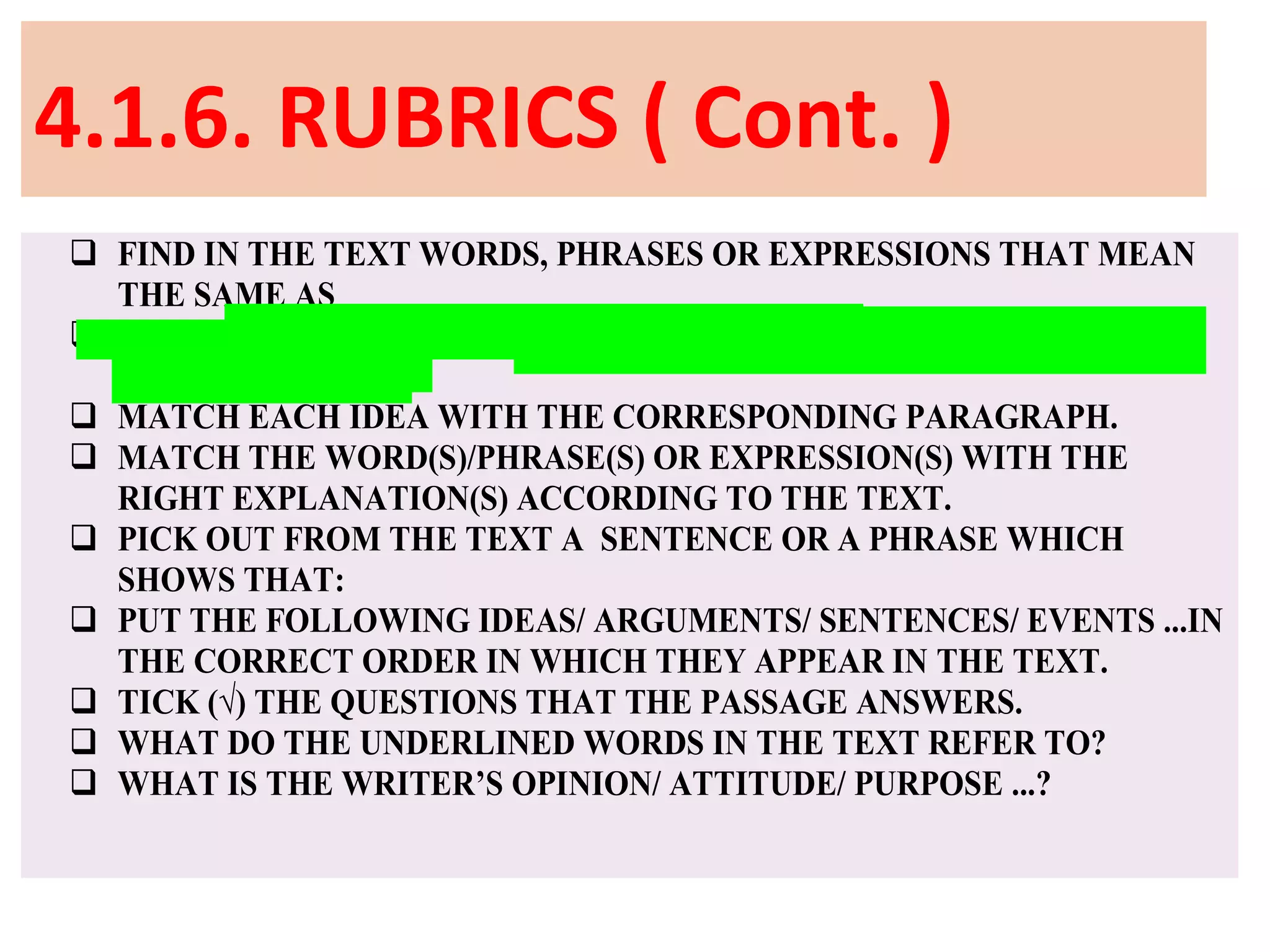
 FIND IN THE TEXT WORDS, PHRASES OR EXPRESSIONS THAT MEAN
THE SAME AS
 FIND IN THE TEXT WORDS, PHRASES OR EXPRESSIONS THAT MEAN
THE OPPOSITE OF
 MATCH EACH IDEA WITH THE CORRESPONDING PARAGRAPH.
 MATCH THE WORD(S)/PHRASE(S) OR EXPRESSION(S) WITH THE
RIGHT EXPLANATION(S) ACCORDING TO THE TEXT.
 PICK OUT FROM THE TEXT A SENTENCE OR A PHRASE WHICH
SHOWS THAT:
 PUT THE FOLLOWING IDEAS/ ARGUMENTS/ SENTENCES/ EVENTS ...IN
THE CORRECT ORDER IN WHICH THEY APPEAR IN THE TEXT.
 TICK (√) THE QUESTIONS THAT THE PASSAGE ANSWERS.
 WHAT DO THE UNDERLINED WORDS IN THE TEXT REFER TO?
 WHAT IS THE WRITER’S OPINION/ ATTITUDE/ PURPOSE ...?
4.1.7. SCORING
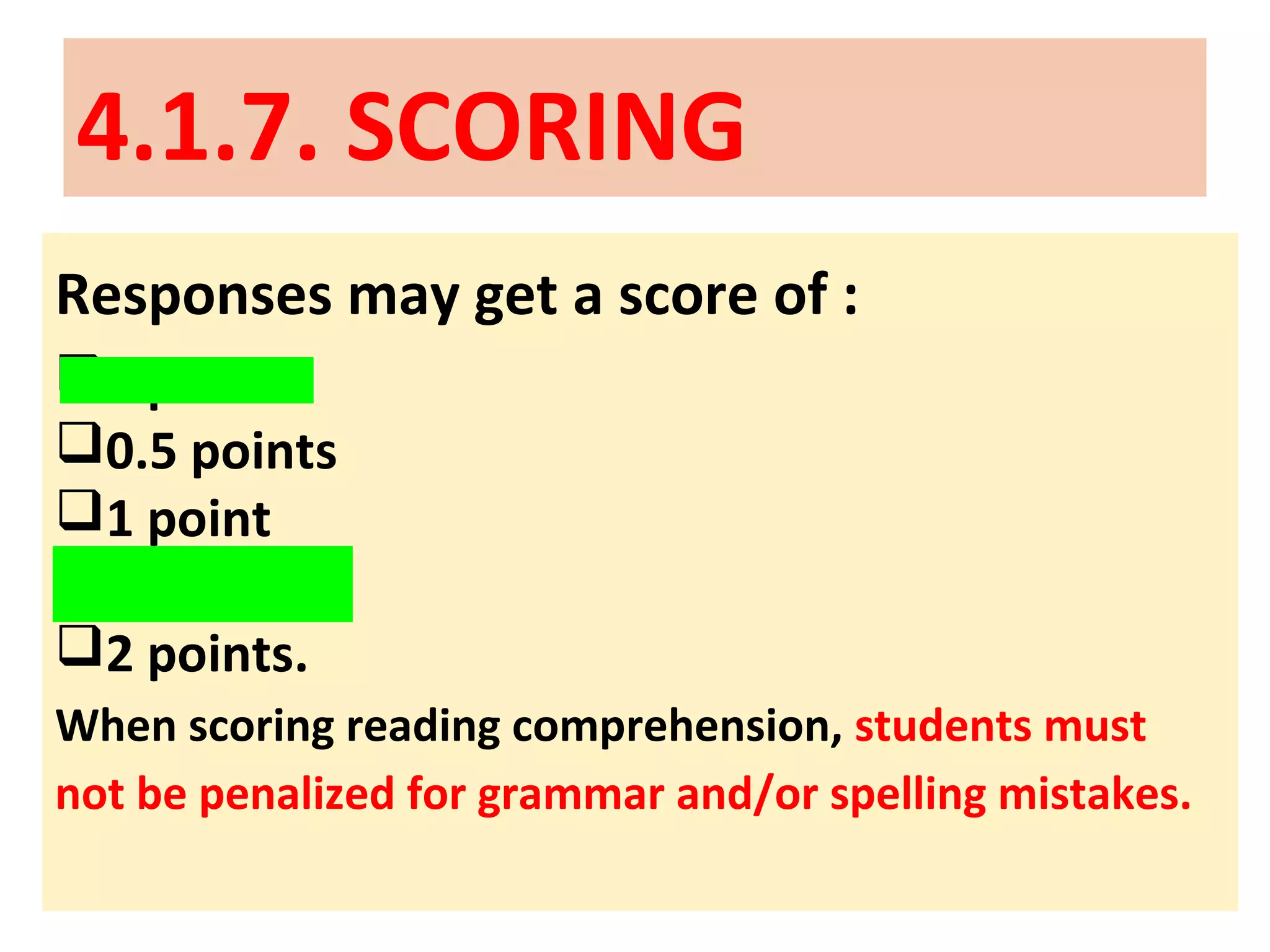
Responses may get a score of :
0 points
0.5 points
1 point
1.5 points
2 points.
When scoring reading comprehension, students must
not be penalized for grammar and/or spelling mistakes.
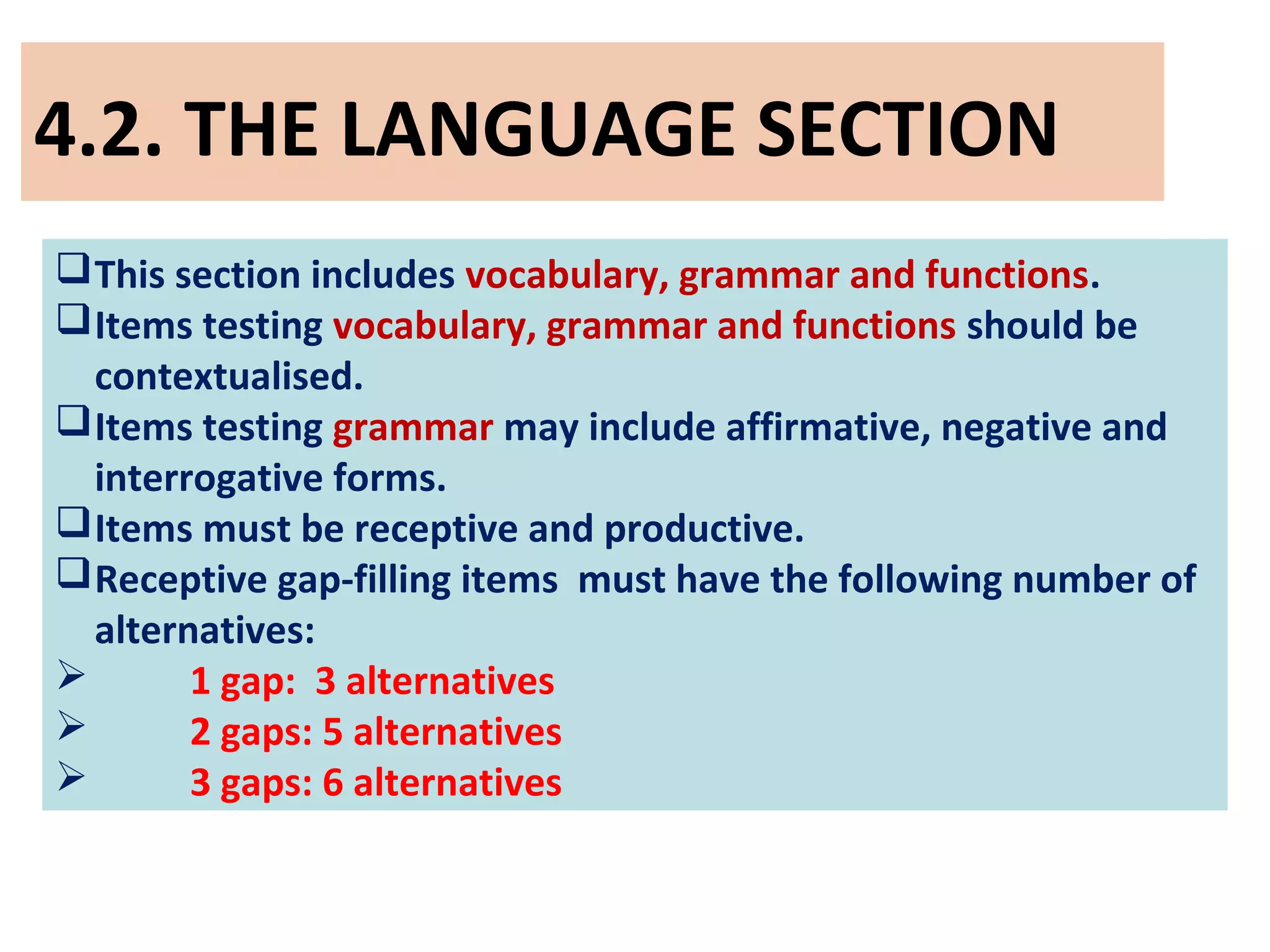
4.2. THE LANGUAGE SECTION
This section includes vocabulary, grammar and functions.
Items testing vocabulary, grammar and functions should be
contextualised.
Items testing grammar may include affirmative, negative and
interrogative forms.
Items must be receptive and productive.
Receptive gap-filling items must have the following number of
alternatives:
 1 gap: 3 alternatives
 2 gaps: 5 alternatives
 3 gaps: 6 alternatives
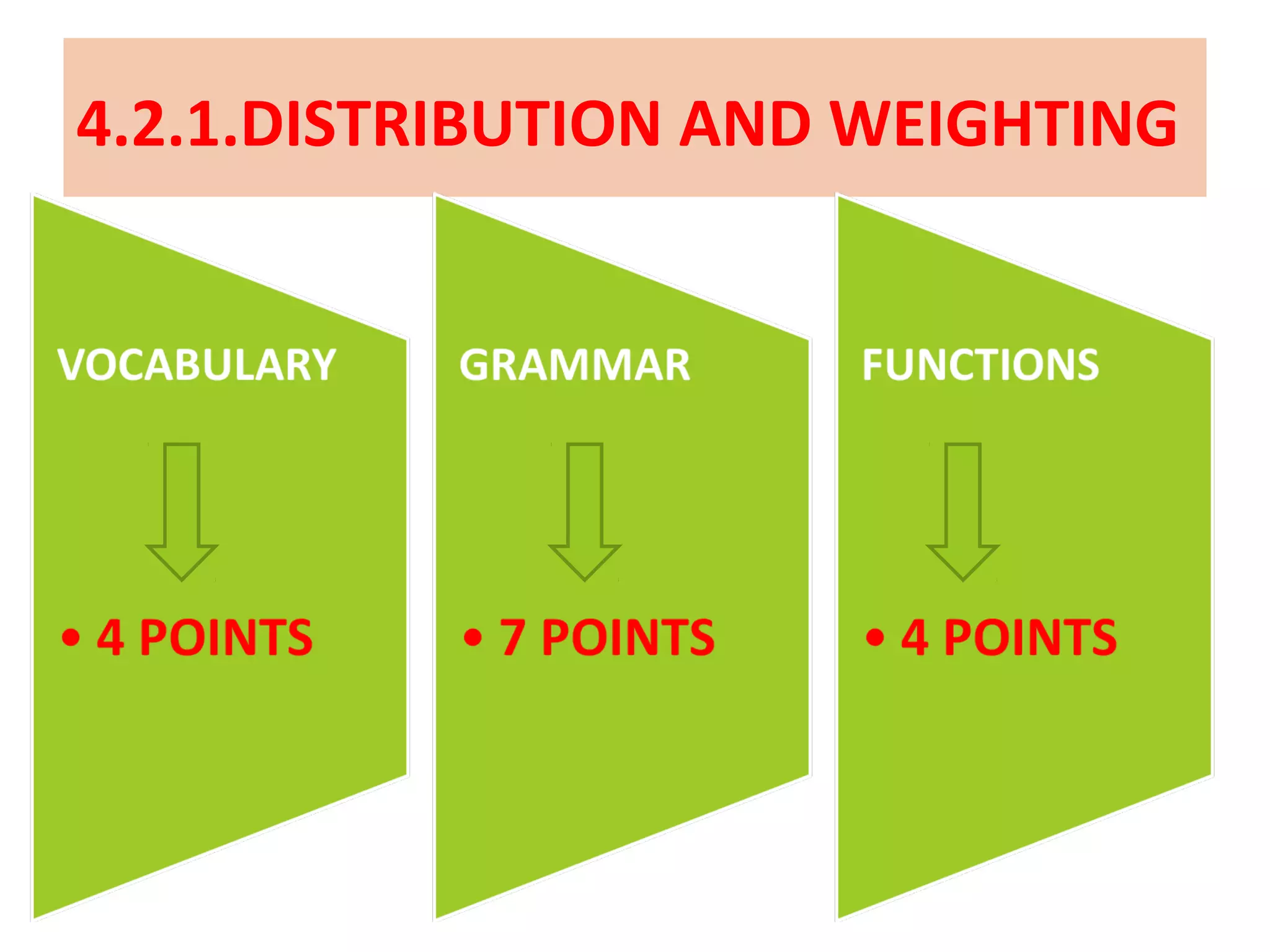
4.2.1.DISTRIBUTION AND WEIGHTING
4.2.2. VOCABULARY
Vocabulary Items testing should be:
 and themes inĞůĂ ĞĚ Ž ŚĞ Ž ŝĐƌ ƚ ƚ ƚ ƚ Ɖ Ɛ
the syllabus.
 focus on the following lexical
elements:
collocations
word associations
definitions of key terms
synonyms/ antonyms
poly-words
word formation
word meaning
suffixes, prefixes and their meanings
phrasal verbs
idiomatic expressions.
4.2.3. GRAMMAR
The items should be contextualized. They should target
the following:
4.2.4. FUNCTIONS
 Making and responding to requests
 Responding to good and bad news
 Expressing regret
 Complaining
 Apologising
 Asking for advice
 Giving advice
 Expressing opinion
 Asking for opinion
 Agreeing and disagreeing
 Expressing certainty and uncertainty
 Expressing lack of understanding and asking for
clarification
4.2.5. TEST TECHNIQUES FOR THE LANGUAGE SECTION
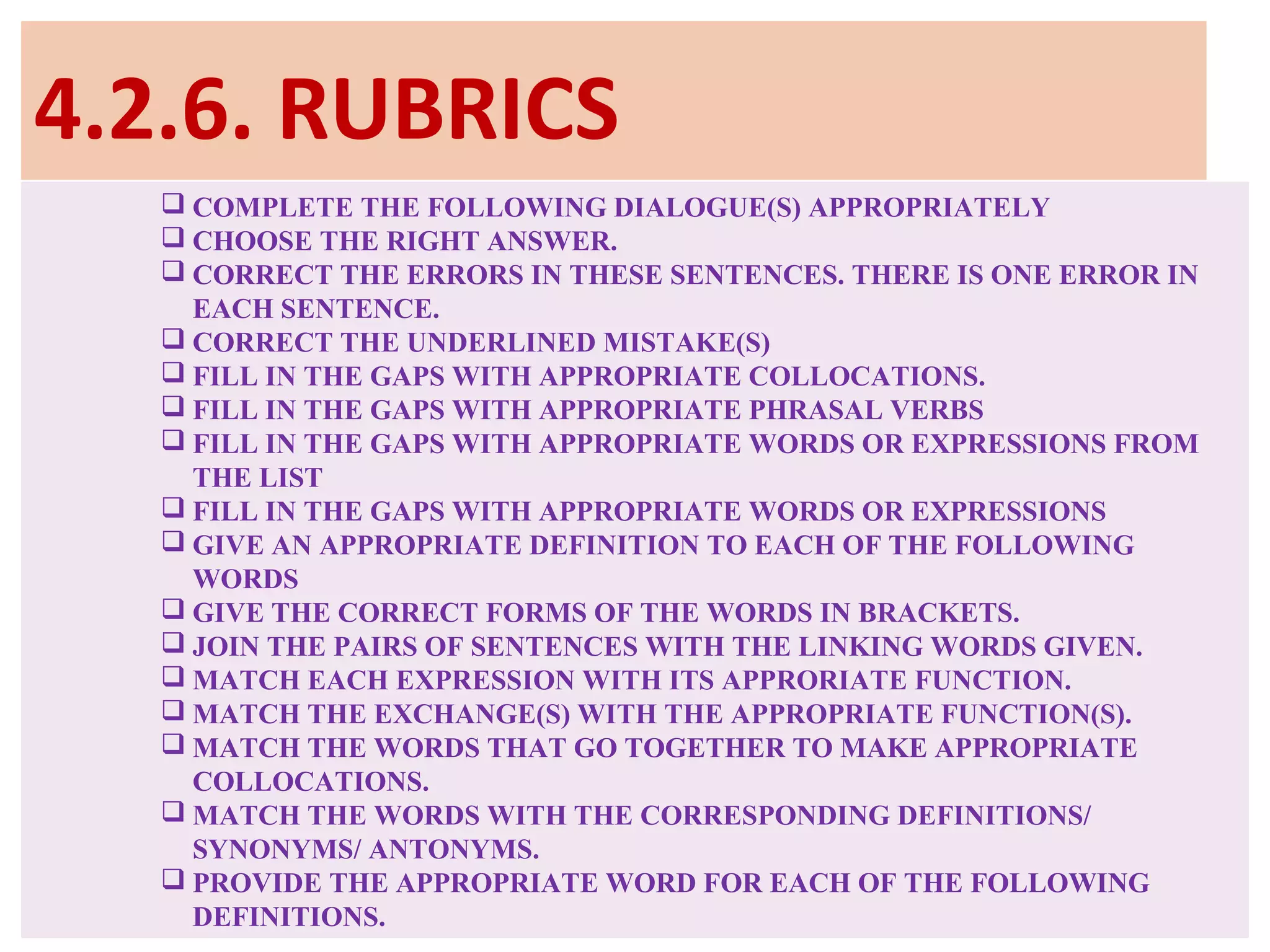
4.2.6. RUBRICS
 COMPLETE THE FOLLOWING DIALOGUE(S) APPROPRIATELY
 CHOOSE THE RIGHT ANSWER.
 CORRECT THE ERRORS IN THESE SENTENCES. THERE IS ONE ERROR IN
EACH SENTENCE.
 CORRECT THE UNDERLINED MISTAKE(S)
 FILL IN THE GAPS WITH APPROPRIATE COLLOCATIONS.
 FILL IN THE GAPS WITH APPROPRIATE PHRASAL VERBS
 FILL IN THE GAPS WITH APPROPRIATE WORDS OR EXPRESSIONS FROM
THE LIST
 FILL IN THE GAPS WITH APPROPRIATE WORDS OR EXPRESSIONS
 GIVE AN APPROPRIATE DEFINITION TO EACH OF THE FOLLOWING
WORDS
 GIVE THE CORRECT FORMS OF THE WORDS IN BRACKETS.
 JOIN THE PAIRS OF SENTENCES WITH THE LINKING WORDS GIVEN.
 MATCH EACH EXPRESSION WITH ITS APPRORIATE FUNCTION.
 MATCH THE EXCHANGE(S) WITH THE APPROPRIATE FUNCTION(S).
 MATCH THE WORDS THAT GO TOGETHER TO MAKE APPROPRIATE
COLLOCATIONS.
 MATCH THE WORDS WITH THE CORRESPONDING DEFINITIONS/
SYNONYMS/ ANTONYMS.
 PROVIDE THE APPROPRIATE WORD FOR EACH OF THE FOLLOWING
DEFINITIONS.
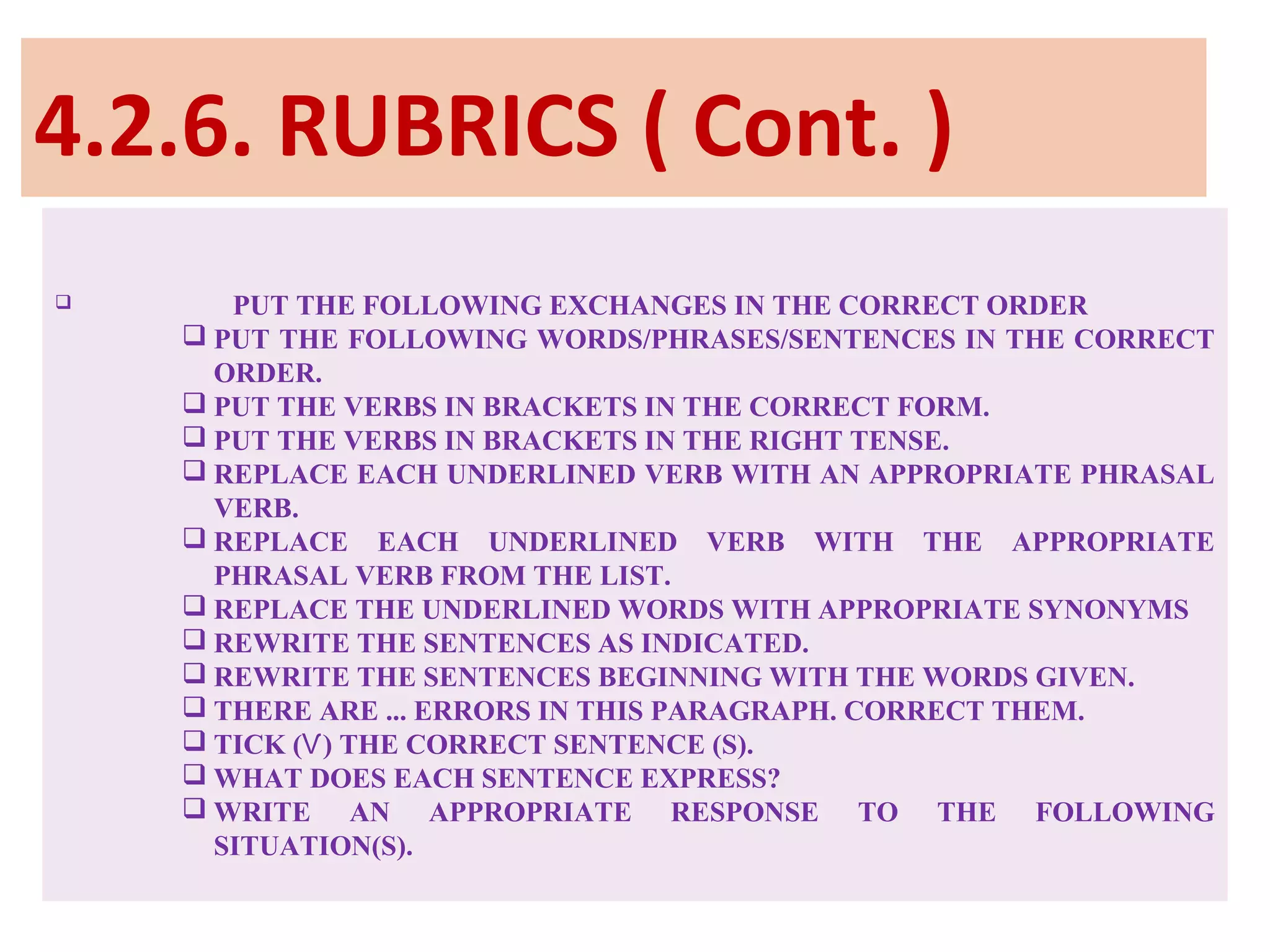
4.2.6. RUBRICS ( Cont. )
 PUT THE FOLLOWING EXCHANGES IN THE CORRECT ORDER
 PUT THE FOLLOWING WORDS/PHRASES/SENTENCES IN THE CORRECT
ORDER.
 PUT THE VERBS IN BRACKETS IN THE CORRECT FORM.
 PUT THE VERBS IN BRACKETS IN THE RIGHT TENSE.
 REPLACE EACH UNDERLINED VERB WITH AN APPROPRIATE PHRASAL
VERB.
 REPLACE EACH UNDERLINED VERB WITH THE APPROPRIATE
PHRASAL VERB FROM THE LIST.
 REPLACE THE UNDERLINED WORDS WITH APPROPRIATE SYNONYMS
 REWRITE THE SENTENCES AS INDICATED.
 REWRITE THE SENTENCES BEGINNING WITH THE WORDS GIVEN.
 THERE ARE ... ERRORS IN THIS PARAGRAPH. CORRECT THEM.
 TICK ( ) THE CORRECT SENTENCE (S).Ѵ
 WHAT DOES EACH SENTENCE EXPRESS?
 WRITE AN APPROPRIATE RESPONSE TO THE FOLLOWING
SITUATION(S).
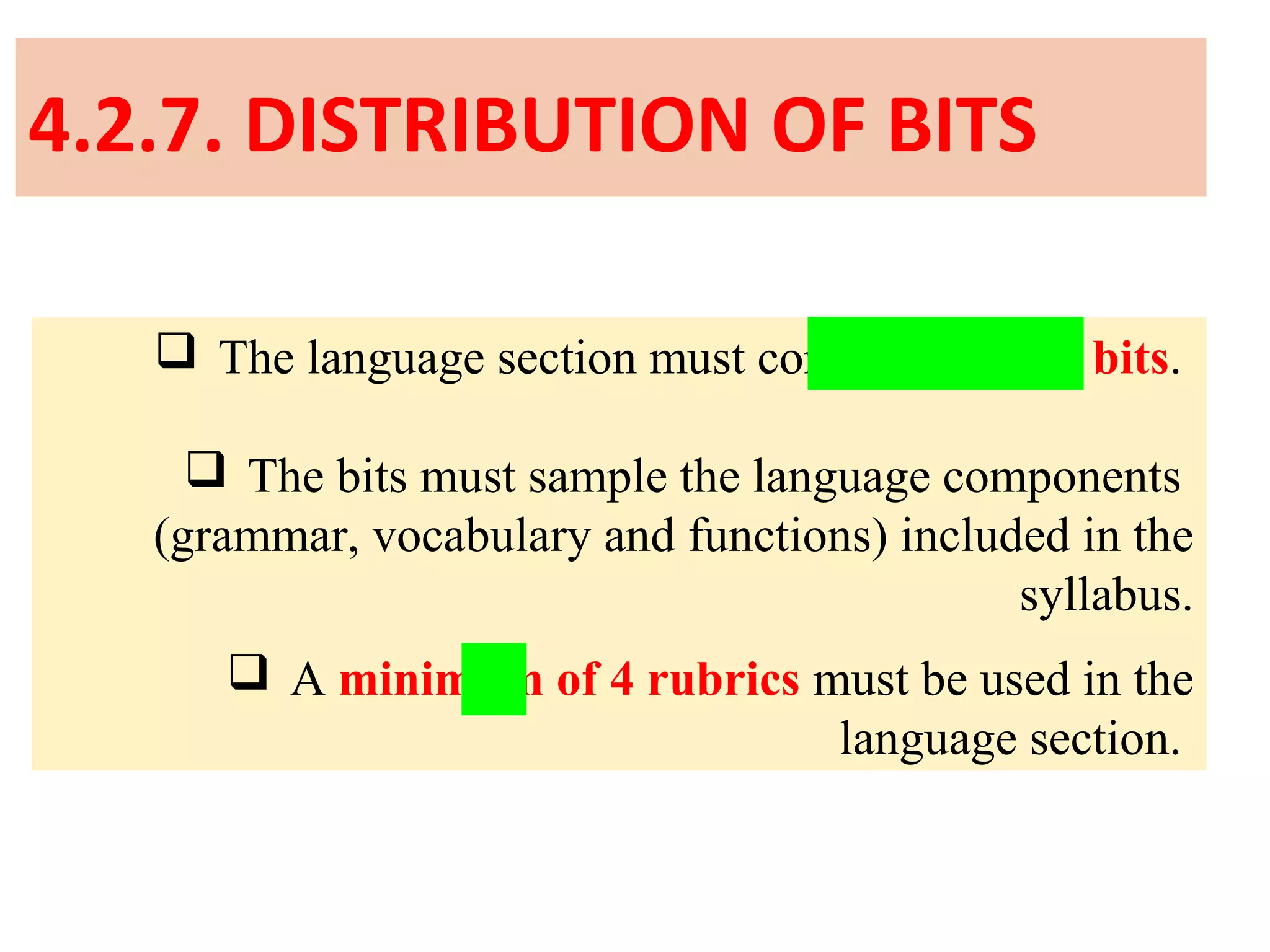
4.2.7. DISTRIBUTION OF BITS
 The language section must contain 10 to 24 bits.
 The bits must sample the language components
(grammar, vocabulary and functions) included in the
syllabus.
 A minimum of 4 rubrics must be used in the
language section.
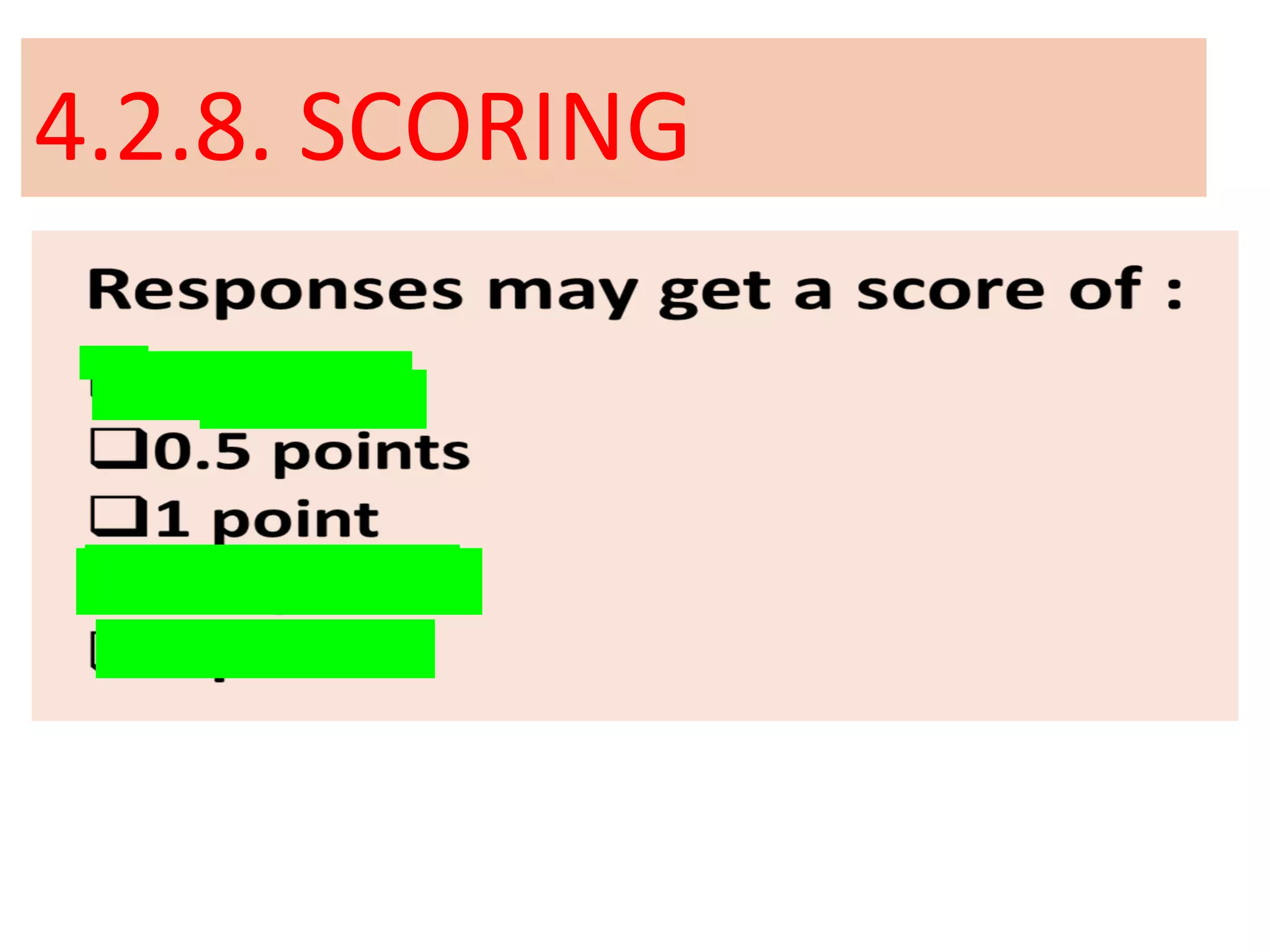
4.2.8. SCORING
4.3. THE WRITING SECTION
The writing section measures the ability to:
o write in English,
o generate ideas,
o organize ideas,
o develop ideas,
o support those ideas with examples, arguments or
evidence, recognise text organization
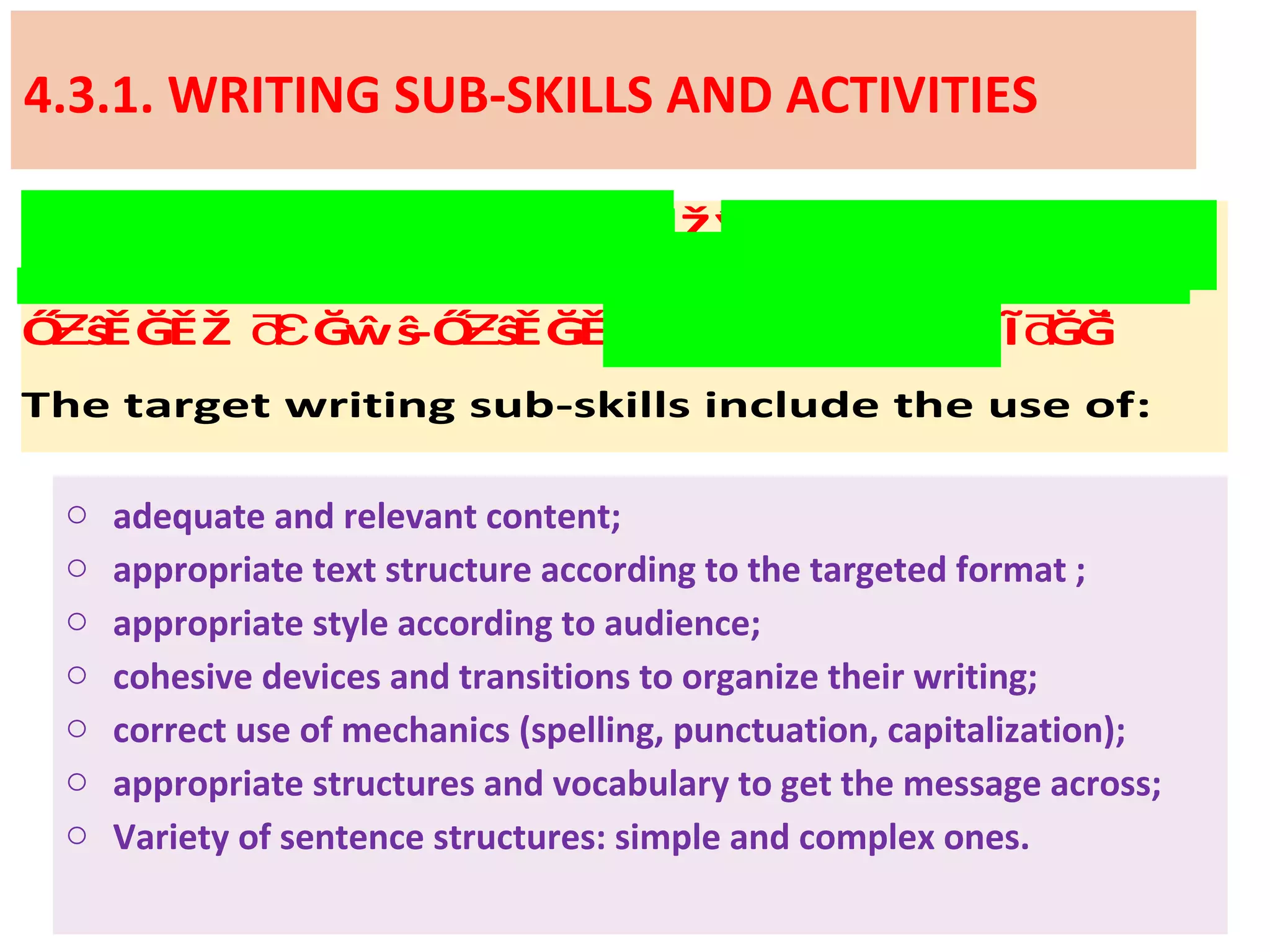
4.3.1. WRITING SUB-SKILLS AND ACTIVITIES
This section may include . InŽŶĞŽ Ž Ă Ŭƌƚǁ ƚ Ɛ Ɛ
case there are two writing tasks, one will be
and the otherŐ ŝĚĞĚŽ ĞŵŝƵ ƌƐ -Ő ŝĚĞĚƵ Ĩ ĞĞƌ ͘
The target writing sub-skills include the use of:
o adequate and relevant content;
o appropriate text structure according to the targeted format ;
o appropriate style according to audience;
o cohesive devices and transitions to organize their writing;
o correct use of mechanics (spelling, punctuation, capitalization);
o appropriate structures and vocabulary to get the message across;
o Variety of sentence structures: simple and complex ones.
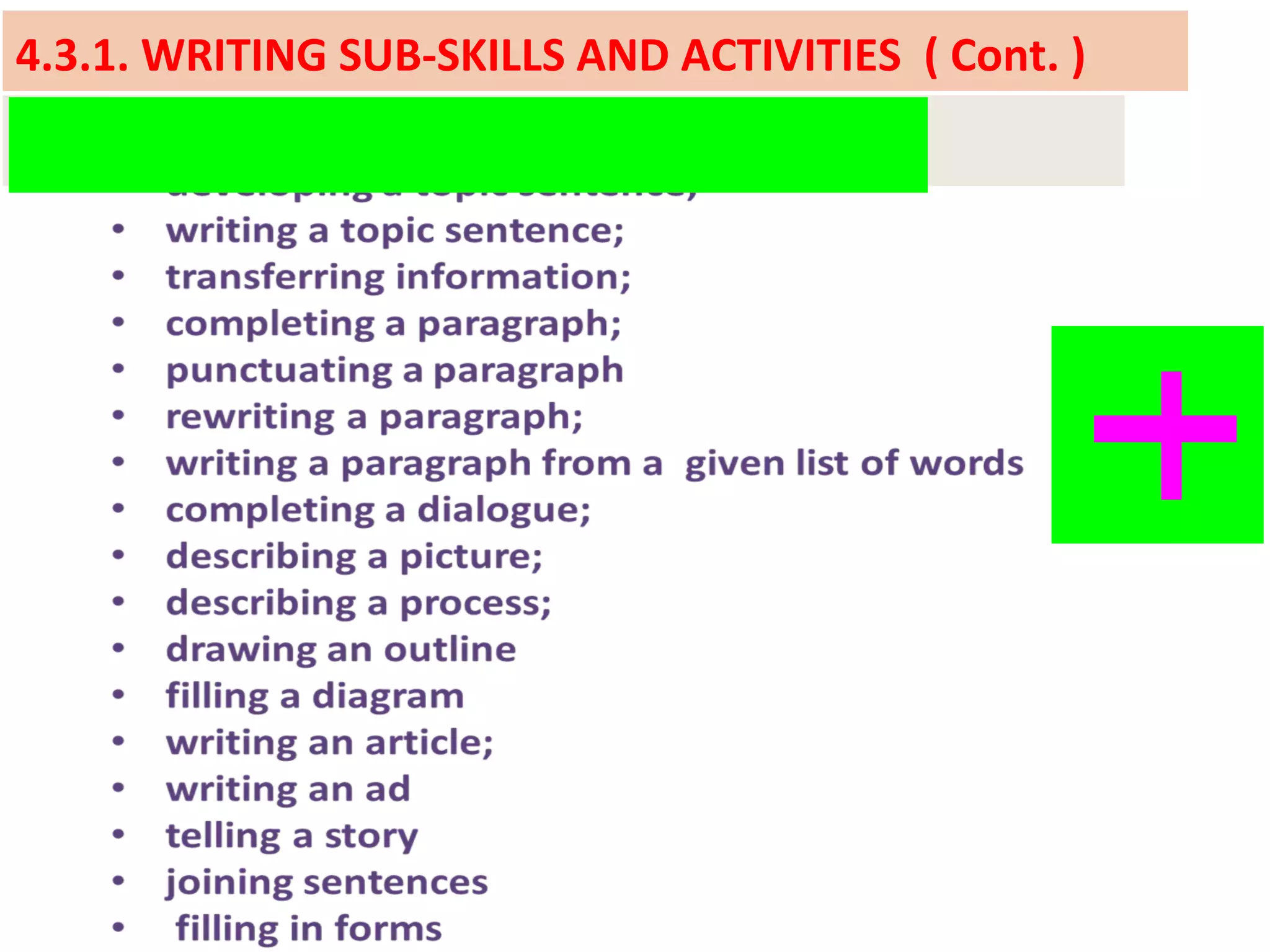
4.3.1. WRITING SUB-SKILLS AND ACTIVITIES ( Cont. )
Tasks related to writing may include:
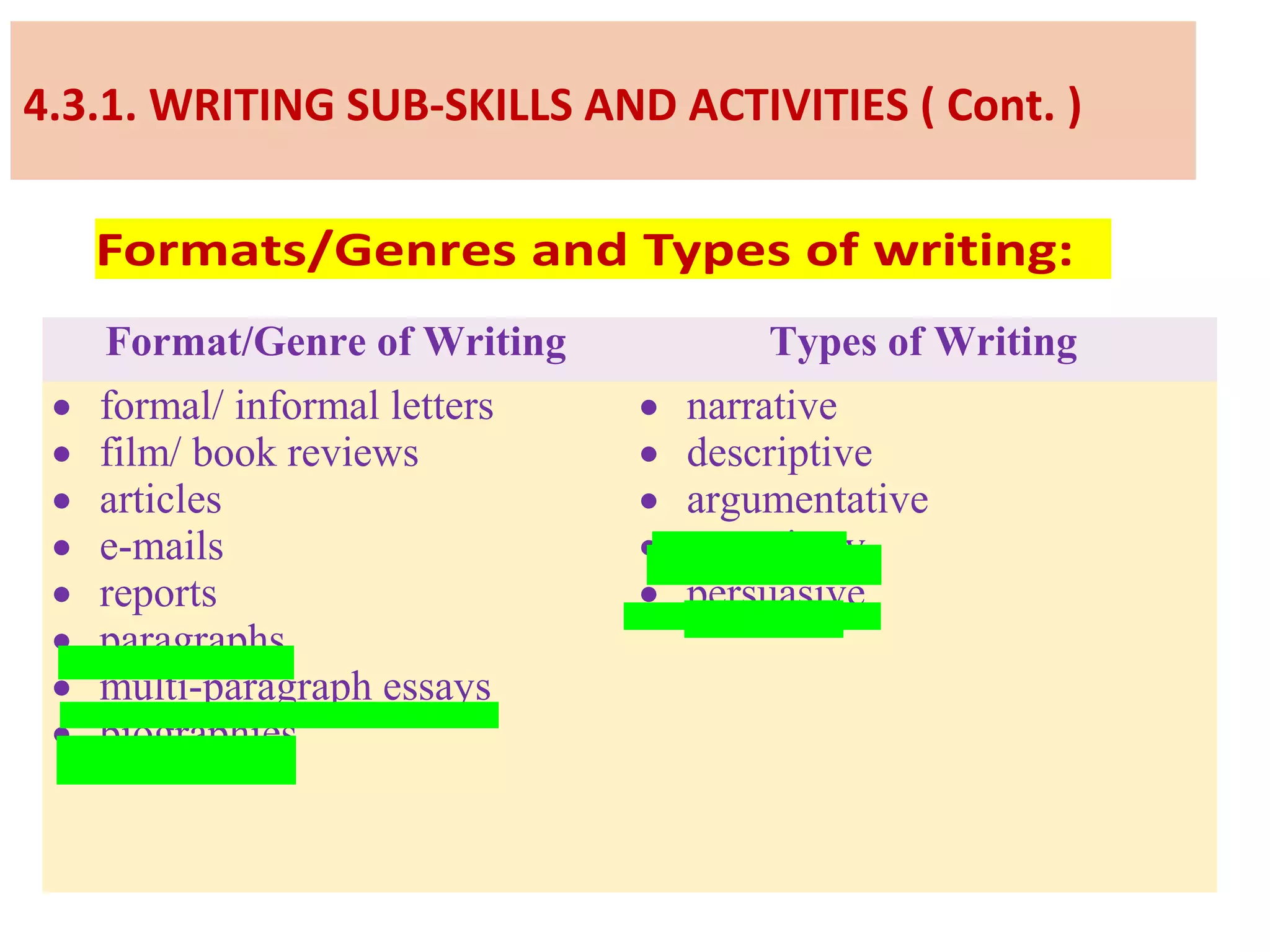
4.3.1. WRITING SUB-SKILLS AND ACTIVITIES ( Cont. )
Formats/Genres and Types of writing:
Format/Genre of Writing Types of Writing
• formal/ informal letters
• film/ book reviews
• articles
• e-mails
• reports
• paragraphs
• multi-paragraph essays
• biographies
• narrative
• descriptive
• argumentative
• expository
• persuasive
4.3.2. LENGTH OF THE WRITTEN PRODUCT
4.3.2. LENGTH OF THE WRITING PRODUCT ( Cont. )
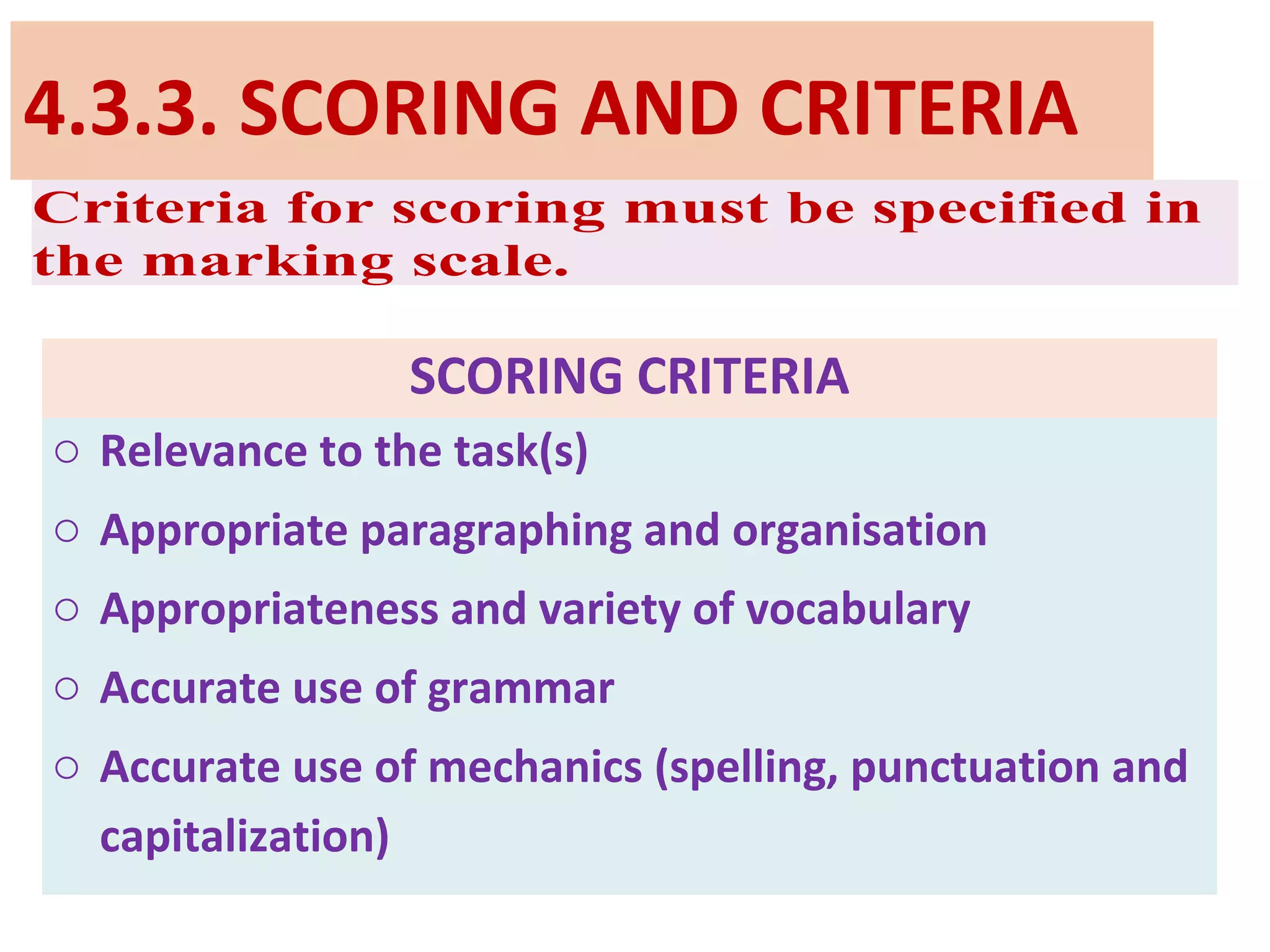
4.3.3. SCORING AND CRITERIA
Criteria for scoring must be specified in
the marking scale.
SCORING CRITERIA
o Relevance to the task(s)
o Appropriate paragraphing and organisation
o Appropriateness and variety of vocabulary
o Accurate use of grammar
o Accurate use of mechanics (spelling, punctuation and
capitalization)
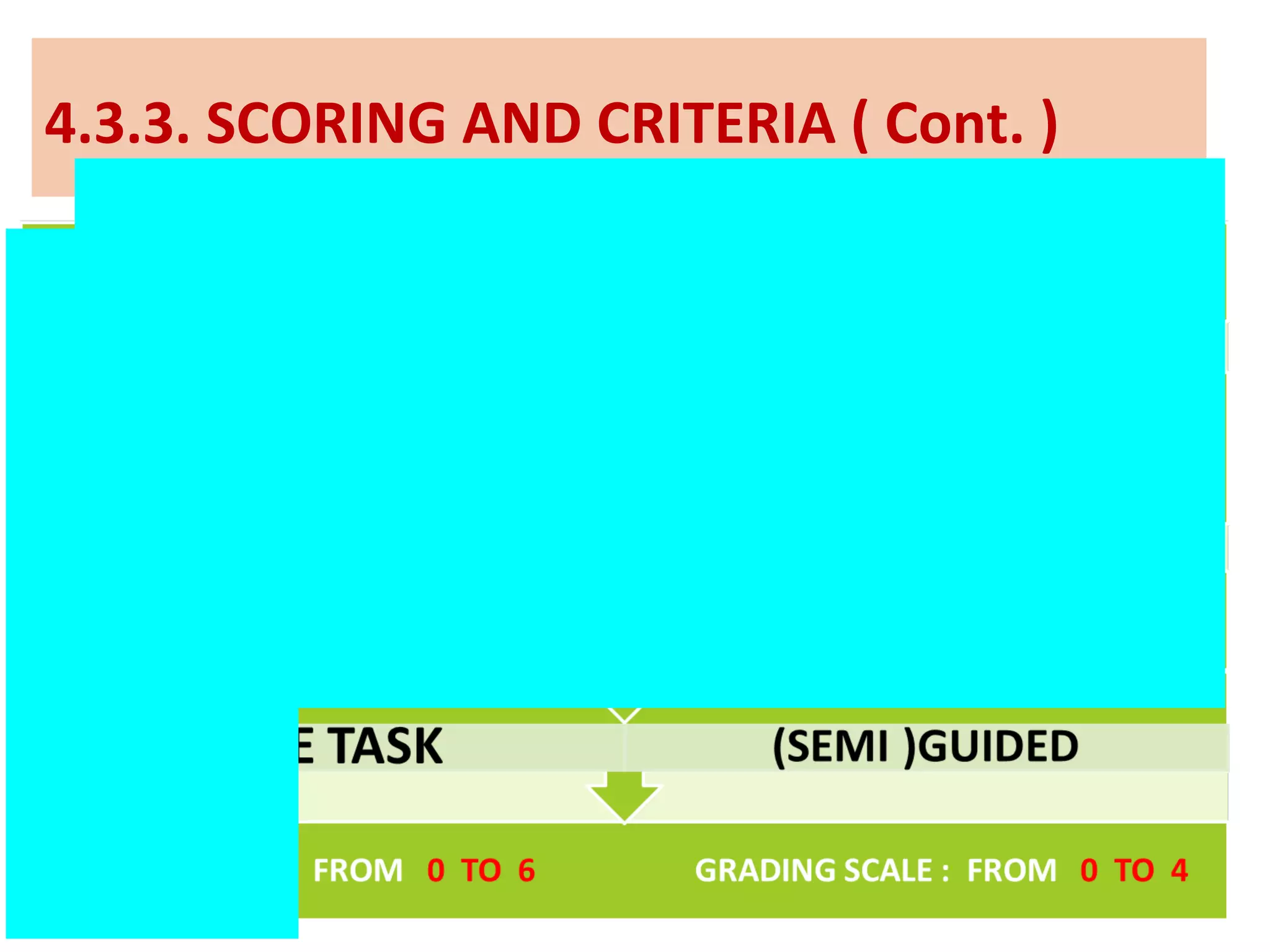
4.3.3. SCORING AND CRITERIA ( Cont. )
the candidate does not write anything
the candidate only copies the prompts or the
topic,
the candidate writes in a language other than
English,
the candidate writes about a topic different
from the one assigned.
THANK YOU FOR YOUR ATTENTION

THE NATIONAL BACCALAUREATE EXAM SPECIFICATIONS 2014 ENGLISH SUBJECT - ALL STREAMS

  • 1.
    MOHAMED KHETTOUCH Teacher ofEnglish- Med V High School – Goulmima- Errachidia
  • 2.
    OUTLINE INTRODUCTION 1.SYLLABUS BREAKDOWN 2.COMPLETION TIMEAND WEIGHTING 3.EXAM SECTIONS AND WEIGHTING. 4.SECTIONS, TEST TECHNIQUES AND RUBRICS 4.1. THE COMPREHENSION SECTION 4.1.1. READING SUBSKILLS 4.1.2. TEXT TYPES AND TOPICS 4.1.3. LENGTH OF TEXTS 4.1.4. TEST TECHNIQUES 4.1.5. DISTRIBUTION OF BITS 4.1.6. RUBRICS 4.1.7. SCORING 4.2. THE LANGUAGE SECTION 4.2.1. DISTRIBUTION AND WEIGHTING 4.2.2. VOCABULARY
  • 3.
    OUTLINE ( Cont.) 4.2.3. GRAMMAR 4.2.4. FUNCTIONS 4.2.5. TEST TECHNIQUES FOR THE LANGUAGE SECTION 4.2.6. RUBRICS 4.2.7. DISTRIBUTION OF BITS 4.2.8. SCORING 4.3. THE WRITING SECTION 4.3.1. WRITING SUB-SKILLS AND ACTIVITIES 4.3.2. LENGTH OF THE WRITTEN PRODUCT 4.3.3. SCORING AND CRITERIA CONCLUSION
  • 4.
  • 5.
    WHAT KIND OFTEST IS THE BACCALAUREATE ENGLISH EXAM ? WHAT ARE ITS AIMS ?
  • 6.
    The Baccalaureate Englishexam is a final written achievement test
  • 7.
  • 8.
  • 9.
    2. COMPLETION TIMEAND WEIGHTING
  • 10.
  • 11.
    3. EXAM SECTIONSAND WEIGHTING
  • 13.
  • 16.
     Reading ComprehensionTexts :  can include ŽŶĞŽ ŵŽ Ğƌ ƌ .Ğƚ džƚƐ  need to be of an appropriate level of difficulty.  target issues ĞůĂ ĞĚ Ž ŚĞƌ ƚ ƚ ƚ in theŽ ŝĐ ĂŶĚ ŚĞŵĞƚ Ɖ Ɛ ƚ Ɛ syllabus.  relate to testees’ interests, age, background knowledge and experience.
  • 17.
     Reading textscould be in the form of:  Ă ŝĐůĞ ͕ůĞ Ğ ͕ĞŵĂŝů ͕ƌƚ Ɛ ƚƚ ƌƐ Ɛ ďŝŽŐ Ă ŚŝĞ ͕Ĩŝůŵ͕ Ŭ Ğ ŝĞ ͕ƌ Ɖ Ɛ ƌ ǀ ǁƐ .Ğ Ž ͕ĂĚ Ğ ŝ ĞŵĞŶƌ Ɖ ƌƚƐ ǀ ƌƚ Ɛ ƚƐ  ŵĂ ŝŶĐů ĚĞĐŚĂ ͕ ŝĐ Ğ ͕LJ Ƶ ƌƚƐƉ ƚƵƌ Ɛ ŵĂ ͕ĚŝĂŐ Ăŵ ͕Ğ ĐƉƐ ƌ Ɛ ƚ ͘  can be narrative, informative, descriptive, expository, or argumentative. 4.1.2. TEXT TYPES AND TOPICS ( Cont. )
  • 18.
  • 19.
    3 to 6of the below techniques must appear in the reading comprehension section.
  • 20.
    4.1.5. DISTRIBUTION OFBITS Thecomprehensionsectionshould: contain10to24bits. samplethereadingsub-skillslistedabove.  avoidover-testingoneortworeading sub-skillsattheexpenseofothers.
  • 21.
    4.1.6. RUBRICS Three tosix rubrics from the list below must be used to test reading comprehension: ANSWER THESE QUESTIONS. ARE THESE STATEMENTS TRUE OR FALSE? ARE THESE STATEMENTS TRUE OR FALSE? CORRECT THE FALSE ONES. ARE THESE STATEMENTS TRUE OR FALSE? JUSTIFY. CHOOSE THE BEST TITLE FOR THE PASSAGE. CHOOSE THE RIGHT ANSWER FROM THE LIST GIVEN. COMPLETE THE FOLLOWING SENTENCES WITH INFORMATION FROM THE TEXT. FILL IN THE BLANKS WITH WORDS, PHRASES OR EXPRESSIONS FROM THE TEXT. FILL IN THE CHART WITH THE RIGHT INFORMATION FROM THE TEXT.
  • 22.
    4.1.6. RUBRICS (Cont. )  FIND IN THE TEXT WORDS, PHRASES OR EXPRESSIONS THAT MEAN THE SAME AS  FIND IN THE TEXT WORDS, PHRASES OR EXPRESSIONS THAT MEAN THE OPPOSITE OF  MATCH EACH IDEA WITH THE CORRESPONDING PARAGRAPH.  MATCH THE WORD(S)/PHRASE(S) OR EXPRESSION(S) WITH THE RIGHT EXPLANATION(S) ACCORDING TO THE TEXT.  PICK OUT FROM THE TEXT A SENTENCE OR A PHRASE WHICH SHOWS THAT:  PUT THE FOLLOWING IDEAS/ ARGUMENTS/ SENTENCES/ EVENTS ...IN THE CORRECT ORDER IN WHICH THEY APPEAR IN THE TEXT.  TICK (√) THE QUESTIONS THAT THE PASSAGE ANSWERS.  WHAT DO THE UNDERLINED WORDS IN THE TEXT REFER TO?  WHAT IS THE WRITER’S OPINION/ ATTITUDE/ PURPOSE ...?
  • 23.
    4.1.7. SCORING Responses mayget a score of : 0 points 0.5 points 1 point 1.5 points 2 points. When scoring reading comprehension, students must not be penalized for grammar and/or spelling mistakes.
  • 24.
    4.2. THE LANGUAGESECTION This section includes vocabulary, grammar and functions. Items testing vocabulary, grammar and functions should be contextualised. Items testing grammar may include affirmative, negative and interrogative forms. Items must be receptive and productive. Receptive gap-filling items must have the following number of alternatives:  1 gap: 3 alternatives  2 gaps: 5 alternatives  3 gaps: 6 alternatives
  • 25.
  • 26.
    4.2.2. VOCABULARY Vocabulary Itemstesting should be:  and themes inĞůĂ ĞĚ Ž ŚĞ Ž ŝĐƌ ƚ ƚ ƚ ƚ Ɖ Ɛ the syllabus.  focus on the following lexical elements: collocations word associations definitions of key terms synonyms/ antonyms poly-words word formation word meaning suffixes, prefixes and their meanings phrasal verbs idiomatic expressions.
  • 27.
    4.2.3. GRAMMAR The itemsshould be contextualized. They should target the following:
  • 28.
    4.2.4. FUNCTIONS  Makingand responding to requests  Responding to good and bad news  Expressing regret  Complaining  Apologising  Asking for advice  Giving advice  Expressing opinion  Asking for opinion  Agreeing and disagreeing  Expressing certainty and uncertainty  Expressing lack of understanding and asking for clarification
  • 29.
    4.2.5. TEST TECHNIQUESFOR THE LANGUAGE SECTION
  • 30.
    4.2.6. RUBRICS  COMPLETETHE FOLLOWING DIALOGUE(S) APPROPRIATELY  CHOOSE THE RIGHT ANSWER.  CORRECT THE ERRORS IN THESE SENTENCES. THERE IS ONE ERROR IN EACH SENTENCE.  CORRECT THE UNDERLINED MISTAKE(S)  FILL IN THE GAPS WITH APPROPRIATE COLLOCATIONS.  FILL IN THE GAPS WITH APPROPRIATE PHRASAL VERBS  FILL IN THE GAPS WITH APPROPRIATE WORDS OR EXPRESSIONS FROM THE LIST  FILL IN THE GAPS WITH APPROPRIATE WORDS OR EXPRESSIONS  GIVE AN APPROPRIATE DEFINITION TO EACH OF THE FOLLOWING WORDS  GIVE THE CORRECT FORMS OF THE WORDS IN BRACKETS.  JOIN THE PAIRS OF SENTENCES WITH THE LINKING WORDS GIVEN.  MATCH EACH EXPRESSION WITH ITS APPRORIATE FUNCTION.  MATCH THE EXCHANGE(S) WITH THE APPROPRIATE FUNCTION(S).  MATCH THE WORDS THAT GO TOGETHER TO MAKE APPROPRIATE COLLOCATIONS.  MATCH THE WORDS WITH THE CORRESPONDING DEFINITIONS/ SYNONYMS/ ANTONYMS.  PROVIDE THE APPROPRIATE WORD FOR EACH OF THE FOLLOWING DEFINITIONS.
  • 31.
    4.2.6. RUBRICS (Cont. )  PUT THE FOLLOWING EXCHANGES IN THE CORRECT ORDER  PUT THE FOLLOWING WORDS/PHRASES/SENTENCES IN THE CORRECT ORDER.  PUT THE VERBS IN BRACKETS IN THE CORRECT FORM.  PUT THE VERBS IN BRACKETS IN THE RIGHT TENSE.  REPLACE EACH UNDERLINED VERB WITH AN APPROPRIATE PHRASAL VERB.  REPLACE EACH UNDERLINED VERB WITH THE APPROPRIATE PHRASAL VERB FROM THE LIST.  REPLACE THE UNDERLINED WORDS WITH APPROPRIATE SYNONYMS  REWRITE THE SENTENCES AS INDICATED.  REWRITE THE SENTENCES BEGINNING WITH THE WORDS GIVEN.  THERE ARE ... ERRORS IN THIS PARAGRAPH. CORRECT THEM.  TICK ( ) THE CORRECT SENTENCE (S).Ѵ  WHAT DOES EACH SENTENCE EXPRESS?  WRITE AN APPROPRIATE RESPONSE TO THE FOLLOWING SITUATION(S).
  • 32.
    4.2.7. DISTRIBUTION OFBITS  The language section must contain 10 to 24 bits.  The bits must sample the language components (grammar, vocabulary and functions) included in the syllabus.  A minimum of 4 rubrics must be used in the language section.
  • 33.
  • 34.
    4.3. THE WRITINGSECTION The writing section measures the ability to: o write in English, o generate ideas, o organize ideas, o develop ideas, o support those ideas with examples, arguments or evidence, recognise text organization
  • 35.
    4.3.1. WRITING SUB-SKILLSAND ACTIVITIES This section may include . InŽŶĞŽ Ž Ă Ŭƌƚǁ ƚ Ɛ Ɛ case there are two writing tasks, one will be and the otherŐ ŝĚĞĚŽ ĞŵŝƵ ƌƐ -Ő ŝĚĞĚƵ Ĩ ĞĞƌ ͘ The target writing sub-skills include the use of: o adequate and relevant content; o appropriate text structure according to the targeted format ; o appropriate style according to audience; o cohesive devices and transitions to organize their writing; o correct use of mechanics (spelling, punctuation, capitalization); o appropriate structures and vocabulary to get the message across; o Variety of sentence structures: simple and complex ones.
  • 36.
    4.3.1. WRITING SUB-SKILLSAND ACTIVITIES ( Cont. ) Tasks related to writing may include:
  • 37.
    4.3.1. WRITING SUB-SKILLSAND ACTIVITIES ( Cont. ) Formats/Genres and Types of writing: Format/Genre of Writing Types of Writing • formal/ informal letters • film/ book reviews • articles • e-mails • reports • paragraphs • multi-paragraph essays • biographies • narrative • descriptive • argumentative • expository • persuasive
  • 38.
    4.3.2. LENGTH OFTHE WRITTEN PRODUCT
  • 39.
    4.3.2. LENGTH OFTHE WRITING PRODUCT ( Cont. )
  • 40.
    4.3.3. SCORING ANDCRITERIA Criteria for scoring must be specified in the marking scale. SCORING CRITERIA o Relevance to the task(s) o Appropriate paragraphing and organisation o Appropriateness and variety of vocabulary o Accurate use of grammar o Accurate use of mechanics (spelling, punctuation and capitalization)
  • 41.
    4.3.3. SCORING ANDCRITERIA ( Cont. )
  • 42.
    4.3.3. SCORING ANDCRITERIA ( Cont. ) the candidate does not write anything the candidate only copies the prompts or the topic, the candidate writes in a language other than English, the candidate writes about a topic different from the one assigned.
  • 43.
    THANK YOU FORYOUR ATTENTION