CODE SWITCHING/MIXING AND
BORROWING
POINTS TO BE DISCUSSED
 Common Examples of CS
 Introduction
 Types of CS
 CS Definition/types
 CM Definition/Types
 Code mixing: Situations
 Difference between CS and CM
 Borrowing
 Causes of borrowing
 Conclusion
INTRODUCTION
 It is the use of more than one language, variety, or style by speaker within
an utterance or discourse, or between different interlocutors or situations.
 Switching of the code usually occurs when there is more than one
language in communication (usually happens in bi/multilingual
environment).
 The speaker uses his or her ability in another language, style, dialect on
different occasions.
 Code switching and code mixing is the phenomenon of code choice.
TYPES OF CODE SWITCHING
• Inter sentential CS—It occurs between clause or sentence boundary,
where each clause or sentence is in one language or another. For
example:
Me tu yahan hoon. What happened? (U> E)
I can explain it to you. Kia ap ko mari baat ke samaj ai hai? (E>U)
TYPES OF CODE SWITCHING
(CON)
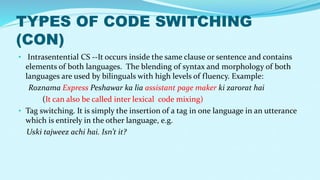
• Intrasentential CS --It occurs inside the same clause or sentence and contains
elements of both languages. The blending of syntax and morphology of both
languages are used by bilinguals with high levels of fluency. Example:
Roznama Express Peshawar ka lia assistant page maker ki zarorat hai
(It can also be called inter lexical code mixing)
• Tag switching. It is simply the insertion of a tag in one language in an utterance
which is entirely in the other language, e.g.
Uski tajweez achi hai. Isn’t it?
CODE MIXING- DEFINITION/TYPES
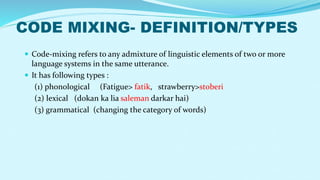
 Code-mixing refers to any admixture of linguistic elements of two or more
language systems in the same utterance.
 It has following types :
(1) phonological (Fatigue> fatik, strawberry>stoberi
(2) lexical (dokan ka lia saleman darkar hai)
(3) grammatical (changing the category of words)
CODE MIXING: SITUATIONS
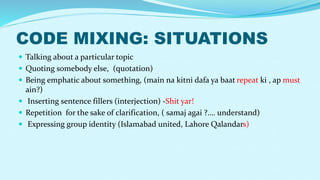
 Talking about a particular topic
 Quoting somebody else, (quotation)
 Being emphatic about something, (main na kitni dafa ya baat repeat ki , ap must
ain?)
 Inserting sentence fillers (interjection) -Shit yar!
 Repetition for the sake of clarification, ( samaj agai ?…. understand)
 Expressing group identity (Islamabad united, Lahore Qalandars)
CODE MIXING: SITUATIONS
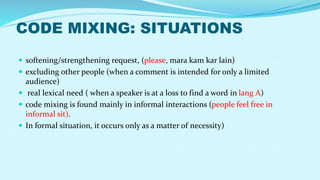
 softening/strengthening request, (please, mara kam kar lain)
 excluding other people (when a comment is intended for only a limited
audience)
 real lexical need ( when a speaker is at a loss to find a word in lang A)
 code mixing is found mainly in informal interactions (people feel free in
informal sit).
 In formal situation, it occurs only as a matter of necessity)
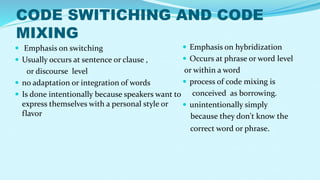
CODE SWITICHING AND CODE
MIXING
 Emphasis on switching
 Usually occurs at sentence or clause ,
or discourse level
 no adaptation or integration of words
 Is done intentionally because speakers want to
express themselves with a personal style or
flavor
 Emphasis on hybridization
 Occurs at phrase or word level
or within a word
 process of code mixing is
conceived as borrowing.
 unintentionally simply
because they don't know the
correct word or phrase.
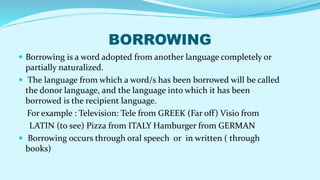
BORROWING
 Borrowing is a word adopted from another language completely or
partially naturalized.
 The language from which a word/s has been borrowed will be called
the donor language, and the language into which it has been
borrowed is the recipient language.
For example : Television: Tele from GREEK (Far off) Visio from
LATIN (to see) Pizza from ITALY Hamburger from GERMAN
 Borrowing occurs through oral speech or in written ( through
books)
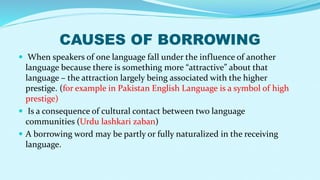
CAUSES OF BORROWING
 When speakers of one language fall under the influence of another
language because there is something more “attractive” about that
language – the attraction largely being associated with the higher
prestige. (for example in Pakistan English Language is a symbol of high
prestige)
 Is a consequence of cultural contact between two language
communities (Urdu lashkari zaban)
 A borrowing word may be partly or fully naturalized in the receiving
language.
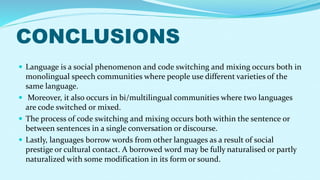
CONCLUSIONS
 Language is a social phenomenon and code switching and mixing occurs both in
monolingual speech communities where people use different varieties of the
same language.
 Moreover, it also occurs in bi/multilingual communities where two languages
are code switched or mixed.
 The process of code switching and mixing occurs both within the sentence or
between sentences in a single conversation or discourse.
 Lastly, languages borrow words from other languages as a result of social
prestige or cultural contact. A borrowed word may be fully naturalised or partly
naturalized with some modification in its form or sound.
?????

Code Switching^J mixing and borrowing.pptx

  • 1.
  • 2.
    POINTS TO BEDISCUSSED  Common Examples of CS  Introduction  Types of CS  CS Definition/types  CM Definition/Types  Code mixing: Situations  Difference between CS and CM  Borrowing  Causes of borrowing  Conclusion
  • 3.
    INTRODUCTION  It isthe use of more than one language, variety, or style by speaker within an utterance or discourse, or between different interlocutors or situations.  Switching of the code usually occurs when there is more than one language in communication (usually happens in bi/multilingual environment).  The speaker uses his or her ability in another language, style, dialect on different occasions.  Code switching and code mixing is the phenomenon of code choice.
  • 4.
    TYPES OF CODESWITCHING • Inter sentential CS—It occurs between clause or sentence boundary, where each clause or sentence is in one language or another. For example: Me tu yahan hoon. What happened? (U> E) I can explain it to you. Kia ap ko mari baat ke samaj ai hai? (E>U)
  • 5.
    TYPES OF CODESWITCHING (CON) • Intrasentential CS --It occurs inside the same clause or sentence and contains elements of both languages. The blending of syntax and morphology of both languages are used by bilinguals with high levels of fluency. Example: Roznama Express Peshawar ka lia assistant page maker ki zarorat hai (It can also be called inter lexical code mixing) • Tag switching. It is simply the insertion of a tag in one language in an utterance which is entirely in the other language, e.g. Uski tajweez achi hai. Isn’t it?
  • 6.
    CODE MIXING- DEFINITION/TYPES Code-mixing refers to any admixture of linguistic elements of two or more language systems in the same utterance.  It has following types : (1) phonological (Fatigue> fatik, strawberry>stoberi (2) lexical (dokan ka lia saleman darkar hai) (3) grammatical (changing the category of words)
  • 7.
    CODE MIXING: SITUATIONS Talking about a particular topic  Quoting somebody else, (quotation)  Being emphatic about something, (main na kitni dafa ya baat repeat ki , ap must ain?)  Inserting sentence fillers (interjection) -Shit yar!  Repetition for the sake of clarification, ( samaj agai ?…. understand)  Expressing group identity (Islamabad united, Lahore Qalandars)
  • 8.
    CODE MIXING: SITUATIONS softening/strengthening request, (please, mara kam kar lain)  excluding other people (when a comment is intended for only a limited audience)  real lexical need ( when a speaker is at a loss to find a word in lang A)  code mixing is found mainly in informal interactions (people feel free in informal sit).  In formal situation, it occurs only as a matter of necessity)
  • 9.
    CODE SWITICHING ANDCODE MIXING  Emphasis on switching  Usually occurs at sentence or clause , or discourse level  no adaptation or integration of words  Is done intentionally because speakers want to express themselves with a personal style or flavor  Emphasis on hybridization  Occurs at phrase or word level or within a word  process of code mixing is conceived as borrowing.  unintentionally simply because they don't know the correct word or phrase.
  • 10.
    BORROWING  Borrowing isa word adopted from another language completely or partially naturalized.  The language from which a word/s has been borrowed will be called the donor language, and the language into which it has been borrowed is the recipient language. For example : Television: Tele from GREEK (Far off) Visio from LATIN (to see) Pizza from ITALY Hamburger from GERMAN  Borrowing occurs through oral speech or in written ( through books)
  • 11.
    CAUSES OF BORROWING When speakers of one language fall under the influence of another language because there is something more “attractive” about that language – the attraction largely being associated with the higher prestige. (for example in Pakistan English Language is a symbol of high prestige)  Is a consequence of cultural contact between two language communities (Urdu lashkari zaban)  A borrowing word may be partly or fully naturalized in the receiving language.
  • 12.
    CONCLUSIONS  Language isa social phenomenon and code switching and mixing occurs both in monolingual speech communities where people use different varieties of the same language.  Moreover, it also occurs in bi/multilingual communities where two languages are code switched or mixed.  The process of code switching and mixing occurs both within the sentence or between sentences in a single conversation or discourse.  Lastly, languages borrow words from other languages as a result of social prestige or cultural contact. A borrowed word may be fully naturalised or partly naturalized with some modification in its form or sound.
  • 13.