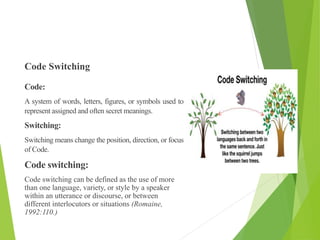
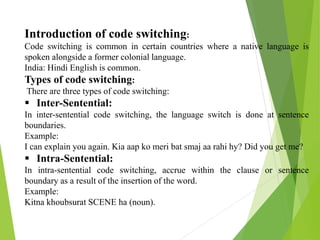
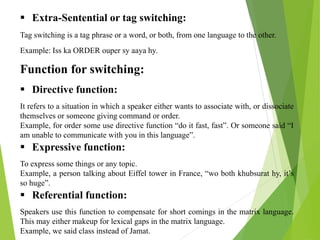
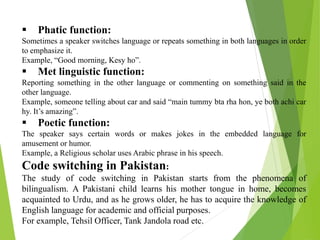
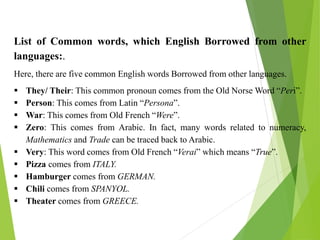
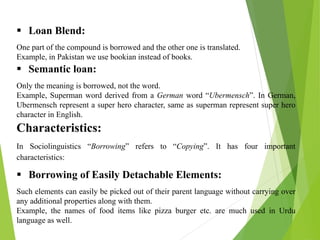
This document discusses code switching and borrowing in sociolinguistics. It defines code switching as using more than one language or variety within an utterance. There are three types of code switching: inter-sentential, intra-sentential, and extra-sentential. Code switching serves directive, expressive, referential, phatic, metlinguistic, and poetic functions. Borrowing occurs when a word is adopted from another language and naturalized. There are direct and core types of borrowing. Social factors that influence code switching and borrowing include situation, participant attitudes, topics, quoting others, group identity, and lexical need.