Diglossia
What
is
diglossia
?
DEFINITION OF Diglossia
Diglossia is the use of local language is also called the use of the first
language, while the use of Indonesian is also known as a second language
use. (Aslinda, et al., 2007:26).
Diglossia is relatively stable language
situation in which, in addition to the
primary dialects of the language , there is
a very divergent, highly codified,
superposed variety, …. , which is learned
largely by formal education and is used
for most written and formal spoken
purpose.
DEFINITION OF Diglossia
Charles A. Ferguson (1959) Diglossia is relatively stable
language . Language situation , in which in the addition of
primary dialect . Of the language there is a divergent highly
codified superposed variety which is learn largely by formal
education and is used for most written and formal spoken
purpose .
Definition of Diglossia
Diglossia is a kind of situation where two
variation of language Happens in same time
Its not a dialect. If a language is dialect that
language will not be called diglossia .
5
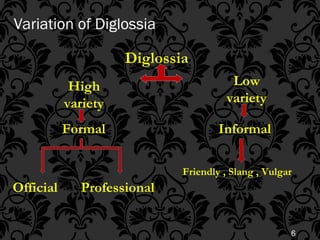
Variation of Diglossia
High
variety
Diglossia
Low
variety
Formal Informal
Official Professional
Friendly , Slang , Vulgar
6
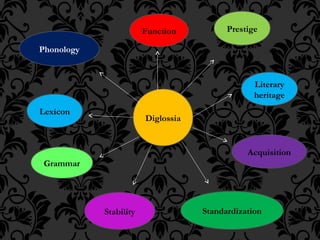
Diglossia
Prestige
Lexicon
Acquisition
Grammar
Literary
heritage
StandardizationStability
Phonology
Function
Function of Diglossia
Standard (High) Non-Standard (Low)
Sermon Instruction of servants
Speech of Parliament Conversation with friends
University Lecture Conversation in tea-stall
Newspapers Editorial Conversation With Children
Serious work in literature
8
In many countries, the globalization
of English has introduced a third
significant language, so that triglossia
and polyglossia is starting to emerge
so that changes in one are refelected
changes.
Formal & Informal English

Formal English is used in “serious” texts and
situations — for example, in official
documents, books, news reports, articles,
business letters or official speeches.

Informal English is used in everyday
conversations and in personal letters.
10
1.Prestige
Prestige Speakers consider High as the more
powerful to Low in a number of respects.
E.g. High variety is more beautiful, logical
and expressive than the Low variety.
11
2. Literary Heritage
There is a sizable body of written literature
in H which is held in high esteem by the
speech community.
3.Acquisition
Low is usually used by adults
while speaking to children and
children use it among each other.
The High variety is ‘taught’,
whereas the L variety is ‘learned’.
13
14
4.Standardization
There are usually no comparable grammars,
dictionaries and standardized texts for the Low
variety, and any view of that variety is likely to be
highly pejorative in nature.
There is an established norm for pronunciation,
grammar, and vocabulary which allows variation
only within certain limits.
14
5.Grammar
The grammar of the Low variety is generally
simpler. For instance, fewer distinctions in the L
variety are marked by the use of grammatical
suffixed. There are also major differences in the
vocabulary of the two varieties.
E.g. Standard German has four cases in the
noun; Swiss German has only three cases in the
noun.
15
6. Lexicon
H includes in its total lexicon technical terms and
learned expressions which have no regular L
equivalents, since the subjects involved are rarely if
ever discussed in pure L.
L includes in its total lexicon popular expressions and
the names of very homely objects or objects of very
localized distribution which have no regular H
equivalents, since the subjects involved are rarely if
ever discussed in pure H.
7.Phonology
The sound systems of High and Low
constitute a single phonological structure of
which the Low variety phonology is the basic
system and the divergent features of the
High phonology are either a subsystem or a
Para system.
17
Diglossia

Diglossia

  • 1.
  • 2.
  • 3.
    DEFINITION OF Diglossia Diglossiais the use of local language is also called the use of the first language, while the use of Indonesian is also known as a second language use. (Aslinda, et al., 2007:26). Diglossia is relatively stable language situation in which, in addition to the primary dialects of the language , there is a very divergent, highly codified, superposed variety, …. , which is learned largely by formal education and is used for most written and formal spoken purpose.
  • 4.
    DEFINITION OF Diglossia CharlesA. Ferguson (1959) Diglossia is relatively stable language . Language situation , in which in the addition of primary dialect . Of the language there is a divergent highly codified superposed variety which is learn largely by formal education and is used for most written and formal spoken purpose .
  • 5.
    Definition of Diglossia Diglossiais a kind of situation where two variation of language Happens in same time Its not a dialect. If a language is dialect that language will not be called diglossia . 5
  • 6.
    Variation of Diglossia High variety Diglossia Low variety FormalInformal Official Professional Friendly , Slang , Vulgar 6
  • 7.
  • 8.
    Function of Diglossia Standard(High) Non-Standard (Low) Sermon Instruction of servants Speech of Parliament Conversation with friends University Lecture Conversation in tea-stall Newspapers Editorial Conversation With Children Serious work in literature 8
  • 9.
    In many countries,the globalization of English has introduced a third significant language, so that triglossia and polyglossia is starting to emerge so that changes in one are refelected changes.
  • 10.
    Formal & InformalEnglish  Formal English is used in “serious” texts and situations — for example, in official documents, books, news reports, articles, business letters or official speeches.  Informal English is used in everyday conversations and in personal letters. 10
  • 11.
    1.Prestige Prestige Speakers considerHigh as the more powerful to Low in a number of respects. E.g. High variety is more beautiful, logical and expressive than the Low variety. 11
  • 12.
    2. Literary Heritage Thereis a sizable body of written literature in H which is held in high esteem by the speech community.
  • 13.
    3.Acquisition Low is usuallyused by adults while speaking to children and children use it among each other. The High variety is ‘taught’, whereas the L variety is ‘learned’. 13
  • 14.
    14 4.Standardization There are usuallyno comparable grammars, dictionaries and standardized texts for the Low variety, and any view of that variety is likely to be highly pejorative in nature. There is an established norm for pronunciation, grammar, and vocabulary which allows variation only within certain limits. 14
  • 15.
    5.Grammar The grammar ofthe Low variety is generally simpler. For instance, fewer distinctions in the L variety are marked by the use of grammatical suffixed. There are also major differences in the vocabulary of the two varieties. E.g. Standard German has four cases in the noun; Swiss German has only three cases in the noun. 15
  • 16.
    6. Lexicon H includesin its total lexicon technical terms and learned expressions which have no regular L equivalents, since the subjects involved are rarely if ever discussed in pure L. L includes in its total lexicon popular expressions and the names of very homely objects or objects of very localized distribution which have no regular H equivalents, since the subjects involved are rarely if ever discussed in pure H.
  • 17.
    7.Phonology The sound systemsof High and Low constitute a single phonological structure of which the Low variety phonology is the basic system and the divergent features of the High phonology are either a subsystem or a Para system. 17