Language
Recovery and
RevitalizationLead discussant: Nasif T. Macaslang, MA
LS 303 (Language and Culture
DR. GRACE S. RAFAL
2
3
Languages: A Very
Short Introduction,
Stephen Anderson
writes:
“Linguistic
diversity all over the
world is in imminent
danger of major decline,
and at least part of the
reason for that is
competition between
‘local’ languages and the
major languages of
wealth and power.”
“Endangered languages are those
that are not being taught to children
by their parents and are not being
used actively in everyday matters.”
Mona Domosh,
Roderick Neumann,
Patricia Price, and
Terry Jordon-Bychkov,
in their textbook The
Human Mosaic: A
Cultural Approach to
Human Geography,
write:
One of the common causes of language death
is linguistic imperialism. According to John
McWhorter:
The language of the dominant power—written,
spoken by the wealthy, and broadcast constantly
on radio and television—quite often comes to be
associated with legitimacy, the cosmopolitan,
and success. Almost inevitably, the home
language is recast as, basically, not that—and
thus antithetical to survival under the best
possible conditions.”
5
Spencer Wells further writes:
○ “In every case of language
death, we lose part of our cultural
history. Particularly when the
language in question has not been
studied or recorded—which is the
case for most of the world’s
languages—we have lost an
irretrievable snapshot of our past.”
6
“
With regard to the impact of language
death, geneticist Spencer Wells, in his
book The Journey of Man: A Genetic
Odyssey, writes:
7
When languages
are lost, then, we
lose a snapshot
of one part of our
history.”
Linguistic diversity is being threatened around the world,
and this threat is acutely felt by indigenous peoples.
According to UNESCO, approximately 600 languages
have disappeared in the last century and they continue to
disappear at a rate of one language every two weeks. Up
to 90 percent of the world’s languages are likely to
disappear before the end of this century if current trends
are allowed to continue.
Languages under threat
8
As for Indigenous languages in Canada,
some are thriving whereas others, such as Oneida,
Cayuga, and Seneca are on the brink of extinction.
According to the UNESCO Atlas of the World’s
Languages in Danger project, “three-quarters of
Indigenous languages in Canada are “definitely,”
“severely” or “critically” endangered. The rest are
classified as “vulnerable/unsafe.”
Why the decline of Indigenous languages in
Canada?
9
As for Indigenous languages in Canada,
some are thriving whereas others, such as Oneida,
Cayuga, and Seneca are on the brink of extinction.
According to the UNESCO Atlas of the World’s
Languages in Danger project, “three-quarters of
Indigenous languages in Canada are “definitely,”
“severely” or “critically” endangered. The rest are
classified as “vulnerable/unsafe.”
Languages under threat
10
The root of the decline lies in the Indian
Act and is compounded by demographics and
the internet.
Created residential schools
1886 to 1996
11
Forbade students from
practicing their traditional
religion
1940s
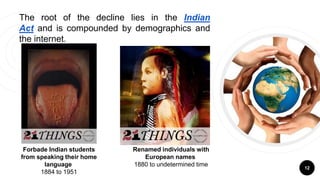
The root of the decline lies in the Indian
Act and is compounded by demographics and
the internet.
Forbade Indian students
from speaking their home
language
1884 to 1951
12
Renamed individuals with
European names
1880 to undetermined time
Why is the protection of indigenous
languages important?
13
As a result of linguistic
erosion, much of the
encyclopedia of traditional
indigenous knowledge that is
usually passed down orally
from generation to
generation is in danger of
being lost forever.
Customary laws of
indigenous communities are
often set out in their
languages, and if the
language is lost the
community may not fully
understand its laws and
system of governance that
foster its future survival.
The loss of indigenous
languages signifies not only
the loss of traditional
knowledge but also the
loss of cultural diversity,
undermining the identity
and spirituality of the
community and the
individual.
Biological, linguistic and cultural
diversity are inseparable and
mutually reinforcing, so when an
indigenous language is lost, so
too is traditional knowledge on
how to maintain the world’s
biological diversity and address
climate change and other
environmental challenges.
14
The right to be
educated in
their mother
tongue.
The right to
have
indigenous
languages
recognized in
constitutions
and laws.
The right to live
free from
discrimination
on the grounds
of language.The right to
establish and
have access
to media in
indigenous
languages.
Basic right to maintain and
use indigenous peoples’
language :
Measures needed to protect and promote
indigenous languages:
Allocating the funding and resources needed to preserve and
develop indigenous languages, and particularly for education.
16
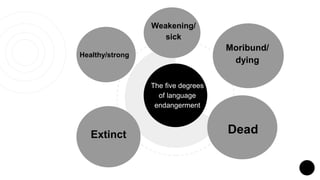
The five degrees
of language
endangerment
Weakening/
sick
Extinct Dead
Healthy/strong
Moribund/
dying
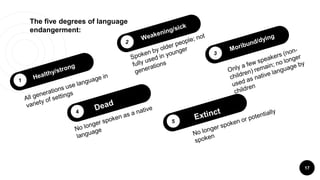
The five degrees of language
endangerment:
17
1
4
5
“
Language Revitalization
18
Language revitalization, also
referred to as language
revival or reversing language shift, is
an attempt to halt or reverse the
decline of a language or to revive an
extinct one.
A central aspect of language
revitalization is the creation of new
speakers.
“
Reasons for Language
Revival:
19
To preserve a
language/prev
ent its
extinction.
In countries with a
colonial history: to
restore the language
of the colonised
instead of speaking
the language of the
colonizes.
To strengthen a
cultural/ethnic identity
by reviewing the
language of that
culture/ethnic group.
Language as a
heritage which
shouldn’t be lost (roots
of an identity in a
language.
To unify an
ethnic group
under one
language and
give then their
identity.
To unify many
cultural groups
under one
language.
20
Acquisition of the language by
adults, who in effect act as
language apprentices
(recommended where most of the
remaining speakers of the
language are elderly and socially
isolated from other speakers of
the language).
Joshua Fishman's
(1991) models for
reviving threatened
(or sleeping)
languages
(The eight stages)
David Crystal, in his book Language Death,
proposes that language revitalization is more
likely to be successful if its speakers
21
increase the
language's
prestige within
the dominant
community
increase
their wealth
and income
increase their
legitimate
power in the
eyes of the
dominant
communityhave a
strong
presence in
the
education
system
can write
down the
language
can use
electronic
technology
Joshua Fishman's (1991) models for reviving
threatened (or sleeping) languages
(The eight stages)
22
create a socially integrated
population of active speakers
(or users) of the language (at
this stage it is usually best to
concentrate mainly on the
spoken language rather than
the written language).
Joshua Fishman's (1991) models for reviving
threatened (or sleeping) languages
(The eight stages)
23
In localities where there are a
reasonable number of people habitually
using the language, encourage the
informal use of the language among
people of all age groups and within
families and bolster its daily use
through the establishment of local
neighborhood institutions in which the
language is encouraged, protected and
(in certain contexts at least) used
exclusively.
Joshua Fishman's (1991) models for reviving
threatened (or sleeping) languages
(The eight stages)
24
In areas where oral
competence in the
language has been
achieved in all age groups,
encourage literacy in the
language, but in a way that
does not depend upon
assistance from (or
goodwill of) the state
education system.
Where the state permits it,
and where numbers
warrant, encourage the
use of the language in
compulsory state
education.
25
Technology can also be
used to preserve the
integrity of spoken
versions of languages
Video
recording
Podcast
Reel-to-reel audio
recording/open-
reel audio tape
recording
Technology can also be used
to preserve the integrity of
spoken versions of languages
26
27
Thanks! 

Language recovery

  • 1.
    Language Recovery and RevitalizationLead discussant:Nasif T. Macaslang, MA LS 303 (Language and Culture DR. GRACE S. RAFAL
  • 2.
  • 3.
    3 Languages: A Very ShortIntroduction, Stephen Anderson writes: “Linguistic diversity all over the world is in imminent danger of major decline, and at least part of the reason for that is competition between ‘local’ languages and the major languages of wealth and power.”
  • 4.
    “Endangered languages arethose that are not being taught to children by their parents and are not being used actively in everyday matters.” Mona Domosh, Roderick Neumann, Patricia Price, and Terry Jordon-Bychkov, in their textbook The Human Mosaic: A Cultural Approach to Human Geography, write:
  • 5.
    One of thecommon causes of language death is linguistic imperialism. According to John McWhorter: The language of the dominant power—written, spoken by the wealthy, and broadcast constantly on radio and television—quite often comes to be associated with legitimacy, the cosmopolitan, and success. Almost inevitably, the home language is recast as, basically, not that—and thus antithetical to survival under the best possible conditions.” 5
  • 6.
    Spencer Wells furtherwrites: ○ “In every case of language death, we lose part of our cultural history. Particularly when the language in question has not been studied or recorded—which is the case for most of the world’s languages—we have lost an irretrievable snapshot of our past.” 6
  • 7.
    “ With regard tothe impact of language death, geneticist Spencer Wells, in his book The Journey of Man: A Genetic Odyssey, writes: 7 When languages are lost, then, we lose a snapshot of one part of our history.”
  • 8.
    Linguistic diversity isbeing threatened around the world, and this threat is acutely felt by indigenous peoples. According to UNESCO, approximately 600 languages have disappeared in the last century and they continue to disappear at a rate of one language every two weeks. Up to 90 percent of the world’s languages are likely to disappear before the end of this century if current trends are allowed to continue. Languages under threat 8
  • 9.
    As for Indigenouslanguages in Canada, some are thriving whereas others, such as Oneida, Cayuga, and Seneca are on the brink of extinction. According to the UNESCO Atlas of the World’s Languages in Danger project, “three-quarters of Indigenous languages in Canada are “definitely,” “severely” or “critically” endangered. The rest are classified as “vulnerable/unsafe.” Why the decline of Indigenous languages in Canada? 9
  • 10.
    As for Indigenouslanguages in Canada, some are thriving whereas others, such as Oneida, Cayuga, and Seneca are on the brink of extinction. According to the UNESCO Atlas of the World’s Languages in Danger project, “three-quarters of Indigenous languages in Canada are “definitely,” “severely” or “critically” endangered. The rest are classified as “vulnerable/unsafe.” Languages under threat 10
  • 11.
    The root ofthe decline lies in the Indian Act and is compounded by demographics and the internet. Created residential schools 1886 to 1996 11 Forbade students from practicing their traditional religion 1940s
  • 12.
    The root ofthe decline lies in the Indian Act and is compounded by demographics and the internet. Forbade Indian students from speaking their home language 1884 to 1951 12 Renamed individuals with European names 1880 to undetermined time
  • 13.
    Why is theprotection of indigenous languages important? 13 As a result of linguistic erosion, much of the encyclopedia of traditional indigenous knowledge that is usually passed down orally from generation to generation is in danger of being lost forever. Customary laws of indigenous communities are often set out in their languages, and if the language is lost the community may not fully understand its laws and system of governance that foster its future survival. The loss of indigenous languages signifies not only the loss of traditional knowledge but also the loss of cultural diversity, undermining the identity and spirituality of the community and the individual. Biological, linguistic and cultural diversity are inseparable and mutually reinforcing, so when an indigenous language is lost, so too is traditional knowledge on how to maintain the world’s biological diversity and address climate change and other environmental challenges.
  • 14.
    14 The right tobe educated in their mother tongue. The right to have indigenous languages recognized in constitutions and laws. The right to live free from discrimination on the grounds of language.The right to establish and have access to media in indigenous languages. Basic right to maintain and use indigenous peoples’ language :
  • 15.
    Measures needed toprotect and promote indigenous languages: Allocating the funding and resources needed to preserve and develop indigenous languages, and particularly for education.
  • 16.
    16 The five degrees oflanguage endangerment Weakening/ sick Extinct Dead Healthy/strong Moribund/ dying
  • 17.
    The five degreesof language endangerment: 17 1 4 5
  • 18.
    “ Language Revitalization 18 Language revitalization,also referred to as language revival or reversing language shift, is an attempt to halt or reverse the decline of a language or to revive an extinct one. A central aspect of language revitalization is the creation of new speakers.
  • 19.
    “ Reasons for Language Revival: 19 Topreserve a language/prev ent its extinction. In countries with a colonial history: to restore the language of the colonised instead of speaking the language of the colonizes. To strengthen a cultural/ethnic identity by reviewing the language of that culture/ethnic group. Language as a heritage which shouldn’t be lost (roots of an identity in a language. To unify an ethnic group under one language and give then their identity. To unify many cultural groups under one language.
  • 20.
    20 Acquisition of thelanguage by adults, who in effect act as language apprentices (recommended where most of the remaining speakers of the language are elderly and socially isolated from other speakers of the language). Joshua Fishman's (1991) models for reviving threatened (or sleeping) languages (The eight stages)
  • 21.
    David Crystal, inhis book Language Death, proposes that language revitalization is more likely to be successful if its speakers 21 increase the language's prestige within the dominant community increase their wealth and income increase their legitimate power in the eyes of the dominant communityhave a strong presence in the education system can write down the language can use electronic technology
  • 22.
    Joshua Fishman's (1991)models for reviving threatened (or sleeping) languages (The eight stages) 22 create a socially integrated population of active speakers (or users) of the language (at this stage it is usually best to concentrate mainly on the spoken language rather than the written language).
  • 23.
    Joshua Fishman's (1991)models for reviving threatened (or sleeping) languages (The eight stages) 23 In localities where there are a reasonable number of people habitually using the language, encourage the informal use of the language among people of all age groups and within families and bolster its daily use through the establishment of local neighborhood institutions in which the language is encouraged, protected and (in certain contexts at least) used exclusively.
  • 24.
    Joshua Fishman's (1991)models for reviving threatened (or sleeping) languages (The eight stages) 24 In areas where oral competence in the language has been achieved in all age groups, encourage literacy in the language, but in a way that does not depend upon assistance from (or goodwill of) the state education system. Where the state permits it, and where numbers warrant, encourage the use of the language in compulsory state education.
  • 25.
    25 Technology can alsobe used to preserve the integrity of spoken versions of languages Video recording Podcast Reel-to-reel audio recording/open- reel audio tape recording
  • 26.
    Technology can alsobe used to preserve the integrity of spoken versions of languages 26
  • 27.