
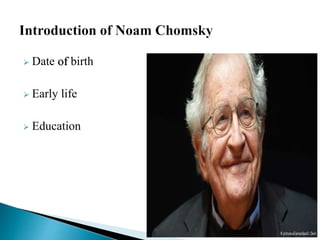

 Date of birth
 Early life
 Education
What is Linguistics
 The scientific study of language of language is called
linguistics.
 Linguistics is the scientific study of language. It
involves analysis of language form, language meaning,
and language in context, as well as an analysis of the
social, cultural, historical, and political factors that
influence language
 He argue that language acquisition is an innate
structure or function of the human brain.
 He believe that there are structure of the brain
that control the interpretation and production of
speech.
 Children do not need any kind of formal teaching
to learn to speak.
 He proposed that all human have a language
acquisition device
1-Behaviorism
It hold that language develops as a result of
environment influence.
2-Nativism
It hold that language development is inborn. The
nativist perspective argue that human are
biologically programmer to gain knowledge.
3-interactionism
It emphasize the interaction between environment
influence and innate abilities in language
development.
1-Language acquisition device
 The LAD is a hypothetical tool hardwired into the brain that
helps children rapidly learn and understand language.
 Chomsky developed the LAD in the 1950s.
 Chomsky proposed that every child was born with an LAD
that holds the fundamental rules for language.
 Chomsky offered a number of pieces of evidence to support
his theory.
 He posed that language is fundamentally similar across all
of humanity.
 Every language has something that is like a noun and a verb,
and every language has the ability to make things positive or
negative
 Chomsky also discovered that when children are learning to
speak, they don't make the errors you would expect.
 Chomsky developed the LAD in the 1950s, and since then,
has moved on to a greater theory called universal grammar.
 Universal Grammar, a set of innate principles and adjustable
parameters that are common to all human languages.
 All the languages of the world share similar characteristics
of using nouns, verbs, pronouns though necessarily in a
similar manner.
 The structure and system of a language, usually
considered to consist of syntax and morphology.
 Grammar is the set of rules which help us to
understand language.
 The rules governed the formation of words,
phrases, clauses and sentences up to whole
texts.
 Perspective Grammar
A prescriptive grammar is a set of rules about
language based on how people think language
should be used. In a prescriptive grammar
there is right and wrong.
 Descriptive Grammar
A descriptive grammar is a set of rules about
language based on how it is actually used. In a
descriptive grammar there is no right or wrong
language.
 Generative grammar is a theory of grammar that
holds that human language is shaped by a set of
basic principles that are part of the human brain
(and even present in the brains of small children).
This "universal grammar," according to linguists
like Chomsky, comes from our innate language
faculty.
Grammar consists of three components
1. Syntactic component
2. Phonological component
3. Semantic component
 Linguistics competence includes component
such as phonetics, phonology, syntax,
semantics and morphology.
 Linguistics performance represents only a
small sample of possible utterances.
 The word ‘syntax’ has been derived from the
Greek word syntaxes which means
‘arrangement.
 It implies the way in which words are
arranged so as to reveal relationships of
meanings within sentences and often
between them.
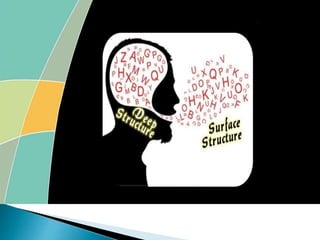
 Deep structure is what you wish to express.
 surface structure how you express it in with the help of
words and sentence.
 Example
“I bought colourful clothes”. This is a surface structure.
The deep structure will contain a lot more details like:
How many clothes?
Which types?
What colours?
 Structural ambiguity is a word ,phrase or statement
which contains more than one meaning.
 Examples
1. A good life depends on a liver.
2. I rode a black horse in red pajamas.
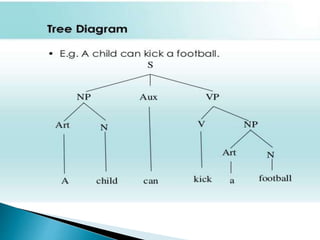
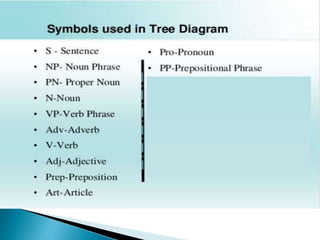
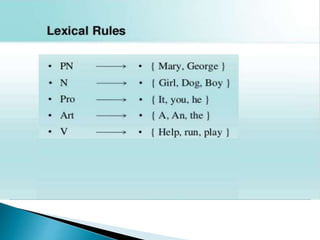
 A tree diagram is a way of representing the hierarchical
nature of a structure in a graphical form. It is named a
"tree diagram” because the classic representation
resembles a tree, even though the chart is generally
upside down compared to an actual tree, with the "root"
at the top and the "leaves" at the bottom.
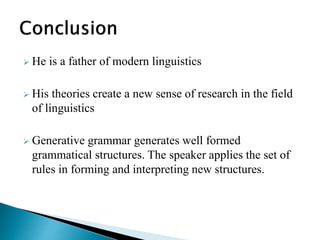
 He is a father of modern linguistics
 His theories create a new sense of research in the field
of linguistics
 Generative grammar generates well formed
grammatical structures. The speaker applies the set of
rules in forming and interpreting new structures.
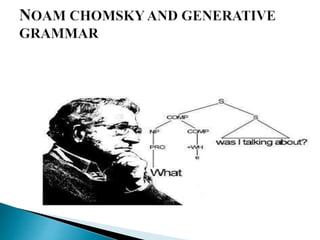
Noam chomsky and generative grammar

Noam chomsky and generative grammar

  • 4.
     Date ofbirth  Early life  Education
  • 5.
    What is Linguistics The scientific study of language of language is called linguistics.  Linguistics is the scientific study of language. It involves analysis of language form, language meaning, and language in context, as well as an analysis of the social, cultural, historical, and political factors that influence language
  • 6.
     He arguethat language acquisition is an innate structure or function of the human brain.  He believe that there are structure of the brain that control the interpretation and production of speech.  Children do not need any kind of formal teaching to learn to speak.  He proposed that all human have a language acquisition device
  • 7.
    1-Behaviorism It hold thatlanguage develops as a result of environment influence. 2-Nativism It hold that language development is inborn. The nativist perspective argue that human are biologically programmer to gain knowledge. 3-interactionism It emphasize the interaction between environment influence and innate abilities in language development.
  • 8.
    1-Language acquisition device The LAD is a hypothetical tool hardwired into the brain that helps children rapidly learn and understand language.  Chomsky developed the LAD in the 1950s.  Chomsky proposed that every child was born with an LAD that holds the fundamental rules for language.
  • 9.
     Chomsky offereda number of pieces of evidence to support his theory.  He posed that language is fundamentally similar across all of humanity.  Every language has something that is like a noun and a verb, and every language has the ability to make things positive or negative  Chomsky also discovered that when children are learning to speak, they don't make the errors you would expect.
  • 10.
     Chomsky developedthe LAD in the 1950s, and since then, has moved on to a greater theory called universal grammar.  Universal Grammar, a set of innate principles and adjustable parameters that are common to all human languages.  All the languages of the world share similar characteristics of using nouns, verbs, pronouns though necessarily in a similar manner.
  • 11.
     The structureand system of a language, usually considered to consist of syntax and morphology.  Grammar is the set of rules which help us to understand language.  The rules governed the formation of words, phrases, clauses and sentences up to whole texts.
  • 12.
     Perspective Grammar Aprescriptive grammar is a set of rules about language based on how people think language should be used. In a prescriptive grammar there is right and wrong.  Descriptive Grammar A descriptive grammar is a set of rules about language based on how it is actually used. In a descriptive grammar there is no right or wrong language.
  • 13.
     Generative grammaris a theory of grammar that holds that human language is shaped by a set of basic principles that are part of the human brain (and even present in the brains of small children). This "universal grammar," according to linguists like Chomsky, comes from our innate language faculty.
  • 14.
    Grammar consists ofthree components 1. Syntactic component 2. Phonological component 3. Semantic component
  • 15.
     Linguistics competenceincludes component such as phonetics, phonology, syntax, semantics and morphology.  Linguistics performance represents only a small sample of possible utterances.
  • 16.
     The word‘syntax’ has been derived from the Greek word syntaxes which means ‘arrangement.  It implies the way in which words are arranged so as to reveal relationships of meanings within sentences and often between them.
  • 17.
     Deep structureis what you wish to express.  surface structure how you express it in with the help of words and sentence.  Example “I bought colourful clothes”. This is a surface structure. The deep structure will contain a lot more details like: How many clothes? Which types? What colours?
  • 19.
     Structural ambiguityis a word ,phrase or statement which contains more than one meaning.  Examples 1. A good life depends on a liver. 2. I rode a black horse in red pajamas.
  • 20.
     A treediagram is a way of representing the hierarchical nature of a structure in a graphical form. It is named a "tree diagram” because the classic representation resembles a tree, even though the chart is generally upside down compared to an actual tree, with the "root" at the top and the "leaves" at the bottom.
  • 24.
     He isa father of modern linguistics  His theories create a new sense of research in the field of linguistics  Generative grammar generates well formed grammatical structures. The speaker applies the set of rules in forming and interpreting new structures.