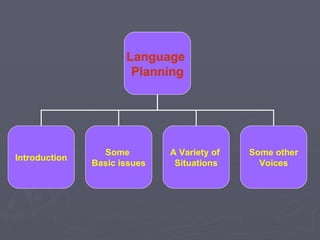
Language  Planning Introduction Some  Basic issues A Variety of  Situations Some other Voices
Introduction   Birth of language planning How language planning is defined  Some examples The reasons for language planning Language planning is carried out by whom
Introduction 1  Birth of Language Planning Language planning was first put forward by Uriel Weinrich, in 1957, at a seminar held in Columbia University, the U.S. In the literature concerned with "language planning", the American-Norwegian sociolinguist Einar Haugen is often mentioned as the person who gave birth to the concept. In the article "Language Planning in Modern Norway“(1959), which was widely acknowledged after its second edition in 1968, Haugen introduced and attempted to define the concept. Bente Bakmand( http://www.immi.se/intercultural/nr3/bakmand.htm )
Introduction 2   How language planning is defined 1 the development of policies or programs designed to direct or change language use, as through the establishment of an official language, the standardization or modernization of a language, or the development or alteration of a writing system.   http://dictionary.reference.com/browse/language+planning5 The numerous attempts that have been made to change a particular variety of a language, or a particular language, or some aspect of how either of these functions in society. Such changes are usually described as instances of  language planning.  Ronald (1998, p. 347) “ Language planning is a government authorized, longterm, sustained, and conscious effort to alter a language’s function in a society for the purpose of solving communication problems”  Weinstein(1980, p. 56)
Introduction 2 How language planning is defined 2 4.  Language planning involves the creation and implementation of an official policy about how the languages and linguistic varieties of a country are to be used. David Crystal (1996, p. 366)  5.  国家或社会团体为了对语言进行管理而进行的各种工作的统称。所谓规划或管理是个广义的概念,包括语言的选择和规范化、文字的创制和改革等方面的具体问题。 ( http://baike.baidu.com/view/677104.htm )
Introduction 2 Two examples The founding of the Acadamie Francaise in 1634.  For more information, visit  http://en.wikipedia.org/wiki/Acad%C3%A9mie_fran%C3%A7aise The Ethiopian literacy campaign around 1974  For more information,visit  http://www.mongabay.com/history/ethiopia/ethiopia-literacy.html
The reasons for language planning Different social groups wish to maintain their linguistic identities and interests, and may actively and often violently campaign for recognition. Changes increasing, countries becoming aware, it is not possible to rely on the slow course of natural liguistic evolution to resolve the pressures and conflicts that arise. Therefore, many governments try to solve their problems by engaging in conscious, principled ‘language planning’, or ‘linguistic engineering’ Introduction 3
Introduction 4 Language planning is carried out by: government departments and agencies  academies committees popular societies Individuals Historical, political, economic, religious, educational, judicial, and social factors all have to be disentangled (David Crystal,   1997, p. 367)
Some Basic Issues 1 Language planning is an attempt to interfere deliberately with a language or one of its varieties which may focus on either its  status  with regard to some other language or variety or its  internal condition  with a view to changing that condition, or on both of these since they are not mutually exclusive. The first focus results in  status planning  ( 地位规划 ),  the second corpus planning ( 本体规划 )
Some Basic Issues 2  status planning ;  corpus planning Status planning changes the function of a language or a variety of a language and the rights of those who use it. Ronald Wardhaugh(1998, p. 347) According to David Crystal (1997, p. 366), changes, in status planning, are proposed in the way a language/variety is to be used in society —permitted for the first time in law courts or in official publications.
Some Basic Issues 3  status planning ;  corpus planning Corpus planning seeks to develop a variety of a language or a language, usually to standardize it, that is, to provide it with the means for serving every possible language function in society.  According to David Crystal (1997, p. 366), changes, in corpus planning, are introduced into the stucture of a language/variety — spelling, pronunciation, grammar, or vocabulary.
Some Basic Issues 3  status planning ;  corpus planning The corpus/status dichotomy emphasizes the dual nature of language planning, that is, its concern with both the linguistic and social aspects of language.  “ Corpus planning” refers to all actions aiming at modifying “the nature of the language itself”, “ Status planning” is concerned with whether the social status of language should be lowered or raised.  However, the two cannot be separated from each other. And language planning can never be corpus-oriented or status-oriented exclusively.  Florian Coulmas(1998, P. 448)
Some Basic Issues 3 According to Kenneth Ives,   there is a third kind—   acquisition planning.  Refers to organized efforts to promote the learning of a language.  ( http://www.spellingsociety.org/journals/j12/planning.php ) Kenneth Ives, a retired sociologist and social worker. He is author of  Written Dialects N Spelling Reforms: History N Alternatives  (1979) and of two articles on studies of acceptability of spelling reforms
Some Basic Issues 4 linguistic assimilation,  linguistic pluralism, vernacularizaiton, internationalism Cobarrubias(1983)has described four  typical ideologies that may motivate actual decision-making in language planning in a particular society:
Some Basic Issues 5 linguistic assimilation the belief that everyone, regardless of origin,should learn the dominant language of the society. examples:  France applied this policy to various peoples within its borders. Russification in the former Soviet Union .
Some Basic Issues 6 linguistic pluralism the recognition of more than one language, also takes a variety of forms. It can be territorially or individually based or there may be some combination of the two. It can be complete or partial, so that all or only some aspects of life can be conducted in more than one language in society. examples are countries like Belgium ,  Canada, Switzerland
Some Basic Issues 7 Vernacularization the restoration or elaboration of an indigenous language and its adoption as an official language. Examples: Hebrew in Israel;  Tagalog(or Pilipino) in the Philippines( visit   http://en.wikipedia.org/wiki/Filipino_language )
Some Basic Issues 8 Internationalism the adoption of a non-indigenous language of wider communication either as an official language or for such purposes, as education or trade. Example: English in Singapore,  India, the Pilippines
Some Basic Issues 9 As a result of planning decisions, A language can achieve one of a variety of statuses. A language may be recognized as the sole official anguage, as French is in France. Two or more languages may share official status in some countries, e.g., English and French in Canada and Cameroon. A language may also  have official status but only  on a regional basis, e.g.,  German in Belgium
Some Basic Issues 10 Planning decisions will obviously play a very large role in determining what happens to any minority language or languages in a country. They can result in deliberate attempts to eradicate such a language, as with Franco’s attempt to eliminate Basque from Spain by banning it from public life .
A variety of Situations we will look at a variety of linguistic situations in the world to see some instances of planning. France serves as a good example of a country which has a single national language and does little or nothing for any other language.  The bilingualism of Belgium. Today, French and Flemis(Dutch) co-exist in a somewhat uneasy truce in Belgium. The struggle between the French and the Flemish has a long history. For more examples, see  P  353-358
A variety of Situations 2 some further examples Papua New Guinea, a nation of 700 or more indigenous languages some, possibly more than a third, with fewer than 500 speakers,and this in a total population of approximately 4 million. Singapore, an independent republic of nearly 3 million people. Modern Norway, 4 million people. Canada, 30 million people. China See P 360-365
Some others  voices
Planning in Practice 1  ( David Crystal,   1997, p. 366) Selecting the norm( 选择规范 ) choose a single language as a norm for official, educational, and other purposes. choose a particular variety of a language or to construct a new variety, considering such factors as formality, social class, regional dialect, and previous literary use.
Planning in Practice 2 Codification( 规范法典化 ) The chosen language needs to be developed to meet the demands placed upon it as a medium of national or international communication. If the language has previously existed only in spoken form, or in an unusual writing system, an alphabet will have to be devised, along with rules of spelling and punctuation. An early aim will be the codification of the pronunciation, grammar, and vocab to provide a set of norms for standard use, especially  if there is a great deal of local variation.
Planning in Practice 3 Modernization( 完善功能 ) The vocab will need to be modernized to enable foreign material to be translated consistently. Principles will have to be agreed for the introduction of new terms; for example, should they be loan words or coinages based on native roots? New styles of discourse may need to be developed, for use on radio or in the press. Decisions will need to be made about new or uncertain usages, especially in technical contexts.
Planning in Practice 4 Implementation  ( 推广使用 )   The chosen standard will need to be officially implemented by using it for government publications, in the media, and in schools. It will be viewed as the ‘best’ form of language in the speech community, because it will be associated with educational progress and social status. It will also provide the norm for literary style, and may be associated with factors of a nationalistic, cultural, or religious kind. In due course, it is likely to be promulgated as a norm through an official body, such as an academy, or through prescriptive grammars, dictionaries, and manuals of usage.
Chinese language planning   ( David Crystal,   1997, p. 367) Some of the most ambitious programmes of language planning ever conceived have taken place in China since the 1950s, with hundreds of millions of people affected. Two main developments The provision of a romanized alphabet(pin-yin) The promotion of a common spoken language,  putonghua  to provide a means of communication between the various regional languages. An example, Datian county in Fujian province A pin-yin class picture
A pin-yin class in   Ningwu County,  Shanxi. ( David Crystal,   1997, p. 367)
Referrences David Crystal. (1997).  The Cambridge Encyclopedia of Language.  Cambridge: Cambridge University Press. Florian Coulmas. (1998).  The Handbook of Sociolinguistics.  Hoboken: Blackwell Publishers Ltd. Ronald Wardhrugh. (1998).  An Introduction to Sociolinguistics.  Hoboken: Blackwell Publishers Ltd. http://baike.baidu.com/view/677104.htm http ://dictionary.reference.com/browse/language+planning5 http://www.immi.se/intercultural/nr3/bakmand.htm http://www.spellingsociety.org/journals/j12/planning.php http://en.wikipedia.org/wiki/Languages_of_Belgium http://en.wikipedia.org/wiki/Russification
Thank you
Russification an adoption of the  Russian language  or some other Russian attributes (whether voluntarily or not) by non- Russian  communities. In a narrow sense, Russification is used to indicate the influence of the  Russian language  on  Slavic ,  Baltic  and other languages, spoken in areas currently or formerly controlled by Russia, which led to the emerging of  russianisms ,  trasianka  and  surzhyk . In a historical sense, the term refers to both official and unofficial policies of  Imperial Russia  and the  Soviet Union  with respect to their national constituents and to  national minorities  in  Russia , aimed at Russian domination.The major areas of Russification are politics and culture http://en.wikipedia.org/wiki/Russification
Belgium’s linguistic pluralism Official languages: Dutch ,  French , and  German A number of non-official, minority languages and dialects:  Flemish, Walloon, Picard, Champenois, Lorrain, Low Dietsch, Luxembourgish, Yiddish  Other minority and foreign languages: Languages spoken by immigrants from recent decades and their descendants include  Arabic  ( Maghrebi Arabic ),  Spanish ,  Turkish ,  Portuguese ,  Italian  and  Polish   For more information, visit  http://en.wikipedia.org/wiki/Languages_of_Belgium
Franco’s attempt to eliminate Basque Francisco Paulino Hermenegildo Teódulo Franco y Bahamonde  (4 December 1892 – 20 November 1975), known simply as  Francisco Franco,  a Spanish dictator, military general and  head of state of Spain  from October 1936 (as a unified nation from 1939 onwards),  Euzkadi was the autonomous Basque region straddling northern Spain and southern France.  This autonomous Basque republic had been granted wartime self-rule by the Spanish Republic in 1936, when the Republic was fighting against Franco’s fascist forces in the Spanish Civil War.  Euzkadi, which had its own language and customs, held out for nine months before Bilbao in the region fell to Franco in June of 1937, and the Basque army surrendered in August of 1937. About 7,000 Basques had been killed in the fighting, 6,000 were later executed by Franco, and 45,000 were imprisoned. Approximately 150,000 went into exile for decades.  Franco subsequently tried to eliminate the Basque language (known as Euskera) and customs .

Language planning

  • 1.
    Language PlanningIntroduction Some Basic issues A Variety of Situations Some other Voices
  • 2.
    Introduction Birth of language planning How language planning is defined Some examples The reasons for language planning Language planning is carried out by whom
  • 3.
    Introduction 1 Birth of Language Planning Language planning was first put forward by Uriel Weinrich, in 1957, at a seminar held in Columbia University, the U.S. In the literature concerned with "language planning", the American-Norwegian sociolinguist Einar Haugen is often mentioned as the person who gave birth to the concept. In the article "Language Planning in Modern Norway“(1959), which was widely acknowledged after its second edition in 1968, Haugen introduced and attempted to define the concept. Bente Bakmand( http://www.immi.se/intercultural/nr3/bakmand.htm )
  • 4.
    Introduction 2 How language planning is defined 1 the development of policies or programs designed to direct or change language use, as through the establishment of an official language, the standardization or modernization of a language, or the development or alteration of a writing system. http://dictionary.reference.com/browse/language+planning5 The numerous attempts that have been made to change a particular variety of a language, or a particular language, or some aspect of how either of these functions in society. Such changes are usually described as instances of language planning. Ronald (1998, p. 347) “ Language planning is a government authorized, longterm, sustained, and conscious effort to alter a language’s function in a society for the purpose of solving communication problems” Weinstein(1980, p. 56)
  • 5.
    Introduction 2 Howlanguage planning is defined 2 4. Language planning involves the creation and implementation of an official policy about how the languages and linguistic varieties of a country are to be used. David Crystal (1996, p. 366) 5. 国家或社会团体为了对语言进行管理而进行的各种工作的统称。所谓规划或管理是个广义的概念,包括语言的选择和规范化、文字的创制和改革等方面的具体问题。 ( http://baike.baidu.com/view/677104.htm )
  • 6.
    Introduction 2 Twoexamples The founding of the Acadamie Francaise in 1634. For more information, visit http://en.wikipedia.org/wiki/Acad%C3%A9mie_fran%C3%A7aise The Ethiopian literacy campaign around 1974 For more information,visit http://www.mongabay.com/history/ethiopia/ethiopia-literacy.html
  • 7.
    The reasons forlanguage planning Different social groups wish to maintain their linguistic identities and interests, and may actively and often violently campaign for recognition. Changes increasing, countries becoming aware, it is not possible to rely on the slow course of natural liguistic evolution to resolve the pressures and conflicts that arise. Therefore, many governments try to solve their problems by engaging in conscious, principled ‘language planning’, or ‘linguistic engineering’ Introduction 3
  • 8.
    Introduction 4 Languageplanning is carried out by: government departments and agencies academies committees popular societies Individuals Historical, political, economic, religious, educational, judicial, and social factors all have to be disentangled (David Crystal, 1997, p. 367)
  • 9.
    Some Basic Issues1 Language planning is an attempt to interfere deliberately with a language or one of its varieties which may focus on either its status with regard to some other language or variety or its internal condition with a view to changing that condition, or on both of these since they are not mutually exclusive. The first focus results in status planning ( 地位规划 ), the second corpus planning ( 本体规划 )
  • 10.
    Some Basic Issues2 status planning ; corpus planning Status planning changes the function of a language or a variety of a language and the rights of those who use it. Ronald Wardhaugh(1998, p. 347) According to David Crystal (1997, p. 366), changes, in status planning, are proposed in the way a language/variety is to be used in society —permitted for the first time in law courts or in official publications.
  • 11.
    Some Basic Issues3 status planning ; corpus planning Corpus planning seeks to develop a variety of a language or a language, usually to standardize it, that is, to provide it with the means for serving every possible language function in society. According to David Crystal (1997, p. 366), changes, in corpus planning, are introduced into the stucture of a language/variety — spelling, pronunciation, grammar, or vocabulary.
  • 12.
    Some Basic Issues3 status planning ; corpus planning The corpus/status dichotomy emphasizes the dual nature of language planning, that is, its concern with both the linguistic and social aspects of language. “ Corpus planning” refers to all actions aiming at modifying “the nature of the language itself”, “ Status planning” is concerned with whether the social status of language should be lowered or raised. However, the two cannot be separated from each other. And language planning can never be corpus-oriented or status-oriented exclusively. Florian Coulmas(1998, P. 448)
  • 13.
    Some Basic Issues3 According to Kenneth Ives, there is a third kind— acquisition planning. Refers to organized efforts to promote the learning of a language. ( http://www.spellingsociety.org/journals/j12/planning.php ) Kenneth Ives, a retired sociologist and social worker. He is author of Written Dialects N Spelling Reforms: History N Alternatives (1979) and of two articles on studies of acceptability of spelling reforms
  • 14.
    Some Basic Issues4 linguistic assimilation, linguistic pluralism, vernacularizaiton, internationalism Cobarrubias(1983)has described four typical ideologies that may motivate actual decision-making in language planning in a particular society:
  • 15.
    Some Basic Issues5 linguistic assimilation the belief that everyone, regardless of origin,should learn the dominant language of the society. examples: France applied this policy to various peoples within its borders. Russification in the former Soviet Union .
  • 16.
    Some Basic Issues6 linguistic pluralism the recognition of more than one language, also takes a variety of forms. It can be territorially or individually based or there may be some combination of the two. It can be complete or partial, so that all or only some aspects of life can be conducted in more than one language in society. examples are countries like Belgium , Canada, Switzerland
  • 17.
    Some Basic Issues7 Vernacularization the restoration or elaboration of an indigenous language and its adoption as an official language. Examples: Hebrew in Israel; Tagalog(or Pilipino) in the Philippines( visit http://en.wikipedia.org/wiki/Filipino_language )
  • 18.
    Some Basic Issues8 Internationalism the adoption of a non-indigenous language of wider communication either as an official language or for such purposes, as education or trade. Example: English in Singapore, India, the Pilippines
  • 19.
    Some Basic Issues9 As a result of planning decisions, A language can achieve one of a variety of statuses. A language may be recognized as the sole official anguage, as French is in France. Two or more languages may share official status in some countries, e.g., English and French in Canada and Cameroon. A language may also have official status but only on a regional basis, e.g., German in Belgium
  • 20.
    Some Basic Issues10 Planning decisions will obviously play a very large role in determining what happens to any minority language or languages in a country. They can result in deliberate attempts to eradicate such a language, as with Franco’s attempt to eliminate Basque from Spain by banning it from public life .
  • 21.
    A variety ofSituations we will look at a variety of linguistic situations in the world to see some instances of planning. France serves as a good example of a country which has a single national language and does little or nothing for any other language. The bilingualism of Belgium. Today, French and Flemis(Dutch) co-exist in a somewhat uneasy truce in Belgium. The struggle between the French and the Flemish has a long history. For more examples, see P 353-358
  • 22.
    A variety ofSituations 2 some further examples Papua New Guinea, a nation of 700 or more indigenous languages some, possibly more than a third, with fewer than 500 speakers,and this in a total population of approximately 4 million. Singapore, an independent republic of nearly 3 million people. Modern Norway, 4 million people. Canada, 30 million people. China See P 360-365
  • 23.
  • 24.
    Planning in Practice1 ( David Crystal, 1997, p. 366) Selecting the norm( 选择规范 ) choose a single language as a norm for official, educational, and other purposes. choose a particular variety of a language or to construct a new variety, considering such factors as formality, social class, regional dialect, and previous literary use.
  • 25.
    Planning in Practice2 Codification( 规范法典化 ) The chosen language needs to be developed to meet the demands placed upon it as a medium of national or international communication. If the language has previously existed only in spoken form, or in an unusual writing system, an alphabet will have to be devised, along with rules of spelling and punctuation. An early aim will be the codification of the pronunciation, grammar, and vocab to provide a set of norms for standard use, especially if there is a great deal of local variation.
  • 26.
    Planning in Practice3 Modernization( 完善功能 ) The vocab will need to be modernized to enable foreign material to be translated consistently. Principles will have to be agreed for the introduction of new terms; for example, should they be loan words or coinages based on native roots? New styles of discourse may need to be developed, for use on radio or in the press. Decisions will need to be made about new or uncertain usages, especially in technical contexts.
  • 27.
    Planning in Practice4 Implementation ( 推广使用 ) The chosen standard will need to be officially implemented by using it for government publications, in the media, and in schools. It will be viewed as the ‘best’ form of language in the speech community, because it will be associated with educational progress and social status. It will also provide the norm for literary style, and may be associated with factors of a nationalistic, cultural, or religious kind. In due course, it is likely to be promulgated as a norm through an official body, such as an academy, or through prescriptive grammars, dictionaries, and manuals of usage.
  • 28.
    Chinese language planning ( David Crystal, 1997, p. 367) Some of the most ambitious programmes of language planning ever conceived have taken place in China since the 1950s, with hundreds of millions of people affected. Two main developments The provision of a romanized alphabet(pin-yin) The promotion of a common spoken language, putonghua to provide a means of communication between the various regional languages. An example, Datian county in Fujian province A pin-yin class picture
  • 29.
    A pin-yin classin Ningwu County, Shanxi. ( David Crystal, 1997, p. 367)
  • 30.
    Referrences David Crystal.(1997). The Cambridge Encyclopedia of Language. Cambridge: Cambridge University Press. Florian Coulmas. (1998). The Handbook of Sociolinguistics. Hoboken: Blackwell Publishers Ltd. Ronald Wardhrugh. (1998). An Introduction to Sociolinguistics. Hoboken: Blackwell Publishers Ltd. http://baike.baidu.com/view/677104.htm http ://dictionary.reference.com/browse/language+planning5 http://www.immi.se/intercultural/nr3/bakmand.htm http://www.spellingsociety.org/journals/j12/planning.php http://en.wikipedia.org/wiki/Languages_of_Belgium http://en.wikipedia.org/wiki/Russification
  • 31.
  • 32.
    Russification an adoptionof the Russian language or some other Russian attributes (whether voluntarily or not) by non- Russian communities. In a narrow sense, Russification is used to indicate the influence of the Russian language on Slavic , Baltic and other languages, spoken in areas currently or formerly controlled by Russia, which led to the emerging of russianisms , trasianka and surzhyk . In a historical sense, the term refers to both official and unofficial policies of Imperial Russia and the Soviet Union with respect to their national constituents and to national minorities in Russia , aimed at Russian domination.The major areas of Russification are politics and culture http://en.wikipedia.org/wiki/Russification
  • 33.
    Belgium’s linguistic pluralismOfficial languages: Dutch , French , and German A number of non-official, minority languages and dialects: Flemish, Walloon, Picard, Champenois, Lorrain, Low Dietsch, Luxembourgish, Yiddish Other minority and foreign languages: Languages spoken by immigrants from recent decades and their descendants include Arabic ( Maghrebi Arabic ), Spanish , Turkish , Portuguese , Italian and Polish For more information, visit http://en.wikipedia.org/wiki/Languages_of_Belgium
  • 34.
    Franco’s attempt toeliminate Basque Francisco Paulino Hermenegildo Teódulo Franco y Bahamonde (4 December 1892 – 20 November 1975), known simply as Francisco Franco, a Spanish dictator, military general and head of state of Spain from October 1936 (as a unified nation from 1939 onwards), Euzkadi was the autonomous Basque region straddling northern Spain and southern France.  This autonomous Basque republic had been granted wartime self-rule by the Spanish Republic in 1936, when the Republic was fighting against Franco’s fascist forces in the Spanish Civil War.  Euzkadi, which had its own language and customs, held out for nine months before Bilbao in the region fell to Franco in June of 1937, and the Basque army surrendered in August of 1937. About 7,000 Basques had been killed in the fighting, 6,000 were later executed by Franco, and 45,000 were imprisoned. Approximately 150,000 went into exile for decades.  Franco subsequently tried to eliminate the Basque language (known as Euskera) and customs .