PIDGIN AND CREOLE LANGUAGE


ABSTRACT
        One of some factors in sociolinguistics that makes language becomes
interesting to be investigated is the contact of the people in certain community. The
outcome of this contact result new languages, those are Pidgin and Creole language.
These languages are spoken between people who do not speak each other’s language.
When they meet for different aims (trade, plantation work, business) they
immediately look for a quick means of communication. These two languages have
their own characteristics that are able to be used to distinguish between them. A
pidgin is a reduced language resulting from contact between groups with no common
language, while a Creole is a pidgin or jargon that has become the native language of
an entire speech community, often as a result of slavery or other population
displacements. In,
Keywords: language contact, Pidgin, Creole


INTRODUCTION
         Primarily, Pidgins and creoles are used in third world nation, occurred in
response to changes in the political and social environment of the community where
they are spoken in. Today, over one hundred pidgins and creoles are spoken around
the world. Actually, most pidgins and creoles are based on European languages,
primarily on English, Spanish and French.
Pidgin
         Pidgins often serve as the means of communication between two language
groups. For example, they are often used between immigrants and locals or
missionaries and natives in order to be understood by each other without having to
learn the language of the other group.
         The language on which the majority of the lexicon is based is called the base
(usually the European language). The language on which the grammatical structure is
based is called the substrate. In a pidgin, gender and case as well as other elements of
language are often dropped from the base European language. The phonology is
extremely unstable and changes often. Characteristics of a pidgin vary tremendously
from speaker to speaker. Anything can be said in pidgin that can be said in any other
language, but at a great disadvantage, because the pidgin language lacks the building
blocks provided in other native languages for successful communication. For
example, articles, prepositions, auxiliary verbs, and subordinate clauses are often
absent or sporadic in pidgin. Pidgin sentences are often little more than strings of
nouns, verbs and adjectives. Although the substance of the idea gets across, many of
the details and contextual information gets lost in the pidgin version.
       From the introduction above, we can say that Pidgin is a new language which
develops in situations where the speakers of different languages need to communicate
but don’t share a common language. Pidgin has the following seven qualities:
   a. No native speakers – no one’s native language. Yet spoken by millions as
       means of communication
   b. A product of multilingual – 3 languages – one is dominant. The dominant
       language  superior (economical or social factor). Two languages involved
        a power struggle for dominance
   c. Combined effort of speakers (different language)  contribute to a new
       variety  phonology, morphology and syntax)
   d. The dominant group –more vocabulary (lexifier –superstrate) while the less
       dominant languages –grammar (substrate)
   e. Reduced grammatical structure, limited vocabulary and a narrow range of
       functions –does not have inflections to mark plural.tenses, - does not contain
       any affixes
   f. Main function –trading
   g. Not used as a means of group identification
The pidgin language that spoken by a certain people in a certain place or area,
has it life span to be indicated:
    -    Short –limited function
    -    Exists for several years – rarely more than a century
    -    Remains if the need exists
         For example
         In Vietnam: Pidgin French disappeared – French left; used for trading –
         disappear when trading between the group members comes to an end
Here is the example of Pidgin:
    •    Nigerian Pidgin in Nigeria
    •    Bislama in Vanuatu
    •    Tok Pisin in PNG
    •    Chinese Pidgin English in China
    •    Solomon Island pidgin English in Solomon Island


Creole
         It is from Latin creare, meaning "to beget" or "create". The term was coined
in the sixteenth century during the great expansion in European maritime power and
trade and the establishment of European colonies in the Americas, Africa, and along
the coast of South and Southeast Asia up to the Philippines, China, India, and in
Oceania . Originally, therefore, "Creole language" meant the speech of those Creole
peoples. A stable language that originates seemingly as a nativized pidgin. When
children start learning a pidgin as their first language and it becomes the mother
tongue of a community, it is called a Creole. Like a pidgin, a Creole is a distinct
language which has taken most of its vocabulary from another language, the lexifier,
but has its own unique grammatical rules.
         Presumably, between six and twelve million people still using pidgin
languages and between ten and seventeen using descendents from pidgins. Unlike a
pidgin, however, a Creole is not restricted in use, and is like any other language in its
full range of functions. Creoles have certain grammatical similarities to each other
and, arguably, not languages that they are derived from.          Creoles exhibit more
internal variability than other languages. Creoles are simpler than other languages.
       Creole languages have generally been regarded as degenerate, or at best as
rudimentary dialects of one of their parent languages. "Creole" has come to be used
in opposition to "language" rather than a qualifier for it, for example,         Gullah,
Jamaican Creole and Hawai`i Creole English. 'Pidgin' and 'Creole' are technical
terms used by linguists, and not necessarily by speakers of the language. For
example, speakers of Jamaican Creole call their language 'Patwa' (from patois) and
speakers of Hawai’i Creole English call theirs 'Pidgin'.
There are some Creole Languages around the words:
   •   Aku in Gambia,
   •   Krio in Siera Leone,
   •   Kru Englsih in Liberia
   •   Kamtok in Cameroon
   •   Bajan in Barbados
   •   Creolese in Guyana
   •   Miskito Coast Creole in Nicaragua
   •   Sranan in Surinam
   •   Trinbagonia in Trinidad and Tobago
   •   Bislama in Vanutu
   •   Broken in Torres Straits
   •   Hawaii Creole English in Hawaii
Theories to describe Creole phenomenon:
1. The monogenetic theory of pidgins and creoles A single origin for these
   languages, deriving them through relexification from a West African Pidgin
Portuguese of the 17th century and ultimately from the Lingua franca of the
   Mediterranean.     Originally formulated by Hugo Schuchardt in the late 19th
   century and popularized in the late 1950s and early 1960s by Douglas Taylor as
   well as in Whinnom (1956), Thompson (1961) and Stewart (1962).
2. European dialect origin hypotheses The French creoles are the foremost
   candidates to being the outcome of "normal" linguistic change creoleness to be
   sociohistoric in nature and relative to their colonial origin though.
3. The Domestic Origin Hypothesis Proposed by Hancock (1985) for the
   development of a local form of English in West Africa. Towards the end of the
   16th century, English-speaking traders began to settle in the Gambia and Sierra
   Leone rivers as well as in neighboring areas such as the Bullom and Sherbro
   coasts. These settlers intermarried with the local population leading to mixed
   populations and as a result of this intermarriage, an English pidgin was created,
   which in turn was learned by slaves in slave depots, who later on took it to the
   West Indies and formed one component of the emerging English Creoles.
4. Foreigner talk or baby talk A pidgin or Creole language forms when native
   speakers attempt to simplify their language in order to address speakers who do
   not know their language at all. Because of the similarities found in this type of
   speech and the speech which is usually directed at children.
       One class of creoles might start as pidgins, rudimentary second languages
improvised for use between speakers of two or more non-intelligible native
languages. Keith Whinnom (in Hymes (1971)) suggests that pidgins need three
languages to form, with one (the superstrate) being clearly dominant over the others.
The lexicon of a pidgin is usually small and drawn from the vocabularies of its
speakers, in varying proportions. Morphological details like word inflections, which
usually take years to learn, are omitted; the syntax is kept very simple, usually based
on strict word order. In this initial stage, all aspects of the speech — syntax, lexicon,
and pronunciation —tend to be quite variable, especially with regard to the speaker's
background. If a pidgin manages to be learned by the children of a community as a
native language, it may become fixed and acquire a more complex grammar, with
fixed phonology, syntax, morphology, and syntactic embedding. Pidgins can become
full languages in only a single generation. "Creolization" is this second stage where
the pidgin language develops into a fully developed native language.                The
vocabulary, too, will contain more and more words according to a rational and stable
system.
       Universalist models stress the intervention of specific general processes
during the transmission of language from generation to generation and from speaker
to speaker.   The process invoked varies: a general tendency towards semantic
transparency, first language learning driven by universal process, or general process
of discourse organization. Creoles are inventions of the children growing up on
newly founded plantations. Around them, they only heard pidgins spoken, without
enough structure to function as natural languages. The children used their own innate
linguistic capacities to transform the pidgin input into a full-fledged language.
CONCLUSION
       Those languages, Pidgin and Creole, are often considered simplified
languages uncounciously born from a practical situation of interlinguistis
communication. They have their own characteristics that make them to be unique to
be investigated and learnt.     By comparing them, we will perhaps finds some
information that useful for language development.
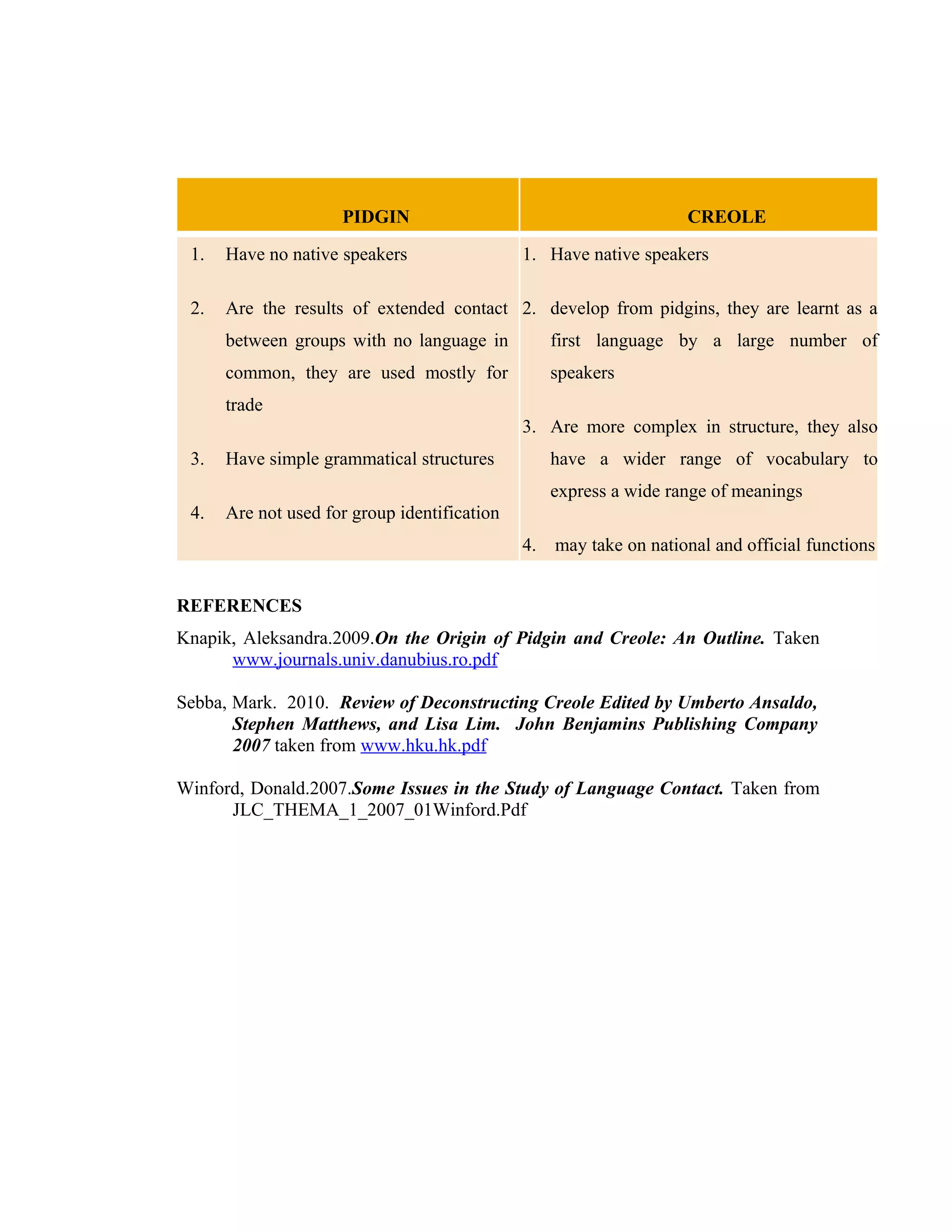
PIDGIN                                         CREOLE

 1.   Have no native speakers                 1. Have native speakers

 2.   Are the results of extended contact 2. develop from pidgins, they are learnt as a
      between groups with no language in           first language by a large number of
      common, they are used mostly for             speakers
      trade
                                              3. Are more complex in structure, they also
 3.   Have simple grammatical structures           have a wider range of vocabulary to
                                                   express a wide range of meanings
 4.   Are not used for group identification
                                              4.   may take on national and official functions


REFERENCES
Knapik, Aleksandra.2009.On the Origin of Pidgin and Creole: An Outline. Taken
      www.journals.univ.danubius.ro.pdf

Sebba, Mark. 2010. Review of Deconstructing Creole Edited by Umberto Ansaldo,
       Stephen Matthews, and Lisa Lim. John Benjamins Publishing Company
       2007 taken from www.hku.hk.pdf

Winford, Donald.2007.Some Issues in the Study of Language Contact. Taken from
      JLC_THEMA_1_2007_01Winford.Pdf

Pidgin and creole language

  • 1.
    PIDGIN AND CREOLELANGUAGE ABSTRACT One of some factors in sociolinguistics that makes language becomes interesting to be investigated is the contact of the people in certain community. The outcome of this contact result new languages, those are Pidgin and Creole language. These languages are spoken between people who do not speak each other’s language. When they meet for different aims (trade, plantation work, business) they immediately look for a quick means of communication. These two languages have their own characteristics that are able to be used to distinguish between them. A pidgin is a reduced language resulting from contact between groups with no common language, while a Creole is a pidgin or jargon that has become the native language of an entire speech community, often as a result of slavery or other population displacements. In, Keywords: language contact, Pidgin, Creole INTRODUCTION Primarily, Pidgins and creoles are used in third world nation, occurred in response to changes in the political and social environment of the community where they are spoken in. Today, over one hundred pidgins and creoles are spoken around the world. Actually, most pidgins and creoles are based on European languages, primarily on English, Spanish and French. Pidgin Pidgins often serve as the means of communication between two language groups. For example, they are often used between immigrants and locals or missionaries and natives in order to be understood by each other without having to learn the language of the other group. The language on which the majority of the lexicon is based is called the base (usually the European language). The language on which the grammatical structure is based is called the substrate. In a pidgin, gender and case as well as other elements of language are often dropped from the base European language. The phonology is
  • 2.
    extremely unstable andchanges often. Characteristics of a pidgin vary tremendously from speaker to speaker. Anything can be said in pidgin that can be said in any other language, but at a great disadvantage, because the pidgin language lacks the building blocks provided in other native languages for successful communication. For example, articles, prepositions, auxiliary verbs, and subordinate clauses are often absent or sporadic in pidgin. Pidgin sentences are often little more than strings of nouns, verbs and adjectives. Although the substance of the idea gets across, many of the details and contextual information gets lost in the pidgin version. From the introduction above, we can say that Pidgin is a new language which develops in situations where the speakers of different languages need to communicate but don’t share a common language. Pidgin has the following seven qualities: a. No native speakers – no one’s native language. Yet spoken by millions as means of communication b. A product of multilingual – 3 languages – one is dominant. The dominant language  superior (economical or social factor). Two languages involved  a power struggle for dominance c. Combined effort of speakers (different language)  contribute to a new variety  phonology, morphology and syntax) d. The dominant group –more vocabulary (lexifier –superstrate) while the less dominant languages –grammar (substrate) e. Reduced grammatical structure, limited vocabulary and a narrow range of functions –does not have inflections to mark plural.tenses, - does not contain any affixes f. Main function –trading g. Not used as a means of group identification
  • 3.
    The pidgin languagethat spoken by a certain people in a certain place or area, has it life span to be indicated: - Short –limited function - Exists for several years – rarely more than a century - Remains if the need exists For example In Vietnam: Pidgin French disappeared – French left; used for trading – disappear when trading between the group members comes to an end Here is the example of Pidgin: • Nigerian Pidgin in Nigeria • Bislama in Vanuatu • Tok Pisin in PNG • Chinese Pidgin English in China • Solomon Island pidgin English in Solomon Island Creole It is from Latin creare, meaning "to beget" or "create". The term was coined in the sixteenth century during the great expansion in European maritime power and trade and the establishment of European colonies in the Americas, Africa, and along the coast of South and Southeast Asia up to the Philippines, China, India, and in Oceania . Originally, therefore, "Creole language" meant the speech of those Creole peoples. A stable language that originates seemingly as a nativized pidgin. When children start learning a pidgin as their first language and it becomes the mother tongue of a community, it is called a Creole. Like a pidgin, a Creole is a distinct language which has taken most of its vocabulary from another language, the lexifier, but has its own unique grammatical rules. Presumably, between six and twelve million people still using pidgin languages and between ten and seventeen using descendents from pidgins. Unlike a
  • 4.
    pidgin, however, aCreole is not restricted in use, and is like any other language in its full range of functions. Creoles have certain grammatical similarities to each other and, arguably, not languages that they are derived from. Creoles exhibit more internal variability than other languages. Creoles are simpler than other languages. Creole languages have generally been regarded as degenerate, or at best as rudimentary dialects of one of their parent languages. "Creole" has come to be used in opposition to "language" rather than a qualifier for it, for example, Gullah, Jamaican Creole and Hawai`i Creole English. 'Pidgin' and 'Creole' are technical terms used by linguists, and not necessarily by speakers of the language. For example, speakers of Jamaican Creole call their language 'Patwa' (from patois) and speakers of Hawai’i Creole English call theirs 'Pidgin'. There are some Creole Languages around the words: • Aku in Gambia, • Krio in Siera Leone, • Kru Englsih in Liberia • Kamtok in Cameroon • Bajan in Barbados • Creolese in Guyana • Miskito Coast Creole in Nicaragua • Sranan in Surinam • Trinbagonia in Trinidad and Tobago • Bislama in Vanutu • Broken in Torres Straits • Hawaii Creole English in Hawaii Theories to describe Creole phenomenon: 1. The monogenetic theory of pidgins and creoles A single origin for these languages, deriving them through relexification from a West African Pidgin
  • 5.
    Portuguese of the17th century and ultimately from the Lingua franca of the Mediterranean. Originally formulated by Hugo Schuchardt in the late 19th century and popularized in the late 1950s and early 1960s by Douglas Taylor as well as in Whinnom (1956), Thompson (1961) and Stewart (1962). 2. European dialect origin hypotheses The French creoles are the foremost candidates to being the outcome of "normal" linguistic change creoleness to be sociohistoric in nature and relative to their colonial origin though. 3. The Domestic Origin Hypothesis Proposed by Hancock (1985) for the development of a local form of English in West Africa. Towards the end of the 16th century, English-speaking traders began to settle in the Gambia and Sierra Leone rivers as well as in neighboring areas such as the Bullom and Sherbro coasts. These settlers intermarried with the local population leading to mixed populations and as a result of this intermarriage, an English pidgin was created, which in turn was learned by slaves in slave depots, who later on took it to the West Indies and formed one component of the emerging English Creoles. 4. Foreigner talk or baby talk A pidgin or Creole language forms when native speakers attempt to simplify their language in order to address speakers who do not know their language at all. Because of the similarities found in this type of speech and the speech which is usually directed at children. One class of creoles might start as pidgins, rudimentary second languages improvised for use between speakers of two or more non-intelligible native languages. Keith Whinnom (in Hymes (1971)) suggests that pidgins need three languages to form, with one (the superstrate) being clearly dominant over the others. The lexicon of a pidgin is usually small and drawn from the vocabularies of its speakers, in varying proportions. Morphological details like word inflections, which usually take years to learn, are omitted; the syntax is kept very simple, usually based on strict word order. In this initial stage, all aspects of the speech — syntax, lexicon, and pronunciation —tend to be quite variable, especially with regard to the speaker's background. If a pidgin manages to be learned by the children of a community as a
  • 6.
    native language, itmay become fixed and acquire a more complex grammar, with fixed phonology, syntax, morphology, and syntactic embedding. Pidgins can become full languages in only a single generation. "Creolization" is this second stage where the pidgin language develops into a fully developed native language. The vocabulary, too, will contain more and more words according to a rational and stable system. Universalist models stress the intervention of specific general processes during the transmission of language from generation to generation and from speaker to speaker. The process invoked varies: a general tendency towards semantic transparency, first language learning driven by universal process, or general process of discourse organization. Creoles are inventions of the children growing up on newly founded plantations. Around them, they only heard pidgins spoken, without enough structure to function as natural languages. The children used their own innate linguistic capacities to transform the pidgin input into a full-fledged language. CONCLUSION Those languages, Pidgin and Creole, are often considered simplified languages uncounciously born from a practical situation of interlinguistis communication. They have their own characteristics that make them to be unique to be investigated and learnt. By comparing them, we will perhaps finds some information that useful for language development.
  • 7.
    PIDGIN CREOLE 1. Have no native speakers 1. Have native speakers 2. Are the results of extended contact 2. develop from pidgins, they are learnt as a between groups with no language in first language by a large number of common, they are used mostly for speakers trade 3. Are more complex in structure, they also 3. Have simple grammatical structures have a wider range of vocabulary to express a wide range of meanings 4. Are not used for group identification 4. may take on national and official functions REFERENCES Knapik, Aleksandra.2009.On the Origin of Pidgin and Creole: An Outline. Taken www.journals.univ.danubius.ro.pdf Sebba, Mark. 2010. Review of Deconstructing Creole Edited by Umberto Ansaldo, Stephen Matthews, and Lisa Lim. John Benjamins Publishing Company 2007 taken from www.hku.hk.pdf Winford, Donald.2007.Some Issues in the Study of Language Contact. Taken from JLC_THEMA_1_2007_01Winford.Pdf