LANGUAGE AND
REGIONAL
VARIATION
FROM THE STUDY OF LANGUAGE –George Yule
By Vennila Ramanathan
Copyright Š 2020 careertochoose.com Vennila Ramanathan,. All rights reserved
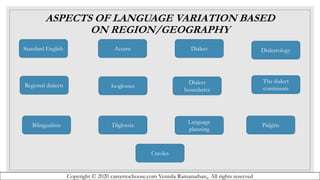
ASPECTS OF LANGUAGE VARIATION BASED
ON REGION/GEOGRAPHY
AccentStandard English
Isoglosses
Bilingualism
Regional dialects
Creoles
Language
planning
Dialect
boundaries
Dialect
Pidgins
The dialect
continuum
Dialectology
Diglossia
Copyright Š 2020 careertochoose.com Vennila Ramanathan,. All rights reserved
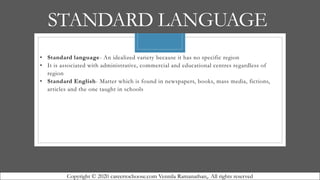
STANDARD LANGUAGE
• Standard language- An idealized variety because it has no specific region
• It is associated with administrative, commercial and educational centres regardless of
region
• Standard English- Matter which is found in newspapers, books, mass media, fictions,
articles and the one taught in schools
Copyright Š 2020 careertochoose.com Vennila Ramanathan,. All rights reserved
ACCENT
• Every language user speaks with an accent
• Accent refers to the description of aspects of pronunciation where an individual
speaker is from, regionally or socially
Copyright Š 2020 careertochoose.com Vennila Ramanathan,. All rights reserved
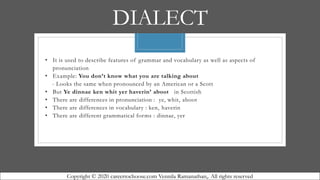
DIALECT
• It is used to describe features of grammar and vocabulary as well as aspects of
pronunciation
• Example: You don’t know what you are talking about
- Looks the same when pronounced by an American or a Scott
• But Ye dinnae ken whit yer haverin’ aboot in Scottish
• There are differences in pronunciation : ye, whit, aboot
• There are differences in vocabulary : ken, haverin
• There are different grammatical forms : dinnae, yer
Copyright Š 2020 careertochoose.com Vennila Ramanathan,. All rights reserved
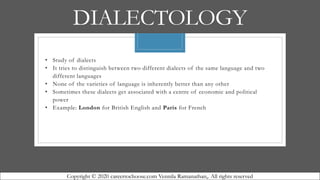
DIALECTOLOGY
• Study of dialects
• It tries to distinguish between two different dialects of the same language and two
different languages
• None of the varieties of language is inherently better than any other
• Sometimes these dialects get associated with a centre of economic and political
power
• Example: London for British English and Paris for French
Copyright Š 2020 careertochoose.com Vennila Ramanathan,. All rights reserved
REGIONAL DIALECTS
• The existence of different dialects is widely recognised and often become the source
of humour for those living in different regions
• Example – Tree guy in Brooklyn maybe humorous to Southerners since they have
heard Brooklyn speakers refer to doze tree guys.
Copyright Š 2020 careertochoose.com Vennila Ramanathan,. All rights reserved
ISOGLOSSES
• There are significant differences in the speech of those living in different areas
• Example - In one area people may say they carry things home from the store in a
paper bag
• In another area they say Paper Sac
• This difference helps to draw a line across a map separating two areas- This line is
called as Isogloss and it represents a boundary linguistic item between the areas with
regard to that one particular
• Example – Pail in the North and bucket in the South, the other isoglosses can be
drawn on the map
Copyright Š 2020 careertochoose.com Vennila Ramanathan,. All rights reserved
DIALECT BOUNDARIES
• The broken line in the map in between the two areas is an Isogloss
• If an American English (male) speaker pronounces the word greasy as [Grizy] and
asks for a bucket
to carry water, then he is not
likely to have grown up and
spent most of his life in
Minnesota
Source image from George Yule
Copyright Š 2020 careertochoose.com Vennila Ramanathan,. All rights reserved
THE DIALECT CONTINUUM
• The drawing of dialect boundaries is quite useful in establishing a broad view of regional
dialects, but it tends to obscure the fact that, in the boundary areas, one dialect or
language variety merges into another
• Regional variation actually exists along a dialect continuum rather than having sharp
brakes from one region to the next
• It occurs on the side of a political border
• Example – As you travel from Netherlands to Germany, concentrations of Dutch speakers
may sound more like Deutsch because the Dutch dialects and the German dialects are less
clearly differentiated
• In border regions speakers maybe bidialectal
• In some places, people who know both languages are described as bilingual
Copyright Š 2020 careertochoose.com Vennila Ramanathan,. All rights reserved
BILINGUALISM
• Regional variation is not only a matter of two or more dialects of a single language
but can involve two or more distinct and different languages
• Example – Canada is a bilingual country with both French and English as official
languages
• In some cases French speaking people can be a minority group but they learn another
language in order to take part in a larger dominant linguistic community
Copyright Š 2020 careertochoose.com Vennila Ramanathan,. All rights reserved
DIGLOSSIA
• A special situation involving two distinct varieties of a language is called Diglossia
• In Diglossia, a low variety is acquired locally and a high variety is learned in schools
• In Arab speaking countries, a high variety is used for formal lectures, political and
religious discussions
Copyright Š 2020 careertochoose.com Vennila Ramanathan,. All rights reserved
LANGUAGE PLANNING
• Some countries are mono-lingual- example. USA
• Some other countries are bilingual or multi-lingual
• So there has to be a language planning
Example -In Israel Hebrew was chosen as the official government language
In India the choice was Hindi
In East Africa Swahili is the official language in Tanzania
• The process of ‘Selection’ ( choosing an official language)is followed by ‘Codification’ in which
basic grammar, dictionaries or written models are used to establish the standard variety
• The process of ‘Elaboration’ follows with the standard variety
• The process of ‘Implementation’ refers to the government’s attempts to encourage the use of the
standard and ‘acceptance’ is the final stage when the majority of the population starts using it as
their National language
Copyright Š 2020 careertochoose.com Vennila Ramanathan,. All rights reserved
PIDGINS
• In some areas the standard chosen language may be a variety that originally had no native
speakers in the country
• Example – In Papua New Guinea, more than 800 languages are spoken but official
business is conducted in Tok Pisin
• This language is now used by over a million people, but it began many years ago as a kind
of impromptu language called a Pidgin
• Pidgin is also often considered as a contact language(used for trading)
• If the main source of words in the Pidgin is English, it is called English Pidgin
• Example – The word gras- origin in the English word grass
In Tok Pisin, it came to be used for hair
Copyright Š 2020 careertochoose.com Vennila Ramanathan,. All rights reserved
PIDGINS
• Pidgins are characterized by an absence of any complex grammatical morphology and a
somewhat limited vocabulary
• Sometimes suffix like –s is rare in English Pidgins
• Example – tu buk for (two books) (plural)
di gyal place ( the girl’s place) (possessive)
• The –ed suffix of standard English is missing in Pidgins
• Example – Items for sale appear as ‘smoke meat’ / ‘pickle mango’
• The syntax of Pidgins can be quite unlike the languages from which terms were borrowed
and modified
• Example – Baimbai yu go – by & by you go
hed – head
bilongyu – belong you
Copyright Š 2020 careertochoose.com Vennila Ramanathan,. All rights reserved
CREOLES
• There are 6 to 12 million people using Pidgin language
• Between 10 and 17 million are using descendants from Pidgins called Creoles
• Beyond being a trade or contact language, when a Pidgin becomes the first language
of a social community, it is described as a Creole
• Example – Tok Pisin is a Creole now
• A Creole develops as the first language of children growing up in a Pidgin using
community and becomes more complex
as it serves more communicative purposes
• Creoles have large numbers of native speakers
Copyright Š 2020 careertochoose.com Vennila Ramanathan,. All rights reserved
CREOLIZATION
• The development of a Pidgin into a Creole is known as creolization
• There is now a retreat from the use of the Creole by those who are familiar with the
standard variety of the language. This process is known decreolization
• Post-creole continuum- The existence of different varieties between a basic variety with
more local creole features and a standard variety
• Example – In Jamaica, one speaker may say “a fi mi buk dat”
Another speaker may say “iz mi buk”
Another speaker may say “it’s my book with’ a creole accent
• These differences are naturally connected to social values and social identity
Copyright Š 2020 careertochoose.com Vennila Ramanathan,. All rights reserved

Language and Regional Variation

  • 1.
    LANGUAGE AND REGIONAL VARIATION FROM THESTUDY OF LANGUAGE –George Yule By Vennila Ramanathan Copyright © 2020 careertochoose.com Vennila Ramanathan,. All rights reserved
  • 2.
    ASPECTS OF LANGUAGEVARIATION BASED ON REGION/GEOGRAPHY AccentStandard English Isoglosses Bilingualism Regional dialects Creoles Language planning Dialect boundaries Dialect Pidgins The dialect continuum Dialectology Diglossia Copyright Š 2020 careertochoose.com Vennila Ramanathan,. All rights reserved
  • 3.
    STANDARD LANGUAGE • Standardlanguage- An idealized variety because it has no specific region • It is associated with administrative, commercial and educational centres regardless of region • Standard English- Matter which is found in newspapers, books, mass media, fictions, articles and the one taught in schools Copyright © 2020 careertochoose.com Vennila Ramanathan,. All rights reserved
  • 4.
    ACCENT • Every languageuser speaks with an accent • Accent refers to the description of aspects of pronunciation where an individual speaker is from, regionally or socially Copyright © 2020 careertochoose.com Vennila Ramanathan,. All rights reserved
  • 5.
    DIALECT • It isused to describe features of grammar and vocabulary as well as aspects of pronunciation • Example: You don’t know what you are talking about - Looks the same when pronounced by an American or a Scott • But Ye dinnae ken whit yer haverin’ aboot in Scottish • There are differences in pronunciation : ye, whit, aboot • There are differences in vocabulary : ken, haverin • There are different grammatical forms : dinnae, yer Copyright © 2020 careertochoose.com Vennila Ramanathan,. All rights reserved
  • 6.
    DIALECTOLOGY • Study ofdialects • It tries to distinguish between two different dialects of the same language and two different languages • None of the varieties of language is inherently better than any other • Sometimes these dialects get associated with a centre of economic and political power • Example: London for British English and Paris for French Copyright © 2020 careertochoose.com Vennila Ramanathan,. All rights reserved
  • 7.
    REGIONAL DIALECTS • Theexistence of different dialects is widely recognised and often become the source of humour for those living in different regions • Example – Tree guy in Brooklyn maybe humorous to Southerners since they have heard Brooklyn speakers refer to doze tree guys. Copyright © 2020 careertochoose.com Vennila Ramanathan,. All rights reserved
  • 8.
    ISOGLOSSES • There aresignificant differences in the speech of those living in different areas • Example - In one area people may say they carry things home from the store in a paper bag • In another area they say Paper Sac • This difference helps to draw a line across a map separating two areas- This line is called as Isogloss and it represents a boundary linguistic item between the areas with regard to that one particular • Example – Pail in the North and bucket in the South, the other isoglosses can be drawn on the map Copyright © 2020 careertochoose.com Vennila Ramanathan,. All rights reserved
  • 9.
    DIALECT BOUNDARIES • Thebroken line in the map in between the two areas is an Isogloss • If an American English (male) speaker pronounces the word greasy as [Grizy] and asks for a bucket to carry water, then he is not likely to have grown up and spent most of his life in Minnesota Source image from George Yule Copyright © 2020 careertochoose.com Vennila Ramanathan,. All rights reserved
  • 10.
    THE DIALECT CONTINUUM •The drawing of dialect boundaries is quite useful in establishing a broad view of regional dialects, but it tends to obscure the fact that, in the boundary areas, one dialect or language variety merges into another • Regional variation actually exists along a dialect continuum rather than having sharp brakes from one region to the next • It occurs on the side of a political border • Example – As you travel from Netherlands to Germany, concentrations of Dutch speakers may sound more like Deutsch because the Dutch dialects and the German dialects are less clearly differentiated • In border regions speakers maybe bidialectal • In some places, people who know both languages are described as bilingual Copyright © 2020 careertochoose.com Vennila Ramanathan,. All rights reserved
  • 11.
    BILINGUALISM • Regional variationis not only a matter of two or more dialects of a single language but can involve two or more distinct and different languages • Example – Canada is a bilingual country with both French and English as official languages • In some cases French speaking people can be a minority group but they learn another language in order to take part in a larger dominant linguistic community Copyright © 2020 careertochoose.com Vennila Ramanathan,. All rights reserved
  • 12.
    DIGLOSSIA • A specialsituation involving two distinct varieties of a language is called Diglossia • In Diglossia, a low variety is acquired locally and a high variety is learned in schools • In Arab speaking countries, a high variety is used for formal lectures, political and religious discussions Copyright © 2020 careertochoose.com Vennila Ramanathan,. All rights reserved
  • 13.
    LANGUAGE PLANNING • Somecountries are mono-lingual- example. USA • Some other countries are bilingual or multi-lingual • So there has to be a language planning Example -In Israel Hebrew was chosen as the official government language In India the choice was Hindi In East Africa Swahili is the official language in Tanzania • The process of ‘Selection’ ( choosing an official language)is followed by ‘Codification’ in which basic grammar, dictionaries or written models are used to establish the standard variety • The process of ‘Elaboration’ follows with the standard variety • The process of ‘Implementation’ refers to the government’s attempts to encourage the use of the standard and ‘acceptance’ is the final stage when the majority of the population starts using it as their National language Copyright © 2020 careertochoose.com Vennila Ramanathan,. All rights reserved
  • 14.
    PIDGINS • In someareas the standard chosen language may be a variety that originally had no native speakers in the country • Example – In Papua New Guinea, more than 800 languages are spoken but official business is conducted in Tok Pisin • This language is now used by over a million people, but it began many years ago as a kind of impromptu language called a Pidgin • Pidgin is also often considered as a contact language(used for trading) • If the main source of words in the Pidgin is English, it is called English Pidgin • Example – The word gras- origin in the English word grass In Tok Pisin, it came to be used for hair Copyright © 2020 careertochoose.com Vennila Ramanathan,. All rights reserved
  • 15.
    PIDGINS • Pidgins arecharacterized by an absence of any complex grammatical morphology and a somewhat limited vocabulary • Sometimes suffix like –s is rare in English Pidgins • Example – tu buk for (two books) (plural) di gyal place ( the girl’s place) (possessive) • The –ed suffix of standard English is missing in Pidgins • Example – Items for sale appear as ‘smoke meat’ / ‘pickle mango’ • The syntax of Pidgins can be quite unlike the languages from which terms were borrowed and modified • Example – Baimbai yu go – by & by you go hed – head bilongyu – belong you Copyright © 2020 careertochoose.com Vennila Ramanathan,. All rights reserved
  • 16.
    CREOLES • There are6 to 12 million people using Pidgin language • Between 10 and 17 million are using descendants from Pidgins called Creoles • Beyond being a trade or contact language, when a Pidgin becomes the first language of a social community, it is described as a Creole • Example – Tok Pisin is a Creole now • A Creole develops as the first language of children growing up in a Pidgin using community and becomes more complex as it serves more communicative purposes • Creoles have large numbers of native speakers Copyright © 2020 careertochoose.com Vennila Ramanathan,. All rights reserved
  • 17.
    CREOLIZATION • The developmentof a Pidgin into a Creole is known as creolization • There is now a retreat from the use of the Creole by those who are familiar with the standard variety of the language. This process is known decreolization • Post-creole continuum- The existence of different varieties between a basic variety with more local creole features and a standard variety • Example – In Jamaica, one speaker may say “a fi mi buk dat” Another speaker may say “iz mi buk” Another speaker may say “it’s my book with’ a creole accent • These differences are naturally connected to social values and social identity Copyright © 2020 careertochoose.com Vennila Ramanathan,. All rights reserved