PSYCHOLINGUISTICS
P R O F . R . R . B O R S E ,
E N G . D E P T . ,
B . P . A R T S , S . M . A . S C I . , K . K . C . C O M M . C O L L E G E ,
C H A L I S G A O N
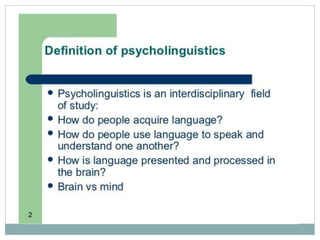
The field is concerned with psychological and
neurobiological factors that enable humans to
acquire, use, comprehend and produce language.
The discipline is mainly concerned with the
mechanisms in which languages are processed
and represented in the brain
Language
•It’s an integral part of our waking lives.
So…..
–Can you imagine your life without language?
•Most of us take language (and its use) for granted as…
–effortless, automatic, yet so accurate (most of the time)
–unconscious(you’re seldom aware of your language use)
•Think for a moment:-
–how you listen to and make sense of my speech,
–how you create meaning to ask questions,
–how you decipher printed words on these slides,
–how you manage to write down notes (using language)
What is psycholinguistics?
“Psycholinguistics [or the psychology of
language] explores the relationship
between
the human mind and language”
(Field, 2003: 2)
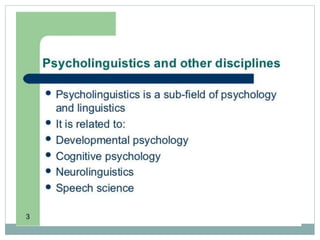
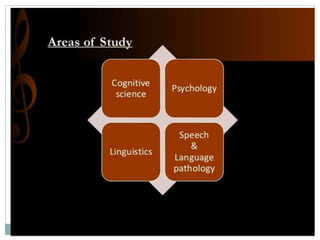
* Psycholinguistics is an interdisciplinary
field.
• It is studied by researchers from a variety of
different backgrounds, such as psychology,
cognitive science,
• linguistics,
• speech and
• language pathology, and
• discourse analysis.
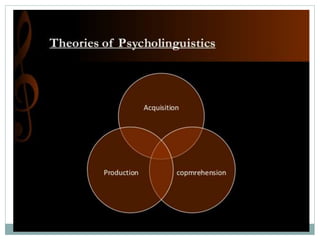
Psycholinguistics Studies…
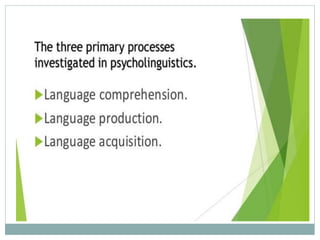
(1)how do children acquire language (language
acquisition)?;
(2) how do people process and comprehend
language (language comprehension)?;
(3) how do people produce language (language
production)?; and
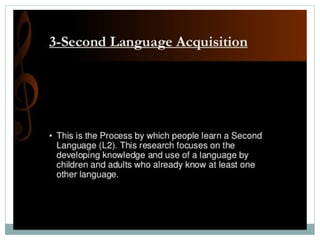
(4) how do people acquire a new language (second
language acquisition)?
This scientific discipline focuses on–the
individual language user,–patterns of
linguistic behaviors across language users,–
the psychological processes underlying
language,–language as a window into the
human mind.
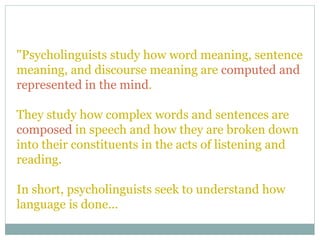
"Psycholinguists study how word meaning, sentence
meaning, and discourse meaning are computed and
represented in the mind.
They study how complex words and sentences are
composed in speech and how they are broken down
into their constituents in the acts of listening and
reading.
In short, psycholinguists seek to understand how
language is done...
“An account of language processing
also requires that we understand
how these linguistic concepts
interact with other aspects of
human processing to enable
language production and
comprehension."
An Interdisciplinary Field
"Psycholinguistics... draws on ideas and
knowledge from a number of associated
areas, such as …
phonetics,
semantics, and
pure linguistics.
There is a constant exchange of
information between
psycholinguists and those working
in neurolinguistics,
who study how language is
represented in the brain.
Psycholinguistics has a close links
with studies in artificial intelligence.
AI goals of designing computer
programs that can turn speech into
writing and programs that can
recognize the human voice
It Studies of brain as it correlates of
psycholinguistic processes can complement
behavioral results, and in some cases...can
lead to direct information about the basis of
psycholinguistic processes
Psycholinguistics involves:
1) language processing – reading, writing, speaking, listening
and memory . For instance, how words on paper are turned
into meaning in the mind.
2) lexical storage and retrieval – the way words are stored in
our minds and used. How we are able to map words onto
objects such as ‘ball’ and actions such as ‘kick’ and ‘love’ and
access these when needed.
3)language acquisition – how language is first learnt and
used by children. For example, learning the rules of grammar
and how to communicate with other people.
4) special circumstances – how internal and external factors can impact
language development, such as twins and their use of ‘twin language’,
the influence of hearing and vision impairments on acquisition, and
how damage to the brain can affect certain aspects of language.
5)the brain and language – evolutionary explanations of why humans
have the capacity to use language, and the parts of the brain concerned
with different areas of language, also considering whether or not non-
human animals have the ability to use language too.
6) second language acquisition and use – looking at bilingualism and
how individuals can learn a second language and are able to
differentiate between them.
The common aim of psycholinguistics is …
“to find out about the structures and processes which underlie a human’s
ability to speak and understand language”
The research within the psycholinguistics field can be broken
down into specific topics:-
1) Phonetics or Phonology:- study of speech sounds.
2) Morphology, the study of word structure and relationships
between words.
3)Syntax:-study of word patterns and how they build
sentences.
4)Semantics:-the study of the actual meanings of words and
sentences
5)Pragmatics:- the study of the context or interpretation of
meaning.
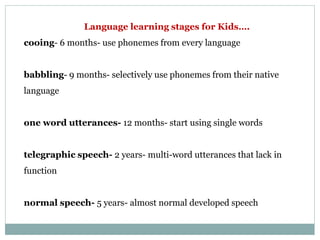
Language learning stages for Kids….
cooing- 6 months- use phonemes from every language
babbling- 9 months- selectively use phonemes from their native
language
one word utterances- 12 months- start using single words
telegraphic speech- 2 years- multi-word utterances that lack in
function
normal speech- 5 years- almost normal developed speech
But…
Language acquisition is a complex and unique
human quality for which there is still no theory that
is able to completely explain how language is
attained.
Psycholinguistics

Psycholinguistics

  • 1.
    PSYCHOLINGUISTICS P R OF . R . R . B O R S E , E N G . D E P T . , B . P . A R T S , S . M . A . S C I . , K . K . C . C O M M . C O L L E G E , C H A L I S G A O N
  • 3.
    The field isconcerned with psychological and neurobiological factors that enable humans to acquire, use, comprehend and produce language. The discipline is mainly concerned with the mechanisms in which languages are processed and represented in the brain
  • 4.
    Language •It’s an integralpart of our waking lives. So….. –Can you imagine your life without language? •Most of us take language (and its use) for granted as… –effortless, automatic, yet so accurate (most of the time) –unconscious(you’re seldom aware of your language use) •Think for a moment:- –how you listen to and make sense of my speech, –how you create meaning to ask questions, –how you decipher printed words on these slides, –how you manage to write down notes (using language)
  • 5.
    What is psycholinguistics? “Psycholinguistics[or the psychology of language] explores the relationship between the human mind and language” (Field, 2003: 2)
  • 6.
    * Psycholinguistics isan interdisciplinary field. • It is studied by researchers from a variety of different backgrounds, such as psychology, cognitive science, • linguistics, • speech and • language pathology, and • discourse analysis.
  • 7.
    Psycholinguistics Studies… (1)how dochildren acquire language (language acquisition)?; (2) how do people process and comprehend language (language comprehension)?; (3) how do people produce language (language production)?; and (4) how do people acquire a new language (second language acquisition)?
  • 8.
    This scientific disciplinefocuses on–the individual language user,–patterns of linguistic behaviors across language users,– the psychological processes underlying language,–language as a window into the human mind.
  • 34.
    "Psycholinguists study howword meaning, sentence meaning, and discourse meaning are computed and represented in the mind. They study how complex words and sentences are composed in speech and how they are broken down into their constituents in the acts of listening and reading. In short, psycholinguists seek to understand how language is done...
  • 35.
    “An account oflanguage processing also requires that we understand how these linguistic concepts interact with other aspects of human processing to enable language production and comprehension."
  • 36.
    An Interdisciplinary Field "Psycholinguistics...draws on ideas and knowledge from a number of associated areas, such as … phonetics, semantics, and pure linguistics.
  • 37.
    There is aconstant exchange of information between psycholinguists and those working in neurolinguistics, who study how language is represented in the brain.
  • 38.
    Psycholinguistics has aclose links with studies in artificial intelligence. AI goals of designing computer programs that can turn speech into writing and programs that can recognize the human voice
  • 39.
    It Studies ofbrain as it correlates of psycholinguistic processes can complement behavioral results, and in some cases...can lead to direct information about the basis of psycholinguistic processes
  • 40.
    Psycholinguistics involves: 1) languageprocessing – reading, writing, speaking, listening and memory . For instance, how words on paper are turned into meaning in the mind. 2) lexical storage and retrieval – the way words are stored in our minds and used. How we are able to map words onto objects such as ‘ball’ and actions such as ‘kick’ and ‘love’ and access these when needed. 3)language acquisition – how language is first learnt and used by children. For example, learning the rules of grammar and how to communicate with other people.
  • 41.
    4) special circumstances– how internal and external factors can impact language development, such as twins and their use of ‘twin language’, the influence of hearing and vision impairments on acquisition, and how damage to the brain can affect certain aspects of language. 5)the brain and language – evolutionary explanations of why humans have the capacity to use language, and the parts of the brain concerned with different areas of language, also considering whether or not non- human animals have the ability to use language too. 6) second language acquisition and use – looking at bilingualism and how individuals can learn a second language and are able to differentiate between them. The common aim of psycholinguistics is … “to find out about the structures and processes which underlie a human’s ability to speak and understand language”
  • 42.
    The research withinthe psycholinguistics field can be broken down into specific topics:- 1) Phonetics or Phonology:- study of speech sounds. 2) Morphology, the study of word structure and relationships between words. 3)Syntax:-study of word patterns and how they build sentences. 4)Semantics:-the study of the actual meanings of words and sentences 5)Pragmatics:- the study of the context or interpretation of meaning.
  • 44.
    Language learning stagesfor Kids…. cooing- 6 months- use phonemes from every language babbling- 9 months- selectively use phonemes from their native language one word utterances- 12 months- start using single words telegraphic speech- 2 years- multi-word utterances that lack in function normal speech- 5 years- almost normal developed speech
  • 45.
    But… Language acquisition isa complex and unique human quality for which there is still no theory that is able to completely explain how language is attained.