ICE401: PROCESS INSTRUMENTATION
AND CONTROL
Class 35
Advanced Control Strategies – Ratio
Control, Split Range Control
Dr. S. Meenatchisundaram
Email: meenasundar@gmail.com
Process Instrumentation and Control (ICE 401)
Dr. S.Meenatchisundaram, MIT, Manipal, Aug – Nov 2015
Ratio Control:
Process Instrumentation and Control (ICE 401)
Dr. S.Meenatchisundaram, MIT, Manipal, Aug – Nov 2015
• An important control problem in the chemical industry is the
combining of two or more streams to provide a mixture having a
desired ratio of components.
• Examples of this mixing operation include the blending of
reactants entering a chemical reactor or for the injection of a
fuel/air mixture into a furnace.
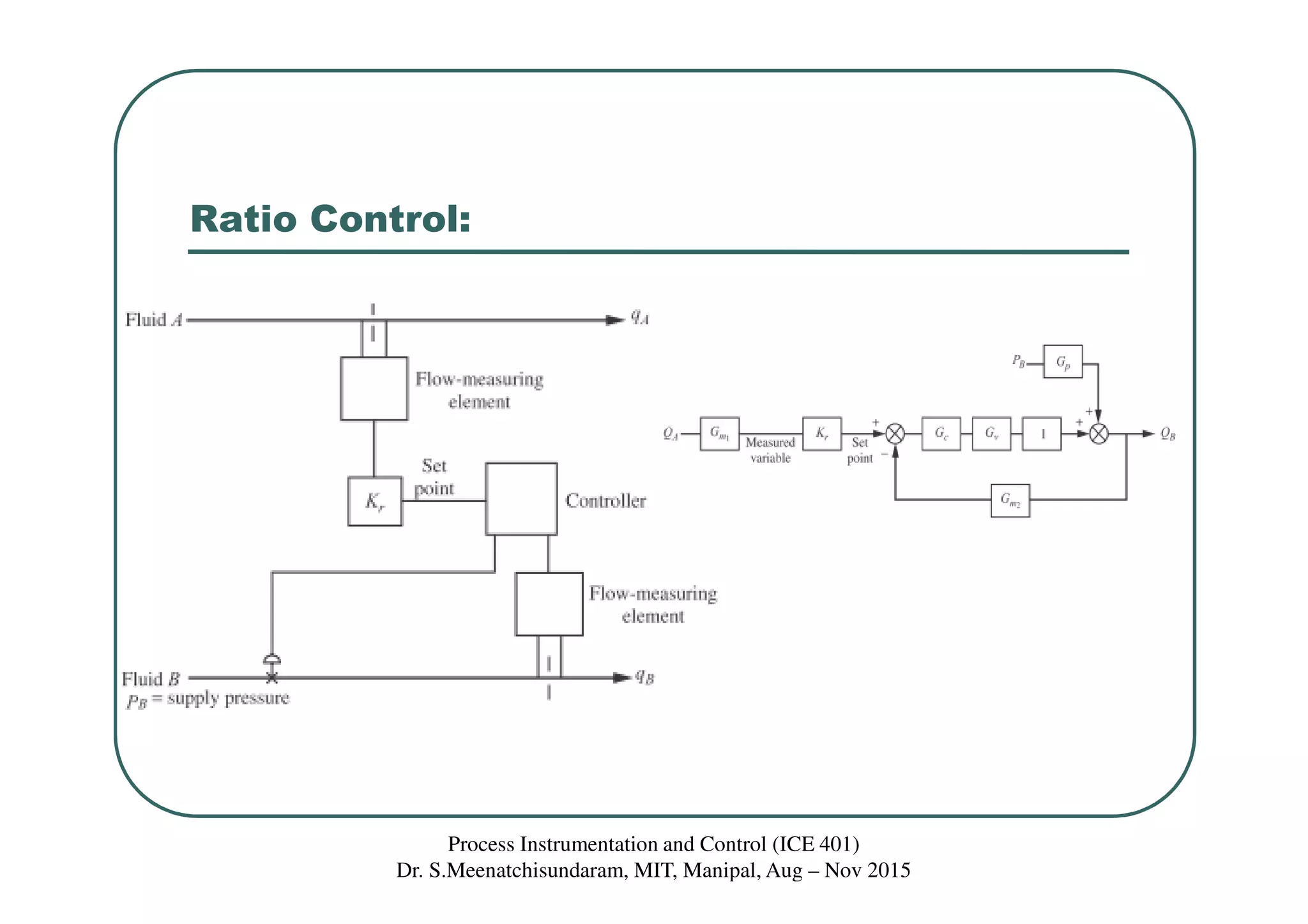
• Figure shows an example of a ratio control system. It depicts a
control system for blending two liquid streams A and B to
produce a mixed stream having the ratio Kr in units of mass B /
mass A.
• Stream A, which is uncontrolled, is used to adjust the flow of
stream B so that the desired ratio is maintained.
Ratio Control:
Process Instrumentation and Control (ICE 401)
Dr. S.Meenatchisundaram, MIT, Manipal, Aug – Nov 2015
• The measured signal for stream A is multiplied by the desired
ratio Kr to provide a signal that is the set point for the flow
control loop for stream B.
• The parameter Kr can be adjusted to the desired value.
• Control hardware is available to perform the multiplication of two
control signals.
Ratio Control:
Process Instrumentation and Control (ICE 401)
Dr. S.Meenatchisundaram, MIT, Manipal, Aug – Nov 2015
Ratio Control:
Process Instrumentation and Control (ICE 401)
Dr. S.Meenatchisundaram, MIT, Manipal, Aug – Nov 2015
• In a flow control loop, the dynamic elements consist of the
controller, the flow-measuring element, and the control valve.
• For incompressible fluids, there is no lag between the change in
valve position and the corresponding flow rate.
• For this reason, the transfer function between the valve and the
measurement of flow rate is simply unity.
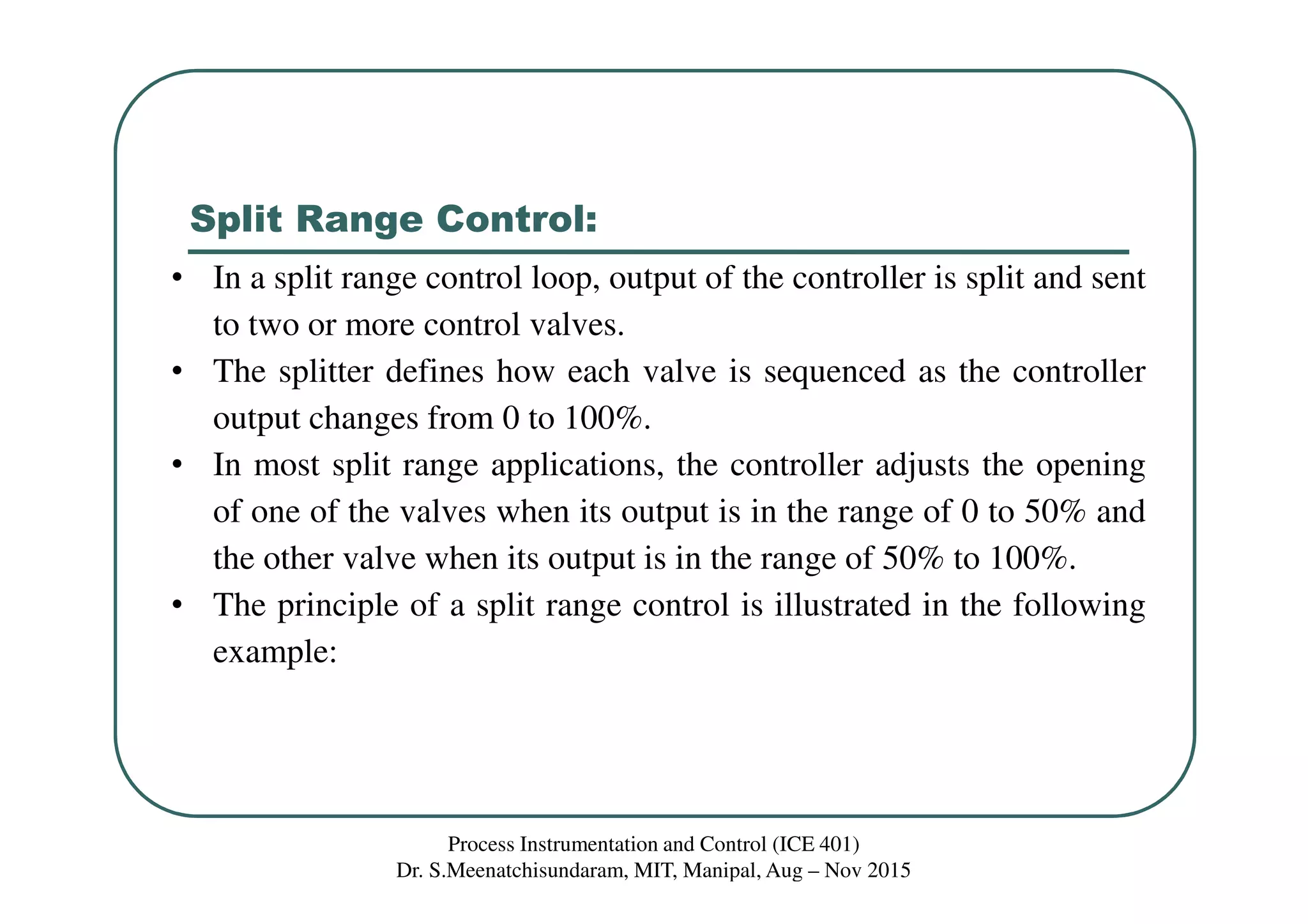
• The block diagram also shows a transfer function Gp that relates
the flow rate of B to the supply pressure of B.
• A transfer function Gm1 is also shown that represents the
dynamic lag of the flow measuring element for stream A.
• From the block diagram, the flow of B may be written as
Ratio Control:
Process Instrumentation and Control (ICE 401)
Dr. S.Meenatchisundaram, MIT, Manipal, Aug – Nov 2015
• The control action for a flow control system is usually PI.
• The integral action is needed to eliminate offset and thereby
establish a precise ratio of the mixed streams of A and B.
• Derivative action is usually avoided in flow control because the
signal from a flow measuring element is inherently noisy.
• The presence of derivative action would amplify the noise and
give poor control.
1
2 21 1
pm r c v
B A B
c v m c v m
GG K G G
Q Q P
G G G G G G
= +
+ +
Split Range Control:
Process Instrumentation and Control (ICE 401)
Dr. S.Meenatchisundaram, MIT, Manipal, Aug – Nov 2015
• In a split range control loop, output of the controller is split and sent
to two or more control valves.
• The splitter defines how each valve is sequenced as the controller
output changes from 0 to 100%.
• In most split range applications, the controller adjusts the opening
of one of the valves when its output is in the range of 0 to 50% and
the other valve when its output is in the range of 50% to 100%.
• The principle of a split range control is illustrated in the following
example:
Split Range Control:
Process Instrumentation and Control (ICE 401)
Dr. S.Meenatchisundaram, MIT, Manipal, Aug – Nov 2015
Split Range Control:
Process Instrumentation and Control (ICE 401)
Dr. S.Meenatchisundaram, MIT, Manipal, Aug – Nov 2015
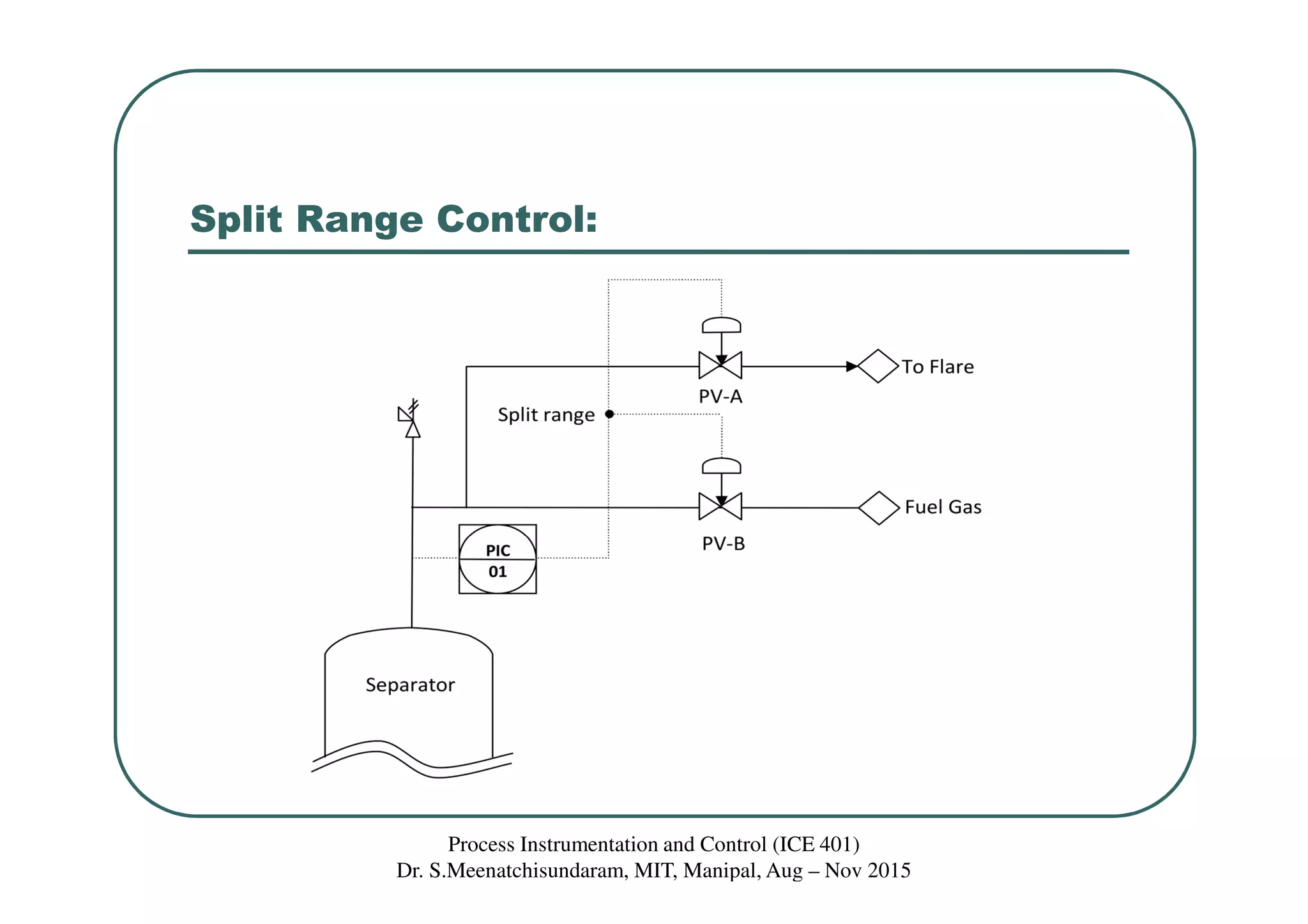
• In figure, PIC-01 controls the pressure of the separator for liquid
vapour hydrocarbons, by mean of a split range controller with the
output signal split and sent to two pressure control valves PV-A and
PV-B.
• When pressure increases, the fluid shall be discharged to flare.
When the pressure decreases, Fuel gas is introduced to compensate
the pressure of the separator.
• The fuel gas valve (PV-B) needs to close in response to increasing
of pressure of the separator, while the flare valve (PV-A) will need
to open when the pressure increases beyond setpoint.
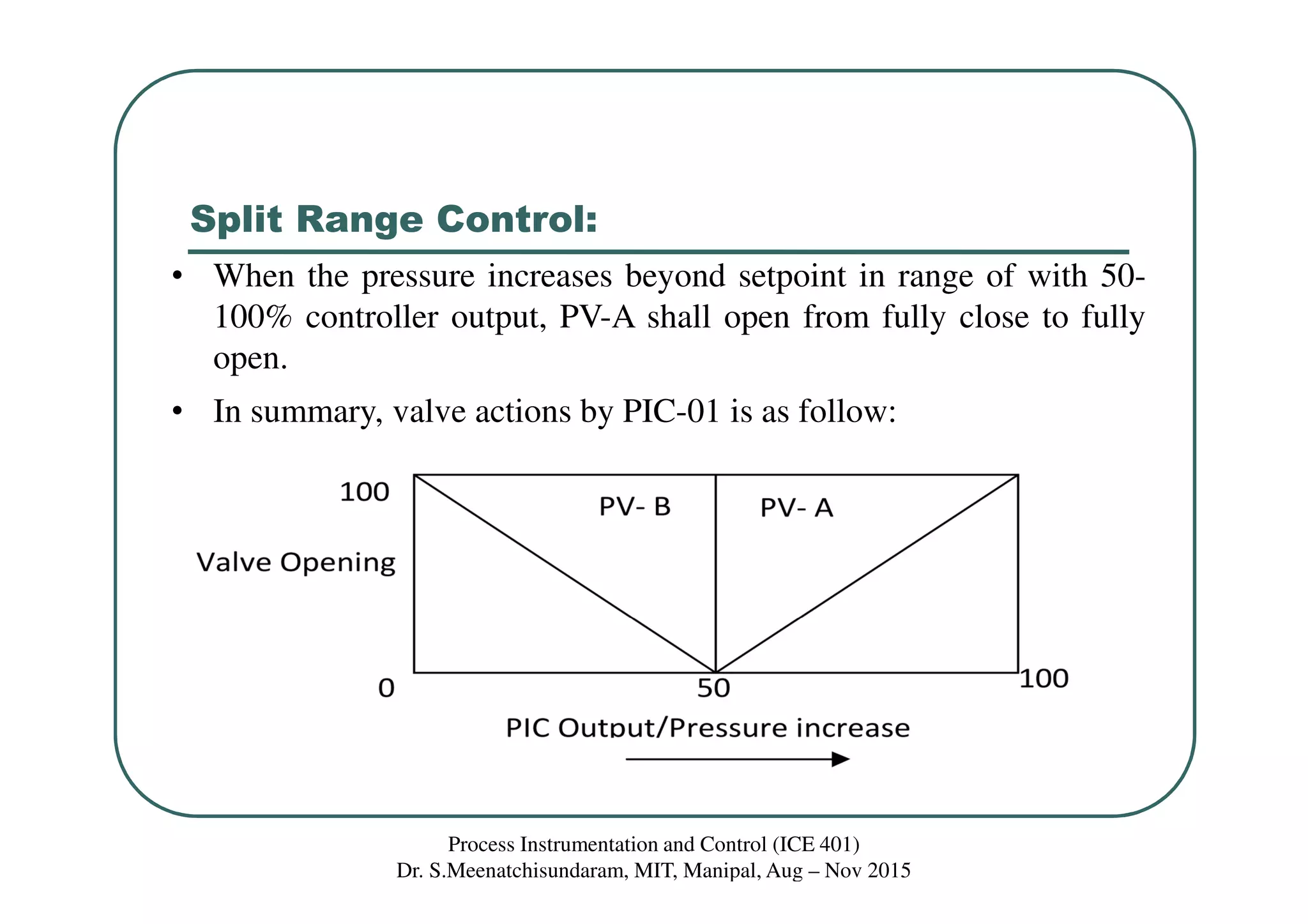
• When the pressure increases beyond setpoint in range of with 0-
50% controller output, PV-B shall close from fully open to fully
close.
Split Range Control:
Process Instrumentation and Control (ICE 401)
Dr. S.Meenatchisundaram, MIT, Manipal, Aug – Nov 2015
• When the pressure increases beyond setpoint in range of with 50-
100% controller output, PV-A shall open from fully close to fully
open.
• In summary, valve actions by PIC-01 is as follow:
Split Range Control:
Process Instrumentation and Control (ICE 401)
Dr. S.Meenatchisundaram, MIT, Manipal, Aug – Nov 2015
• In this case, the service of both control valves is different, with
respect to use of fuel gas and flaring for pressure control.
• Another case of use of split range control loop is when one control
valve cannot be suitably designed to cover the complete operating
range of the controller.
• In that case, valve with a smaller Cv operated between 0-50% range
and the other operates for 50-100% range.
• For example, a pressure controller for accumulator drum in
overhead of a stabilizer column splits range to open 2 control
valves.
Split Range Control:
Process Instrumentation and Control (ICE 401)
Dr. S.Meenatchisundaram, MIT, Manipal, Aug – Nov 2015
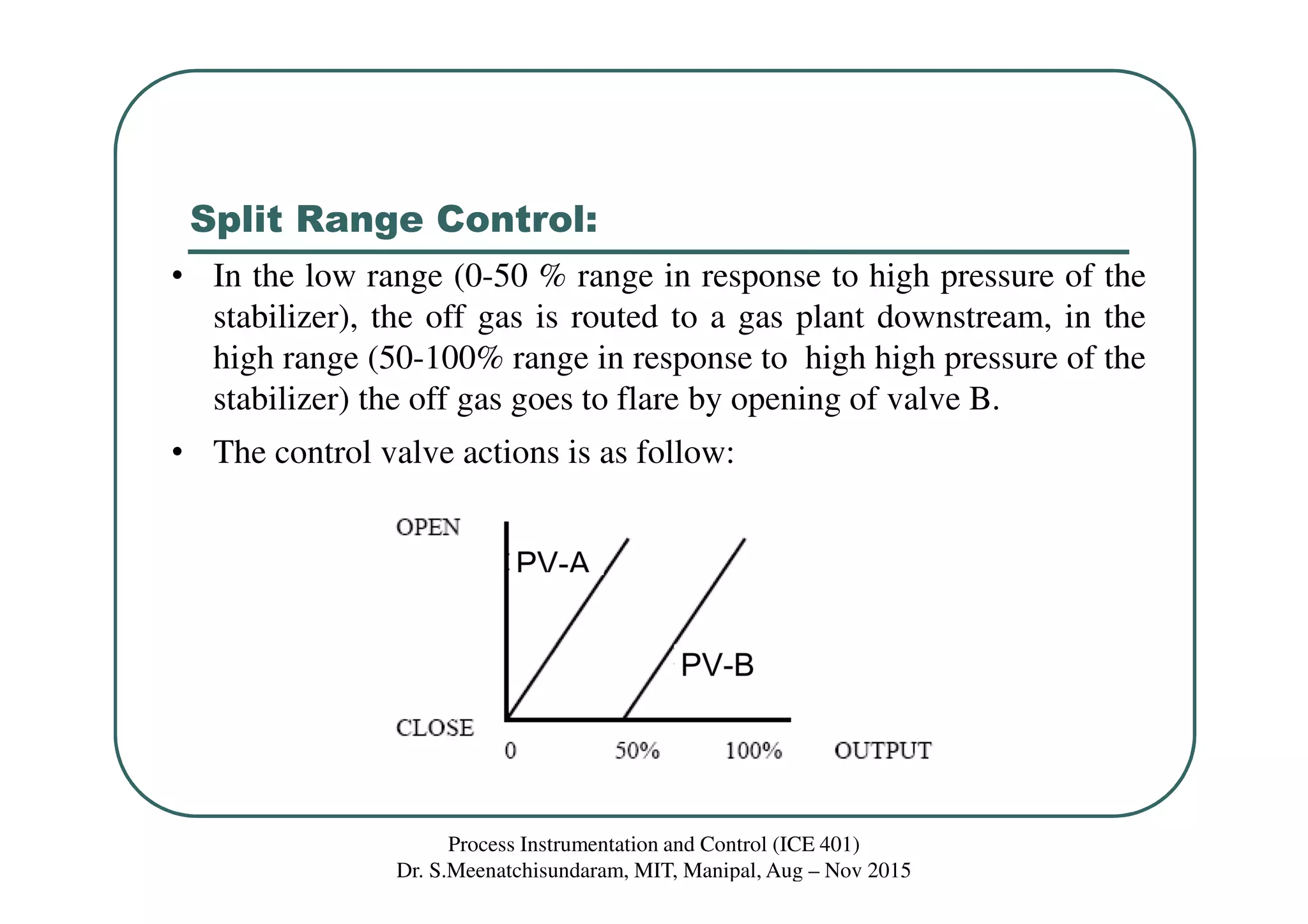
• In the low range (0-50 % range in response to high pressure of the
stabilizer), the off gas is routed to a gas plant downstream, in the
high range (50-100% range in response to high high pressure of the
stabilizer) the off gas goes to flare by opening of valve B.
• The control valve actions is as follow:
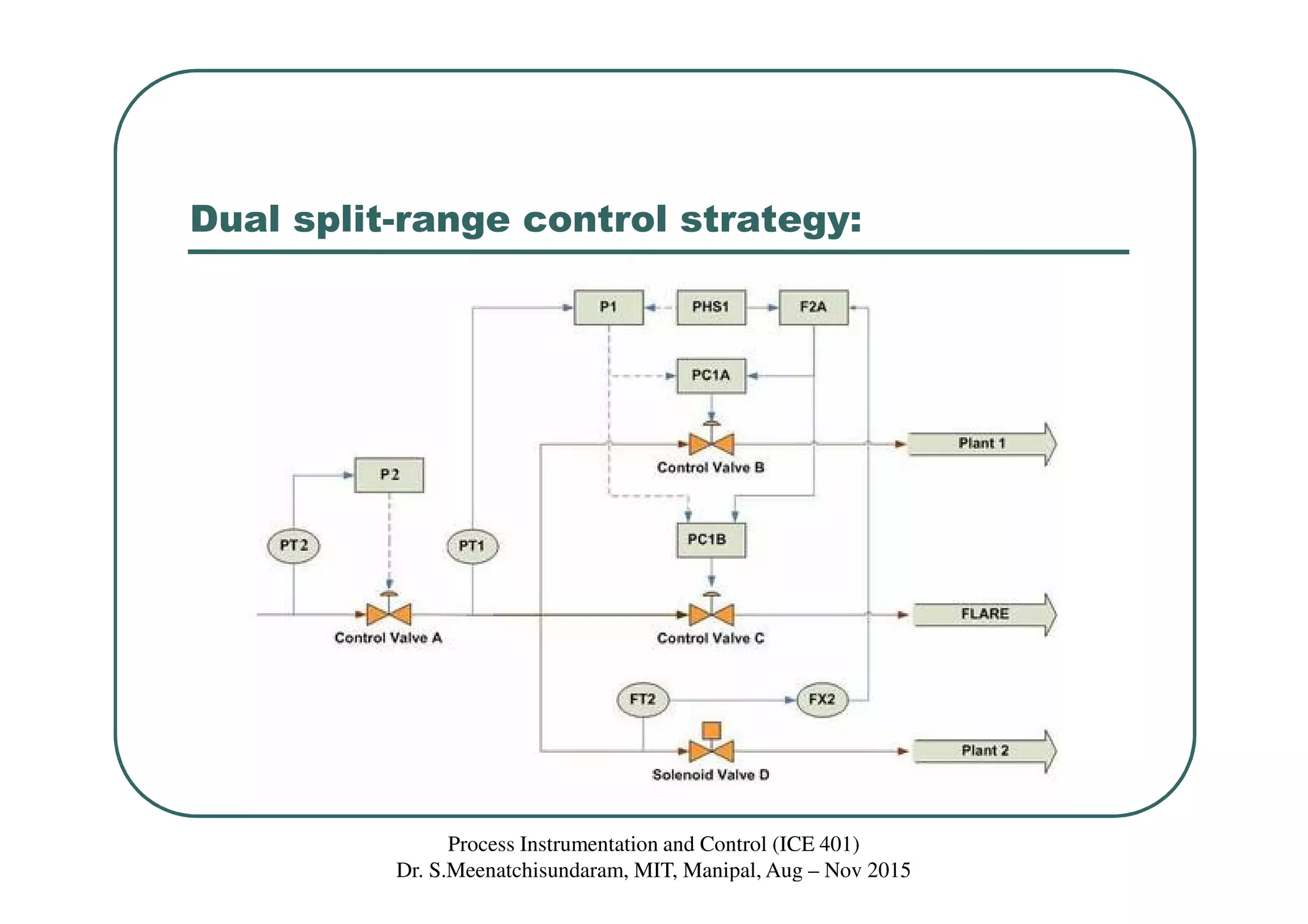
Dual split-range control strategy:
Process Instrumentation and Control (ICE 401)
Dr. S.Meenatchisundaram, MIT, Manipal, Aug – Nov 2015
References:
• http://www.enggcyclopedia.com/2012/06/split-range-control-loop/
• http://www.controleng.com/single-article/a-dual-split-range-control-
strategy-for-pressure-and-flow-
processes/e02afa4eb60717657598546e8feb895e.html
Process Instrumentation and Control (ICE 401)
Dr. S.Meenatchisundaram, MIT, Manipal, Aug – Nov 2015

Class 35 advanced control strategies – ratio control, split range control

  • 1.
    ICE401: PROCESS INSTRUMENTATION ANDCONTROL Class 35 Advanced Control Strategies – Ratio Control, Split Range Control Dr. S. Meenatchisundaram Email: meenasundar@gmail.com Process Instrumentation and Control (ICE 401) Dr. S.Meenatchisundaram, MIT, Manipal, Aug – Nov 2015
  • 2.
    Ratio Control: Process Instrumentationand Control (ICE 401) Dr. S.Meenatchisundaram, MIT, Manipal, Aug – Nov 2015 • An important control problem in the chemical industry is the combining of two or more streams to provide a mixture having a desired ratio of components. • Examples of this mixing operation include the blending of reactants entering a chemical reactor or for the injection of a fuel/air mixture into a furnace. • Figure shows an example of a ratio control system. It depicts a control system for blending two liquid streams A and B to produce a mixed stream having the ratio Kr in units of mass B / mass A. • Stream A, which is uncontrolled, is used to adjust the flow of stream B so that the desired ratio is maintained.
  • 3.
    Ratio Control: Process Instrumentationand Control (ICE 401) Dr. S.Meenatchisundaram, MIT, Manipal, Aug – Nov 2015 • The measured signal for stream A is multiplied by the desired ratio Kr to provide a signal that is the set point for the flow control loop for stream B. • The parameter Kr can be adjusted to the desired value. • Control hardware is available to perform the multiplication of two control signals.
  • 4.
    Ratio Control: Process Instrumentationand Control (ICE 401) Dr. S.Meenatchisundaram, MIT, Manipal, Aug – Nov 2015
  • 5.
    Ratio Control: Process Instrumentationand Control (ICE 401) Dr. S.Meenatchisundaram, MIT, Manipal, Aug – Nov 2015 • In a flow control loop, the dynamic elements consist of the controller, the flow-measuring element, and the control valve. • For incompressible fluids, there is no lag between the change in valve position and the corresponding flow rate. • For this reason, the transfer function between the valve and the measurement of flow rate is simply unity. • The block diagram also shows a transfer function Gp that relates the flow rate of B to the supply pressure of B. • A transfer function Gm1 is also shown that represents the dynamic lag of the flow measuring element for stream A. • From the block diagram, the flow of B may be written as
  • 6.
    Ratio Control: Process Instrumentationand Control (ICE 401) Dr. S.Meenatchisundaram, MIT, Manipal, Aug – Nov 2015 • The control action for a flow control system is usually PI. • The integral action is needed to eliminate offset and thereby establish a precise ratio of the mixed streams of A and B. • Derivative action is usually avoided in flow control because the signal from a flow measuring element is inherently noisy. • The presence of derivative action would amplify the noise and give poor control. 1 2 21 1 pm r c v B A B c v m c v m GG K G G Q Q P G G G G G G = + + +
  • 7.
    Split Range Control: ProcessInstrumentation and Control (ICE 401) Dr. S.Meenatchisundaram, MIT, Manipal, Aug – Nov 2015 • In a split range control loop, output of the controller is split and sent to two or more control valves. • The splitter defines how each valve is sequenced as the controller output changes from 0 to 100%. • In most split range applications, the controller adjusts the opening of one of the valves when its output is in the range of 0 to 50% and the other valve when its output is in the range of 50% to 100%. • The principle of a split range control is illustrated in the following example:
  • 8.
    Split Range Control: ProcessInstrumentation and Control (ICE 401) Dr. S.Meenatchisundaram, MIT, Manipal, Aug – Nov 2015
  • 9.
    Split Range Control: ProcessInstrumentation and Control (ICE 401) Dr. S.Meenatchisundaram, MIT, Manipal, Aug – Nov 2015 • In figure, PIC-01 controls the pressure of the separator for liquid vapour hydrocarbons, by mean of a split range controller with the output signal split and sent to two pressure control valves PV-A and PV-B. • When pressure increases, the fluid shall be discharged to flare. When the pressure decreases, Fuel gas is introduced to compensate the pressure of the separator. • The fuel gas valve (PV-B) needs to close in response to increasing of pressure of the separator, while the flare valve (PV-A) will need to open when the pressure increases beyond setpoint. • When the pressure increases beyond setpoint in range of with 0- 50% controller output, PV-B shall close from fully open to fully close.
  • 10.
    Split Range Control: ProcessInstrumentation and Control (ICE 401) Dr. S.Meenatchisundaram, MIT, Manipal, Aug – Nov 2015 • When the pressure increases beyond setpoint in range of with 50- 100% controller output, PV-A shall open from fully close to fully open. • In summary, valve actions by PIC-01 is as follow:
  • 11.
    Split Range Control: ProcessInstrumentation and Control (ICE 401) Dr. S.Meenatchisundaram, MIT, Manipal, Aug – Nov 2015 • In this case, the service of both control valves is different, with respect to use of fuel gas and flaring for pressure control. • Another case of use of split range control loop is when one control valve cannot be suitably designed to cover the complete operating range of the controller. • In that case, valve with a smaller Cv operated between 0-50% range and the other operates for 50-100% range. • For example, a pressure controller for accumulator drum in overhead of a stabilizer column splits range to open 2 control valves.
  • 12.
    Split Range Control: ProcessInstrumentation and Control (ICE 401) Dr. S.Meenatchisundaram, MIT, Manipal, Aug – Nov 2015 • In the low range (0-50 % range in response to high pressure of the stabilizer), the off gas is routed to a gas plant downstream, in the high range (50-100% range in response to high high pressure of the stabilizer) the off gas goes to flare by opening of valve B. • The control valve actions is as follow:
  • 13.
    Dual split-range controlstrategy: Process Instrumentation and Control (ICE 401) Dr. S.Meenatchisundaram, MIT, Manipal, Aug – Nov 2015
  • 14.