WHEN ACCURACY MATTERS
Introduction
Actuation Technology
WHEN ACCURACY MATTERS
What is Pneumatics?What is Pneumatics?
• Pneumatics is an application of fluid power. Pneumatics
uses air, which is compressible. Most industrial
pneumatic applications use pressures of about 40 to 100
pounds per square inch (psi)
• Advantages of pneumatics
– The working fluid is very light in weight so supply hoses are not
heavy.
– Because the working fluid is (mostly) just air, there is usually no
need for a return line for the working fluid and leaks of the
working fluid tend not to be messy.
– Because air is compressible, the equipment is less likely to be
damaged by shock. The air in pneumatics absorbs excessive
forces due to sudden valve closures or shift, etc.
WHEN ACCURACY MATTERS
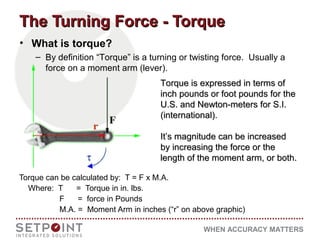
• What is torque?
– By definition “Torque” is a turning or twisting force. Usually a
force on a moment arm (lever).
Torque is expressed in terms ofTorque is expressed in terms of
inch pounds or foot pounds for theinch pounds or foot pounds for the
U.S. and Newton-meters for S.I.U.S. and Newton-meters for S.I.
(international).(international).
It’s magnitude can be increasedIt’s magnitude can be increased
by increasing the force or theby increasing the force or the
length of the moment arm, or both.length of the moment arm, or both.
The Turning Force - TorqueThe Turning Force - Torque
Torque can be calculated by: T = F x M.A.
Where: T = Torque in in. lbs.
F = force in Pounds
M.A. = Moment Arm in inches (“r” on above graphic)
WHEN ACCURACY MATTERS
ForceForce
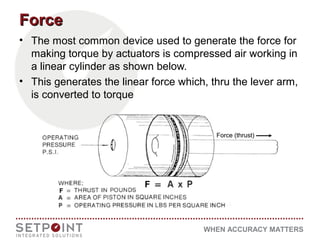
• The most common device used to generate the force for
making torque by actuators is compressed air working in
a linear cylinder as shown below.
• This generates the linear force which, thru the lever arm,
is converted to torque
WHEN ACCURACY MATTERS
Crank ArmCrank Arm
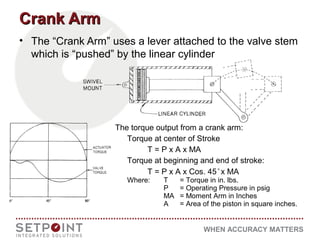
• The “Crank Arm” uses a lever attached to the valve stem
which is “pushed” by the linear cylinder
The torque output from a crank arm:
Torque at center of Stroke
T = P x A x MA
Torque at beginning and end of stroke:
T = P x A x Cos. 45°x MA
Where: T = Torque in in. lbs.
P = Operating Pressure in psig
MA = Moment Arm in Inches
A = Area of the piston in square inches.
WHEN ACCURACY MATTERS
Power to the LeverPower to the Lever
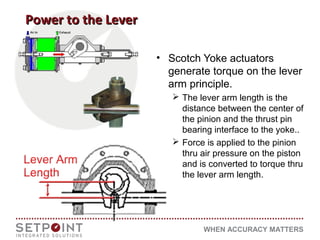
• Scotch Yoke actuators
generate torque on the lever
arm principle.
 The lever arm length is the
distance between the center of
the pinion and the thrust pin
bearing interface to the yoke..
 Force is applied to the pinion
thru air pressure on the piston
and is converted to torque thru
the lever arm length.
WHEN ACCURACY MATTERS
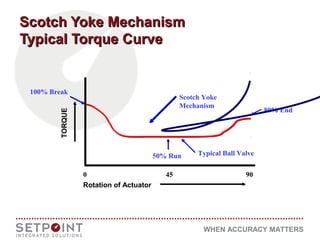
Scotch Yoke MechanismScotch Yoke Mechanism
Typical Torque CurveTypical Torque Curve
TORQUE
0 45 90
100% Break
50% Run
80% End
Typical Ball Valve
Scotch Yoke
Mechanism
Rotation of Actuator
WHEN ACCURACY MATTERS
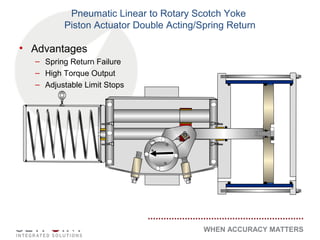
Pneumatic Linear to Rotary Scotch Yoke
Piston Actuator Double Acting/Spring Return
• Advantages
– Spring Return Failure
– High Torque Output
– Adjustable Limit Stops
WHEN ACCURACY MATTERS
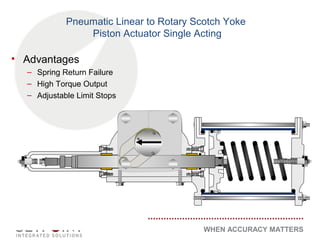
Pneumatic Linear to Rotary Scotch Yoke
Piston Actuator Single Acting
• Advantages
– Spring Return Failure
– High Torque Output
– Adjustable Limit Stops
WHEN ACCURACY MATTERS
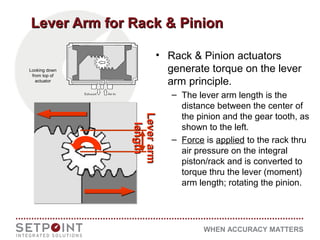
Lever Arm for Rack & PinionLever Arm for Rack & Pinion
• Rack & Pinion actuators
generate torque on the lever
arm principle.
– The lever arm length is the
distance between the center of
the pinion and the gear tooth, as
shown to the left.
– Force is applied to the rack thru
air pressure on the integral
piston/rack and is converted to
torque thru the lever (moment)
arm length; rotating the pinion.
LeverarmLeverarm
lengthlength
Looking down
from top of
actuator
WHEN ACCURACY MATTERS
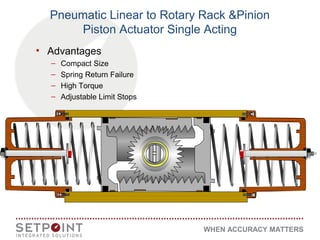
Pneumatic Linear to Rotary Rack &Pinion
Piston Actuator Single Acting
• Advantages
– Compact Size
– Spring Return Failure
– High Torque
– Adjustable Limit Stops
WHEN ACCURACY MATTERS
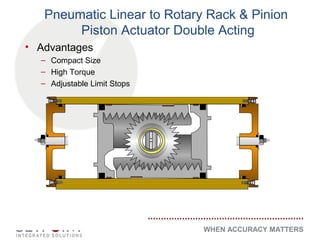
Pneumatic Linear to Rotary Rack & Pinion
Piston Actuator Double Acting
• Advantages
– Compact Size
– High Torque
– Adjustable Limit Stops
WHEN ACCURACY MATTERS
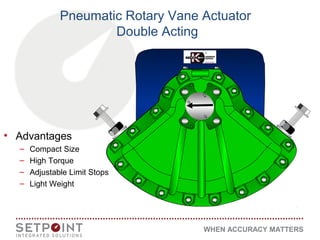
Pneumatic Rotary Vane Actuator
Double Acting
• Advantages
– Compact Size
– High Torque
– Adjustable Limit Stops
– Light Weight
WHEN ACCURACY MATTERS
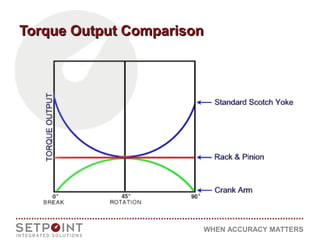
Torque Output ComparisonTorque Output Comparison
WHEN ACCURACY MATTERS
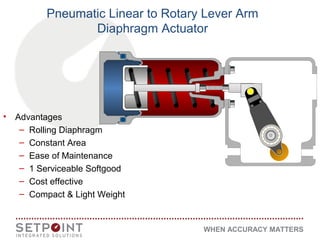
• Advantages
– Rolling Diaphragm
– Constant Area
– Ease of Maintenance
– 1 Serviceable Softgood
– Cost effective
– Compact & Light Weight
Pneumatic Linear to Rotary Lever Arm
Diaphragm Actuator
WHEN ACCURACY MATTERS
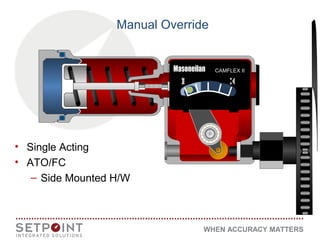
Manual Override
• Single Acting
• ATO/FC
– Side Mounted H/W
CAMFLEX II
WHEN ACCURACY MATTERS
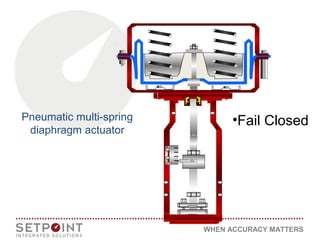
Pneumatic multi-spring
diaphragm actuator
•Fail Closed
WHEN ACCURACY MATTERS
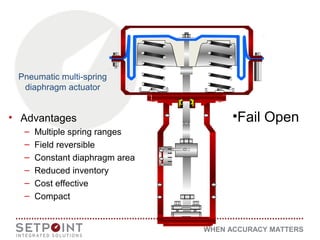
• Advantages
– Multiple spring ranges
– Field reversible
– Constant diaphragm area
– Reduced inventory
– Cost effective
– Compact
Pneumatic multi-spring
diaphragm actuator
•Fail Open
WHEN ACCURACY MATTERS
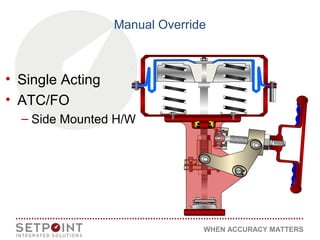
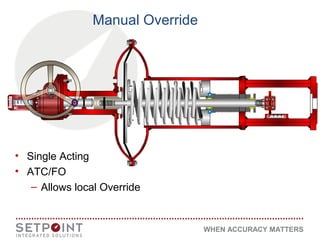
Manual Override
• Single Acting
• ATC/FO
– Side Mounted H/W
WHEN ACCURACY MATTERS
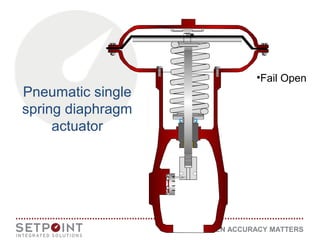
Pneumatic single
spring diaphragm
actuator
•Fail Open
WHEN ACCURACY MATTERS
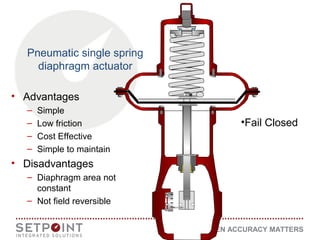
• Advantages
– Simple
– Low friction
– Cost Effective
– Simple to maintain
• Disadvantages
– Diaphragm area not
constant
– Not field reversible
Pneumatic single spring
diaphragm actuator
•Fail Closed
WHEN ACCURACY MATTERS
Manual Override
• Single Acting
• ATC/FO
– Allows local Override
WHEN ACCURACY MATTERS
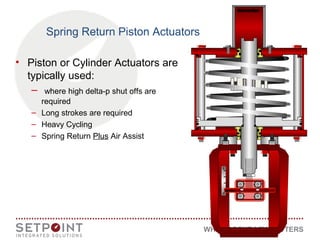
• Piston or Cylinder Actuators are
typically used:
– where high delta-p shut offs are
required
– Long strokes are required
– Heavy Cycling
– Spring Return Plus Air Assist
Spring Return Piston Actuators
WHEN ACCURACY MATTERS
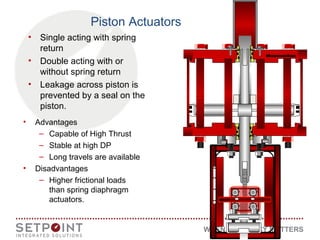
Piston Actuators
• Single acting with spring
return
• Double acting with or
without spring return
• Leakage across piston is
prevented by a seal on the
piston.
• Advantages
– Capable of High Thrust
– Stable at high DP
– Long travels are available
• Disadvantages
– Higher frictional loads
than spring diaphragm
actuators.
WHEN ACCURACY MATTERS
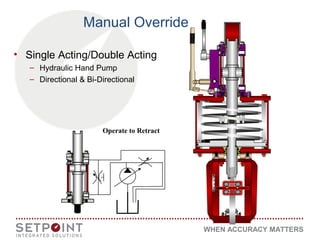
Manual Override
• Single Acting/Double Acting
– Hydraulic Hand Pump
– Directional & Bi-Directional
Operate to Retract
WHEN ACCURACY MATTERS
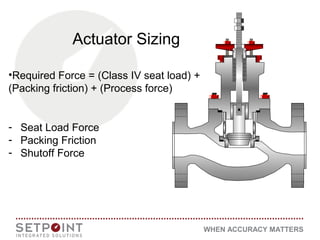
•Required Force = (Class IV seat load) +
(Packing friction) + (Process force)
Actuator Sizing
- Seat Load Force
- Packing Friction
- Shutoff Force
WHEN ACCURACY MATTERS
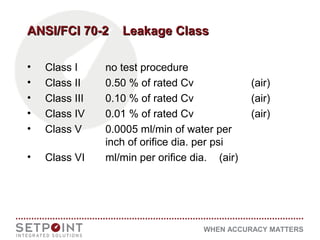
ANSI/FCI 70-2 Leakage ClassANSI/FCI 70-2 Leakage Class
• Class I no test procedure
• Class II 0.50 % of rated Cv (air)
• Class III 0.10 % of rated Cv (air)
• Class IV 0.01 % of rated Cv (air)
• Class V 0.0005 ml/min of water per
inch of orifice dia. per psi
• Class VI ml/min per orifice dia. (air)
WHEN ACCURACY MATTERS
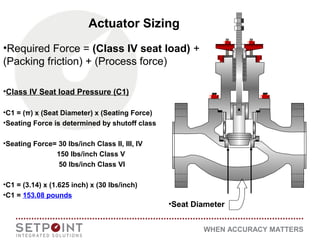
•Required Force = (Class IV seat load) +
(Packing friction) + (Process force)
•Class IV Seat load Pressure (C1)
•C1 = (π) x (Seat Diameter) x (Seating Force)
•Seating Force is determined by shutoff class
•Seating Force= 30 lbs/inch Class II, III, IV
150 lbs/inch Class V
50 lbs/inch Class VI
•C1 = (3.14) x (1.625 inch) x (30 lbs/inch)
•C1 = 153.08 pounds
•Seat Diameter
Actuator Sizing
WHEN ACCURACY MATTERS
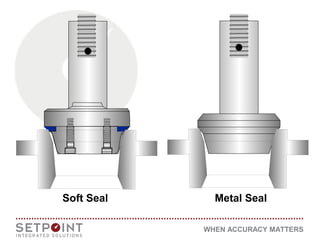
Soft Seal Metal Seal
WHEN ACCURACY MATTERS
•Required Force = (Class IV seat load) +
(Packing friction) + (Process force)
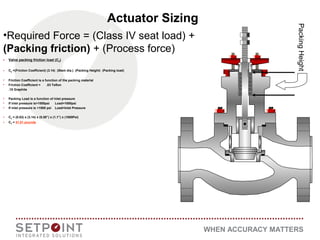
• Valve packing friction load (C2)
• C2 =(Friction Coefficient) (3.14) (Stem dia.) (Packing Height) (Packing load)
• Friction Coefficient is a function of the packing material
• Friction Coefficient = .03 Teflon
.15 Graphite
• Packing Load is a function of inlet pressure
• If inlet pressure is>1000psi Load=1000psi
• If inlet pressure is <1000 psi Load=Inlet Pressure
• C2 = (0.03) x (3.14) x (0.50”) x (1.1”) x (1000Psi)
• C2 = 51.81 pounds
PackingHeight
Actuator Sizing
WHEN ACCURACY MATTERS
•Required Force = (Class IV seat load) +
(Packing friction) + (Process force)
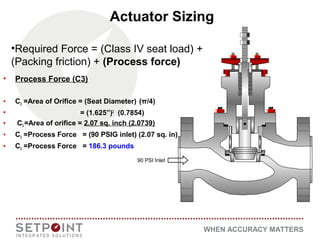
• Process Force (C3)
• C3 =Area of Orifice = (Seat Diameter) (π/4)
• = (1.625”)2
(0.7854)
• C3 =Area of orifice = 2.07 sq. inch (2.0739)
• C3 =Process Force = (90 PSIG inlet) (2.07 sq. in)
• C3 =Process Force = 186.3 pounds
90 PSI Inlet
Actuator Sizing
WHEN ACCURACY MATTERS
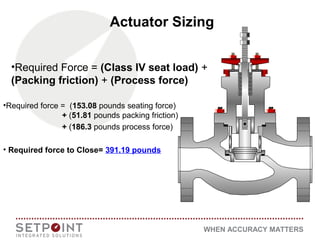
•Required Force = (Class IV seat load) +
(Packing friction) + (Process force)
•Required force = (153.08 pounds seating force)
+ (51.81 pounds packing friction)
+ (186.3 pounds process force)
• Required force to Close= 391.19 pounds
Actuator Sizing
WHEN ACCURACY MATTERS
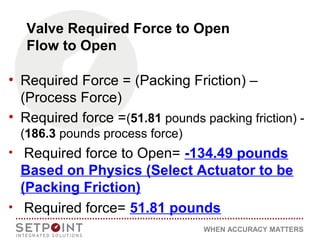
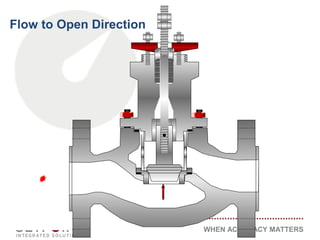
Valve Required Force to Open
Flow to Open
• Required Force = (Packing Friction) –
(Process Force)
• Required force =(51.81 pounds packing friction) -
(186.3 pounds process force)
• Required force to Open= -134.49 pounds
Based on Physics (Select Actuator to be
(Packing Friction)
• Required force= 51.81 pounds
WHEN ACCURACY MATTERS
Flow to Open Direction
WHEN ACCURACY MATTERS
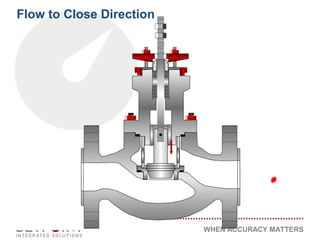
Flow to Close Direction
WHEN ACCURACY MATTERS
Unbalanced Trim
• Valve closure member which is under unbalanced
dynamic forces induced by process media.
• Process force tends to influence trim generating
additional forces in the flow direction.
• Unbalanced Trim in moderate to hi-pressure
applications required larger thrust actuators.
WHEN ACCURACY MATTERS
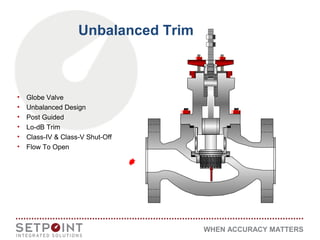
Unbalanced Trim
• Globe Valve
• Unbalanced Design
• Post Guided
• Lo-dB Trim
• Class-IV & Class-V Shut-Off
• Flow To Open
WHEN ACCURACY MATTERS
Balanced Trim
• Valve closure member which is equalized/ balance
with dynamic forces induced by process media.
• Balance trim designs include Semi-Balanced and
Fully-Balanced.
• Balanced Trim in moderate to hi-pressure
applications required much smaller thrust actuators
compared to unbalanced trim.
WHEN ACCURACY MATTERS
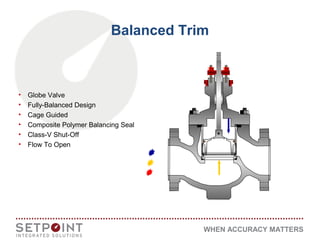
Balanced Trim
• Globe Valve
• Fully-Balanced Design
• Cage Guided
• Composite Polymer Balancing Seal
• Class-V Shut-Off
• Flow To Open
WHEN ACCURACY MATTERS
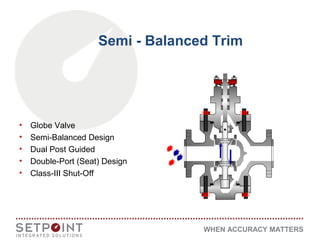
Semi - Balanced Trim
• Globe Valve
• Semi-Balanced Design
• Dual Post Guided
• Double-Port (Seat) Design
• Class-III Shut-Off
WHEN ACCURACY MATTERS
Questions?Questions?

Control Valve Actuation

  • 1.
  • 2.
    WHEN ACCURACY MATTERS Whatis Pneumatics?What is Pneumatics? • Pneumatics is an application of fluid power. Pneumatics uses air, which is compressible. Most industrial pneumatic applications use pressures of about 40 to 100 pounds per square inch (psi) • Advantages of pneumatics – The working fluid is very light in weight so supply hoses are not heavy. – Because the working fluid is (mostly) just air, there is usually no need for a return line for the working fluid and leaks of the working fluid tend not to be messy. – Because air is compressible, the equipment is less likely to be damaged by shock. The air in pneumatics absorbs excessive forces due to sudden valve closures or shift, etc.
  • 3.
    WHEN ACCURACY MATTERS •What is torque? – By definition “Torque” is a turning or twisting force. Usually a force on a moment arm (lever). Torque is expressed in terms ofTorque is expressed in terms of inch pounds or foot pounds for theinch pounds or foot pounds for the U.S. and Newton-meters for S.I.U.S. and Newton-meters for S.I. (international).(international). It’s magnitude can be increasedIt’s magnitude can be increased by increasing the force or theby increasing the force or the length of the moment arm, or both.length of the moment arm, or both. The Turning Force - TorqueThe Turning Force - Torque Torque can be calculated by: T = F x M.A. Where: T = Torque in in. lbs. F = force in Pounds M.A. = Moment Arm in inches (“r” on above graphic)
  • 4.
    WHEN ACCURACY MATTERS ForceForce •The most common device used to generate the force for making torque by actuators is compressed air working in a linear cylinder as shown below. • This generates the linear force which, thru the lever arm, is converted to torque
  • 5.
    WHEN ACCURACY MATTERS CrankArmCrank Arm • The “Crank Arm” uses a lever attached to the valve stem which is “pushed” by the linear cylinder The torque output from a crank arm: Torque at center of Stroke T = P x A x MA Torque at beginning and end of stroke: T = P x A x Cos. 45°x MA Where: T = Torque in in. lbs. P = Operating Pressure in psig MA = Moment Arm in Inches A = Area of the piston in square inches.
  • 6.
    WHEN ACCURACY MATTERS Powerto the LeverPower to the Lever • Scotch Yoke actuators generate torque on the lever arm principle.  The lever arm length is the distance between the center of the pinion and the thrust pin bearing interface to the yoke..  Force is applied to the pinion thru air pressure on the piston and is converted to torque thru the lever arm length.
  • 7.
    WHEN ACCURACY MATTERS ScotchYoke MechanismScotch Yoke Mechanism Typical Torque CurveTypical Torque Curve TORQUE 0 45 90 100% Break 50% Run 80% End Typical Ball Valve Scotch Yoke Mechanism Rotation of Actuator
  • 8.
    WHEN ACCURACY MATTERS PneumaticLinear to Rotary Scotch Yoke Piston Actuator Double Acting/Spring Return • Advantages – Spring Return Failure – High Torque Output – Adjustable Limit Stops
  • 9.
    WHEN ACCURACY MATTERS PneumaticLinear to Rotary Scotch Yoke Piston Actuator Single Acting • Advantages – Spring Return Failure – High Torque Output – Adjustable Limit Stops
  • 10.
    WHEN ACCURACY MATTERS LeverArm for Rack & PinionLever Arm for Rack & Pinion • Rack & Pinion actuators generate torque on the lever arm principle. – The lever arm length is the distance between the center of the pinion and the gear tooth, as shown to the left. – Force is applied to the rack thru air pressure on the integral piston/rack and is converted to torque thru the lever (moment) arm length; rotating the pinion. LeverarmLeverarm lengthlength Looking down from top of actuator
  • 11.
    WHEN ACCURACY MATTERS PneumaticLinear to Rotary Rack &Pinion Piston Actuator Single Acting • Advantages – Compact Size – Spring Return Failure – High Torque – Adjustable Limit Stops
  • 12.
    WHEN ACCURACY MATTERS PneumaticLinear to Rotary Rack & Pinion Piston Actuator Double Acting • Advantages – Compact Size – High Torque – Adjustable Limit Stops
  • 13.
    WHEN ACCURACY MATTERS PneumaticRotary Vane Actuator Double Acting • Advantages – Compact Size – High Torque – Adjustable Limit Stops – Light Weight
  • 14.
    WHEN ACCURACY MATTERS TorqueOutput ComparisonTorque Output Comparison
  • 15.
    WHEN ACCURACY MATTERS •Advantages – Rolling Diaphragm – Constant Area – Ease of Maintenance – 1 Serviceable Softgood – Cost effective – Compact & Light Weight Pneumatic Linear to Rotary Lever Arm Diaphragm Actuator
  • 16.
    WHEN ACCURACY MATTERS ManualOverride • Single Acting • ATO/FC – Side Mounted H/W CAMFLEX II
  • 17.
    WHEN ACCURACY MATTERS Pneumaticmulti-spring diaphragm actuator •Fail Closed
  • 18.
    WHEN ACCURACY MATTERS •Advantages – Multiple spring ranges – Field reversible – Constant diaphragm area – Reduced inventory – Cost effective – Compact Pneumatic multi-spring diaphragm actuator •Fail Open
  • 19.
    WHEN ACCURACY MATTERS ManualOverride • Single Acting • ATC/FO – Side Mounted H/W
  • 20.
    WHEN ACCURACY MATTERS Pneumaticsingle spring diaphragm actuator •Fail Open
  • 21.
    WHEN ACCURACY MATTERS •Advantages – Simple – Low friction – Cost Effective – Simple to maintain • Disadvantages – Diaphragm area not constant – Not field reversible Pneumatic single spring diaphragm actuator •Fail Closed
  • 22.
    WHEN ACCURACY MATTERS ManualOverride • Single Acting • ATC/FO – Allows local Override
  • 23.
    WHEN ACCURACY MATTERS •Piston or Cylinder Actuators are typically used: – where high delta-p shut offs are required – Long strokes are required – Heavy Cycling – Spring Return Plus Air Assist Spring Return Piston Actuators
  • 24.
    WHEN ACCURACY MATTERS PistonActuators • Single acting with spring return • Double acting with or without spring return • Leakage across piston is prevented by a seal on the piston. • Advantages – Capable of High Thrust – Stable at high DP – Long travels are available • Disadvantages – Higher frictional loads than spring diaphragm actuators.
  • 25.
    WHEN ACCURACY MATTERS ManualOverride • Single Acting/Double Acting – Hydraulic Hand Pump – Directional & Bi-Directional Operate to Retract
  • 26.
    WHEN ACCURACY MATTERS •RequiredForce = (Class IV seat load) + (Packing friction) + (Process force) Actuator Sizing - Seat Load Force - Packing Friction - Shutoff Force
  • 27.
    WHEN ACCURACY MATTERS ANSI/FCI70-2 Leakage ClassANSI/FCI 70-2 Leakage Class • Class I no test procedure • Class II 0.50 % of rated Cv (air) • Class III 0.10 % of rated Cv (air) • Class IV 0.01 % of rated Cv (air) • Class V 0.0005 ml/min of water per inch of orifice dia. per psi • Class VI ml/min per orifice dia. (air)
  • 28.
    WHEN ACCURACY MATTERS •RequiredForce = (Class IV seat load) + (Packing friction) + (Process force) •Class IV Seat load Pressure (C1) •C1 = (π) x (Seat Diameter) x (Seating Force) •Seating Force is determined by shutoff class •Seating Force= 30 lbs/inch Class II, III, IV 150 lbs/inch Class V 50 lbs/inch Class VI •C1 = (3.14) x (1.625 inch) x (30 lbs/inch) •C1 = 153.08 pounds •Seat Diameter Actuator Sizing
  • 29.
  • 30.
    WHEN ACCURACY MATTERS •RequiredForce = (Class IV seat load) + (Packing friction) + (Process force) • Valve packing friction load (C2) • C2 =(Friction Coefficient) (3.14) (Stem dia.) (Packing Height) (Packing load) • Friction Coefficient is a function of the packing material • Friction Coefficient = .03 Teflon .15 Graphite • Packing Load is a function of inlet pressure • If inlet pressure is>1000psi Load=1000psi • If inlet pressure is <1000 psi Load=Inlet Pressure • C2 = (0.03) x (3.14) x (0.50”) x (1.1”) x (1000Psi) • C2 = 51.81 pounds PackingHeight Actuator Sizing
  • 31.
    WHEN ACCURACY MATTERS •RequiredForce = (Class IV seat load) + (Packing friction) + (Process force) • Process Force (C3) • C3 =Area of Orifice = (Seat Diameter) (π/4) • = (1.625”)2 (0.7854) • C3 =Area of orifice = 2.07 sq. inch (2.0739) • C3 =Process Force = (90 PSIG inlet) (2.07 sq. in) • C3 =Process Force = 186.3 pounds 90 PSI Inlet Actuator Sizing
  • 32.
    WHEN ACCURACY MATTERS •RequiredForce = (Class IV seat load) + (Packing friction) + (Process force) •Required force = (153.08 pounds seating force) + (51.81 pounds packing friction) + (186.3 pounds process force) • Required force to Close= 391.19 pounds Actuator Sizing
  • 33.
    WHEN ACCURACY MATTERS ValveRequired Force to Open Flow to Open • Required Force = (Packing Friction) – (Process Force) • Required force =(51.81 pounds packing friction) - (186.3 pounds process force) • Required force to Open= -134.49 pounds Based on Physics (Select Actuator to be (Packing Friction) • Required force= 51.81 pounds
  • 34.
    WHEN ACCURACY MATTERS Flowto Open Direction
  • 35.
    WHEN ACCURACY MATTERS Flowto Close Direction
  • 36.
    WHEN ACCURACY MATTERS UnbalancedTrim • Valve closure member which is under unbalanced dynamic forces induced by process media. • Process force tends to influence trim generating additional forces in the flow direction. • Unbalanced Trim in moderate to hi-pressure applications required larger thrust actuators.
  • 37.
    WHEN ACCURACY MATTERS UnbalancedTrim • Globe Valve • Unbalanced Design • Post Guided • Lo-dB Trim • Class-IV & Class-V Shut-Off • Flow To Open
  • 38.
    WHEN ACCURACY MATTERS BalancedTrim • Valve closure member which is equalized/ balance with dynamic forces induced by process media. • Balance trim designs include Semi-Balanced and Fully-Balanced. • Balanced Trim in moderate to hi-pressure applications required much smaller thrust actuators compared to unbalanced trim.
  • 39.
    WHEN ACCURACY MATTERS BalancedTrim • Globe Valve • Fully-Balanced Design • Cage Guided • Composite Polymer Balancing Seal • Class-V Shut-Off • Flow To Open
  • 40.
    WHEN ACCURACY MATTERS Semi- Balanced Trim • Globe Valve • Semi-Balanced Design • Dual Post Guided • Double-Port (Seat) Design • Class-III Shut-Off
  • 41.

Editor's Notes

  • #3 The scope of this training is a familiarization with pneumatic actuators. Pneumatic actuators are predominately used in modulating applications. Other type actuators including electric and electro-hydraulic actuators are also used in modulating applications.
  • #4 In rotary terminology Torque is calculated. In rising stem type valves Thrust is calculated. It is important we use the terminology correctly. The objective in calculating Torque is to fit the Torque output of the actuator to the Torque requirement of the valve.
  • #5 The objective in calculating Torque is to fit the Torque output of the actuator to the Torque requirement of the valve.
  • #6 Notice the output torque of a common Crank Arm lever exhibits high run torque.
  • #7 We are converting liner force into rotary motion
  • #8 The scotch yoke mechanism is an efficient means of converting the linear force created by the pneumatic power cylinder to torque. It follows the typical valve torque curve of an rotary isolation valve with high break away torque, low run torque and high end torque.
  • #9 Scotch yoke actuators are predominately used for on / off applications where valves exhibit high break away torque, low run torque and high end torque. Symmetrical Yoke actuators give equal torque at both ends of the stroke to allow operation of valves that have high torque in open and closed positions.
  • #10 Single acting spring return.
  • #11 The rack and pinion torque output is created by the moment arm shown. From the center of the pinion to the pitch circle diameter. It can be seen that this output will be constant throughout its stroke because the moment (lever) arm is constant.
  • #12 While R&amp;P actuators offer a flat torque output curve they are susceptible to dynamic friction not conducive for high resolution control. R&amp;P actuators are frequently used for modulating control applications where high cycle and position accuracy is not required.
  • #13 Double acting R&amp;P Actuator
  • #14 The pneumatic Vane actuator is a low cost work horse in the industry primarily for on / off control in SR or DA applications. The output Torque of a Vane actuator is constant throughout the stroke. We commonly see these type actuators in air damper combustion control on furnaces.
  • #15 This slide depicts output torque of the three most common actuator designs.
  • #16 We will now discuss Diaphragm actuators. Diaphragm actuators offer low friction operation, low wear rate and high position accuracy primarily used in modulating applications. The spring-and-diaphragm pneumatic actuator is the most commonly specified actuator for control applications partly due to simplicity and dependability. Camflex spring apposed rolling diaphragm actuator offers top and bottom guided spring, a constant area diaphragm with constant torque output, low friction operation, ATC FO or ATO FC orientation dependent, smooth high cycle operation, easy maintenance with flexibility.
  • #17 Manual override mounted into linkage box for easy manual adjustments.
  • #18 In rotary actuators we are converting linear force, through the lever arm to a Torque output. Reciprocating actuators net output Thrust is the difference between diaphragm force and opposing spring force. The 87/88 includes a Rolling Diaphragm design, which provides extremely low friction operation for excellent control performance and a low wear rate. The diaphragm also provides a constant effective area over the full stroke range, which results in excellent linearity with respect to the actuator supply pressure. The 87/88 has been designed with a minimum amount of component variation, including a limited number of standard spring designs that can provide a multiple set of Bench Ranges for each actuator size.
  • #19 Direct acting actuator is where upon increase of air supply the actuator stem extends. Reverse acting actuator is where upon increase of air supply the stem retracts. The 87/88 is fully Field Reversible without any additional parts.
  • #20 Hand wheel overrides are fixed on the yoke of the actuator for manual operation. The hand wheel drives the stem in one direction while the spring drives the stem in the opposite direction.
  • #21 This represents a conventional spring apposed diaphragm actuator ATC Fail open operation. This design offers adjustable bench range with single or nested spring arrangements. This slide depicts the 37 series Masoneilan reciprocating actuator
  • #22 This is the fail closed design with the spring mounted on top of the diaphragm. While there are advantages to this simple well proven design there are disadvantages with limiting flexibility. This slide depicts the 38 series reciprocating actuator.
  • #23 Top Mounted Manual Override
  • #24 Piston actuators furnish maximum Thrust output and fast stroking speeds. Piston actuators are typically specified for long strokes, unbalanced valves or where the required thrust is outside of a spring-and-diaphragm capability.
  • #25 Double acting piston design
  • #26 Hydraulic overrides offer manual operation in both directions
  • #27 We will now examine what is required when sizing an actuator. We will first calculate the required thrust to close the valve and required thrust to open the valve.
  • #28 This relates to leakage through the seat, when the valve is in full closed position.
  • #29 Follow along with the required force calculation
  • #30 Masoneilan soft seat design in a 21000 unbalanced design utilizes a 2 piece plug capturing a TFE seat ring. Seat loads for soft seats are much lower than metal to metal seat load.
  • #31 Follow along with the required force calculation
  • #32 Follow along with the required force calculation
  • #33 Follow along with the required force calculation
  • #34 Follow along with the required force calculation
  • #35 Flow tending to open the plug. Flow to open is the preferred flow orientation in most unbalanced applications with exception to cavitation or flashing fluids.
  • #36 Flow tending to close the plug. Flow to close is susceptible to dynamic instability on the low end resulting from a vacuum effect by the flowing media pulling the plug closed. Actuator selection is critical to prevent instability in the flow to close orientation.
  • #37 Unbalanced trim requires brute force to close against full upstream pressure without any assistance from the process.
  • #38 Unbalanced valves must shutoff against full upstream pressure with no process assistance therefore sizes &amp; pressure ratings are limited due to high thrust requirements calling for very large actuators.
  • #39 Balanced trim design offer smaller stem sizes, dynamic stability and smaller actuators. Balanced trim is preferred in high shutoff requirements and larger size valves.
  • #40 In balanced single port designs notice how the process enters the area above the plug equalizing the pressure. Balancing the pressure reduces stem size and requires much less actuator thrust. Notice the small holes or balancing ports in the top of the plug, pressure is equalized on top and bottom where various seals are used between the plug and cage . The plug is guided by the cage through the entire stroke ensuring dynamic stability.
  • #41 Double Port valves are considered semi-balanced where process forces are acting in opposing directions on the top and bottom port.