Prepared by:
Sagar Jathan
Roll no: 12
 A positioner is a device put into a valve to ensure that it is at a correct
position of opening as per the control signal. An I/P converter only sends
the opening/closing request to valve but can not confirm its position.
Positioner senses the valve opening through a position feedback link
connected to valve stem which is its input signal. I/P converter output is
its setpoint input. The difference between these two is the error signal
based on which the positioner positions the valve to correct position to
reduce error to zero. Hence positioner is nothing but a pneumatic
feedback controller. Controlled external supply air to positioner provides
power to positioner to position a valve. Also positioner is used in a valve
when valve operating signal range is different from I/P converter output
range.
In recent days software configurable digital positioner are being used in
valves which do not require I/P converter and has many features like
advanced valve diagnostics, partial stroke testing, remote communication
etc
The purpose of a positioner is to improve the accuracy of
control valve response. This means that the valve position
will more closely approach the position commanded by the
control system. A positioner can reduce the effects of many
dynamic variations. These include changes in packing friction
due to dirt, corrosion, lubrication, or lack of lubrication;
variations in the dynamic forces of the process; sloppy linkages
(causing dead band); and nonlinearities in the valve
actuator.
The dead band of a good valve/actuator is 2% (Section
6.4), but it has been measured at up to 5%. Large plug valves
and ball valves with less than perfect linkages and inadequate
actuators may be far worse. A better positioner with the proper
actuator can often have a dead band of less than 0.5% of stroke.
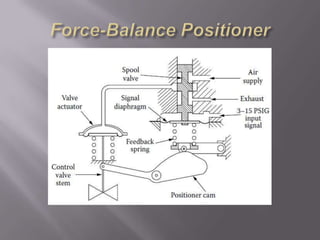
 Force Balance Positioner
 Motion Balance Positioner
 Electro-Pneumatic Positioner
 Digital to Pneumatic Positioner
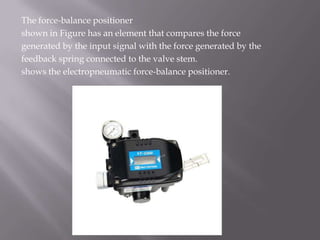
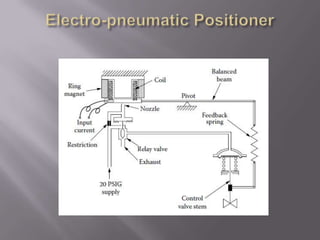
The force-balance positioner
shown in Figure has an element that compares the force
generated by the input signal with the force generated by the
feedback spring connected to the valve stem.
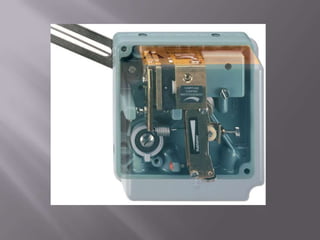
shows the electropneumatic force-balance positioner.
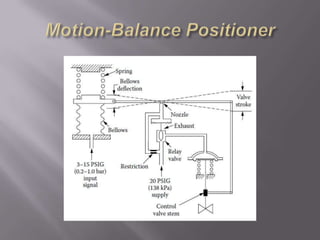
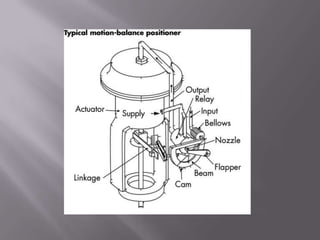
The motion-balance positioner in Figure 6.2g
compares the motion of an input bellows or diaphragm
with linkage attached to the valve stem. Either can be
very accurate. Bellows-type input elements are
generally thought to be more accurate than
diaphragms, and although slightly more likely to fail in
fatigue, both types are used successfully. New and
mostly electronic positioners differ widely in design
and performance.
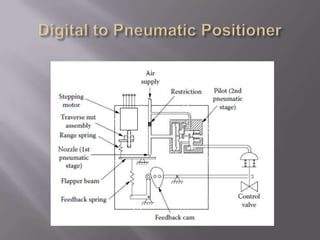
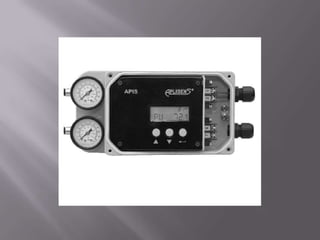
The digital valve actuators are described in Section 6.3. Some of
the digital to pneumatic positioner designs have used rotary
motors to control the pilot system. These tend to feature
lock-in-place on loss of input signal. Others use a small fast
solenoid valve that switches rapidly between open and
closed to create an average air pressure for the actuator.
Still others may use a piezoelectric valve (electrical signals
cause a deflection in a special crystal structure), either
proportional or pulsating. A pulse stepping motor may
rotate a shaft to set a follower, which develops an input
signal force or position . The remainder of the positioner is
pneumatic. Stroke speed may be limited by stepping motor
response. The only way to make decisions during the
selection process with the many different designs with their
many subtle differences may be to rely on proven
performance.
Control valve positioners

Control valve positioners

  • 1.
  • 2.
     A positioneris a device put into a valve to ensure that it is at a correct position of opening as per the control signal. An I/P converter only sends the opening/closing request to valve but can not confirm its position. Positioner senses the valve opening through a position feedback link connected to valve stem which is its input signal. I/P converter output is its setpoint input. The difference between these two is the error signal based on which the positioner positions the valve to correct position to reduce error to zero. Hence positioner is nothing but a pneumatic feedback controller. Controlled external supply air to positioner provides power to positioner to position a valve. Also positioner is used in a valve when valve operating signal range is different from I/P converter output range. In recent days software configurable digital positioner are being used in valves which do not require I/P converter and has many features like advanced valve diagnostics, partial stroke testing, remote communication etc
  • 3.
    The purpose ofa positioner is to improve the accuracy of control valve response. This means that the valve position will more closely approach the position commanded by the control system. A positioner can reduce the effects of many dynamic variations. These include changes in packing friction due to dirt, corrosion, lubrication, or lack of lubrication; variations in the dynamic forces of the process; sloppy linkages (causing dead band); and nonlinearities in the valve actuator. The dead band of a good valve/actuator is 2% (Section 6.4), but it has been measured at up to 5%. Large plug valves and ball valves with less than perfect linkages and inadequate actuators may be far worse. A better positioner with the proper actuator can often have a dead band of less than 0.5% of stroke.
  • 4.
     Force BalancePositioner  Motion Balance Positioner  Electro-Pneumatic Positioner  Digital to Pneumatic Positioner
  • 6.
    The force-balance positioner shownin Figure has an element that compares the force generated by the input signal with the force generated by the feedback spring connected to the valve stem. shows the electropneumatic force-balance positioner.
  • 8.
    The motion-balance positionerin Figure 6.2g compares the motion of an input bellows or diaphragm with linkage attached to the valve stem. Either can be very accurate. Bellows-type input elements are generally thought to be more accurate than diaphragms, and although slightly more likely to fail in fatigue, both types are used successfully. New and mostly electronic positioners differ widely in design and performance.
  • 14.
    The digital valveactuators are described in Section 6.3. Some of the digital to pneumatic positioner designs have used rotary motors to control the pilot system. These tend to feature lock-in-place on loss of input signal. Others use a small fast solenoid valve that switches rapidly between open and closed to create an average air pressure for the actuator. Still others may use a piezoelectric valve (electrical signals cause a deflection in a special crystal structure), either proportional or pulsating. A pulse stepping motor may rotate a shaft to set a follower, which develops an input signal force or position . The remainder of the positioner is pneumatic. Stroke speed may be limited by stepping motor response. The only way to make decisions during the selection process with the many different designs with their many subtle differences may be to rely on proven performance.