CASCADE CONTROL SYSTEM
Prepared by,
1. Vedant Patel (140130117089).
2. Neel Patel (140130117083).
3. Sachin Patel (140130117087).
 Introduction
Requirement
Block Diagram
Application In Power Plants
Drawbacks
Advantages
INTRODUCTION
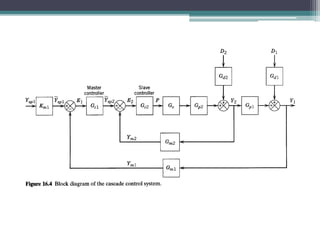
• In cascade control a process is contrloed by two
controllers in such way that both are acting for each
other.
• Cascade control is technique which contains two closed
loop control cascade to each other in such way that first
loop controller output will be set point for second loop
controller .it is called remote set point for second
controller.
• In cascade control First Loop called Master
Controller and second loop called Slave
Controller.
• Master controller generate the set point for the slave
controller.
• Finally slave controller control the process depends upon
the remote set point provide by the master controller.
Why We Required The Cascade
Control?
• In simple closed loop control , controller is controlling
single measured variable at a point , so it is called single
point closed loop control. So in short the process has
only one stage information for control and less effective
with respect to change in set point.
• In cascade we are controlling single variable in two stage
. We have effective control of process with respect to
disturbance and set point change.
• Cascade control are used where required precise and
critical control.
• Cascade control are able to compensate the load change
of process and maintain at desired set value of any
physical quantity.
Block diagram
The Block Diagram Symbols
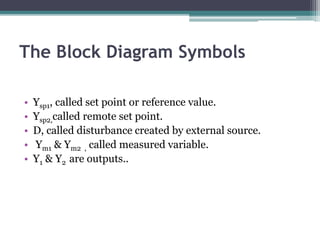
• Ysp1, called set point or reference value.
• Ysp2,called remote set point.
• D, called disturbance created by external source.
• Ym1 & Ym2 , called measured variable.
• Y1 & Y2 are outputs..
Application In Power Plant
• Cascade control are used in steam power plants at…
• BOILER….
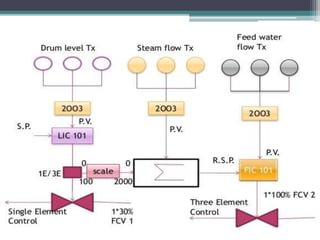
• In boiler we are using various types of closed loop
control and cascade controls. Some cascade loops are
given below.
• 1. Drum level control
• 2. steam temperature control.
Drum level control
Drawbacks
• Cascade control makes the system more complex.
• Cascade control required more instruments and
equipments which leads the cost of process.
• tuning of cascade controllers are more difficult then
closed loop control.
• It requires an additional measurement (usually flow
rate) to work.
• Cascade control should generally not be used if the inner
loop is not at least three times faster then the outer loop ,
because the improved performance may not justify the
added complexity.
Advantages
• Reduce the dead time and phase lag time in the control
system.
• Can be combined with feed forward and other types of
controllers.
• Improved dynamic response and performance and
provide limit on secondary variable.
• Cascade control should always be used if you have a
process with relatively show dynamics (likes level,
temperature , composition, humidity ) and liquid or gas
flow ,or some other relatively-fast process, has to be
manipulated to control the slow process.
Cascade control system

Cascade control system

  • 1.
    CASCADE CONTROL SYSTEM Preparedby, 1. Vedant Patel (140130117089). 2. Neel Patel (140130117083). 3. Sachin Patel (140130117087).
  • 2.
     Introduction Requirement Block Diagram ApplicationIn Power Plants Drawbacks Advantages
  • 3.
    INTRODUCTION • In cascadecontrol a process is contrloed by two controllers in such way that both are acting for each other. • Cascade control is technique which contains two closed loop control cascade to each other in such way that first loop controller output will be set point for second loop controller .it is called remote set point for second controller. • In cascade control First Loop called Master Controller and second loop called Slave Controller.
  • 4.
    • Master controllergenerate the set point for the slave controller. • Finally slave controller control the process depends upon the remote set point provide by the master controller.
  • 5.
    Why We RequiredThe Cascade Control? • In simple closed loop control , controller is controlling single measured variable at a point , so it is called single point closed loop control. So in short the process has only one stage information for control and less effective with respect to change in set point. • In cascade we are controlling single variable in two stage . We have effective control of process with respect to disturbance and set point change. • Cascade control are used where required precise and critical control. • Cascade control are able to compensate the load change of process and maintain at desired set value of any physical quantity.
  • 6.
  • 7.
    The Block DiagramSymbols • Ysp1, called set point or reference value. • Ysp2,called remote set point. • D, called disturbance created by external source. • Ym1 & Ym2 , called measured variable. • Y1 & Y2 are outputs..
  • 8.
    Application In PowerPlant • Cascade control are used in steam power plants at… • BOILER…. • In boiler we are using various types of closed loop control and cascade controls. Some cascade loops are given below. • 1. Drum level control • 2. steam temperature control.
  • 9.
  • 10.
    Drawbacks • Cascade controlmakes the system more complex. • Cascade control required more instruments and equipments which leads the cost of process. • tuning of cascade controllers are more difficult then closed loop control. • It requires an additional measurement (usually flow rate) to work. • Cascade control should generally not be used if the inner loop is not at least three times faster then the outer loop , because the improved performance may not justify the added complexity.
  • 11.
    Advantages • Reduce thedead time and phase lag time in the control system. • Can be combined with feed forward and other types of controllers. • Improved dynamic response and performance and provide limit on secondary variable. • Cascade control should always be used if you have a process with relatively show dynamics (likes level, temperature , composition, humidity ) and liquid or gas flow ,or some other relatively-fast process, has to be manipulated to control the slow process.