1
Instrumentation and Process
Control (CHE 323)
Lecture 36 :
1. Multi-loop control
i. Cascade control
ii. Ratio control
iii. Split-range control
2. Servo and regulator problems
1. Multi-loop control
a) Single-input, single-output (SISO), or single-loop,
control problems
Control problems that have only one controlled
variable and one manipulated variable.
b) Multiple-input, multiple-output (MIMO) control
problems
In many practical control problems, typically a
number of variables must be controlled, and a
number of variables can be manipulated. These
problems are referred to as multiple-input, multiple-
output (MIMO) control problems.
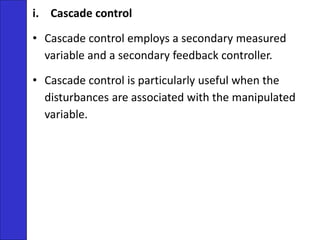
i. Cascade control
• Cascade control employs a secondary measured
variable and a secondary feedback controller.
• Cascade control is particularly useful when the
disturbances are associated with the manipulated
variable.
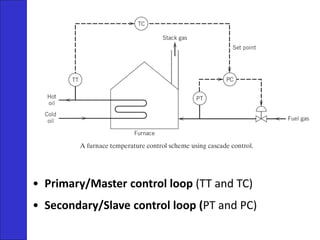
• If a disturbance occurs in the fuel gas supply pressure (disturbance
associated with the manipulated variable),
 Then, feedback control will give very sluggish responses to changes in
fuel gas supply pressure.
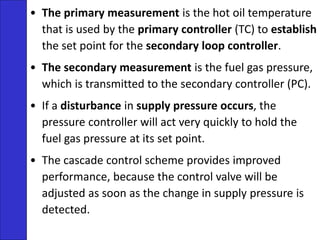
• Primary/Master control loop (TT and TC)
• Secondary/Slave control loop (PT and PC)
• The primary measurement is the hot oil temperature
that is used by the primary controller (TC) to establish
the set point for the secondary loop controller.
• The secondary measurement is the fuel gas pressure,
which is transmitted to the secondary controller (PC).
• If a disturbance in supply pressure occurs, the
pressure controller will act very quickly to hold the
fuel gas pressure at its set point.
• The cascade control scheme provides improved
performance, because the control valve will be
adjusted as soon as the change in supply pressure is
detected.
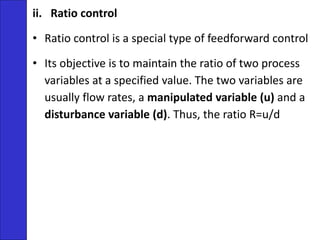
ii. Ratio control
• Ratio control is a special type of feedforward control
• Its objective is to maintain the ratio of two process
variables at a specified value. The two variables are
usually flow rates, a manipulated variable (u) and a
disturbance variable (d). Thus, the ratio R=u/d
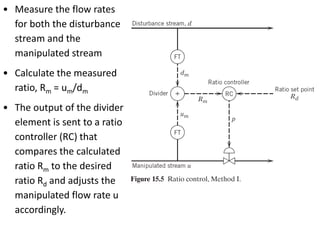
• Measure the flow rates
for both the disturbance
stream and the
manipulated stream
• Calculate the measured
ratio, Rm = um/dm
• The output of the divider
element is sent to a ratio
controller (RC) that
compares the calculated
ratio Rm to the desired
ratio Rd and adjusts the
manipulated flow rate u
accordingly.
iii. Split-range control
• In split-range control, several manipulated variables
are used to control a single controlled variable.
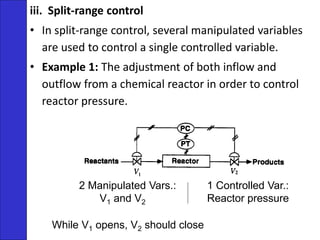
• Example 1: The adjustment of both inflow and
outflow from a chemical reactor in order to control
reactor pressure.
2 Manipulated Vars.:
V1 and V2
1 Controlled Var.:
Reactor pressure
While V1 opens, V2 should close
iii. Split-range control (Cont’d)
• Example 2: The adjustment of both acid and base flow
to control pH in wastewater treatment.
• Example 3: In reactor control, where both heating and
cooling are used to maintain precise regulation of the
reactor temperature.
2. Servo and regulator problems
• Servo problem: The closed-loop system behavior for
set-point changes, assume no disturbance occur.
• Regulator problem: The process is to be regulated at
a constant set point while the disturbance changes

IPC - Lectures 36 (Multiloop-control).pdf

  • 1.
    1 Instrumentation and Process Control(CHE 323) Lecture 36 : 1. Multi-loop control i. Cascade control ii. Ratio control iii. Split-range control 2. Servo and regulator problems
  • 2.
    1. Multi-loop control a)Single-input, single-output (SISO), or single-loop, control problems Control problems that have only one controlled variable and one manipulated variable. b) Multiple-input, multiple-output (MIMO) control problems In many practical control problems, typically a number of variables must be controlled, and a number of variables can be manipulated. These problems are referred to as multiple-input, multiple- output (MIMO) control problems.
  • 5.
    i. Cascade control •Cascade control employs a secondary measured variable and a secondary feedback controller. • Cascade control is particularly useful when the disturbances are associated with the manipulated variable.
  • 6.
    • If adisturbance occurs in the fuel gas supply pressure (disturbance associated with the manipulated variable),  Then, feedback control will give very sluggish responses to changes in fuel gas supply pressure.
  • 7.
    • Primary/Master controlloop (TT and TC) • Secondary/Slave control loop (PT and PC)
  • 8.
    • The primarymeasurement is the hot oil temperature that is used by the primary controller (TC) to establish the set point for the secondary loop controller. • The secondary measurement is the fuel gas pressure, which is transmitted to the secondary controller (PC). • If a disturbance in supply pressure occurs, the pressure controller will act very quickly to hold the fuel gas pressure at its set point. • The cascade control scheme provides improved performance, because the control valve will be adjusted as soon as the change in supply pressure is detected.
  • 9.
    ii. Ratio control •Ratio control is a special type of feedforward control • Its objective is to maintain the ratio of two process variables at a specified value. The two variables are usually flow rates, a manipulated variable (u) and a disturbance variable (d). Thus, the ratio R=u/d
  • 10.
    • Measure theflow rates for both the disturbance stream and the manipulated stream • Calculate the measured ratio, Rm = um/dm • The output of the divider element is sent to a ratio controller (RC) that compares the calculated ratio Rm to the desired ratio Rd and adjusts the manipulated flow rate u accordingly.
  • 11.
    iii. Split-range control •In split-range control, several manipulated variables are used to control a single controlled variable. • Example 1: The adjustment of both inflow and outflow from a chemical reactor in order to control reactor pressure. 2 Manipulated Vars.: V1 and V2 1 Controlled Var.: Reactor pressure While V1 opens, V2 should close
  • 12.
    iii. Split-range control(Cont’d) • Example 2: The adjustment of both acid and base flow to control pH in wastewater treatment. • Example 3: In reactor control, where both heating and cooling are used to maintain precise regulation of the reactor temperature.
  • 13.
    2. Servo andregulator problems • Servo problem: The closed-loop system behavior for set-point changes, assume no disturbance occur. • Regulator problem: The process is to be regulated at a constant set point while the disturbance changes