



WEL-COME TO
RAI SAHEB BHANWAR
SINGH COLLEGE
NASRULLAGANJ
PHYSICS PRESENTATION
Topic- Circular and
Elliptical Polarizer
Presented to Presented by
Gyan rao Dhote Sanjay Panwar
Circular polarizers-
Circular polarizers, also referred to as circular polarizing
filters, can be used to create circularly polarized light or
alternatively to selectively absorb or pass clockwise and
counter-clockwise circularly polarized light. They are used
aspolarizing filters in photography to reduce oblique
reflections from non-metallic surfaces, and are the lenses of
the 3D glasses worn for the viewing
some stereoscopic movies (notably, the RealD 3D variety),
where the polarization of light is used to differentiate which
image should be seen by the left and right eye
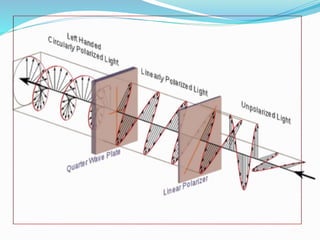
There are several ways to create circularly polarized light, the
cheapest and most common involves placing a quarter-wave
plate after a linear polarizer and directing unpolarized light through
the linear polarizer. The linearly polarized light leaving the linear
polarizer is transformed into circularly polarized light by the quarter
wave plate. The transmission axis of the linear polarizer needs to be
half way (45°) between the fast and slow
axes of the quarter-wave plate. In the arrangement above, the
transmission axis of the linear polarizer is at a positive 45° angle
relative to the right horizontal and is represented with an orange line.
The quarter-wave plate has a horizontal slow axis and a vertical fast
axis and they are also represented using orange lines. In this instance
the unpolarized light entering the linear polarizer is displayed as a
single wave whose amplitude and angle of linear polarization are
suddenly changing.
I
circularly polarized when viewed from the receiver.

Because the quarter-wave plate is made of
a birefringent material, when in the wave plate, the light
travels at different speeds depending on the direction of
its electric field. This means that the horizontal
component which is along the slow axis of the wave plate
will travel at a slower speed than the component that is
directed along the vertical fast axis. Initially the two
components are in phase, but as the two components
travel through the wave plate the horizontal component
of the light drifts farther behind that of the vertical. By
adjusting the thickness of the wave plate one can control
how much the horizontal.
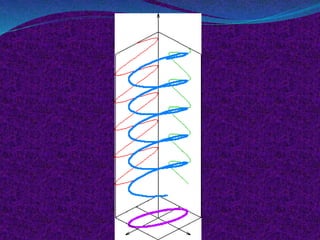
ELLIPTICAL POLARIZATION-
Inelectrodynamics, elliptical polarization is
the polarization of electromagnetic radiation such that the tip of
the electric field vector describes an ellipse in any fixed plane
intersecting, and normal to, the direction of propagation. An
elliptically polarized wave may be resolved into two linearly
polarized waves in phase quadrature, with their polarization planes
at right angles to each other. Since the electric field can rotate
clockwise or counterclockwise as it propagates, elliptically polarized
waves exhibit chirality.
Other forms of polarization, such as circular and linear polarization,
can be considered to be special cases of elliptical polarization.
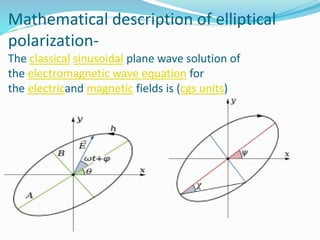
Mathematical description of elliptical
polarization-
The classical sinusoidal plane wave solution of
the electromagnetic wave equation for
the electricand magnetic fields is (cgs units)
CIRCULAR AND ELLIPTICAL POLARIZER

CIRCULAR AND ELLIPTICAL POLARIZER

  • 1.
    WEL-COME TO RAI SAHEBBHANWAR SINGH COLLEGE NASRULLAGANJ
  • 2.
    PHYSICS PRESENTATION Topic- Circularand Elliptical Polarizer Presented to Presented by Gyan rao Dhote Sanjay Panwar
  • 3.
    Circular polarizers- Circular polarizers,also referred to as circular polarizing filters, can be used to create circularly polarized light or alternatively to selectively absorb or pass clockwise and counter-clockwise circularly polarized light. They are used aspolarizing filters in photography to reduce oblique reflections from non-metallic surfaces, and are the lenses of the 3D glasses worn for the viewing some stereoscopic movies (notably, the RealD 3D variety), where the polarization of light is used to differentiate which image should be seen by the left and right eye
  • 5.
    There are severalways to create circularly polarized light, the cheapest and most common involves placing a quarter-wave plate after a linear polarizer and directing unpolarized light through the linear polarizer. The linearly polarized light leaving the linear polarizer is transformed into circularly polarized light by the quarter wave plate. The transmission axis of the linear polarizer needs to be half way (45°) between the fast and slow axes of the quarter-wave plate. In the arrangement above, the transmission axis of the linear polarizer is at a positive 45° angle relative to the right horizontal and is represented with an orange line. The quarter-wave plate has a horizontal slow axis and a vertical fast axis and they are also represented using orange lines. In this instance the unpolarized light entering the linear polarizer is displayed as a single wave whose amplitude and angle of linear polarization are suddenly changing. I
  • 6.
    circularly polarized whenviewed from the receiver.  Because the quarter-wave plate is made of a birefringent material, when in the wave plate, the light travels at different speeds depending on the direction of its electric field. This means that the horizontal component which is along the slow axis of the wave plate will travel at a slower speed than the component that is directed along the vertical fast axis. Initially the two components are in phase, but as the two components travel through the wave plate the horizontal component of the light drifts farther behind that of the vertical. By adjusting the thickness of the wave plate one can control how much the horizontal.
  • 7.
    ELLIPTICAL POLARIZATION- Inelectrodynamics, ellipticalpolarization is the polarization of electromagnetic radiation such that the tip of the electric field vector describes an ellipse in any fixed plane intersecting, and normal to, the direction of propagation. An elliptically polarized wave may be resolved into two linearly polarized waves in phase quadrature, with their polarization planes at right angles to each other. Since the electric field can rotate clockwise or counterclockwise as it propagates, elliptically polarized waves exhibit chirality. Other forms of polarization, such as circular and linear polarization, can be considered to be special cases of elliptical polarization.
  • 9.
    Mathematical description ofelliptical polarization- The classical sinusoidal plane wave solution of the electromagnetic wave equation for the electricand magnetic fields is (cgs units)