Polarization of Light
Polarization
Polarization is a property applying to transverse waves that specifies the geometrical orientation of the
oscillations. In a transverse wave, the direction of the oscillation is perpendicular to the direction of motion of
the wave.
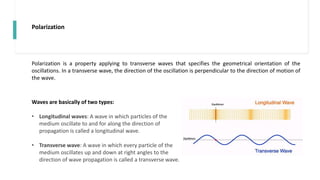
Waves are basically of two types:
• Longitudinal waves: A wave in which particles of the
medium oscillate to and for along the direction of
propagation is called a longitudinal wave.
• Transverse wave: A wave in which every particle of the
medium oscillates up and down at right angles to the
direction of wave propagation is called a transverse wave.
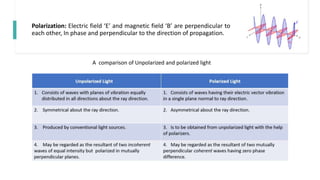
Polarization: Electric field ‘E’ and magnetic field ‘B’ are perpendicular to
each other, In phase and perpendicular to the direction of propagation.
A comparison of Unpolarized and polarized light
Type of Polarization
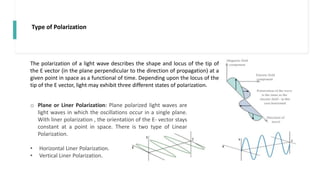
The polarization of a light wave describes the shape and locus of the tip of
the E vector (in the plane perpendicular to the direction of propagation) at a
given point in space as a functional of time. Depending upon the locus of the
tip of the E vector, light may exhibit three different states of polarization.
o Plane or Liner Polarization: Plane polarized light waves are
light waves in which the oscillations occur in a single plane.
With liner polarization , the orientation of the E- vector stays
constant at a point in space. There is two type of Linear
Polarization.
• Horizontal Liner Polarization.
• Vertical Liner Polarization.
Type of Polarization
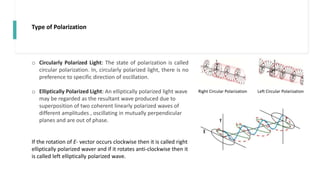
o Circularly Polarized Light: The state of polarization is called
circular polarization. In, circularly polarized light, there is no
preference to specific direction of oscillation.
o Elliptically Polarized Light: An elliptically polarized light wave
may be regarded as the resultant wave produced due to
superposition of two coherent linearly polarized waves of
different amplitudes , oscillating in mutually perpendicular
planes and are out of phase.
If the rotation of E- vector occurs clockwise then it is called right
elliptically polarized waver and if it rotates anti-clockwise then it
is called left elliptically polarized wave.
Right Circular Polarization Left Circular Polarization
Type of Polarization
o Partially Polarized Light: Partially polarized light, like natural light, can be represented in the form of a
superposition of two inherent plane of oscillations.
Degree of Polarization: We define the degree of polarization with the help of the following expression.
𝑃 = ( 𝐼max −𝐼𝑚𝑖𝑛 )/ (𝐼𝑚𝑎𝑥 + 𝐼𝑚𝑖𝑛)
% Polarization =[( 𝐼max −𝐼𝑚𝑖𝑛 )/ (𝐼𝑚𝑎𝑥 + 𝐼𝑚𝑖𝑛)] × 100
The intensity of the transmitted light will change within the limits from 𝐼𝑚𝑎𝑥 to 𝐼𝑚𝑖𝑛
• For plane polarized light 𝐼𝑚𝑖𝑛 = 0, and hence P = 1 , and the 1 % polarization is 100% .
• For natural light, 𝐼𝑚𝑎𝑥 = 𝐼𝑚𝑖𝑛 , and hence P =0 and the % polarization is zero .
If 𝐼𝑚𝑎𝑥 = 2 𝐼𝑚𝑖𝑛, P = 0.33 and polarization = 100/3 =33%
Malus Law
Malus Law was derived by Etienne-Louis Malus in 1808. He discovered that natural light could be polarized
when reflected by a glass surface. He used a calcite crystal to conduct his experiment. This law is useful in
quantitatively verifying the nature of polarised light.
Coming to the expression of Malus law, let us first see two points
• When unpolarized light is incident on an ideal polarizer, the intensity of the transmitted light is exactly half
of the intensity of the incident unpolarized light, regardless of how the polarizing axis is oriented.
• An ideal polarizing filter allows 100% of the incident unpolarized light to pass through, which is polarized in
the direction of the filter’s polarizing axis.
The intensity of plane-polarized light that passes through an analyzer varies directly with the square of the
cosine of the angle between the plane of the polarizer and the transmission axes of the analyzer.
Malus Law
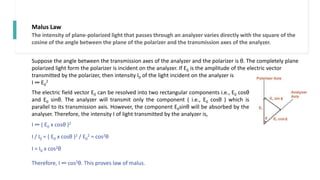
Suppose the angle between the transmission axes of the analyzer and the polarizer is θ. The completely plane
polarized light form the polarizer is incident on the analyzer. If E0 is the amplitude of the electric vector
transmitted by the polarizer, then intensity I0 of the light incident on the analyzer is
I ∞ E0
2
The electric field vector E0 can be resolved into two rectangular components i.e., E0 cosθ
and E0 sinθ. The analyzer will transmit only the component ( i.e., E0 cosθ ) which is
parallel to its transmission axis. However, the component E0sinθ will be absorbed by the
analyser. Therefore, the intensity I of light transmitted by the analyzer is,
I ∞ ( E0 x cosθ )2
I / I0 = ( E0 x cosθ )2 / E0
2 = cos2θ
I = I0 x cos2θ
Therefore, I ∞ cos2θ. This proves law of malus.
The intensity of plane-polarized light that passes through an analyzer varies directly with the square of the
cosine of the angle between the plane of the polarizer and the transmission axes of the analyzer.
Malus Law
The intensity of plane-polarized light that passes through an analyzer varies directly with the square of the
cosine of the angle between the plane of the polarizer and the transmission axes of the analyzer.
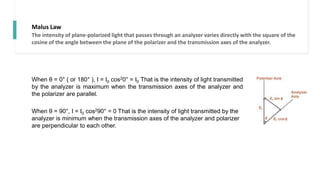
When θ = 0° ( or 180° ), I = I0 cos20° = I0 That is the intensity of light transmitted
by the analyzer is maximum when the transmission axes of the analyzer and
the polarizer are parallel.
When θ = 90°, I = I0 cos290° = 0 That is the intensity of light transmitted by the
analyzer is minimum when the transmission axes of the analyzer and polarizer
are perpendicular to each other.
Methods of Polarizations
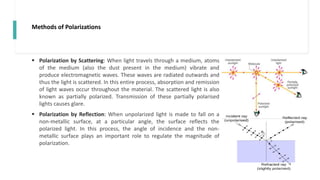
 Polarization by Scattering: When light travels through a medium, atoms
of the medium (also the dust present in the medium) vibrate and
produce electromagnetic waves. These waves are radiated outwards and
thus the light is scattered. In this entire process, absorption and remission
of light waves occur throughout the material. The scattered light is also
known as partially polarized. Transmission of these partially polarised
lights causes glare.
 Polarization by Reflection: When unpolarized light is made to fall on a
non-metallic surface, at a particular angle, the surface reflects the
polarized light. In this process, the angle of incidence and the non-
metallic surface plays an important role to regulate the magnitude of
polarization.
Methods of Polarizations
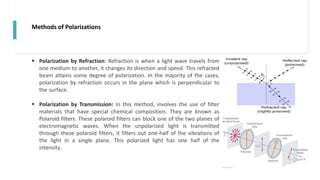
 Polarization by Refraction: Refraction is when a light wave travels from
one medium to another, it changes its direction and speed. This refracted
beam attains some degree of polarization. In the majority of the cases,
polarization by refraction occurs in the plane which is perpendicular to
the surface.
 Polarization by Transmission: In this method, involves the use of filter
materials that have special chemical composition. They are known as
Polaroid filters. These polaroid filters can block one of the two planes of
electromagnetic waves. When the unpolarized light is transmitted
through these polaroid filters, it filters out one-half of the vibrations of
the light in a single plane. This polarized light has one half of the
intensity.
Applications of Polarized Light
• Sunglass: Light emitted by the Sun is unpolarized, but sunlight can become at least partly polarized when it
reflects from a flat surface. In general, the direction of polarization is parallel to the plane of the reflecting
surface. Light commonly reflects from horizontal surfaces. The lenses in polarized sunglasses have vertical
transmission axes, so they block light polarized horizontally. This greatly reduces glare from light reflecting off
horizontal surfaces.
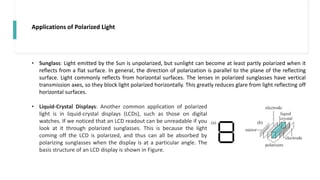
• Liquid-Crystal Displays: Another common application of polarized
light is in liquid-crystal displays (LCDs), such as those on digital
watches. If we noticed that an LCD readout can be unreadable if you
look at it through polarized sunglasses. This is because the light
coming off the LCD is polarized, and thus can all be absorbed by
polarizing sunglasses when the display is at a particular angle. The
basis structure of an LCD display is shown in Figure.
Applications of Polarized Light
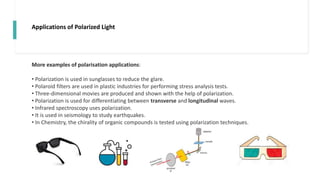
More examples of polarisation applications:
• Polarization is used in sunglasses to reduce the glare.
• Polaroid filters are used in plastic industries for performing stress analysis tests.
• Three-dimensional movies are produced and shown with the help of polarization.
• Polarization is used for differentiating between transverse and longitudinal waves.
• Infrared spectroscopy uses polarization.
• It is used in seismology to study earthquakes.
• In Chemistry, the chirality of organic compounds is tested using polarization techniques.

Polarization of Light.pptx

  • 1.
  • 2.
    Polarization Polarization is aproperty applying to transverse waves that specifies the geometrical orientation of the oscillations. In a transverse wave, the direction of the oscillation is perpendicular to the direction of motion of the wave. Waves are basically of two types: • Longitudinal waves: A wave in which particles of the medium oscillate to and for along the direction of propagation is called a longitudinal wave. • Transverse wave: A wave in which every particle of the medium oscillates up and down at right angles to the direction of wave propagation is called a transverse wave.
  • 3.
    Polarization: Electric field‘E’ and magnetic field ‘B’ are perpendicular to each other, In phase and perpendicular to the direction of propagation. A comparison of Unpolarized and polarized light
  • 4.
    Type of Polarization Thepolarization of a light wave describes the shape and locus of the tip of the E vector (in the plane perpendicular to the direction of propagation) at a given point in space as a functional of time. Depending upon the locus of the tip of the E vector, light may exhibit three different states of polarization. o Plane or Liner Polarization: Plane polarized light waves are light waves in which the oscillations occur in a single plane. With liner polarization , the orientation of the E- vector stays constant at a point in space. There is two type of Linear Polarization. • Horizontal Liner Polarization. • Vertical Liner Polarization.
  • 5.
    Type of Polarization oCircularly Polarized Light: The state of polarization is called circular polarization. In, circularly polarized light, there is no preference to specific direction of oscillation. o Elliptically Polarized Light: An elliptically polarized light wave may be regarded as the resultant wave produced due to superposition of two coherent linearly polarized waves of different amplitudes , oscillating in mutually perpendicular planes and are out of phase. If the rotation of E- vector occurs clockwise then it is called right elliptically polarized waver and if it rotates anti-clockwise then it is called left elliptically polarized wave. Right Circular Polarization Left Circular Polarization
  • 6.
    Type of Polarization oPartially Polarized Light: Partially polarized light, like natural light, can be represented in the form of a superposition of two inherent plane of oscillations. Degree of Polarization: We define the degree of polarization with the help of the following expression. 𝑃 = ( 𝐼max −𝐼𝑚𝑖𝑛 )/ (𝐼𝑚𝑎𝑥 + 𝐼𝑚𝑖𝑛) % Polarization =[( 𝐼max −𝐼𝑚𝑖𝑛 )/ (𝐼𝑚𝑎𝑥 + 𝐼𝑚𝑖𝑛)] × 100 The intensity of the transmitted light will change within the limits from 𝐼𝑚𝑎𝑥 to 𝐼𝑚𝑖𝑛 • For plane polarized light 𝐼𝑚𝑖𝑛 = 0, and hence P = 1 , and the 1 % polarization is 100% . • For natural light, 𝐼𝑚𝑎𝑥 = 𝐼𝑚𝑖𝑛 , and hence P =0 and the % polarization is zero . If 𝐼𝑚𝑎𝑥 = 2 𝐼𝑚𝑖𝑛, P = 0.33 and polarization = 100/3 =33%
  • 7.
    Malus Law Malus Lawwas derived by Etienne-Louis Malus in 1808. He discovered that natural light could be polarized when reflected by a glass surface. He used a calcite crystal to conduct his experiment. This law is useful in quantitatively verifying the nature of polarised light. Coming to the expression of Malus law, let us first see two points • When unpolarized light is incident on an ideal polarizer, the intensity of the transmitted light is exactly half of the intensity of the incident unpolarized light, regardless of how the polarizing axis is oriented. • An ideal polarizing filter allows 100% of the incident unpolarized light to pass through, which is polarized in the direction of the filter’s polarizing axis. The intensity of plane-polarized light that passes through an analyzer varies directly with the square of the cosine of the angle between the plane of the polarizer and the transmission axes of the analyzer.
  • 8.
    Malus Law Suppose theangle between the transmission axes of the analyzer and the polarizer is θ. The completely plane polarized light form the polarizer is incident on the analyzer. If E0 is the amplitude of the electric vector transmitted by the polarizer, then intensity I0 of the light incident on the analyzer is I ∞ E0 2 The electric field vector E0 can be resolved into two rectangular components i.e., E0 cosθ and E0 sinθ. The analyzer will transmit only the component ( i.e., E0 cosθ ) which is parallel to its transmission axis. However, the component E0sinθ will be absorbed by the analyser. Therefore, the intensity I of light transmitted by the analyzer is, I ∞ ( E0 x cosθ )2 I / I0 = ( E0 x cosθ )2 / E0 2 = cos2θ I = I0 x cos2θ Therefore, I ∞ cos2θ. This proves law of malus. The intensity of plane-polarized light that passes through an analyzer varies directly with the square of the cosine of the angle between the plane of the polarizer and the transmission axes of the analyzer.
  • 9.
    Malus Law The intensityof plane-polarized light that passes through an analyzer varies directly with the square of the cosine of the angle between the plane of the polarizer and the transmission axes of the analyzer. When θ = 0° ( or 180° ), I = I0 cos20° = I0 That is the intensity of light transmitted by the analyzer is maximum when the transmission axes of the analyzer and the polarizer are parallel. When θ = 90°, I = I0 cos290° = 0 That is the intensity of light transmitted by the analyzer is minimum when the transmission axes of the analyzer and polarizer are perpendicular to each other.
  • 10.
    Methods of Polarizations Polarization by Scattering: When light travels through a medium, atoms of the medium (also the dust present in the medium) vibrate and produce electromagnetic waves. These waves are radiated outwards and thus the light is scattered. In this entire process, absorption and remission of light waves occur throughout the material. The scattered light is also known as partially polarized. Transmission of these partially polarised lights causes glare.  Polarization by Reflection: When unpolarized light is made to fall on a non-metallic surface, at a particular angle, the surface reflects the polarized light. In this process, the angle of incidence and the non- metallic surface plays an important role to regulate the magnitude of polarization.
  • 11.
    Methods of Polarizations Polarization by Refraction: Refraction is when a light wave travels from one medium to another, it changes its direction and speed. This refracted beam attains some degree of polarization. In the majority of the cases, polarization by refraction occurs in the plane which is perpendicular to the surface.  Polarization by Transmission: In this method, involves the use of filter materials that have special chemical composition. They are known as Polaroid filters. These polaroid filters can block one of the two planes of electromagnetic waves. When the unpolarized light is transmitted through these polaroid filters, it filters out one-half of the vibrations of the light in a single plane. This polarized light has one half of the intensity.
  • 12.
    Applications of PolarizedLight • Sunglass: Light emitted by the Sun is unpolarized, but sunlight can become at least partly polarized when it reflects from a flat surface. In general, the direction of polarization is parallel to the plane of the reflecting surface. Light commonly reflects from horizontal surfaces. The lenses in polarized sunglasses have vertical transmission axes, so they block light polarized horizontally. This greatly reduces glare from light reflecting off horizontal surfaces. • Liquid-Crystal Displays: Another common application of polarized light is in liquid-crystal displays (LCDs), such as those on digital watches. If we noticed that an LCD readout can be unreadable if you look at it through polarized sunglasses. This is because the light coming off the LCD is polarized, and thus can all be absorbed by polarizing sunglasses when the display is at a particular angle. The basis structure of an LCD display is shown in Figure.
  • 13.
    Applications of PolarizedLight More examples of polarisation applications: • Polarization is used in sunglasses to reduce the glare. • Polaroid filters are used in plastic industries for performing stress analysis tests. • Three-dimensional movies are produced and shown with the help of polarization. • Polarization is used for differentiating between transverse and longitudinal waves. • Infrared spectroscopy uses polarization. • It is used in seismology to study earthquakes. • In Chemistry, the chirality of organic compounds is tested using polarization techniques.