
POLARIZATION
HAROON HUSSAIN
MOIDU
Lecturer
Department of Physics
CMS College, Kottayam
POLARIZATION
 Light wave is a transverse em wave.
 Light wave is described by the electric field vector.
 The polarization of em wave refers to the orientation of
its electric field vector.
 Unpolarized light : A light wave, in which electric field
vector oscillates in all the possible planes
perpendicular to the beam direction.
 Polarized light : A light wave with a definite direction of
oscillation of E-vector, which occurs in a single plane
or in some specific way
 The plane created by the direction of oscillation of the
E vector and the direction of propagation of the beam
is called the plane of polarization of light waves.
Types of Polarization
 The polarization of a light wave describes the shape
and locus of the tip of the E vector( in the plane
perpendicular to the direction of propagation) at a
given point in space as a function of time. Depending
on this , there are three different states of polarization
:
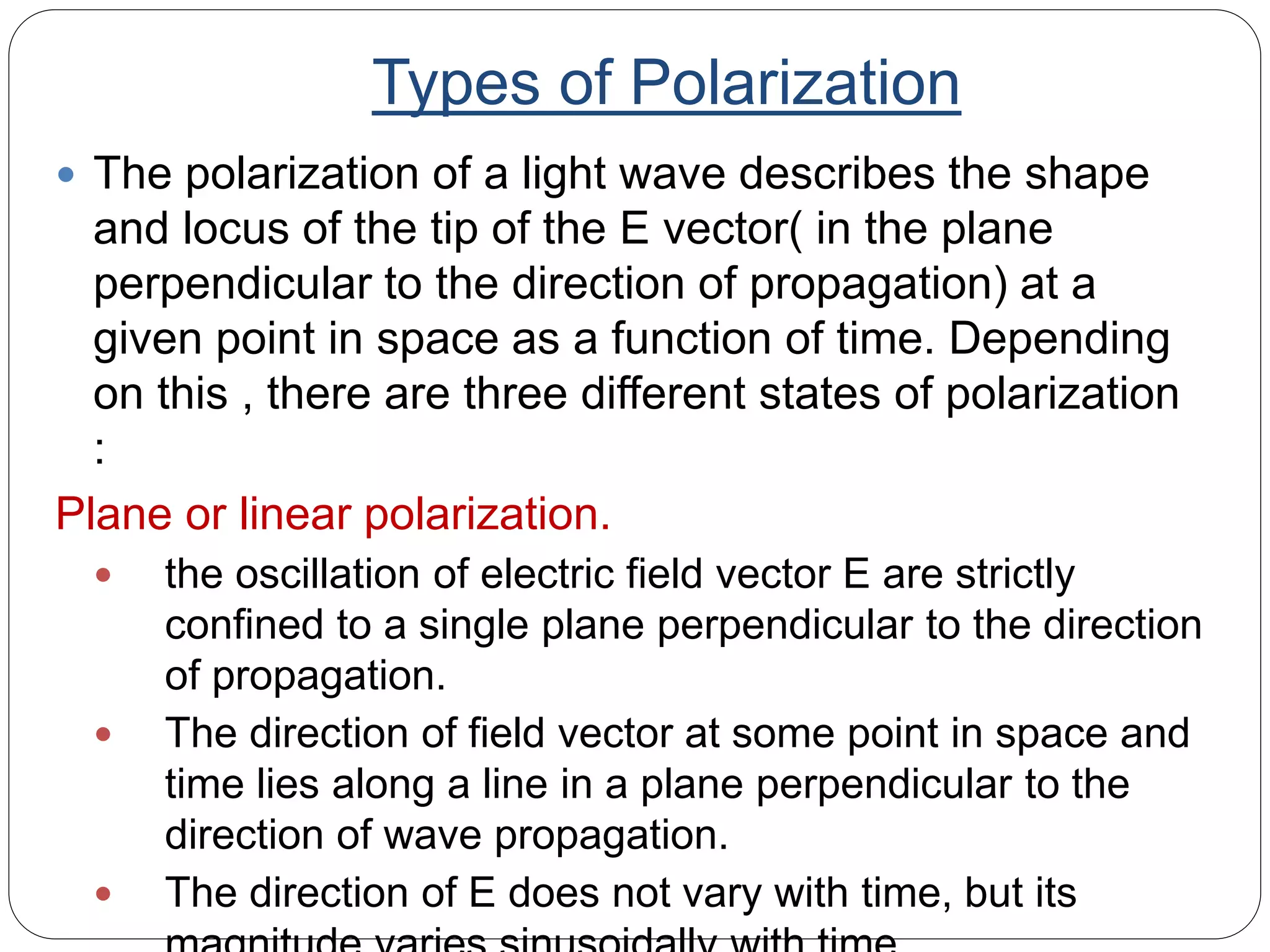
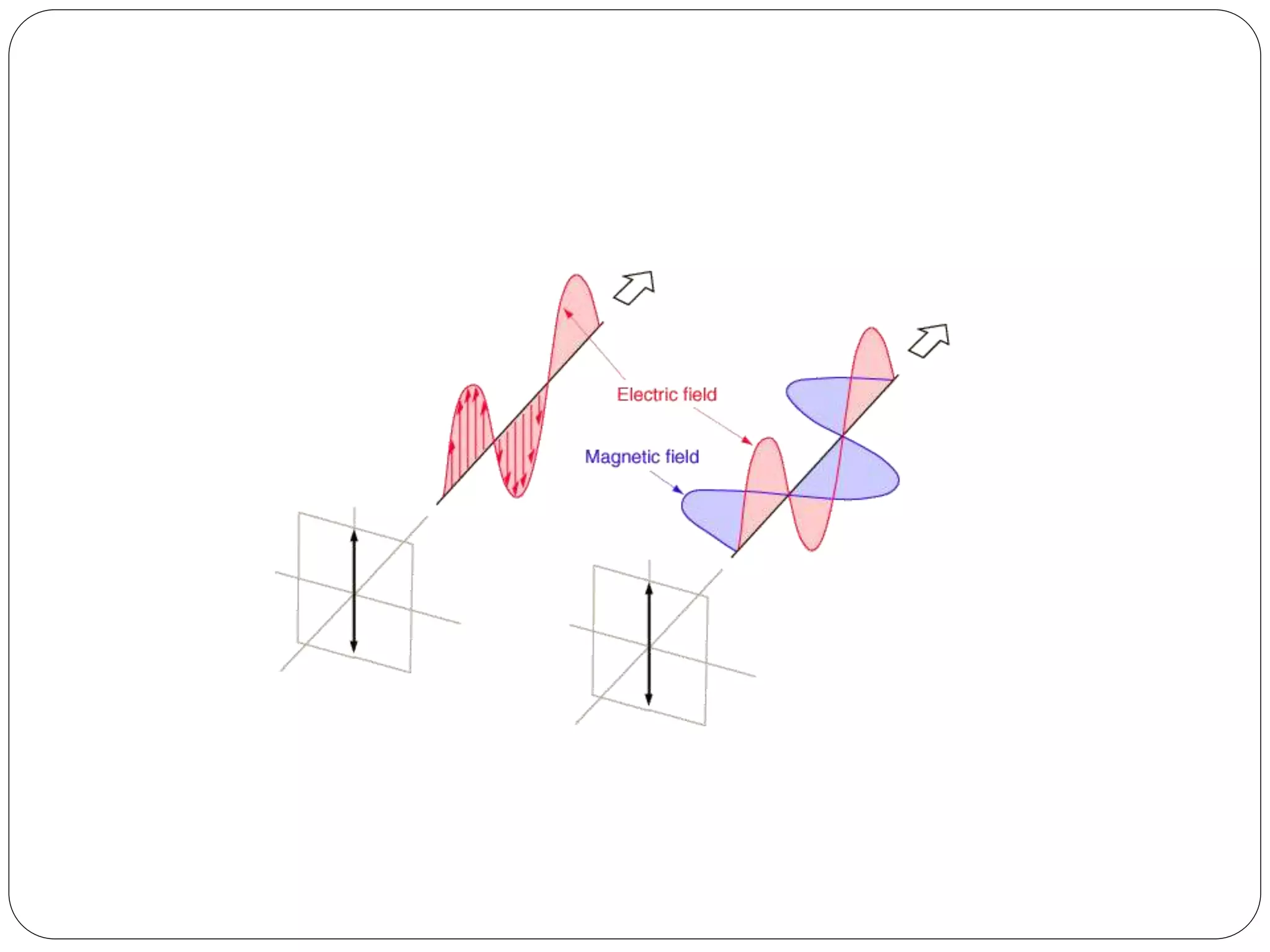
Plane or linear polarization.
 the oscillation of electric field vector E are strictly
confined to a single plane perpendicular to the direction
of propagation.
 The direction of field vector at some point in space and
time lies along a line in a plane perpendicular to the
direction of wave propagation.
 The direction of E does not vary with time, but its
Types of Polarization
Circular polarization.
 In terms of space variation of E, the magnitude of the
E-vector stays constant but it rotates at a constant rate
about the direction of propagation and sweeps a
circular helix in space.
 It is regarded as the resultant wave produced due to
the superposition of two coherent linearly polarized
waves of equal amplitude oscillation in mutual
perpendicular planes and are out of phase by 90.
.
Types of Polarization
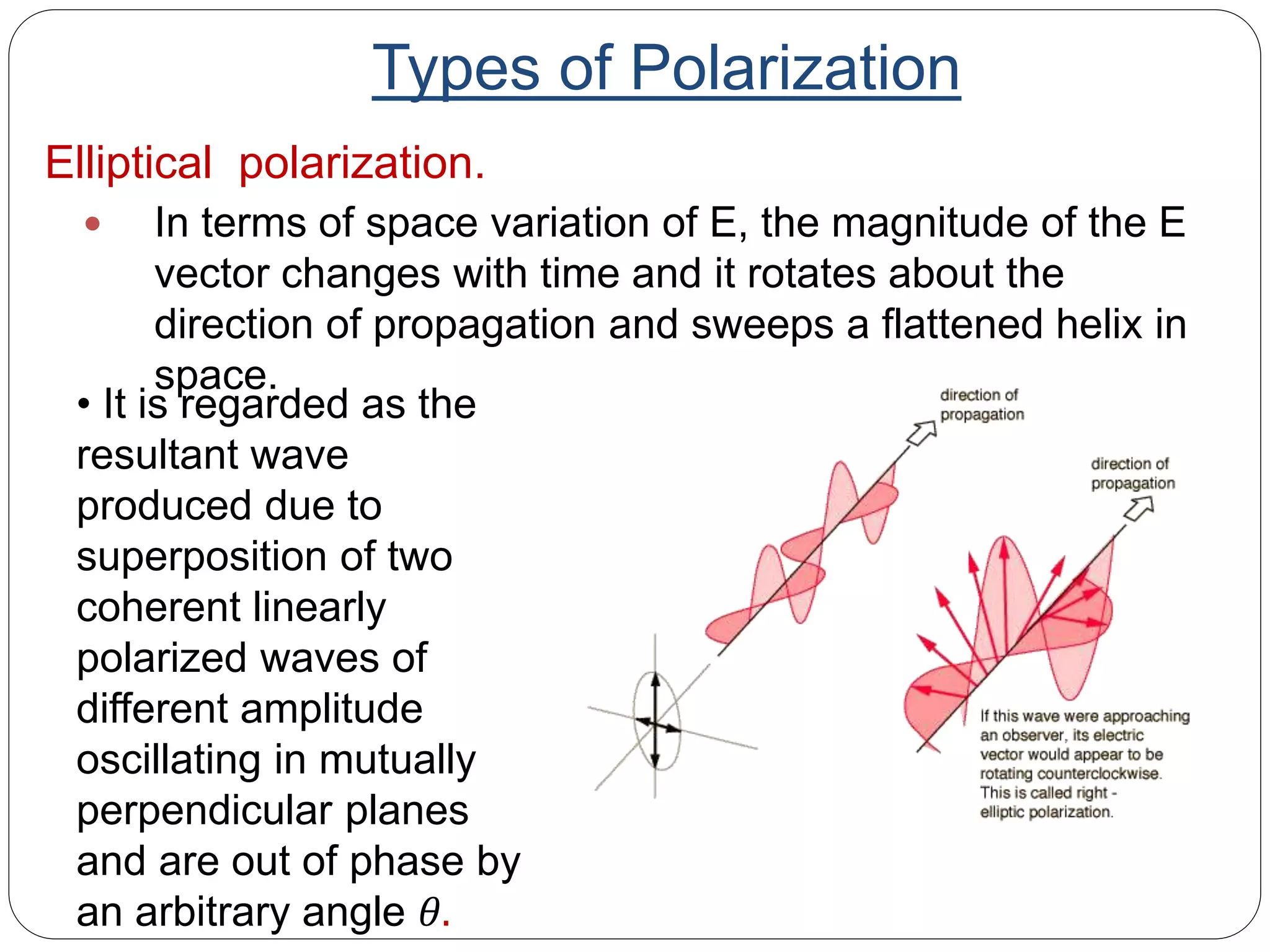
Elliptical polarization.
 In terms of space variation of E, the magnitude of the E
vector changes with time and it rotates about the
direction of propagation and sweeps a flattened helix in
space.
• It is regarded as the
resultant wave
produced due to
superposition of two
coherent linearly
polarized waves of
different amplitude
oscillating in mutually
perpendicular planes
and are out of phase by
an arbitrary angle 𝜃.
Production of Plane polarized light
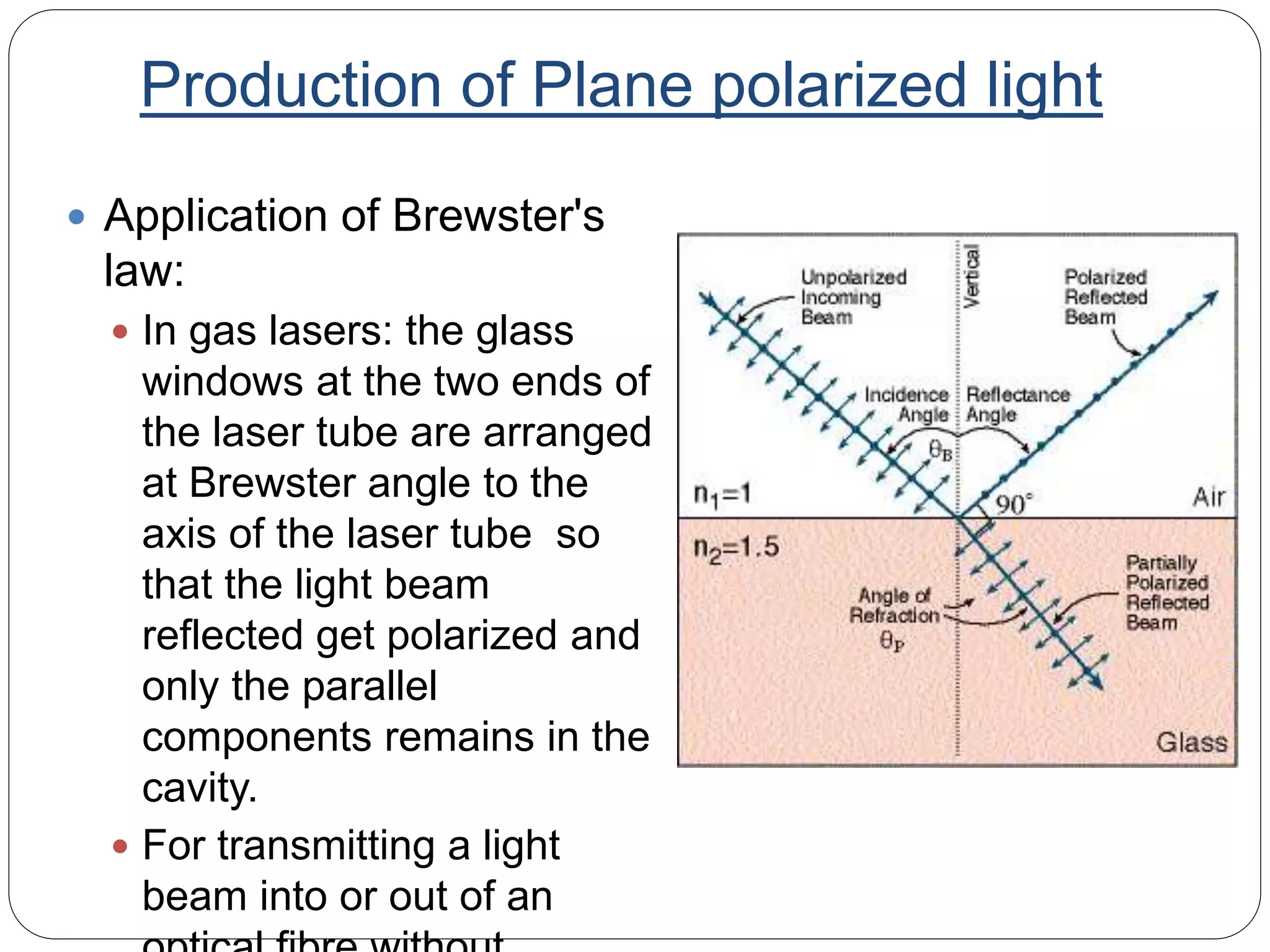
 Polarization by reflection from dielectric surfaces.
 the perpendicular to the plane of incidence is
represented by dots – s component.
 The parallel component lying in the plane of incidence is
represented by arrows – p component.
 At a particular angle of incidence, the reflection
coefficient of p component goes to zero and the
reflected beam does not contain any p-component. It
contain only s component and become totally polarized.
This angle is called polarising angle or Brewster’s angle,
𝜃B.
 Brewster’s Law : the tangent of the angle at which
polarization is obtained by reflection is numerically equal
to the refractive index of medium.
𝜇 = tan 𝜃B
Production of Plane polarized light
 Application of Brewster's
law:
 In gas lasers: the glass
windows at the two ends of
the laser tube are arranged
at Brewster angle to the
axis of the laser tube so
that the light beam
reflected get polarized and
only the parallel
components remains in the
cavity.
 For transmitting a light
beam into or out of an
Production of Plane polarized light
 Polarization by refraction – Piles of plates.
 When unpolarized light is incident at Brewster's angle on
a smooth glass surface, the refracted light is partially
polarized.
 If a stack of glass plates are used, then successive
reflections from successive surfaces occur leading to the
filtering of the s component in the transmitted ray.
 A stack of 15 glass plates is required for this purpose.
 The glass plates are supported in a tube of a suitable
size and cnclined at an angle of about 33 to the axis
Production of Plane polarized light
 Polarization by scattering:
 Polarization by selective absorption ( dichorism)
 Polarization by double refraction:
Huygen’s explanation of double
refraction
 According to Huygen’s theory , a point in a doubly
refracting or birefringent crystal produces 2 types of
wavefronts: (or The incident light excites two separate
wavelets within the crystal )
 Spherical wavefront - corresponding to the O-ray
 The ordinary wave travels with same velocity in all
directions and so the corresponding wavefront is
spherical.
 Ellipsoidal wavefront - corresponding to the E-ray
 Extraordinary waves have different velocities in different
directions, so the corresponding wavefront is elliptical.
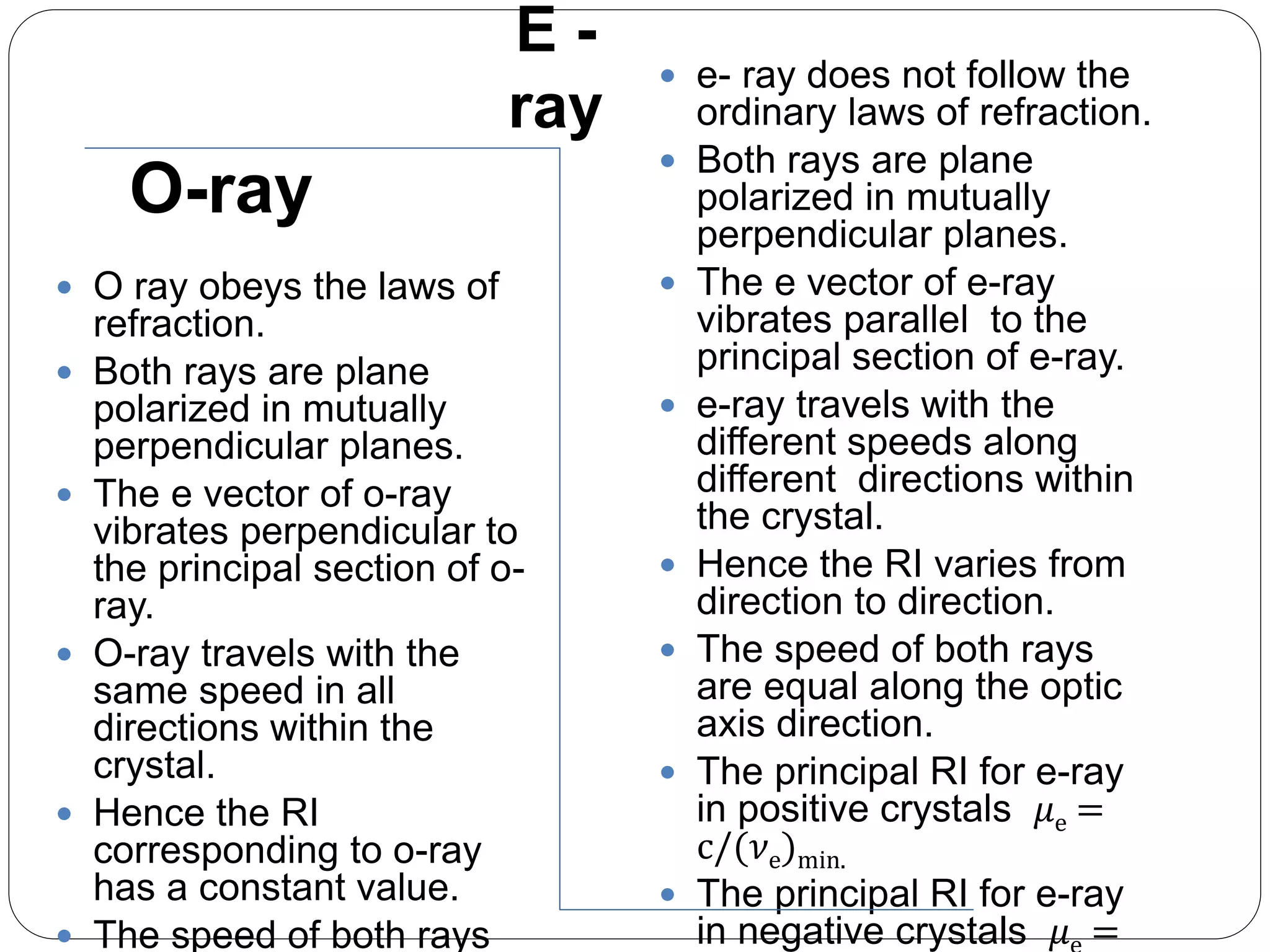
E -
ray
 O ray obeys the laws of
refraction.
 Both rays are plane
polarized in mutually
perpendicular planes.
 The e vector of o-ray
vibrates perpendicular to
the principal section of o-
ray.
 O-ray travels with the
same speed in all
directions within the
crystal.
 Hence the RI
corresponding to o-ray
has a constant value.
 The speed of both rays
 e- ray does not follow the
ordinary laws of refraction.
 Both rays are plane
polarized in mutually
perpendicular planes.
 The e vector of e-ray
vibrates parallel to the
principal section of e-ray.
 e-ray travels with the
different speeds along
different directions within
the crystal.
 Hence the RI varies from
direction to direction.
 The speed of both rays
are equal along the optic
axis direction.
 The principal RI for e-ray
in positive crystals 𝜇e =
c/(𝜈e)min.
 The principal RI for e-ray
in negative crystals 𝜇 =
O-ray
 The distinction of o-ray and e-ray exist only within the
crystal.once they emerge from the crystal, they travel
with the same velocity.
 The rays outside the crystal differ only in their direction
of travel and plane of polarisation.
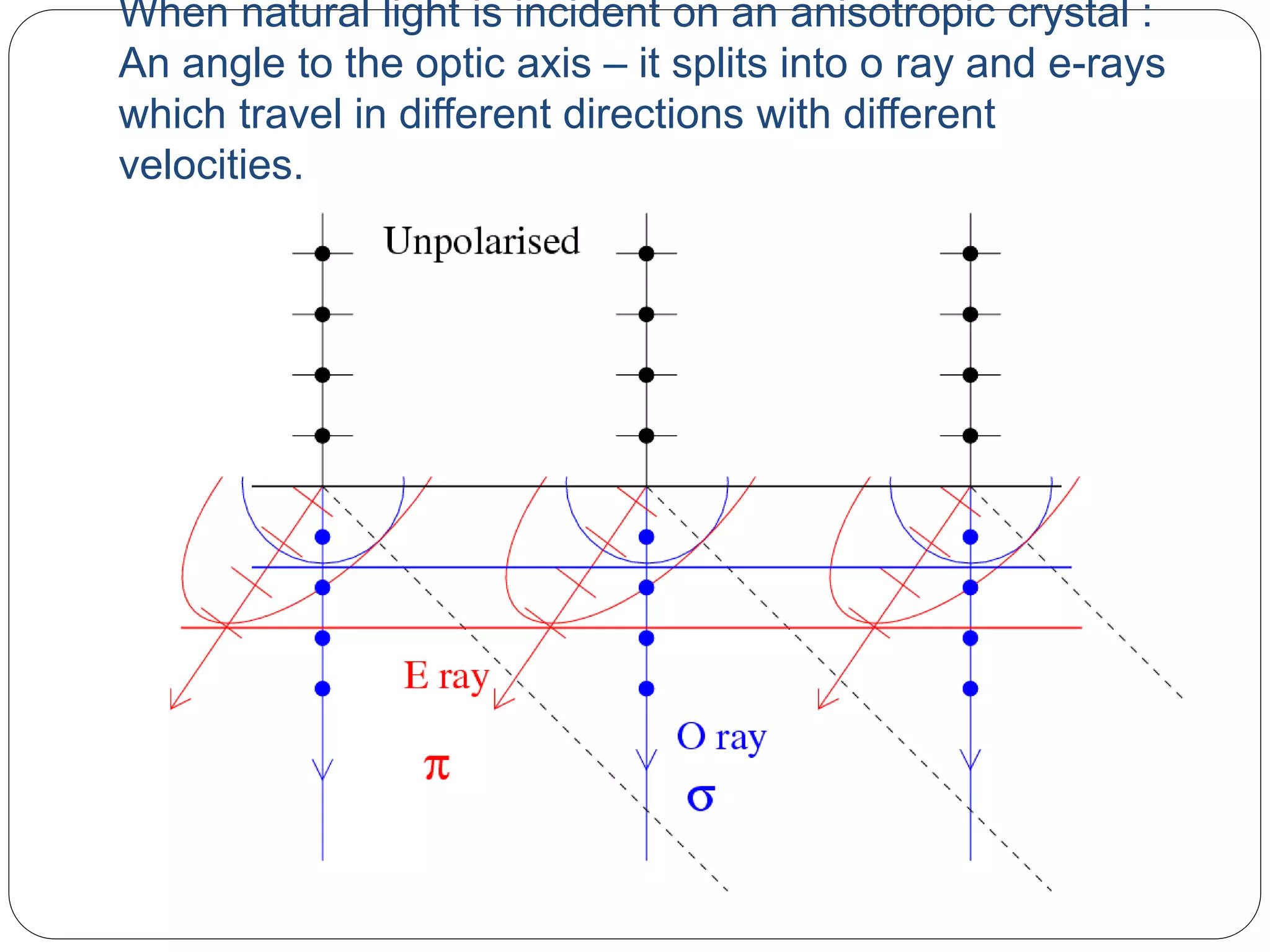
 When natural light is incident on an anisotropic crystal :
 An angle to the optic axis – it splits into o ray and e-rays
which travel in different directions with different velocities.
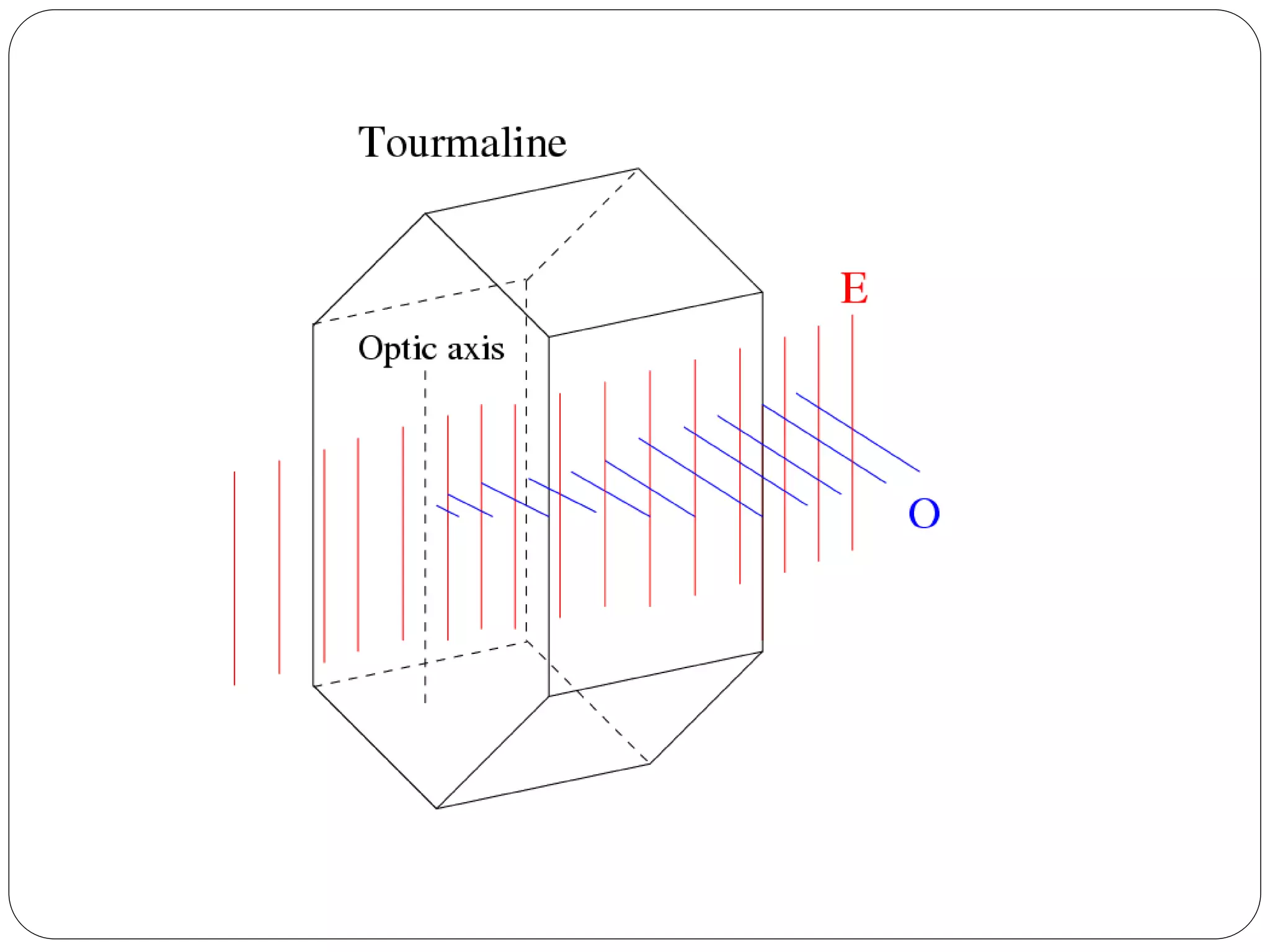
 In a direction perpendicular to the optic axis , o-ray and e-
ray propagate in the same direction in the crystal but with
different velocities.
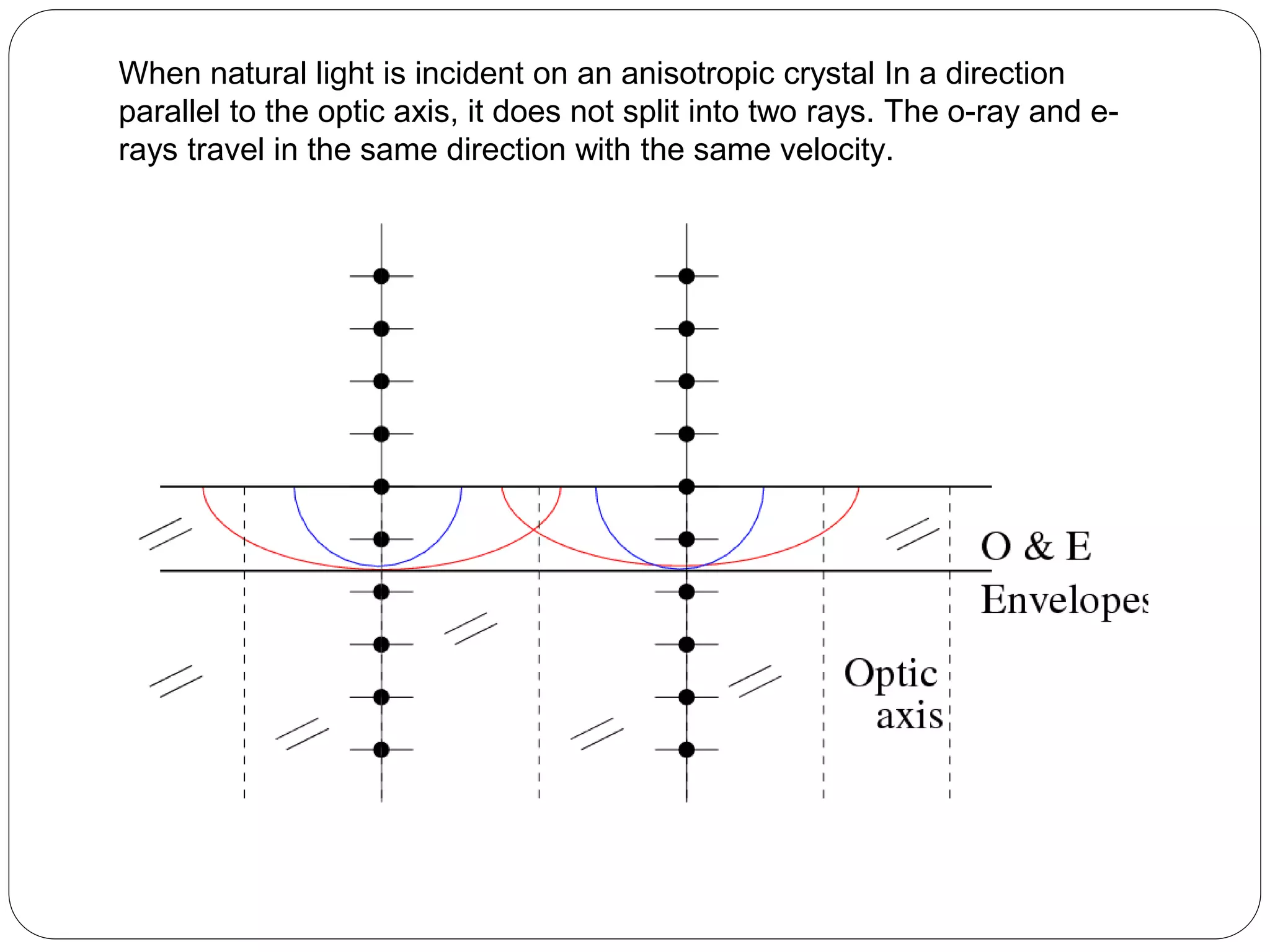
 In a direction parallel to the optic axis, it does not split into
two rays. The o-ray and e-rays travel in the same
direction with the same velocity.
When natural light is incident on an anisotropic crystal :
An angle to the optic axis – it splits into o ray and e-rays
which travel in different directions with different
velocities.
When natural light is incident on an anisotropic crystal In a direction
perpendicular to the optic axis , o-ray and e-ray propagate in the same
direction in the crystal but with different velocities.
When natural light is incident on an anisotropic crystal In a direction
parallel to the optic axis, it does not split into two rays. The o-ray and e-
rays travel in the same direction with the same velocity.
Positive and negative crystals
 The ellipsoid of
revolution(spheroid)
corresponding to the e-ray is
totally contained within the
sphere corresponding to the
o-ray.
 The e-ray velocity has a
maximum value along the
optic axis and a minimum
value in a direction
perpendicular to the optic
axis.
 E-ray travels slower than o-
ray in all directions except
along the optic axis.
 The principal RI for e-ray is
larger than the principal RI for
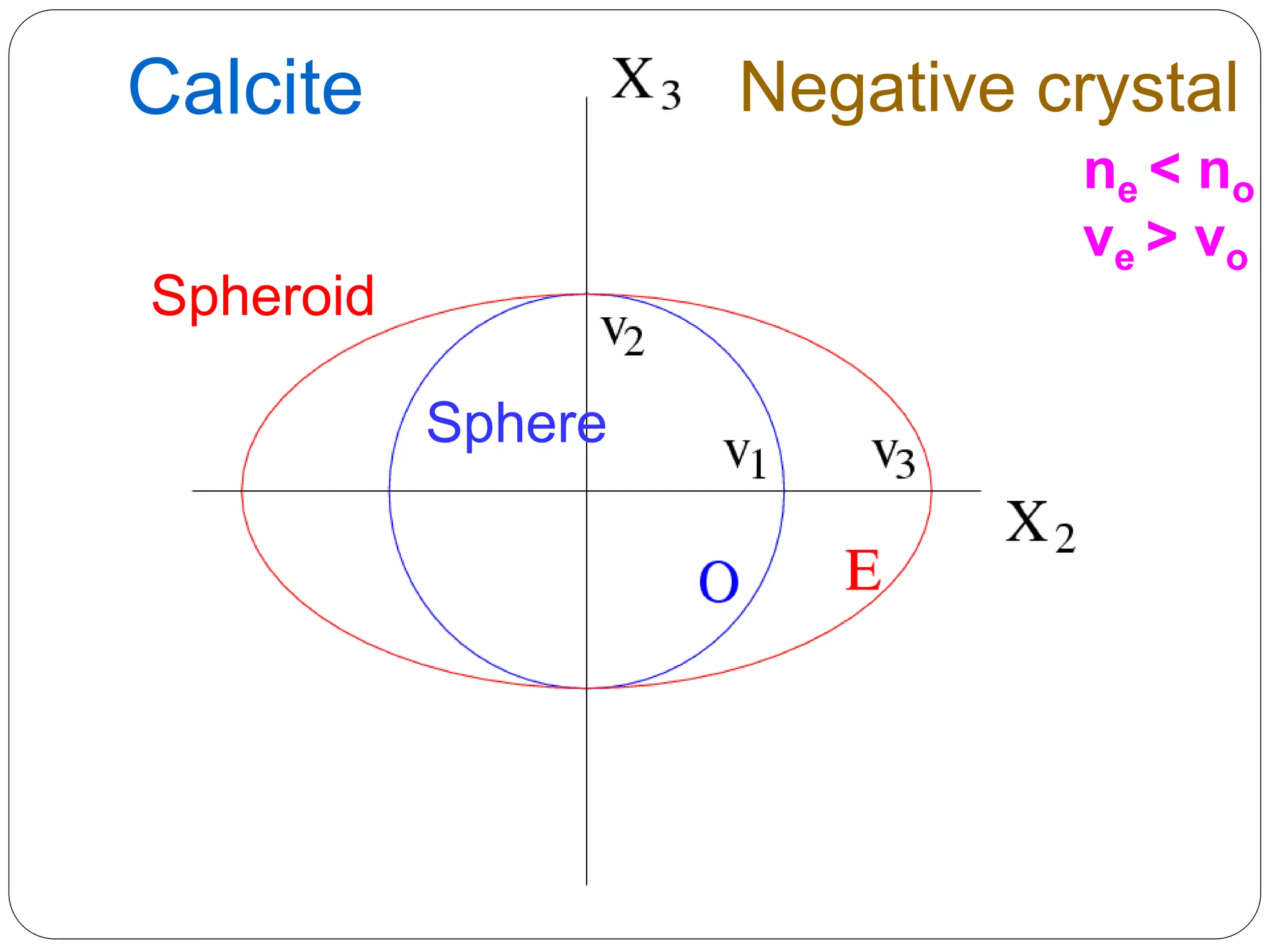
 The ellipsoid of
revolution(spheroid) for e-ray
lies completely outside the
sphere corresponding to the
o-ray.
 The e-ray velocity has a
minimum value along the
optic axis and a maximum
value in a direction
perpendicular to the optic
axis.
 o-ray travels slower than e-
ray in all directions except
along the optic axis.
 The principal RI for o-ray is
larger than the principal RI for
e-ray.
Sphere
ne > no
ve < vo
Quartz
Positive crystal
Velocity ellipsoid
Sphere
Spheroid
ne < no
ve > vo
Calcite Negative crystal
Phase difference between e-ray and o-ray
 Consider negative uniaxial crystal of thickness d where the
optic axis is parallel to refracting face of the crystal,
 then the optical path for o-ray within the crystal is 𝜇od
 And the optical path for e-ray within the crystal is 𝜇ed
 The optical path difference between e-ray and o-ray ,
Δ = (𝜇o - 𝜇e ) d
 Phase difference arises between the two waves ,
δ = ( 2𝜋/𝜆 ) (𝜇o - 𝜇e ) d
 If the two coherent waves are polarised in orthogonal planes,
the resultant vibrational motion takes place in two dimensions
either in the form of an ellipse, a circle or a straight line
depending on the phase difference between the waves –
orthogonal addition.
Orthogonal addition.
 When e-ray and o-ray overlap each other after
emerging from an anisotropic crystal plate, it
produce different states of polarisation depending
upon their optical path difference:
 When the optical path difference is 0 or an even
or odd multiple of 𝜆/2, then the resultant light
wave is linearly polarised.
 When the optical path difference is 𝜆/4, the
resultant wave is elliptically polarised.
 When the wave amplitudes are equal and the
optical path difference is 𝜆/4, the resultant wave
is circularly polarised.
Retarders
 A retarder is a uniform plate of birefringent material
whose optic axis lies in the plane of plate. They divide
the incident wave into two polarised waves that travel at
different speeds.
 Quarter wave plate:
 It is a thin plate of birenfringent crystal having the
optic axis parallel to its refracting faces and its
thickness adjusted such that it introduces a quarter
wave path difference(𝜆/4)( or a phase difference of
90) between the e-ray and o-ray propagating through
it.
 𝜆/4 = (𝜇o - 𝜇e ) d
 A QWP is used for producing elliptically or circularly
polarised light depending upon the angle that the
Retarders
 Half wave plate:
 It is a thin plate of birenfringent crystal having the
optic axis parallel to its refracting faces and its
thickness adjusted such that it introduces a quarter
wave path difference(𝜆/2)( or a phase difference of
180) between the e-ray and o-ray propagating
through it.
 𝜆/2 = (𝜇o - 𝜇e ) d
 when a plane polarised light incident normally on the
HWP with an angle 𝜃, it splits into e-waves and o-
waves , and they emerge with a phase difference of
180.then these waves combine to yield a plane
polarised wave of which its plane of polarisation
rotated through an angle 2𝜃.
 A HWP rotates the plane of polarisation of the
incident plane polarised light through an angle 2𝜃
Polarisation

Polarisation

  • 1.
  • 2.
    POLARIZATION  Light waveis a transverse em wave.  Light wave is described by the electric field vector.  The polarization of em wave refers to the orientation of its electric field vector.  Unpolarized light : A light wave, in which electric field vector oscillates in all the possible planes perpendicular to the beam direction.  Polarized light : A light wave with a definite direction of oscillation of E-vector, which occurs in a single plane or in some specific way  The plane created by the direction of oscillation of the E vector and the direction of propagation of the beam is called the plane of polarization of light waves.
  • 3.
    Types of Polarization The polarization of a light wave describes the shape and locus of the tip of the E vector( in the plane perpendicular to the direction of propagation) at a given point in space as a function of time. Depending on this , there are three different states of polarization : Plane or linear polarization.  the oscillation of electric field vector E are strictly confined to a single plane perpendicular to the direction of propagation.  The direction of field vector at some point in space and time lies along a line in a plane perpendicular to the direction of wave propagation.  The direction of E does not vary with time, but its
  • 5.
    Types of Polarization Circularpolarization.  In terms of space variation of E, the magnitude of the E-vector stays constant but it rotates at a constant rate about the direction of propagation and sweeps a circular helix in space.  It is regarded as the resultant wave produced due to the superposition of two coherent linearly polarized waves of equal amplitude oscillation in mutual perpendicular planes and are out of phase by 90. .
  • 6.
    Types of Polarization Ellipticalpolarization.  In terms of space variation of E, the magnitude of the E vector changes with time and it rotates about the direction of propagation and sweeps a flattened helix in space. • It is regarded as the resultant wave produced due to superposition of two coherent linearly polarized waves of different amplitude oscillating in mutually perpendicular planes and are out of phase by an arbitrary angle 𝜃.
  • 7.
    Production of Planepolarized light  Polarization by reflection from dielectric surfaces.  the perpendicular to the plane of incidence is represented by dots – s component.  The parallel component lying in the plane of incidence is represented by arrows – p component.  At a particular angle of incidence, the reflection coefficient of p component goes to zero and the reflected beam does not contain any p-component. It contain only s component and become totally polarized. This angle is called polarising angle or Brewster’s angle, 𝜃B.  Brewster’s Law : the tangent of the angle at which polarization is obtained by reflection is numerically equal to the refractive index of medium. 𝜇 = tan 𝜃B
  • 8.
    Production of Planepolarized light  Application of Brewster's law:  In gas lasers: the glass windows at the two ends of the laser tube are arranged at Brewster angle to the axis of the laser tube so that the light beam reflected get polarized and only the parallel components remains in the cavity.  For transmitting a light beam into or out of an
  • 9.
    Production of Planepolarized light  Polarization by refraction – Piles of plates.  When unpolarized light is incident at Brewster's angle on a smooth glass surface, the refracted light is partially polarized.  If a stack of glass plates are used, then successive reflections from successive surfaces occur leading to the filtering of the s component in the transmitted ray.  A stack of 15 glass plates is required for this purpose.  The glass plates are supported in a tube of a suitable size and cnclined at an angle of about 33 to the axis
  • 10.
    Production of Planepolarized light  Polarization by scattering:  Polarization by selective absorption ( dichorism)  Polarization by double refraction:
  • 11.
    Huygen’s explanation ofdouble refraction  According to Huygen’s theory , a point in a doubly refracting or birefringent crystal produces 2 types of wavefronts: (or The incident light excites two separate wavelets within the crystal )  Spherical wavefront - corresponding to the O-ray  The ordinary wave travels with same velocity in all directions and so the corresponding wavefront is spherical.  Ellipsoidal wavefront - corresponding to the E-ray  Extraordinary waves have different velocities in different directions, so the corresponding wavefront is elliptical.
  • 12.
    E - ray  Oray obeys the laws of refraction.  Both rays are plane polarized in mutually perpendicular planes.  The e vector of o-ray vibrates perpendicular to the principal section of o- ray.  O-ray travels with the same speed in all directions within the crystal.  Hence the RI corresponding to o-ray has a constant value.  The speed of both rays  e- ray does not follow the ordinary laws of refraction.  Both rays are plane polarized in mutually perpendicular planes.  The e vector of e-ray vibrates parallel to the principal section of e-ray.  e-ray travels with the different speeds along different directions within the crystal.  Hence the RI varies from direction to direction.  The speed of both rays are equal along the optic axis direction.  The principal RI for e-ray in positive crystals 𝜇e = c/(𝜈e)min.  The principal RI for e-ray in negative crystals 𝜇 = O-ray
  • 13.
     The distinctionof o-ray and e-ray exist only within the crystal.once they emerge from the crystal, they travel with the same velocity.  The rays outside the crystal differ only in their direction of travel and plane of polarisation.  When natural light is incident on an anisotropic crystal :  An angle to the optic axis – it splits into o ray and e-rays which travel in different directions with different velocities.  In a direction perpendicular to the optic axis , o-ray and e- ray propagate in the same direction in the crystal but with different velocities.  In a direction parallel to the optic axis, it does not split into two rays. The o-ray and e-rays travel in the same direction with the same velocity.
  • 14.
    When natural lightis incident on an anisotropic crystal : An angle to the optic axis – it splits into o ray and e-rays which travel in different directions with different velocities.
  • 15.
    When natural lightis incident on an anisotropic crystal In a direction perpendicular to the optic axis , o-ray and e-ray propagate in the same direction in the crystal but with different velocities.
  • 16.
    When natural lightis incident on an anisotropic crystal In a direction parallel to the optic axis, it does not split into two rays. The o-ray and e- rays travel in the same direction with the same velocity.
  • 18.
    Positive and negativecrystals  The ellipsoid of revolution(spheroid) corresponding to the e-ray is totally contained within the sphere corresponding to the o-ray.  The e-ray velocity has a maximum value along the optic axis and a minimum value in a direction perpendicular to the optic axis.  E-ray travels slower than o- ray in all directions except along the optic axis.  The principal RI for e-ray is larger than the principal RI for  The ellipsoid of revolution(spheroid) for e-ray lies completely outside the sphere corresponding to the o-ray.  The e-ray velocity has a minimum value along the optic axis and a maximum value in a direction perpendicular to the optic axis.  o-ray travels slower than e- ray in all directions except along the optic axis.  The principal RI for o-ray is larger than the principal RI for e-ray.
  • 19.
    Sphere ne > no ve< vo Quartz Positive crystal Velocity ellipsoid
  • 20.
    Sphere Spheroid ne < no ve> vo Calcite Negative crystal
  • 21.
    Phase difference betweene-ray and o-ray  Consider negative uniaxial crystal of thickness d where the optic axis is parallel to refracting face of the crystal,  then the optical path for o-ray within the crystal is 𝜇od  And the optical path for e-ray within the crystal is 𝜇ed  The optical path difference between e-ray and o-ray , Δ = (𝜇o - 𝜇e ) d  Phase difference arises between the two waves , δ = ( 2𝜋/𝜆 ) (𝜇o - 𝜇e ) d  If the two coherent waves are polarised in orthogonal planes, the resultant vibrational motion takes place in two dimensions either in the form of an ellipse, a circle or a straight line depending on the phase difference between the waves – orthogonal addition.
  • 22.
    Orthogonal addition.  Whene-ray and o-ray overlap each other after emerging from an anisotropic crystal plate, it produce different states of polarisation depending upon their optical path difference:  When the optical path difference is 0 or an even or odd multiple of 𝜆/2, then the resultant light wave is linearly polarised.  When the optical path difference is 𝜆/4, the resultant wave is elliptically polarised.  When the wave amplitudes are equal and the optical path difference is 𝜆/4, the resultant wave is circularly polarised.
  • 23.
    Retarders  A retarderis a uniform plate of birefringent material whose optic axis lies in the plane of plate. They divide the incident wave into two polarised waves that travel at different speeds.  Quarter wave plate:  It is a thin plate of birenfringent crystal having the optic axis parallel to its refracting faces and its thickness adjusted such that it introduces a quarter wave path difference(𝜆/4)( or a phase difference of 90) between the e-ray and o-ray propagating through it.  𝜆/4 = (𝜇o - 𝜇e ) d  A QWP is used for producing elliptically or circularly polarised light depending upon the angle that the
  • 24.
    Retarders  Half waveplate:  It is a thin plate of birenfringent crystal having the optic axis parallel to its refracting faces and its thickness adjusted such that it introduces a quarter wave path difference(𝜆/2)( or a phase difference of 180) between the e-ray and o-ray propagating through it.  𝜆/2 = (𝜇o - 𝜇e ) d  when a plane polarised light incident normally on the HWP with an angle 𝜃, it splits into e-waves and o- waves , and they emerge with a phase difference of 180.then these waves combine to yield a plane polarised wave of which its plane of polarisation rotated through an angle 2𝜃.  A HWP rotates the plane of polarisation of the incident plane polarised light through an angle 2𝜃