Polarization Of Light
Lecture # 6
The material used in this presentation i.e., pictures/graphs/text, etc. is
solely intended for educational/teaching purpose, offered free of cost to
the students for use under special circumstances of Online Education
due to COVID-19 Lockdown situation and may include copyrighted
material - the use of which may not have been specifically authorized by
Copyright Owners.
It’s application constitutes Fair Use of any such copyrighted material as
provided in globally accepted law of many countries. The contents of
presentations are intended only for the attendees of the class being
conducted by the presenter.
• Polarization is a property of waves that can oscillate with more than
one orientation.
• Electromagnetic waves such as light exhibit polarization, as do some
other types of wave, such as gravitational waves.
• Sound waves in a gas or liquid do not exhibit polarization, since the
oscillation is always in the direction the wave travels.
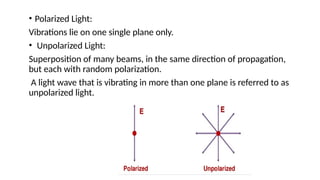
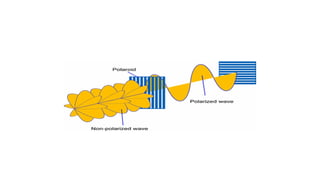
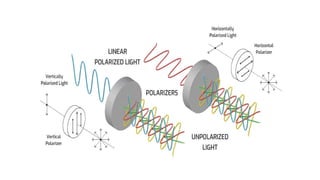
• Polarized Light:
Vibrations lie on one single plane only.
• Unpolarized Light:
Superposition of many beams, in the same direction of propagation,
but each with random polarization.
A light wave that is vibrating in more than one plane is referred to as
unpolarized light.
• It is possible to transform unpolarized light into polarized light.
• The process of transforming unpolarized light into polarized light is
known as polarization.
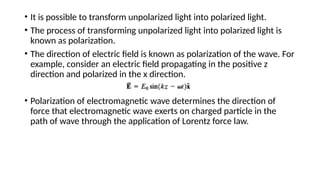
• The direction of electric field is known as polarization of the wave. For
example, consider an electric field propagating in the positive z
direction and polarized in the x direction.
• Polarization of electromagnetic wave determines the direction of
force that electromagnetic wave exerts on charged particle in the
path of wave through the application of Lorentz force law.
• Many optical application critically depend on the nature and
manipulation of polarization of electromagnetic wave.
• The electric field component is used to define the plane of
polarization because many common electromagnetic-wave detectors
respond to the electric forces on electrons in materials, not the
magnetic forces.
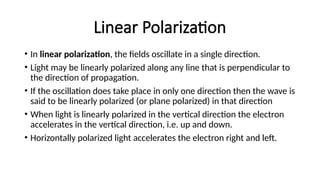
Linear Polarization
• In linear polarization, the fields oscillate in a single direction.
• Light may be linearly polarized along any line that is perpendicular to
the direction of propagation.
• If the oscillation does take place in only one direction then the wave is
said to be linearly polarized (or plane polarized) in that direction
• When light is linearly polarized in the vertical direction the electron
accelerates in the vertical direction, i.e. up and down.
• Horizontally polarized light accelerates the electron right and left.
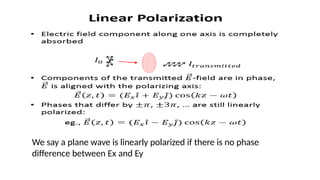
We say a plane wave is linearly polarized if there is no phase
difference between Ex and Ey
Circular Polarization
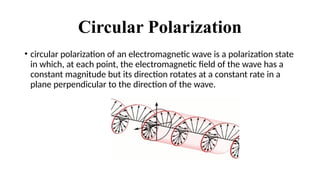
• circular polarization of an electromagnetic wave is a polarization state
in which, at each point, the electromagnetic field of the wave has a
constant magnitude but its direction rotates at a constant rate in a
plane perpendicular to the direction of the wave.
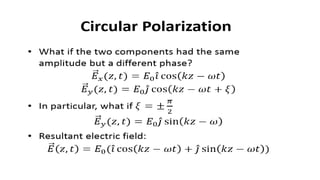
• the electric field of light consists of two linear components that are
perpendicular to each other, equal in amplitude, but have a phase
difference of π/2. The resulting electric field rotates in a circle around
the direction of propagation.
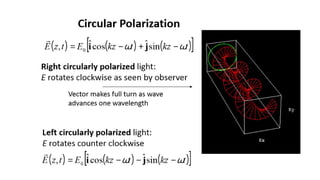
• There are two directions of propagation that come with circular
polarization: Right-Hand-Circular (RHC) which follows a clockwise
pattern, and Left-Hand-Circular (LHC) which follows a
counterclockwise pattern.
ELLIPTICAL POLARIZATION
• The electric field of light describes an ellipse.
• This results from the combination of two linear components with
differing amplitudes and/or a phase difference that is not π/2.
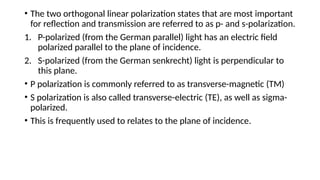
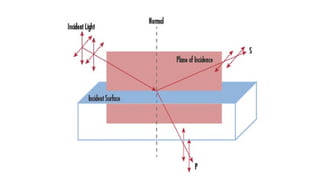
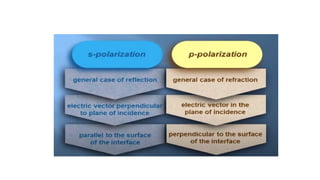
• The two orthogonal linear polarization states that are most important
for reflection and transmission are referred to as p- and s-polarization.
1. P-polarized (from the German parallel) light has an electric field
polarized parallel to the plane of incidence.
2. S-polarized (from the German senkrecht) light is perpendicular to
this plane.
• P polarization is commonly referred to as transverse-magnetic (TM)
• S polarization is also called transverse-electric (TE), as well as sigma-
polarized.
• This is frequently used to relates to the plane of incidence.
TASK:
1. What if we have a superposition of left and right circularly polarized
light of equal amplitude?
2. Write down the applications of Polarization

lecture_6.pptx polarisation. of light.

  • 1.
  • 2.
    The material usedin this presentation i.e., pictures/graphs/text, etc. is solely intended for educational/teaching purpose, offered free of cost to the students for use under special circumstances of Online Education due to COVID-19 Lockdown situation and may include copyrighted material - the use of which may not have been specifically authorized by Copyright Owners. It’s application constitutes Fair Use of any such copyrighted material as provided in globally accepted law of many countries. The contents of presentations are intended only for the attendees of the class being conducted by the presenter.
  • 3.
    • Polarization isa property of waves that can oscillate with more than one orientation. • Electromagnetic waves such as light exhibit polarization, as do some other types of wave, such as gravitational waves. • Sound waves in a gas or liquid do not exhibit polarization, since the oscillation is always in the direction the wave travels.
  • 4.
    • Polarized Light: Vibrationslie on one single plane only. • Unpolarized Light: Superposition of many beams, in the same direction of propagation, but each with random polarization. A light wave that is vibrating in more than one plane is referred to as unpolarized light.
  • 6.
    • It ispossible to transform unpolarized light into polarized light. • The process of transforming unpolarized light into polarized light is known as polarization. • The direction of electric field is known as polarization of the wave. For example, consider an electric field propagating in the positive z direction and polarized in the x direction. • Polarization of electromagnetic wave determines the direction of force that electromagnetic wave exerts on charged particle in the path of wave through the application of Lorentz force law.
  • 7.
    • Many opticalapplication critically depend on the nature and manipulation of polarization of electromagnetic wave. • The electric field component is used to define the plane of polarization because many common electromagnetic-wave detectors respond to the electric forces on electrons in materials, not the magnetic forces.
  • 8.
    Linear Polarization • Inlinear polarization, the fields oscillate in a single direction. • Light may be linearly polarized along any line that is perpendicular to the direction of propagation. • If the oscillation does take place in only one direction then the wave is said to be linearly polarized (or plane polarized) in that direction • When light is linearly polarized in the vertical direction the electron accelerates in the vertical direction, i.e. up and down. • Horizontally polarized light accelerates the electron right and left.
  • 9.
    We say aplane wave is linearly polarized if there is no phase difference between Ex and Ey
  • 11.
    Circular Polarization • circularpolarization of an electromagnetic wave is a polarization state in which, at each point, the electromagnetic field of the wave has a constant magnitude but its direction rotates at a constant rate in a plane perpendicular to the direction of the wave.
  • 13.
    • the electricfield of light consists of two linear components that are perpendicular to each other, equal in amplitude, but have a phase difference of π/2. The resulting electric field rotates in a circle around the direction of propagation. • There are two directions of propagation that come with circular polarization: Right-Hand-Circular (RHC) which follows a clockwise pattern, and Left-Hand-Circular (LHC) which follows a counterclockwise pattern.
  • 15.
    ELLIPTICAL POLARIZATION • Theelectric field of light describes an ellipse. • This results from the combination of two linear components with differing amplitudes and/or a phase difference that is not π/2.
  • 16.
    • The twoorthogonal linear polarization states that are most important for reflection and transmission are referred to as p- and s-polarization. 1. P-polarized (from the German parallel) light has an electric field polarized parallel to the plane of incidence. 2. S-polarized (from the German senkrecht) light is perpendicular to this plane. • P polarization is commonly referred to as transverse-magnetic (TM) • S polarization is also called transverse-electric (TE), as well as sigma- polarized. • This is frequently used to relates to the plane of incidence.
  • 19.
    TASK: 1. What ifwe have a superposition of left and right circularly polarized light of equal amplitude? 2. Write down the applications of Polarization