Polarization of light
• Polarization generally just means “orientation.” It comes from the Greek word
polos,
• Wave polarization occurs for vector fields.
• For light (electromagnetic waves) the vectors are the electric and magnetic
fields, and
• light’s polarization direction is by convention along the direction of the
electric field.
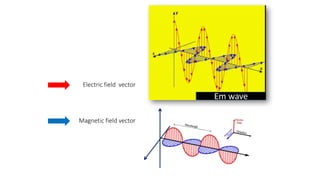
Electric field vector
Magnetic field vector
Em wave
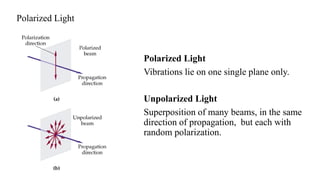
Polarized Light
Polarized Light
Vibrations lie on one single plane only.
Unpolarized Light
Superposition of many beams, in the same
direction of propagation, but each with
random polarization.
4
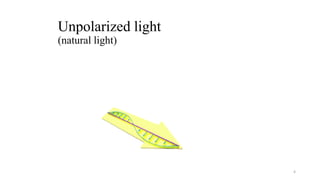
Unpolarized light
(natural light)
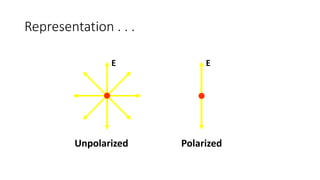
Representation . . .
Unpolarized Polarized
EE
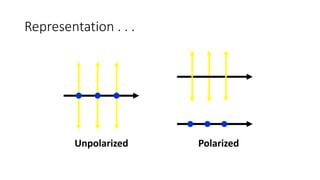
Representation . . .
Unpolarized Polarized
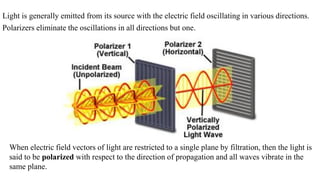
When electric field vectors of light are restricted to a single plane by filtration, then the light is
said to be polarized with respect to the direction of propagation and all waves vibrate in the
same plane.
Light is generally emitted from its source with the electric field oscillating in various directions.
Polarizers eliminate the oscillations in all directions but one.
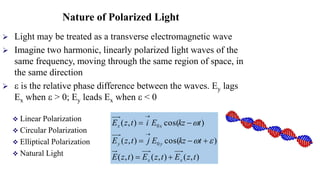
Nature of Polarized Light
 Light may be treated as a transverse electromagnetic wave
 Imagine two harmonic, linearly polarized light waves of the
same frequency, moving through the same region of space, in
the same direction
  is the relative phase difference between the waves. Ey lags
Ex when  > 0; Ey leads Ex when  < 0
),(),(),(
)cos(),(
)cos(),(
0
0
tzEtzEtzE
tkzEjtzE
tkzEitzE
xx
yy
xx






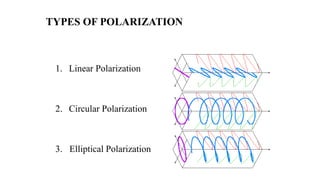
 Linear Polarization
 Circular Polarization
 Elliptical Polarization
 Natural Light
TYPES OF POLARIZATION
1. Linear Polarization
2. Circular Polarization
3. Elliptical Polarization
10
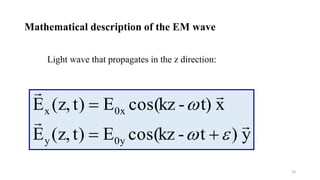
Mathematical description of the EM wave
Light wave that propagates in the z direction:
y)t-kzcos(E)tz,(E
xt)-kzcos(E)tz,(E
0yy
0xx






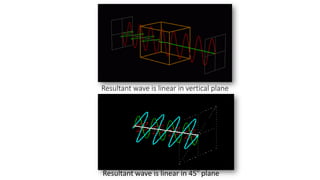
Resultant wave is linear in vertical plane
Resultant wave is linear in 450
plane
12
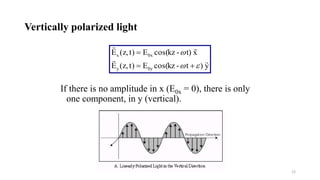
Vertically polarized light
If there is no amplitude in x (E0x = 0), there is only
one component, in y (vertical).
y)t-kzcos(E)tz,(E
xt)-kzcos(E)tz,(E
0yy
0xx






13
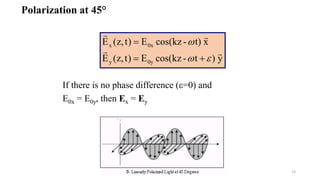
Polarization at 45°
If there is no phase difference (=0) and
E0x = E0y, then Ex = Ey
y)t-kzcos(E)tz,(E
xt)-kzcos(E)tz,(E
0yy
0xx






14
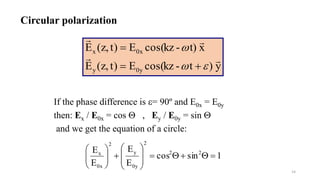
Circular polarization
If the phase difference is = 90º and E0x = E0y
then: Ex / E0x = cos  , Ey / E0y = sin 
and we get the equation of a circle:
1sincos
E
E
E
E 22
2
0y
y
2
0x
x















y)t-kzcos(E)tz,(E
xt)-kzcos(E)tz,(E
0yy
0xx






15
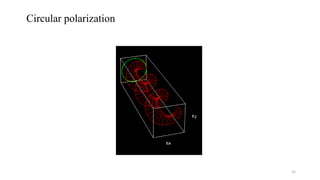
Circular polarization
16
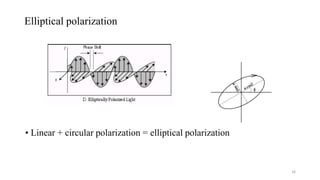
Elliptical polarization
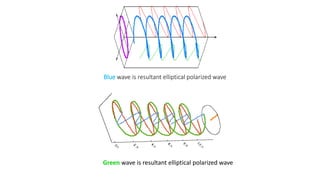
• Linear + circular polarization = elliptical polarization
Blue wave is resultant elliptical polarized wave
Green wave is resultant elliptical polarized wave
Malus’s Law
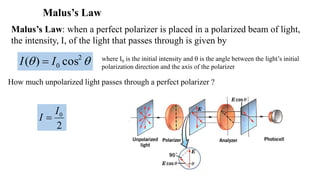
How much unpolarized light passes through a perfect polarizer ?
 2
0 cos)( II 
2
0I
I 
Malus’s Law: when a perfect polarizer is placed in a polarized beam of light,
the intensity, I, of the light that passes through is given by
where I0 is the initial intensity and  is the angle between the light’s initial
polarization direction and the axis of the polarizer
Polarization by reflection
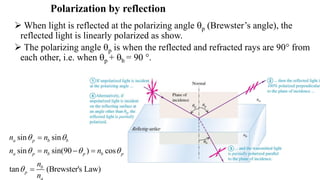
 When light is reflected at the polarizing angle p (Brewster’s angle), the
reflected light is linearly polarized as show.
 The polarizing angle p is when the reflected and refracted rays are 90° from
each other, i.e. when p + b = 90 °.
sin sin
sin sin(90 ) cos
tan (Brewster's Law)
a p b b
a p b p b p
b
p
n n
n n n
n
n
 
  


  

Brewster’s law
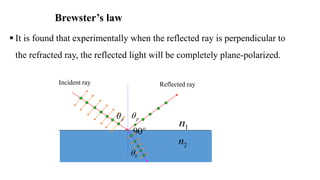
 It is found that experimentally when the reflected ray is perpendicular to
the refracted ray, the reflected light will be completely plane-polarized.
Reflected rayIncident ray
o
90
p
b
p
1n
2n
Polarization by Reflection
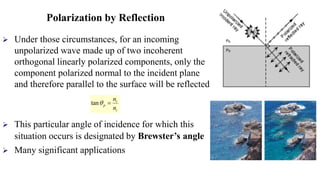
 Under those circumstances, for an incoming
unpolarized wave made up of two incoherent
orthogonal linearly polarized components, only the
component polarized normal to the incident plane
and therefore parallel to the surface will be reflected
 This particular angle of incidence for which this
situation occurs is designated by Brewster’s angle
 Many significant applications
i
t
p
n
n
tan
Polarization by Reflection
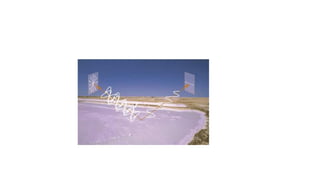
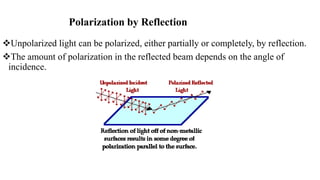
Unpolarized light can be polarized, either partially or completely, by reflection.
The amount of polarization in the reflected beam depends on the angle of
incidence.
Polarization by Scattering
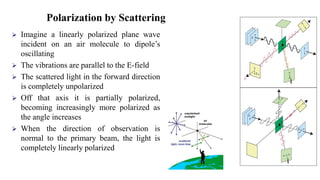
 Imagine a linearly polarized plane wave
incident on an air molecule to dipole’s
oscillating
 The vibrations are parallel to the E-field
 The scattered light in the forward direction
is completely unpolarized
 Off that axis it is partially polarized,
becoming increasingly more polarized as
the angle increases
 When the direction of observation is
normal to the primary beam, the light is
completely linearly polarized
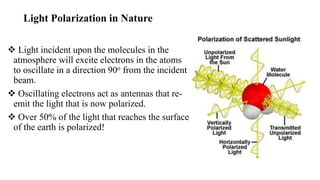
Light Polarization in Nature
 Light incident upon the molecules in the
atmosphere will excite electrons in the atoms
to oscillate in a direction 90o from the incident
beam.
 Oscillating electrons act as antennas that re-
emit the light that is now polarized.
 Over 50% of the light that reaches the surface
of the earth is polarized!
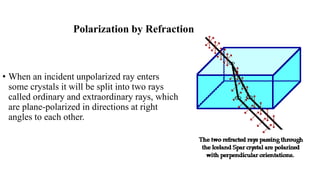
Polarization by Refraction
• When an incident unpolarized ray enters
some crystals it will be split into two rays
called ordinary and extraordinary rays, which
are plane-polarized in directions at right
angles to each other.
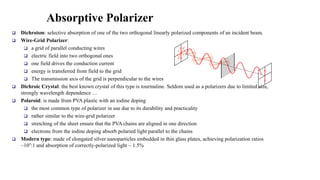
Absorptive Polarizer
 Dichroism: selective absorption of one of the two orthogonal linearly polarized components of an incident beam.
 Wire-Grid Polarizer:
 a grid of parallel conducting wires
 electric field into two orthogonal ones
 one field drives the conduction current
 energy is transferred from field to the grid
 The transmission axis of the grid is perpendicular to the wires
 Dichroic Crystal: the best known crystal of this type is tourmaline. Seldom used as a polarizers due to limited size,
strongly wavelength dependence …
 Polaroid: is made from PVA plastic with an iodine doping
 the most common type of polarizer in use due to its durability and practicality
 rather similar to the wire-grid polarizer
 stretching of the sheet ensure that the PVA chains are aligned in one direction
 electrons from the iodine doping absorb polaried light parallel to the chains
 Modern type: made of elongated silver nanoparticles embedded in thin glass plates, achieving polarization ratios
~105:1 and absorption of correctly-polarized light ~ 1.5%
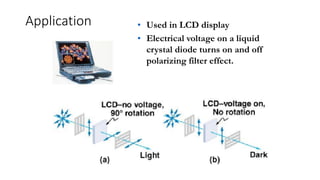
Application • Used in LCD display
• Electrical voltage on a liquid
crystal diode turns on and off
polarizing filter effect.

Polarization of light class note

  • 1.
    Polarization of light •Polarization generally just means “orientation.” It comes from the Greek word polos, • Wave polarization occurs for vector fields. • For light (electromagnetic waves) the vectors are the electric and magnetic fields, and • light’s polarization direction is by convention along the direction of the electric field.
  • 2.
    Electric field vector Magneticfield vector Em wave
  • 3.
    Polarized Light Polarized Light Vibrationslie on one single plane only. Unpolarized Light Superposition of many beams, in the same direction of propagation, but each with random polarization.
  • 4.
  • 5.
    Representation . .. Unpolarized Polarized EE
  • 6.
    Representation . .. Unpolarized Polarized
  • 7.
    When electric fieldvectors of light are restricted to a single plane by filtration, then the light is said to be polarized with respect to the direction of propagation and all waves vibrate in the same plane. Light is generally emitted from its source with the electric field oscillating in various directions. Polarizers eliminate the oscillations in all directions but one.
  • 8.
    Nature of PolarizedLight  Light may be treated as a transverse electromagnetic wave  Imagine two harmonic, linearly polarized light waves of the same frequency, moving through the same region of space, in the same direction   is the relative phase difference between the waves. Ey lags Ex when  > 0; Ey leads Ex when  < 0 ),(),(),( )cos(),( )cos(),( 0 0 tzEtzEtzE tkzEjtzE tkzEitzE xx yy xx        Linear Polarization  Circular Polarization  Elliptical Polarization  Natural Light
  • 9.
    TYPES OF POLARIZATION 1.Linear Polarization 2. Circular Polarization 3. Elliptical Polarization
  • 10.
    10 Mathematical description ofthe EM wave Light wave that propagates in the z direction: y)t-kzcos(E)tz,(E xt)-kzcos(E)tz,(E 0yy 0xx      
  • 11.
    Resultant wave islinear in vertical plane Resultant wave is linear in 450 plane
  • 12.
    12 Vertically polarized light Ifthere is no amplitude in x (E0x = 0), there is only one component, in y (vertical). y)t-kzcos(E)tz,(E xt)-kzcos(E)tz,(E 0yy 0xx      
  • 13.
    13 Polarization at 45° Ifthere is no phase difference (=0) and E0x = E0y, then Ex = Ey y)t-kzcos(E)tz,(E xt)-kzcos(E)tz,(E 0yy 0xx      
  • 14.
    14 Circular polarization If thephase difference is = 90º and E0x = E0y then: Ex / E0x = cos  , Ey / E0y = sin  and we get the equation of a circle: 1sincos E E E E 22 2 0y y 2 0x x                y)t-kzcos(E)tz,(E xt)-kzcos(E)tz,(E 0yy 0xx      
  • 15.
  • 16.
    16 Elliptical polarization • Linear+ circular polarization = elliptical polarization
  • 17.
    Blue wave isresultant elliptical polarized wave Green wave is resultant elliptical polarized wave
  • 18.
    Malus’s Law How muchunpolarized light passes through a perfect polarizer ?  2 0 cos)( II  2 0I I  Malus’s Law: when a perfect polarizer is placed in a polarized beam of light, the intensity, I, of the light that passes through is given by where I0 is the initial intensity and  is the angle between the light’s initial polarization direction and the axis of the polarizer
  • 19.
    Polarization by reflection When light is reflected at the polarizing angle p (Brewster’s angle), the reflected light is linearly polarized as show.  The polarizing angle p is when the reflected and refracted rays are 90° from each other, i.e. when p + b = 90 °. sin sin sin sin(90 ) cos tan (Brewster's Law) a p b b a p b p b p b p n n n n n n n           
  • 21.
    Brewster’s law  Itis found that experimentally when the reflected ray is perpendicular to the refracted ray, the reflected light will be completely plane-polarized. Reflected rayIncident ray o 90 p b p 1n 2n
  • 22.
    Polarization by Reflection Under those circumstances, for an incoming unpolarized wave made up of two incoherent orthogonal linearly polarized components, only the component polarized normal to the incident plane and therefore parallel to the surface will be reflected  This particular angle of incidence for which this situation occurs is designated by Brewster’s angle  Many significant applications i t p n n tan
  • 23.
    Polarization by Reflection Unpolarizedlight can be polarized, either partially or completely, by reflection. The amount of polarization in the reflected beam depends on the angle of incidence.
  • 24.
    Polarization by Scattering Imagine a linearly polarized plane wave incident on an air molecule to dipole’s oscillating  The vibrations are parallel to the E-field  The scattered light in the forward direction is completely unpolarized  Off that axis it is partially polarized, becoming increasingly more polarized as the angle increases  When the direction of observation is normal to the primary beam, the light is completely linearly polarized
  • 25.
    Light Polarization inNature  Light incident upon the molecules in the atmosphere will excite electrons in the atoms to oscillate in a direction 90o from the incident beam.  Oscillating electrons act as antennas that re- emit the light that is now polarized.  Over 50% of the light that reaches the surface of the earth is polarized!
  • 26.
    Polarization by Refraction •When an incident unpolarized ray enters some crystals it will be split into two rays called ordinary and extraordinary rays, which are plane-polarized in directions at right angles to each other.
  • 27.
    Absorptive Polarizer  Dichroism:selective absorption of one of the two orthogonal linearly polarized components of an incident beam.  Wire-Grid Polarizer:  a grid of parallel conducting wires  electric field into two orthogonal ones  one field drives the conduction current  energy is transferred from field to the grid  The transmission axis of the grid is perpendicular to the wires  Dichroic Crystal: the best known crystal of this type is tourmaline. Seldom used as a polarizers due to limited size, strongly wavelength dependence …  Polaroid: is made from PVA plastic with an iodine doping  the most common type of polarizer in use due to its durability and practicality  rather similar to the wire-grid polarizer  stretching of the sheet ensure that the PVA chains are aligned in one direction  electrons from the iodine doping absorb polaried light parallel to the chains  Modern type: made of elongated silver nanoparticles embedded in thin glass plates, achieving polarization ratios ~105:1 and absorption of correctly-polarized light ~ 1.5%
  • 28.
    Application • Usedin LCD display • Electrical voltage on a liquid crystal diode turns on and off polarizing filter effect.