A presentation on Polarization of light and it’s applications
Ratul Prosad
Roll : ASH1811ME121M
Session : 2017-2018
Department of Information and Communication Engineering
PRESENTATION LAYOUT
 Concept of Polarization
 Types of Polarization
 Method of Achieving Polarization
 Advantages and Disadvantages
 Applications of Polarization
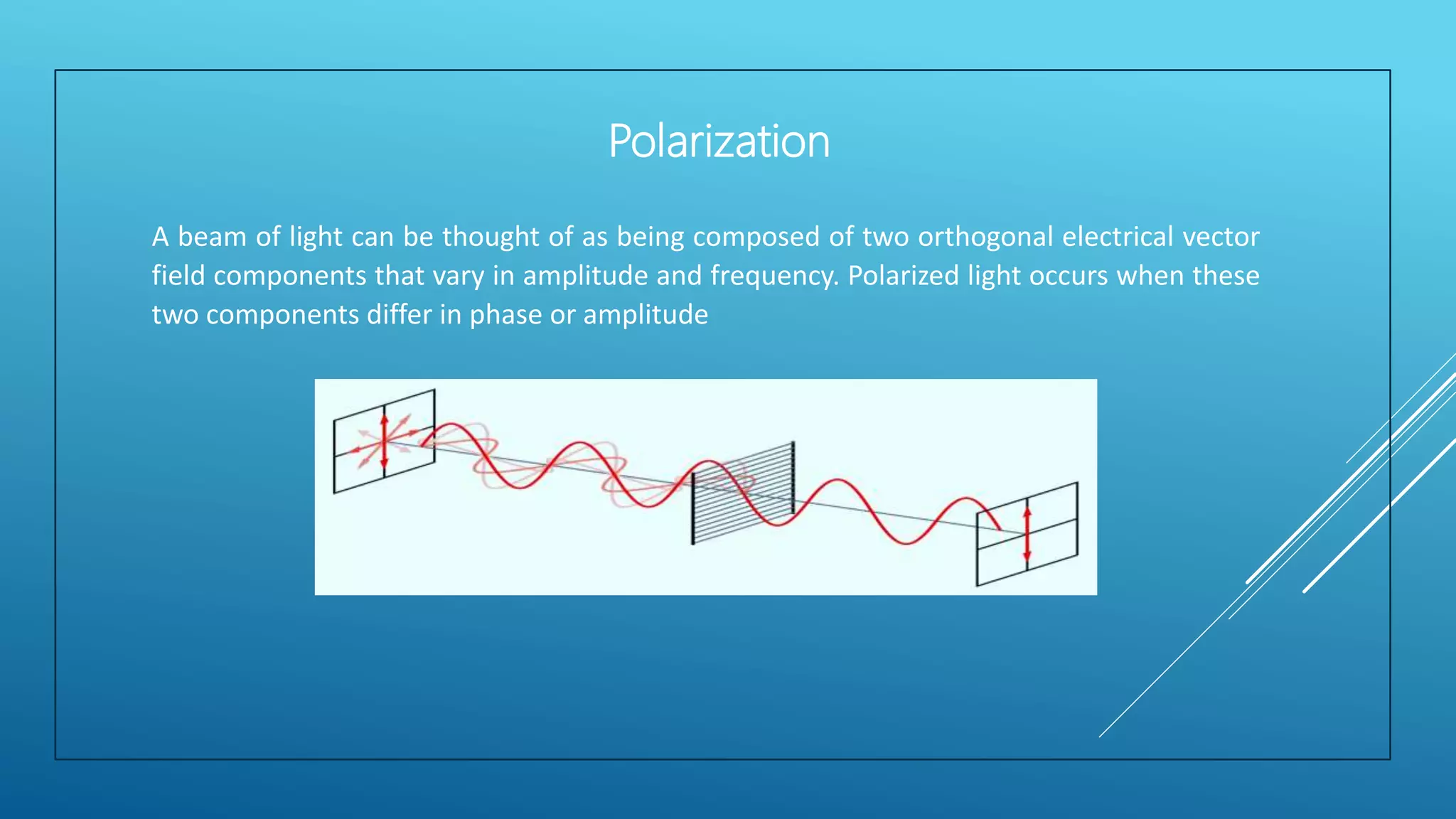
A beam of light can be thought of as being composed of two orthogonal electrical vector
field components that vary in amplitude and frequency. Polarized light occurs when these
two components differ in phase or amplitude
Polarization
 Transforming unpolarized light into polarized light
 Restriction of electric field vector E in a particular plane
so that vibration occurs in a single plane
 Characteristic of transverse wave
 Longitudinal waves can’t be polarized; direction of their
oscillation is along the direction of propagation
Polarization
TYPES OF POLARIZATION
 Linear Polarization
 Circular Polarization
 Elliptical Polarization
Polarization
LINEAR POLARIZATION
 Plane polarized wave
 Electric field vector oscillates along a
straight line in one plane
Polarization
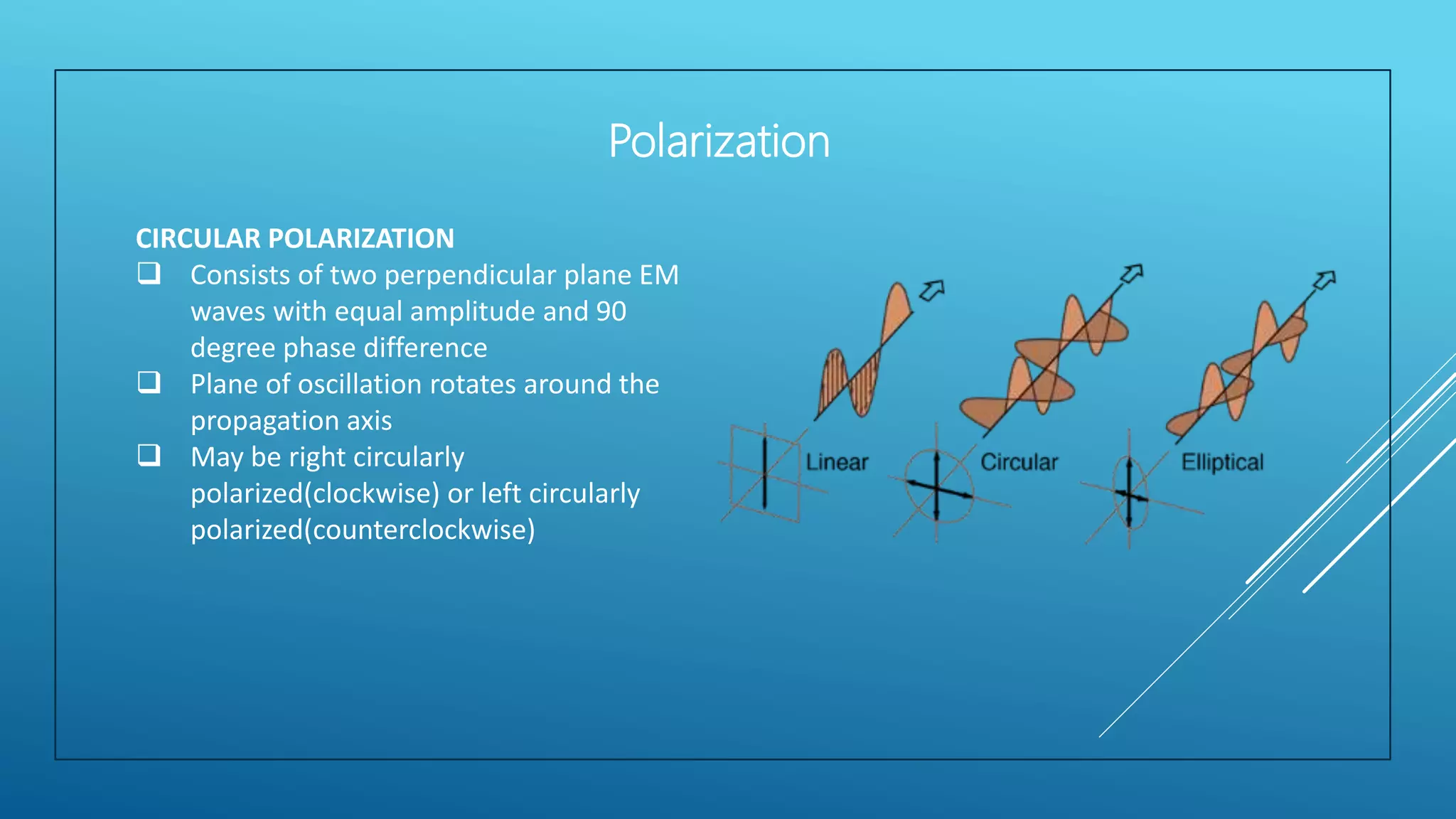
CIRCULAR POLARIZATION
 Consists of two perpendicular plane EM
waves with equal amplitude and 90
degree phase difference
 Plane of oscillation rotates around the
propagation axis
 May be right circularly
polarized(clockwise) or left circularly
polarized(counterclockwise)
Polarization
ELLIPTICAL POLARIZATION
 Consists of two perpendicular waves of
unequal amplitude that differ in phase by 90
degree
 The tip of the resultant electric field vector
describes an ellipse in any fixed plane
intersecting and normal to the direction of
Propagation
 Circular and linear polarization : special
cases of elliptical polarization
Polarization
METHODS OF ACHIEVING POLARIZATION
 Reflection
 Scattering
 Dichroism
 Birefringence
Polarization
POLARIZATION BY REFLECTION
 Unpolarized light can undergo polarization by reflection off of non
metallic surfaces like snow, glass
 Incident angle is such that angle between reflected and refracted
ray is 90 degree
 Such incident angle is k/a polarizing angle or Brewster’s angle
 Reflected ray is linearly polarized parallel to the reflecting surface
Polarization
POLARIZATION BY SCATTERING
 Polarization also occurs when light is scattered
 When light strikes the atoms of a material, electrons are set into vibration
 Vibrating electrons produce new EM waves radiated in all possible
directions
 Newly generated waves strike neighbouring atoms, thereby continuing the
process
 Absorption + re emission →scattered light
Polarization
POLARIZATION BY BIREFRINGENCE
 Polarization due to double refraction
 A double refracting crystals like Iceland spar, calcite refracts
incident light into two different paths
 So if an object is viewed by looking through the crystal, two
images are seen
 Polarizing filter can be used to completely block one image
 Two rays are formed because they have different speeds due to
two index planes in the medium
Polarization
POLARIZATION BY DICHROISM
 Polarization by selective absorption
 Such crystals are used which transmits wave whose
electric field vibrates in a particular plane and
absorbs electric field vibrating in other planes eg.
Tourmaline polaroid
Polarization
Polarization
ADVANTAGES
 Allow for sight clarity
 Reduce the harmful effects of ultraviolet light
DISADVANTAGES
 Eliminate contrast in snowy conditions
 Tend to cost more
APPLICATIONS
 Polaroid Sunglass
 Photographic Filters
 Titmus Ttereo Test
 LCD
 3D Films
 Stress Analysis
Polarization
Polarization

Polarization

  • 1.
    A presentation onPolarization of light and it’s applications Ratul Prosad Roll : ASH1811ME121M Session : 2017-2018 Department of Information and Communication Engineering
  • 2.
    PRESENTATION LAYOUT  Conceptof Polarization  Types of Polarization  Method of Achieving Polarization  Advantages and Disadvantages  Applications of Polarization
  • 3.
    A beam oflight can be thought of as being composed of two orthogonal electrical vector field components that vary in amplitude and frequency. Polarized light occurs when these two components differ in phase or amplitude Polarization
  • 4.
     Transforming unpolarizedlight into polarized light  Restriction of electric field vector E in a particular plane so that vibration occurs in a single plane  Characteristic of transverse wave  Longitudinal waves can’t be polarized; direction of their oscillation is along the direction of propagation Polarization
  • 5.
    TYPES OF POLARIZATION Linear Polarization  Circular Polarization  Elliptical Polarization Polarization
  • 6.
    LINEAR POLARIZATION  Planepolarized wave  Electric field vector oscillates along a straight line in one plane Polarization
  • 7.
    CIRCULAR POLARIZATION  Consistsof two perpendicular plane EM waves with equal amplitude and 90 degree phase difference  Plane of oscillation rotates around the propagation axis  May be right circularly polarized(clockwise) or left circularly polarized(counterclockwise) Polarization
  • 8.
    ELLIPTICAL POLARIZATION  Consistsof two perpendicular waves of unequal amplitude that differ in phase by 90 degree  The tip of the resultant electric field vector describes an ellipse in any fixed plane intersecting and normal to the direction of Propagation  Circular and linear polarization : special cases of elliptical polarization Polarization
  • 9.
    METHODS OF ACHIEVINGPOLARIZATION  Reflection  Scattering  Dichroism  Birefringence Polarization
  • 10.
    POLARIZATION BY REFLECTION Unpolarized light can undergo polarization by reflection off of non metallic surfaces like snow, glass  Incident angle is such that angle between reflected and refracted ray is 90 degree  Such incident angle is k/a polarizing angle or Brewster’s angle  Reflected ray is linearly polarized parallel to the reflecting surface Polarization
  • 11.
    POLARIZATION BY SCATTERING Polarization also occurs when light is scattered  When light strikes the atoms of a material, electrons are set into vibration  Vibrating electrons produce new EM waves radiated in all possible directions  Newly generated waves strike neighbouring atoms, thereby continuing the process  Absorption + re emission →scattered light Polarization
  • 12.
    POLARIZATION BY BIREFRINGENCE Polarization due to double refraction  A double refracting crystals like Iceland spar, calcite refracts incident light into two different paths  So if an object is viewed by looking through the crystal, two images are seen  Polarizing filter can be used to completely block one image  Two rays are formed because they have different speeds due to two index planes in the medium Polarization
  • 13.
    POLARIZATION BY DICHROISM Polarization by selective absorption  Such crystals are used which transmits wave whose electric field vibrates in a particular plane and absorbs electric field vibrating in other planes eg. Tourmaline polaroid Polarization
  • 14.
    Polarization ADVANTAGES  Allow forsight clarity  Reduce the harmful effects of ultraviolet light DISADVANTAGES  Eliminate contrast in snowy conditions  Tend to cost more
  • 15.
    APPLICATIONS  Polaroid Sunglass Photographic Filters  Titmus Ttereo Test  LCD  3D Films  Stress Analysis Polarization