


Polarization And It’s
Application
Tariq Al Fayad. M
PRESENATION LAYOUT
Introduction
Types of polarized light
Few related terms
Few laws related to polarization
Applications
INTRODUCTION
Light is form of energy which gives us the sensation of
vision
Different properties of light are:
 Reflection
Refraction
Interference
Diffraction
Polarization
WHAT IS POLARIZATION?
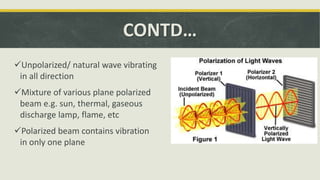
The vibrations are limited to just one direction in a plane
perpendicular to the direction of propagation, the wave is
said to be plane polarized.
Thus, the phenomenon of the restriction of the vibration
to a particular direction is called polarization.
CONTD…
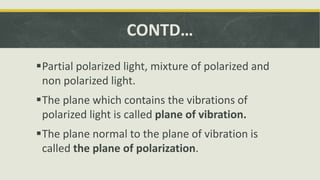
Unpolarized/ natural wave vibrating
in all direction
Mixture of various plane polarized
beam e.g. sun, thermal, gaseous
discharge lamp, flame, etc
Polarized beam contains vibration
in only one plane
CONTD…
Partial polarized light, mixture of polarized and
non polarized light.
The plane which contains the vibrations of
polarized light is called plane of vibration.
The plane normal to the plane of vibration is
called the plane of polarization.
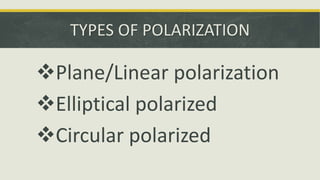
TYPES OF POLARIZATION
Plane/Linear polarization
Elliptical polarized
Circular polarized
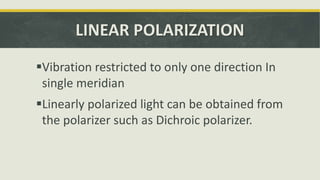
LINEAR POLARIZATION
Vibration restricted to only one direction In
single meridian
Linearly polarized light can be obtained from
the polarizer such as Dichroic polarizer.
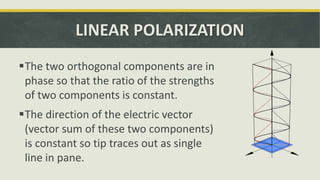
LINEAR POLARIZATION
The two orthogonal components are in
phase so that the ratio of the strengths
of two components is constant.
The direction of the electric vector
(vector sum of these two components)
is constant so tip traces out as single
line in pane.
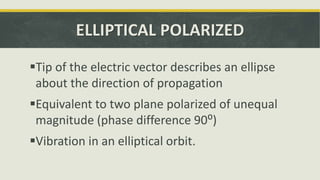
ELLIPTICAL POLARIZED
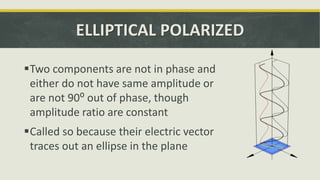
Tip of the electric vector describes an ellipse
about the direction of propagation
Equivalent to two plane polarized of unequal
magnitude (phase difference 90⁰)
Vibration in an elliptical orbit.
ELLIPTICAL POLARIZED
Two components are not in phase and
either do not have same amplitude or
are not 90⁰ out of phase, though
amplitude ratio are constant
Called so because their electric vector
traces out an ellipse in the plane
CIRCULAR POLARIZED
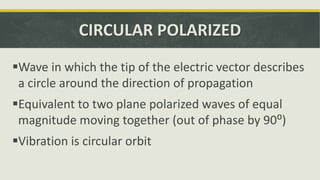
Wave in which the tip of the electric vector describes
a circle around the direction of propagation
Equivalent to two plane polarized waves of equal
magnitude moving together (out of phase by 90⁰)
Vibration is circular orbit
CIRCULAR POLARIZED
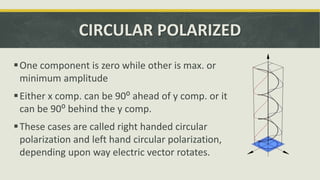
One component is zero while other is max. or
minimum amplitude
Either x comp. can be 90⁰ ahead of y comp. or it
can be 90⁰ behind the y comp.
These cases are called right handed circular
polarization and left hand circular polarization,
depending upon way electric vector rotates.
FEW TERMS
Polarizer: An instrument by which the light gets
polarized.
Analyzer: An instrument which detects whether a
light ray is polarized or not.
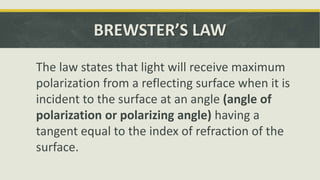
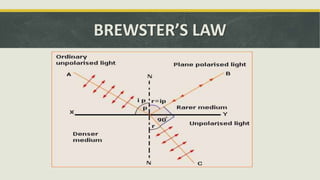
BREWSTER’S LAW
The law states that light will receive maximum
polarization from a reflecting surface when it is
incident to the surface at an angle (angle of
polarization or polarizing angle) having a
tangent equal to the index of refraction of the
surface.
BREWSTER’S LAW
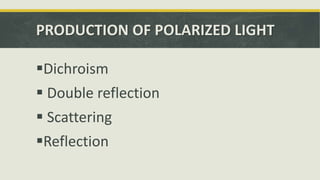
PRODUCTION OF POLARIZED LIGHT
Dichroism
 Double reflection
 Scattering
Reflection
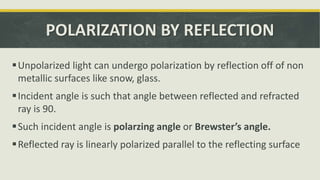
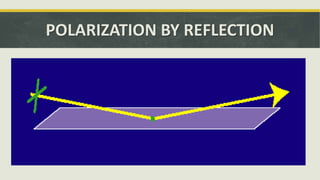
POLARIZATION BY REFLECTION
Unpolarized light can undergo polarization by reflection off of non
metallic surfaces like snow, glass.
Incident angle is such that angle between reflected and refracted
ray is 90.
Such incident angle is polarzing angle or Brewster’s angle.
Reflected ray is linearly polarized parallel to the reflecting surface
POLARIZATION BY REFLECTION
APPLICATION
Astronomy
3D movies
Communication and radar
applications
ASTRONOMY
For providing information on sources of radiation
and scattering, polarization probes the interstellar
magnetic field via Faraday rotation.
Polarization of cosmic microwave background is
being used to study the physics of the early
universe.
3D Movies
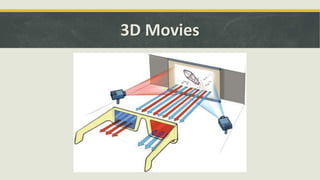
Polarization is used for 3D movies ,in which the images
intended for each eye are either projected from two different
projectors orthogonally oriented polarizing filters or, more
typically , from a single projector with multiplexed polarization
Polarized 3D glasses with suitable polarized filters ensure that
each eye receives only the intended image
3D Movies
COMMUNICATION AND RADAR
APPLICATIONS
All radio transmitting and receiving antennas are
intrinsically polarized, special use of which is made in
radar.
Vertical polarization is most often used when it is
desired to radiate a radio signal in all directions such
as widely distributed mobile units.
CONTD
AM and FM radio use vertical polarization, while
television uses horizontal polarization
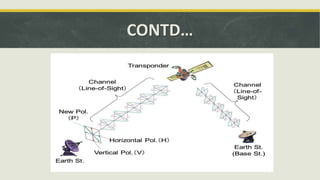
Alternating vertical and horizontal polarization is
used on satellite communications to allow the
satellite to carry two separate transmission on given
frequency
CONTD…
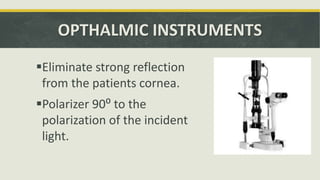
OPTHALMIC INSTRUMENTS
Eliminate strong reflection
from the patients cornea.
Polarizer 90⁰ to the
polarization of the incident
light.
Polarization and its Application

Polarization and its Application

  • 1.
  • 2.
    PRESENATION LAYOUT Introduction Types ofpolarized light Few related terms Few laws related to polarization Applications
  • 3.
    INTRODUCTION Light is formof energy which gives us the sensation of vision Different properties of light are:  Reflection Refraction Interference Diffraction Polarization
  • 4.
    WHAT IS POLARIZATION? Thevibrations are limited to just one direction in a plane perpendicular to the direction of propagation, the wave is said to be plane polarized. Thus, the phenomenon of the restriction of the vibration to a particular direction is called polarization.
  • 5.
    CONTD… Unpolarized/ natural wavevibrating in all direction Mixture of various plane polarized beam e.g. sun, thermal, gaseous discharge lamp, flame, etc Polarized beam contains vibration in only one plane
  • 6.
    CONTD… Partial polarized light,mixture of polarized and non polarized light. The plane which contains the vibrations of polarized light is called plane of vibration. The plane normal to the plane of vibration is called the plane of polarization.
  • 7.
    TYPES OF POLARIZATION Plane/Linearpolarization Elliptical polarized Circular polarized
  • 8.
    LINEAR POLARIZATION Vibration restrictedto only one direction In single meridian Linearly polarized light can be obtained from the polarizer such as Dichroic polarizer.
  • 9.
    LINEAR POLARIZATION The twoorthogonal components are in phase so that the ratio of the strengths of two components is constant. The direction of the electric vector (vector sum of these two components) is constant so tip traces out as single line in pane.
  • 10.
    ELLIPTICAL POLARIZED Tip ofthe electric vector describes an ellipse about the direction of propagation Equivalent to two plane polarized of unequal magnitude (phase difference 90⁰) Vibration in an elliptical orbit.
  • 11.
    ELLIPTICAL POLARIZED Two componentsare not in phase and either do not have same amplitude or are not 90⁰ out of phase, though amplitude ratio are constant Called so because their electric vector traces out an ellipse in the plane
  • 12.
    CIRCULAR POLARIZED Wave inwhich the tip of the electric vector describes a circle around the direction of propagation Equivalent to two plane polarized waves of equal magnitude moving together (out of phase by 90⁰) Vibration is circular orbit
  • 13.
    CIRCULAR POLARIZED One componentis zero while other is max. or minimum amplitude Either x comp. can be 90⁰ ahead of y comp. or it can be 90⁰ behind the y comp. These cases are called right handed circular polarization and left hand circular polarization, depending upon way electric vector rotates.
  • 14.
    FEW TERMS Polarizer: Aninstrument by which the light gets polarized. Analyzer: An instrument which detects whether a light ray is polarized or not.
  • 15.
    BREWSTER’S LAW The lawstates that light will receive maximum polarization from a reflecting surface when it is incident to the surface at an angle (angle of polarization or polarizing angle) having a tangent equal to the index of refraction of the surface.
  • 16.
  • 17.
    PRODUCTION OF POLARIZEDLIGHT Dichroism  Double reflection  Scattering Reflection
  • 18.
    POLARIZATION BY REFLECTION Unpolarizedlight can undergo polarization by reflection off of non metallic surfaces like snow, glass. Incident angle is such that angle between reflected and refracted ray is 90. Such incident angle is polarzing angle or Brewster’s angle. Reflected ray is linearly polarized parallel to the reflecting surface
  • 19.
  • 20.
  • 21.
    ASTRONOMY For providing informationon sources of radiation and scattering, polarization probes the interstellar magnetic field via Faraday rotation. Polarization of cosmic microwave background is being used to study the physics of the early universe.
  • 22.
    3D Movies Polarization isused for 3D movies ,in which the images intended for each eye are either projected from two different projectors orthogonally oriented polarizing filters or, more typically , from a single projector with multiplexed polarization Polarized 3D glasses with suitable polarized filters ensure that each eye receives only the intended image
  • 23.
  • 24.
    COMMUNICATION AND RADAR APPLICATIONS Allradio transmitting and receiving antennas are intrinsically polarized, special use of which is made in radar. Vertical polarization is most often used when it is desired to radiate a radio signal in all directions such as widely distributed mobile units.
  • 25.
    CONTD AM and FMradio use vertical polarization, while television uses horizontal polarization Alternating vertical and horizontal polarization is used on satellite communications to allow the satellite to carry two separate transmission on given frequency
  • 26.
  • 27.
    OPTHALMIC INSTRUMENTS Eliminate strongreflection from the patients cornea. Polarizer 90⁰ to the polarization of the incident light.