Optics
Presented to: Dr. Kamran sb.
Presented by: Tahir Younus
Reg. No. BS-PHYS-18-44 (E)
Semester: 2018-22 5th
Department of Physics
Ghazi University Dera Ghazi
Khan
•Introduction
•Performed by Young in 1801 to demonstrate wave behavior of light.
•In this experiment, Young identified the phenomenon called interference
•The double-slit experiment is a demonstration that light and matter can display
characteristics of both waves and particles.
Interference occurred during experiment is of two types
 Constructive Interference
 Destructive Interference
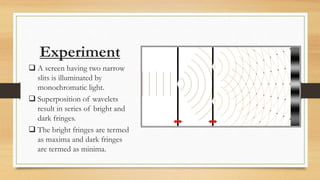
Experiment
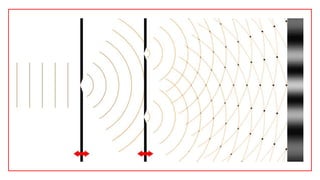
 A screen having two narrow
slits is illuminated by
monochromatic light.
 Superposition of wavelets
result in series of bright and
dark fringes.
 The bright fringes are termed
as maxima and dark fringes
are termed as minima.
Derivation of
Equation for
Maxima and
Minima
Maxima
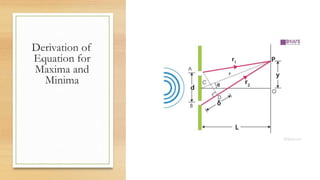
If the point P is to have a bright fringe, the path difference must be an integral multiple of 𝜆.
BD = m𝜆
m = 0,1,2,3,4,….
From ∆𝐴𝐵𝐷.
BD = d sin𝜃
So, d sin𝜃= m𝜆 … . . 1)
Distance between Adjacent Bright Fringes
Since angle ‘𝜃’ is very small,
Sin 𝜃 ≈ 𝑇𝑎𝑛𝜃
So, Equation 1 becomes
d𝑇𝑎𝑛𝜃=m 𝜆 … . . 2)
From figure
Tan𝜃=
𝑌
𝐿
So, equation 2 can be written as
d
𝑌
𝐿
= m 𝜆
Y=m
𝜆𝐿
𝑑
… . . 3)
If there would be a dark fringe at point P then,
Y=(𝑚 +
1
2
)
𝜆𝐿
𝑑
…. 4)
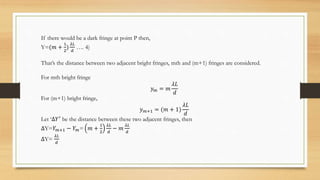
That’s the distance between two adjacent bright fringes, mth and (m+1) fringes are considered.
For mth bright fringe
𝑦𝑚 = 𝑚
𝜆𝐿
𝑑
For (m+1) bright fringe,
𝑦𝑚+1 = (𝑚 + 1)
𝜆𝐿
𝑑
Let ‘∆𝑌′
be the distance between these two adjacent fringes, then
∆Y=𝑌𝑚+1 − 𝑌𝑚= 𝑚 +
1
2
𝜆𝐿
𝑑
− 𝑚
𝜆𝐿
𝑑
∆Y=
𝜆𝐿
𝑑
Minima (Dark fringes)
If the point P is to have a dark fringe, the path difference BD must be half integral number of wavelength
𝜆.
𝐵𝐷 = (𝑚 +
1
2
)𝜆 m=0,1,2,….
From ∆𝐴𝐵𝐷.
BD = d sin𝜃
d sin𝜃 = (𝑚 +
1
2
)𝜆
First dark fringe is obtained at m=0 and second dark for m=1.
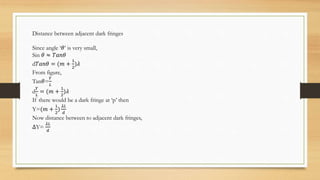
Distance between adjacent dark fringes
Since angle ‘𝜃’ is very small,
Sin 𝜃 ≈ 𝑇𝑎𝑛𝜃
d𝑇𝑎𝑛𝜃 = (𝑚 +
1
2
)𝜆
From figure,
Tan𝜃=
𝑌
𝐿
d
𝑌
𝐿
= (𝑚 +
1
2
)𝜆
If there would be a dark fringe at ‘p’ then
Y=(𝑚 +
1
2
)
𝜆𝐿
𝑑
Now distance between to adjacent dark fringes,
∆Y=
𝜆𝐿
𝑑
Dark and bright fringes are of equal width and are equally spaced.
Fringe spacing is directly proportional to ‘𝜆’ and distance between slits ‘L’.
Inversely to separation of slits ‘d’.

Youngs double slit experiment

  • 1.
    Optics Presented to: Dr.Kamran sb. Presented by: Tahir Younus Reg. No. BS-PHYS-18-44 (E) Semester: 2018-22 5th Department of Physics Ghazi University Dera Ghazi Khan
  • 2.
    •Introduction •Performed by Youngin 1801 to demonstrate wave behavior of light. •In this experiment, Young identified the phenomenon called interference •The double-slit experiment is a demonstration that light and matter can display characteristics of both waves and particles.
  • 3.
    Interference occurred duringexperiment is of two types  Constructive Interference  Destructive Interference
  • 4.
    Experiment  A screenhaving two narrow slits is illuminated by monochromatic light.  Superposition of wavelets result in series of bright and dark fringes.  The bright fringes are termed as maxima and dark fringes are termed as minima.
  • 6.
  • 7.
    Maxima If the pointP is to have a bright fringe, the path difference must be an integral multiple of 𝜆. BD = m𝜆 m = 0,1,2,3,4,…. From ∆𝐴𝐵𝐷. BD = d sin𝜃 So, d sin𝜃= m𝜆 … . . 1)
  • 8.
    Distance between AdjacentBright Fringes Since angle ‘𝜃’ is very small, Sin 𝜃 ≈ 𝑇𝑎𝑛𝜃 So, Equation 1 becomes d𝑇𝑎𝑛𝜃=m 𝜆 … . . 2) From figure Tan𝜃= 𝑌 𝐿 So, equation 2 can be written as d 𝑌 𝐿 = m 𝜆 Y=m 𝜆𝐿 𝑑 … . . 3)
  • 9.
    If there wouldbe a dark fringe at point P then, Y=(𝑚 + 1 2 ) 𝜆𝐿 𝑑 …. 4) That’s the distance between two adjacent bright fringes, mth and (m+1) fringes are considered. For mth bright fringe 𝑦𝑚 = 𝑚 𝜆𝐿 𝑑 For (m+1) bright fringe, 𝑦𝑚+1 = (𝑚 + 1) 𝜆𝐿 𝑑 Let ‘∆𝑌′ be the distance between these two adjacent fringes, then ∆Y=𝑌𝑚+1 − 𝑌𝑚= 𝑚 + 1 2 𝜆𝐿 𝑑 − 𝑚 𝜆𝐿 𝑑 ∆Y= 𝜆𝐿 𝑑
  • 10.
    Minima (Dark fringes) Ifthe point P is to have a dark fringe, the path difference BD must be half integral number of wavelength 𝜆. 𝐵𝐷 = (𝑚 + 1 2 )𝜆 m=0,1,2,…. From ∆𝐴𝐵𝐷. BD = d sin𝜃 d sin𝜃 = (𝑚 + 1 2 )𝜆 First dark fringe is obtained at m=0 and second dark for m=1.
  • 11.
    Distance between adjacentdark fringes Since angle ‘𝜃’ is very small, Sin 𝜃 ≈ 𝑇𝑎𝑛𝜃 d𝑇𝑎𝑛𝜃 = (𝑚 + 1 2 )𝜆 From figure, Tan𝜃= 𝑌 𝐿 d 𝑌 𝐿 = (𝑚 + 1 2 )𝜆 If there would be a dark fringe at ‘p’ then Y=(𝑚 + 1 2 ) 𝜆𝐿 𝑑 Now distance between to adjacent dark fringes, ∆Y= 𝜆𝐿 𝑑
  • 12.
    Dark and brightfringes are of equal width and are equally spaced. Fringe spacing is directly proportional to ‘𝜆’ and distance between slits ‘L’. Inversely to separation of slits ‘d’.