Poynting Theorem & Poynting
Vector
Mr. VIKRAM SINGH
Assistant Professor
Department of Applied Sciences & Humanities
(Physics)
Institute of Technology & Management (ITM)
Meerut
(IAMR Group Of Institutions, Gaziyabad)
Poynting Theorem
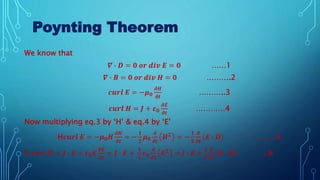
We know that
𝜵 ∙ 𝑫 = 𝟎 𝒐𝒓 𝒅𝒊𝒗 𝑬 = 𝟎 ……1
𝜵 ∙ 𝑩 = 𝟎 𝒐𝒓 𝒅𝒊𝒗 𝑯 = 𝟎 ……….2
𝒄𝒖𝒓𝒍 𝑬 = −𝝁𝟎
𝝏𝑯
𝝏𝒕
………..3
𝒄𝒖𝒓𝒍 𝑯 = 𝑱 + 𝜺𝟎
𝝏𝑬
𝝏𝒕
…………4
Now multiplying eq.3 by ‘H’ & eq.4 by ‘E’
H𝒄𝒖𝒓𝒍 𝑬 = −𝝁𝟎𝑯
𝝏𝑯
𝝏𝒕
= −
𝟏
𝟐
𝝁𝟎
𝝏
𝝏𝒕
𝑯𝟐
= −
𝟏
𝟐
𝝏
𝝏𝒕
(𝑬 ∙ 𝑫) ……….5
E 𝒄𝒖𝒓𝒍 𝑯 = 𝑱 ∙ 𝑬 + 𝜺𝟎𝑬
𝝏𝑬
𝝏𝒕
= 𝑱 ∙ 𝑬 +
𝟏
𝟐
𝜺𝟎
𝝏
𝝏𝒕
𝑬𝟐 = 𝑱 ∙ 𝑬 +
𝟏
𝟐
𝝏
𝝏𝒕
𝑯 ∙ 𝑩 …6
POYNTING THEOREM
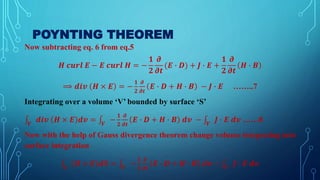
Now subtracting eq. 6 from eq.5
𝑯 𝒄𝒖𝒓𝒍 𝑬 − 𝑬 𝒄𝒖𝒓𝒍 𝑯 = −
𝟏
𝟐
𝝏
𝝏𝒕
(𝑬 ∙ 𝑫) + 𝑱 ∙ 𝑬 +
𝟏
𝟐
𝝏
𝝏𝒕
𝑯 ∙ 𝑩
⟹ 𝒅𝒊𝒗 𝑯 × 𝑬 = −
𝟏
𝟐
𝝏
𝝏𝒕
𝑬 ∙ 𝑫 + 𝑯 ∙ 𝑩 − 𝑱 ∙ 𝑬 ……..7
Integrating over a volume ‘V’ bounded by surface ‘S’
𝑽
𝒅𝒊𝒗 𝑯 × 𝑬 𝒅𝒗 = 𝑽
−
𝟏
𝟐
𝝏
𝝏𝒕
𝑬 ∙ 𝑫 + 𝑯 ∙ 𝑩 𝒅𝒗 − 𝑽
𝑱 ∙ 𝑬 𝒅𝒗 ……8
Now with the help of Gauss divergence theorem change volume integrating into
surface integration
𝑺
𝑯 × 𝑬 𝒅𝑺 = 𝑽
−
𝟏
𝟐
𝝏
𝝏𝒕
𝑬 ∙ 𝑫 + 𝑯 ∙ 𝑩 𝒅𝒗 − 𝑽
𝑱 ∙ 𝑬 𝒅𝒗
Poynting Theorem
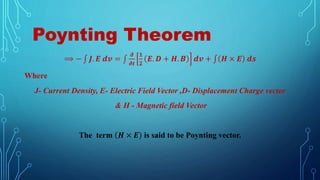
⟹ − 𝑱. 𝑬 𝒅𝒗 =
𝝏
𝝏𝒕
𝟏
𝟐
𝑬. 𝑫 + 𝑯. 𝑩 𝒅𝒗 + 𝑯 × 𝑬 𝒅𝒔
Where
J- Current Density, E- Electric Field Vector ,D- Displacement Charge vector
& H - Magnetic field Vector
The term 𝑯 × 𝑬 is said to be Poynting vector.
Interpretation of 𝑯 × 𝑬 𝒅𝒔
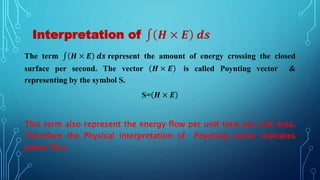
The term 𝑯 × 𝑬 𝒅𝒔 represent the amount of energy crossing the closed
surface per second. The vector 𝑯 × 𝑬 is called Poynting vector &
representing by the symbol S.
S= 𝑯 × 𝑬
This term also represent the energy flow per unit time per unit area.
Therefore the Physical interpretation of Poynting vector indicates
power flux.
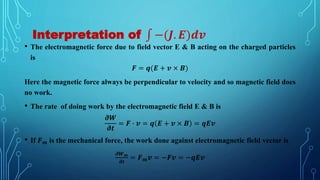
Interpretation of −(𝑱. 𝑬)𝒅𝒗
• The electromagnetic force due to field vector E & B acting on the charged particles
is
𝑭 = 𝒒(𝑬 + 𝒗 × 𝑩)
Here the magnetic force always be perpendicular to velocity and so magnetic field does
no work.
• The rate of doing work by the electromagnetic field E & B is
𝝏𝑾
𝝏𝒕
= 𝑭 ∙ 𝒗 = 𝒒 𝑬 + 𝒗 × 𝑩 = 𝒒𝑬𝒗
• If 𝑭𝒎 is the mechanical force, the work done against electromagnetic field vector is
𝝏𝑾𝒎
𝝏𝒕
= 𝑭𝒎𝒗 = −𝑭𝒗 = −𝒒𝑬𝒗
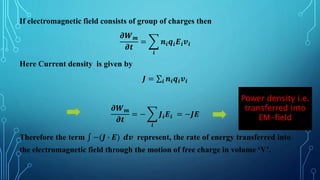
If electromagnetic field consists of group of charges then
𝝏𝑾𝒎
𝝏𝒕
=
𝒊
𝒏𝒊𝒒𝒊𝑬𝒊𝒗𝒊
Here Current density is given by
𝑱 = 𝒊 𝒏𝒊𝒒𝒊𝒗𝒊
𝝏𝑾𝒎
𝝏𝒕
= −
𝒊
𝑱𝒊𝑬𝒊 = −𝑱𝑬
Therefore the term −(𝑱 ∙ 𝑬) 𝒅𝒗 represent, the rate of energy transferred into
the electromagnetic field through the motion of free charge in volume ‘V’.
Power density i.e.
transferred into
EM-field
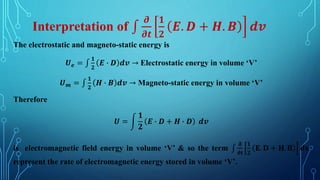
Interpretation of
𝝏
𝝏𝒕
𝟏
𝟐
𝑬. 𝑫 + 𝑯. 𝑩 𝒅𝒗
The electrostatic and magneto-static energy is
𝑼𝒆 =
𝟏
𝟐
𝑬 ∙ 𝑫 𝒅𝒗 → Electrostatic energy in volume ‘V’
𝑼𝒎 =
𝟏
𝟐
𝑯 ∙ 𝑩 𝒅𝒗 → Magneto-static energy in volume ‘V’
Therefore
𝑼 =
𝟏
𝟐
𝑬 ∙ 𝑫 + 𝑯 ∙ 𝑫 𝒅𝒗
is electromagnetic field energy in volume ‘V’ & so the term
𝛛
𝛛𝐭
𝟏
𝟐
𝐄. 𝐃 + 𝐇. 𝐁 𝐝𝐯
represent the rate of electromagnetic energy stored in volume ‘V’.
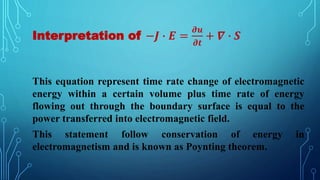
Interpretation of −𝑱 ∙ 𝑬 =
𝝏𝒖
𝝏𝒕
+ 𝜵 ∙ 𝑺
This equation represent time rate change of electromagnetic
energy within a certain volume plus time rate of energy
flowing out through the boundary surface is equal to the
power transferred into electromagnetic field.
This statement follow conservation of energy in
electromagnetism and is known as Poynting theorem.
REFERENCES
• Staya Prakash; Engineering Physics; Pragati Prakashan.
• Poynting's theorem;
https://en.wikipedia.org/wiki/Poynting%27s_theorem#:~:text=4%20Alternative%
20forms-,Definition,energy%20flux%20leaving%20that%20region.
• Maxwell’s Equations : Poynting Theorem; Lecture 30: Electromagnetic Theory
Professor D. K. Ghosh, Physics Department, I.I.T., Bombay.
• Electromagnetic Theory; Devid J. Griffth.
• https://youtu.be/aCTRjVEmeC0.
THANKING
YOU
srt43022@gmail.com

Poynting theorem & Poynting vector

  • 1.
    Poynting Theorem &Poynting Vector Mr. VIKRAM SINGH Assistant Professor Department of Applied Sciences & Humanities (Physics) Institute of Technology & Management (ITM) Meerut (IAMR Group Of Institutions, Gaziyabad)
  • 2.
    Poynting Theorem We knowthat 𝜵 ∙ 𝑫 = 𝟎 𝒐𝒓 𝒅𝒊𝒗 𝑬 = 𝟎 ……1 𝜵 ∙ 𝑩 = 𝟎 𝒐𝒓 𝒅𝒊𝒗 𝑯 = 𝟎 ……….2 𝒄𝒖𝒓𝒍 𝑬 = −𝝁𝟎 𝝏𝑯 𝝏𝒕 ………..3 𝒄𝒖𝒓𝒍 𝑯 = 𝑱 + 𝜺𝟎 𝝏𝑬 𝝏𝒕 …………4 Now multiplying eq.3 by ‘H’ & eq.4 by ‘E’ H𝒄𝒖𝒓𝒍 𝑬 = −𝝁𝟎𝑯 𝝏𝑯 𝝏𝒕 = − 𝟏 𝟐 𝝁𝟎 𝝏 𝝏𝒕 𝑯𝟐 = − 𝟏 𝟐 𝝏 𝝏𝒕 (𝑬 ∙ 𝑫) ……….5 E 𝒄𝒖𝒓𝒍 𝑯 = 𝑱 ∙ 𝑬 + 𝜺𝟎𝑬 𝝏𝑬 𝝏𝒕 = 𝑱 ∙ 𝑬 + 𝟏 𝟐 𝜺𝟎 𝝏 𝝏𝒕 𝑬𝟐 = 𝑱 ∙ 𝑬 + 𝟏 𝟐 𝝏 𝝏𝒕 𝑯 ∙ 𝑩 …6
  • 3.
    POYNTING THEOREM Now subtractingeq. 6 from eq.5 𝑯 𝒄𝒖𝒓𝒍 𝑬 − 𝑬 𝒄𝒖𝒓𝒍 𝑯 = − 𝟏 𝟐 𝝏 𝝏𝒕 (𝑬 ∙ 𝑫) + 𝑱 ∙ 𝑬 + 𝟏 𝟐 𝝏 𝝏𝒕 𝑯 ∙ 𝑩 ⟹ 𝒅𝒊𝒗 𝑯 × 𝑬 = − 𝟏 𝟐 𝝏 𝝏𝒕 𝑬 ∙ 𝑫 + 𝑯 ∙ 𝑩 − 𝑱 ∙ 𝑬 ……..7 Integrating over a volume ‘V’ bounded by surface ‘S’ 𝑽 𝒅𝒊𝒗 𝑯 × 𝑬 𝒅𝒗 = 𝑽 − 𝟏 𝟐 𝝏 𝝏𝒕 𝑬 ∙ 𝑫 + 𝑯 ∙ 𝑩 𝒅𝒗 − 𝑽 𝑱 ∙ 𝑬 𝒅𝒗 ……8 Now with the help of Gauss divergence theorem change volume integrating into surface integration 𝑺 𝑯 × 𝑬 𝒅𝑺 = 𝑽 − 𝟏 𝟐 𝝏 𝝏𝒕 𝑬 ∙ 𝑫 + 𝑯 ∙ 𝑩 𝒅𝒗 − 𝑽 𝑱 ∙ 𝑬 𝒅𝒗
  • 4.
    Poynting Theorem ⟹ −𝑱. 𝑬 𝒅𝒗 = 𝝏 𝝏𝒕 𝟏 𝟐 𝑬. 𝑫 + 𝑯. 𝑩 𝒅𝒗 + 𝑯 × 𝑬 𝒅𝒔 Where J- Current Density, E- Electric Field Vector ,D- Displacement Charge vector & H - Magnetic field Vector The term 𝑯 × 𝑬 is said to be Poynting vector.
  • 5.
    Interpretation of 𝑯× 𝑬 𝒅𝒔 The term 𝑯 × 𝑬 𝒅𝒔 represent the amount of energy crossing the closed surface per second. The vector 𝑯 × 𝑬 is called Poynting vector & representing by the symbol S. S= 𝑯 × 𝑬 This term also represent the energy flow per unit time per unit area. Therefore the Physical interpretation of Poynting vector indicates power flux.
  • 6.
    Interpretation of −(𝑱.𝑬)𝒅𝒗 • The electromagnetic force due to field vector E & B acting on the charged particles is 𝑭 = 𝒒(𝑬 + 𝒗 × 𝑩) Here the magnetic force always be perpendicular to velocity and so magnetic field does no work. • The rate of doing work by the electromagnetic field E & B is 𝝏𝑾 𝝏𝒕 = 𝑭 ∙ 𝒗 = 𝒒 𝑬 + 𝒗 × 𝑩 = 𝒒𝑬𝒗 • If 𝑭𝒎 is the mechanical force, the work done against electromagnetic field vector is 𝝏𝑾𝒎 𝝏𝒕 = 𝑭𝒎𝒗 = −𝑭𝒗 = −𝒒𝑬𝒗
  • 7.
    If electromagnetic fieldconsists of group of charges then 𝝏𝑾𝒎 𝝏𝒕 = 𝒊 𝒏𝒊𝒒𝒊𝑬𝒊𝒗𝒊 Here Current density is given by 𝑱 = 𝒊 𝒏𝒊𝒒𝒊𝒗𝒊 𝝏𝑾𝒎 𝝏𝒕 = − 𝒊 𝑱𝒊𝑬𝒊 = −𝑱𝑬 Therefore the term −(𝑱 ∙ 𝑬) 𝒅𝒗 represent, the rate of energy transferred into the electromagnetic field through the motion of free charge in volume ‘V’. Power density i.e. transferred into EM-field
  • 8.
    Interpretation of 𝝏 𝝏𝒕 𝟏 𝟐 𝑬. 𝑫+ 𝑯. 𝑩 𝒅𝒗 The electrostatic and magneto-static energy is 𝑼𝒆 = 𝟏 𝟐 𝑬 ∙ 𝑫 𝒅𝒗 → Electrostatic energy in volume ‘V’ 𝑼𝒎 = 𝟏 𝟐 𝑯 ∙ 𝑩 𝒅𝒗 → Magneto-static energy in volume ‘V’ Therefore 𝑼 = 𝟏 𝟐 𝑬 ∙ 𝑫 + 𝑯 ∙ 𝑫 𝒅𝒗 is electromagnetic field energy in volume ‘V’ & so the term 𝛛 𝛛𝐭 𝟏 𝟐 𝐄. 𝐃 + 𝐇. 𝐁 𝐝𝐯 represent the rate of electromagnetic energy stored in volume ‘V’.
  • 9.
    Interpretation of −𝑱∙ 𝑬 = 𝝏𝒖 𝝏𝒕 + 𝜵 ∙ 𝑺 This equation represent time rate change of electromagnetic energy within a certain volume plus time rate of energy flowing out through the boundary surface is equal to the power transferred into electromagnetic field. This statement follow conservation of energy in electromagnetism and is known as Poynting theorem.
  • 10.
    REFERENCES • Staya Prakash;Engineering Physics; Pragati Prakashan. • Poynting's theorem; https://en.wikipedia.org/wiki/Poynting%27s_theorem#:~:text=4%20Alternative% 20forms-,Definition,energy%20flux%20leaving%20that%20region. • Maxwell’s Equations : Poynting Theorem; Lecture 30: Electromagnetic Theory Professor D. K. Ghosh, Physics Department, I.I.T., Bombay. • Electromagnetic Theory; Devid J. Griffth. • https://youtu.be/aCTRjVEmeC0.
  • 11.