Diffraction of Light

Austen Corbitt and Lindsey
Stanfield
Objectives
❖Describe how light waves bend around
obstacles and produce bright and dark
fringes.
❖Describe how diffraction determines an
optical instrument’s ability to resolve
images.
Introduction
● In this presentation, we will be introducing:
✓Key Terms

✓How it works
✓How Light Bends Around Obstacles
✓Production of Dark and Light Fringes
✓ Resolving Images
Key Terms

•
•
•
•

Diffraction - a change in light wave direction
as they pass from one medium to another.
Aperture - a small slit in which light travels
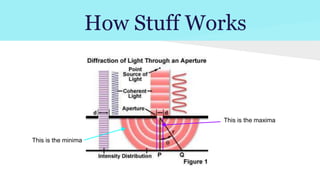
Minima - the dark regions of the diffraction
pattern.
Prima Maxima - bright central region of the
diffraction pattern.
What is Diffraction?

•

•

Diffraction is when light passes through an
object because of the slits or holes in
it, causing it to produce a light on the other
side of that object.
There are many different ways diffraction
occurs: Light, sound, water, etc.
How Stuff Works

This is the maxima
This is the minima
How Light Bends Around an Object
❖Light bends around an object by
diffraction, obviously; but what does that
mean?
❖When an object interferes with the passage
of light, the waves will pass through a slit in
a objects. Then they will spread out in a
certain way on the other side of the object.
Examples
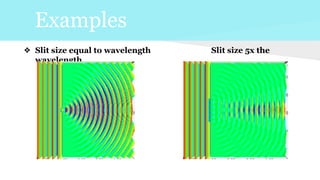
❖ Slit size equal to wavelength
wavelength

Slit size 5x the
Resolving Images

•
•

•

Most people didn’t know that diffraction is
also occurs in the resolution of images.
When a camera lens is used, diffraction
occurs when light passes through the
camera’s aperture, causing the picture to be
disoriented or unresolved.
The camera has a certain feature that
corrects the disoriented picture.
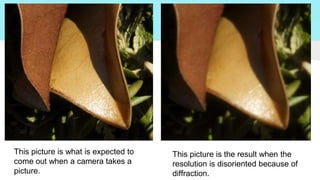
This picture is what is expected to
come out when a camera takes a
picture.

This picture is the result when the
resolution is disoriented because of
diffraction.
Cited Page
●

web.utk.edu. (n.d.). web.utk.edu. Retrieved October 28, 2013, from http://web.utk.edu/

●

Davidson, M. W. (1998, June 20). Molecular Expressions Microscopy Primer: Light and Color - Diffraction of
Light: Interactive Java Tutorial. Molecular Expressions Microscopy Primer: Light and Color - Diffraction of Light:
Interactive Java Tutorial. Retrieved October 28, 2013, from http://micro.magnet.fsu.edu/primer/java/diffra

●

McHugh, S. (n.d.). LENS DIFFRACTION & PHOTOGRAPHY. Diffraction Limited Photography: Pixel Size, Aperture
and Airy Disks. Retrieved October 28, 2013, from http://www.cambridgeincolour.com/tutorials/diffractionphotography.htm

●

Reichmann,, M., Raber, K., & Sanderson, C. (n.d.). Luminous-Landscape Copyright.Luminous-Landscape
Copyright. Retrieved October 26, 2013, from http://www.luminous-landscape.com/about/luminous_landscape

Diffraction of light

  • 1.
    Diffraction of Light AustenCorbitt and Lindsey Stanfield
  • 2.
    Objectives ❖Describe how lightwaves bend around obstacles and produce bright and dark fringes. ❖Describe how diffraction determines an optical instrument’s ability to resolve images.
  • 3.
    Introduction ● In thispresentation, we will be introducing: ✓Key Terms ✓How it works ✓How Light Bends Around Obstacles ✓Production of Dark and Light Fringes ✓ Resolving Images
  • 4.
    Key Terms • • • • Diffraction -a change in light wave direction as they pass from one medium to another. Aperture - a small slit in which light travels Minima - the dark regions of the diffraction pattern. Prima Maxima - bright central region of the diffraction pattern.
  • 5.
    What is Diffraction? • • Diffractionis when light passes through an object because of the slits or holes in it, causing it to produce a light on the other side of that object. There are many different ways diffraction occurs: Light, sound, water, etc.
  • 6.
    How Stuff Works Thisis the maxima This is the minima
  • 7.
    How Light BendsAround an Object ❖Light bends around an object by diffraction, obviously; but what does that mean? ❖When an object interferes with the passage of light, the waves will pass through a slit in a objects. Then they will spread out in a certain way on the other side of the object.
  • 8.
    Examples ❖ Slit sizeequal to wavelength wavelength Slit size 5x the
  • 9.
    Resolving Images • • • Most peopledidn’t know that diffraction is also occurs in the resolution of images. When a camera lens is used, diffraction occurs when light passes through the camera’s aperture, causing the picture to be disoriented or unresolved. The camera has a certain feature that corrects the disoriented picture.
  • 10.
    This picture iswhat is expected to come out when a camera takes a picture. This picture is the result when the resolution is disoriented because of diffraction.
  • 11.
    Cited Page ● web.utk.edu. (n.d.).web.utk.edu. Retrieved October 28, 2013, from http://web.utk.edu/ ● Davidson, M. W. (1998, June 20). Molecular Expressions Microscopy Primer: Light and Color - Diffraction of Light: Interactive Java Tutorial. Molecular Expressions Microscopy Primer: Light and Color - Diffraction of Light: Interactive Java Tutorial. Retrieved October 28, 2013, from http://micro.magnet.fsu.edu/primer/java/diffra ● McHugh, S. (n.d.). LENS DIFFRACTION & PHOTOGRAPHY. Diffraction Limited Photography: Pixel Size, Aperture and Airy Disks. Retrieved October 28, 2013, from http://www.cambridgeincolour.com/tutorials/diffractionphotography.htm ● Reichmann,, M., Raber, K., & Sanderson, C. (n.d.). Luminous-Landscape Copyright.Luminous-Landscape Copyright. Retrieved October 26, 2013, from http://www.luminous-landscape.com/about/luminous_landscape