POLARISATION
Dr A.S. Madhusudanacharyulu
Associate Professor in Physics
Raghu Institute of Technology
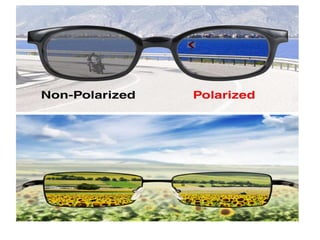
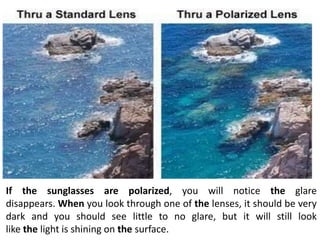
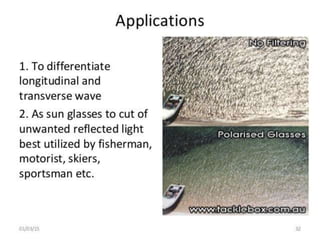
If the sunglasses are polarized, you will notice the glare
disappears. When you look through one of the lenses, it should be very
dark and you should see little to no glare, but it will still look
like the light is shining on the surface.
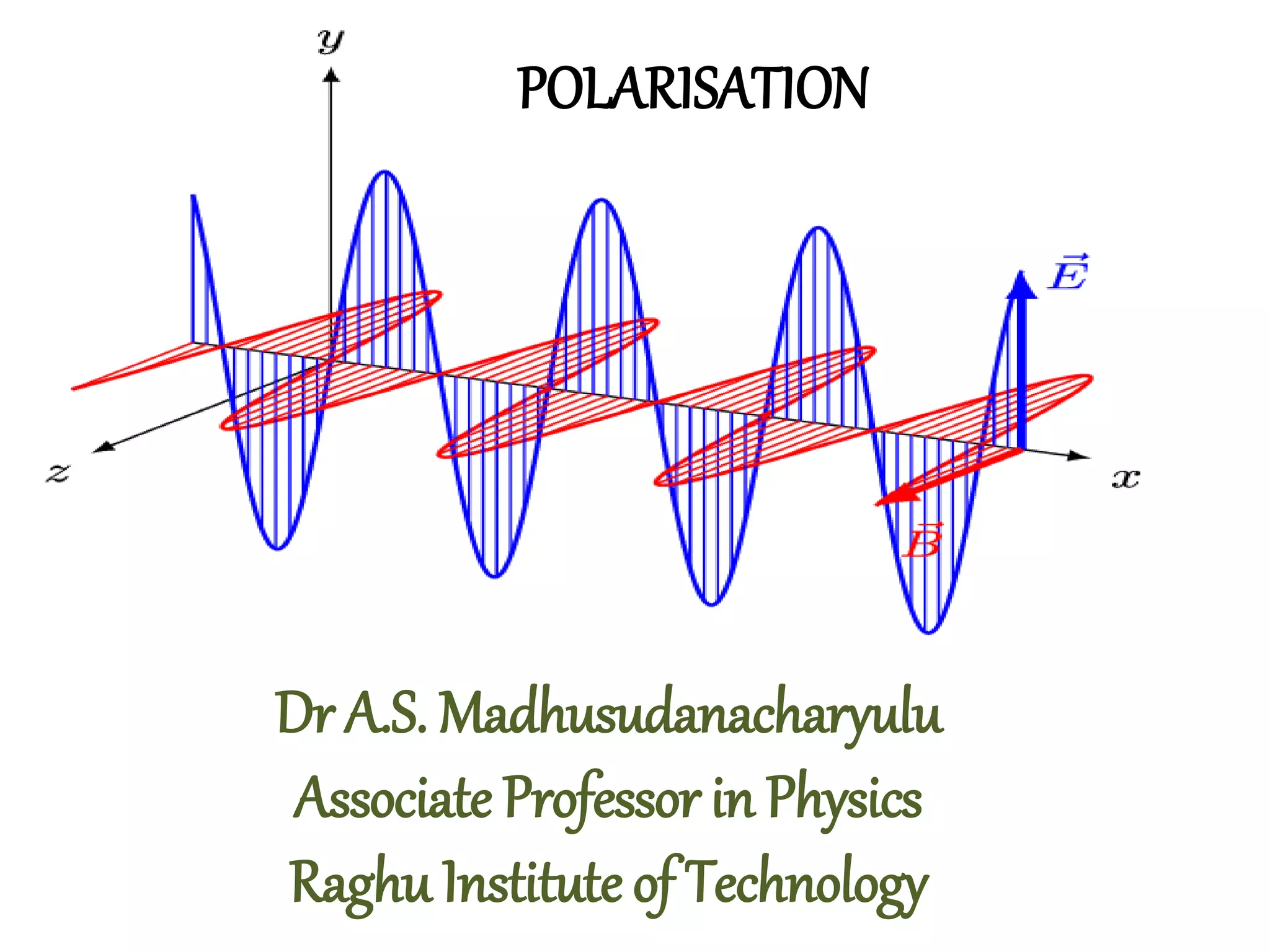
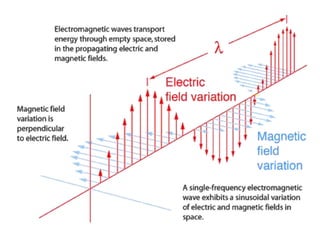
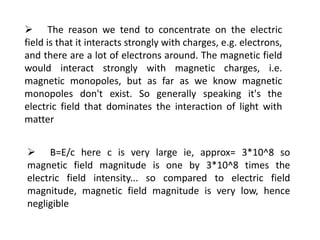
 The reason we tend to concentrate on the electric
field is that it interacts strongly with charges, e.g. electrons,
and there are a lot of electrons around. The magnetic field
would interact strongly with magnetic charges, i.e.
magnetic monopoles, but as far as we know magnetic
monopoles don't exist. So generally speaking it's the
electric field that dominates the interaction of light with
matter
 B=E/c here c is very large ie, approx= 3*10^8 so
magnetic field magnitude is one by 3*10^8 times the
electric field intensity... so compared to electric field
magnitude, magnetic field magnitude is very low, hence
negligible
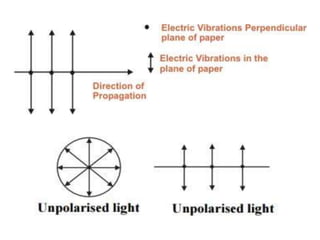
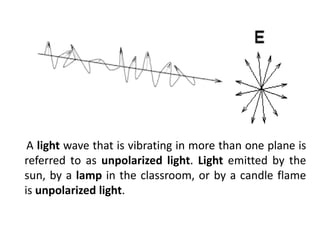
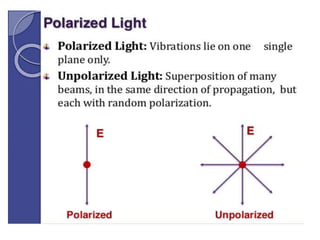
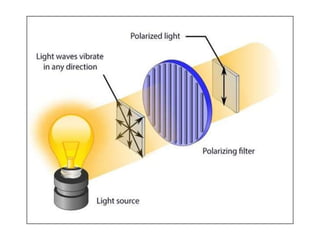
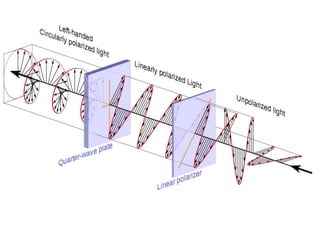
A light wave that is vibrating in more than one plane is
referred to as unpolarized light. Light emitted by the
sun, by a lamp in the classroom, or by a candle flame
is unpolarized light.
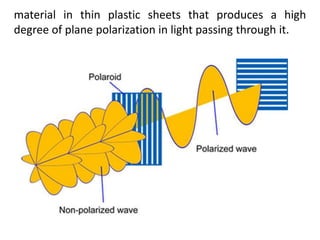
material in thin plastic sheets that produces a high
degree of plane polarization in light passing through it.
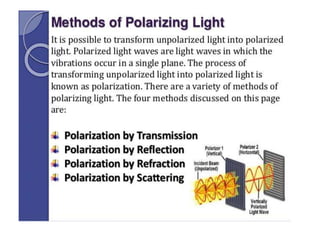
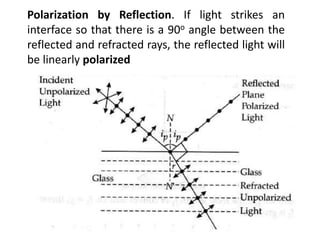
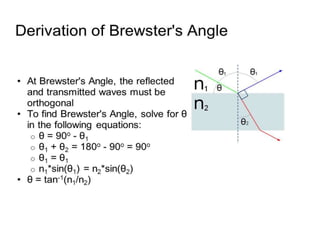
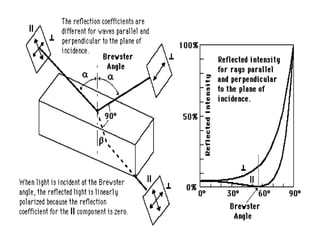
Polarization by Reflection. If light strikes an
interface so that there is a 90o angle between the
reflected and refracted rays, the reflected light will
be linearly polarized
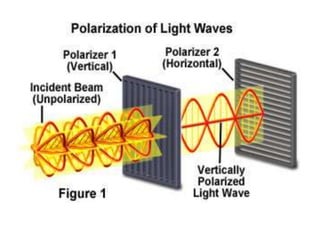
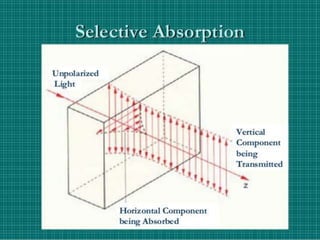
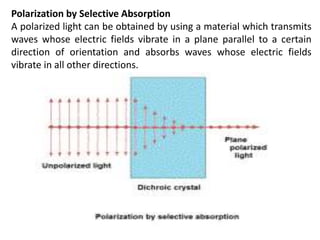
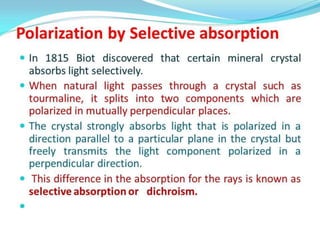
Polarization by Selective Absorption
A polarized light can be obtained by using a material which transmits
waves whose electric fields vibrate in a plane parallel to a certain
direction of orientation and absorbs waves whose electric fields
vibrate in all other directions.
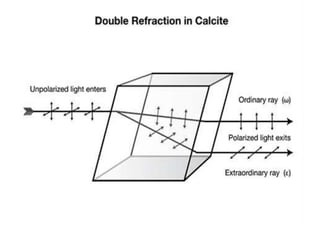
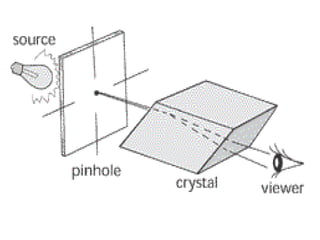
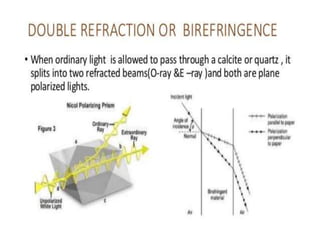
Polarization by double refraction - definition
When the unpolarized light ray falls on certain
crystals like calcite, quartz etc. then it is found that
2 refracted rays are produced. This phenomena is
called double refraction.
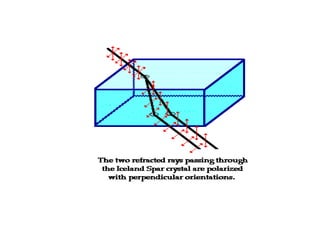
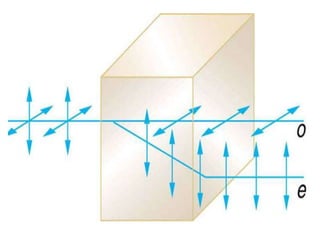
Light passing through a calcite crystal is split into two
rays. This process, first reported by Erasmus
Bartholinus in 1669, is called double refraction. The
two rays of light are each plane polarized by the
calcite such that the planes of polarization are
mutually perpendicular.
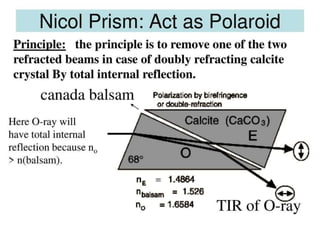
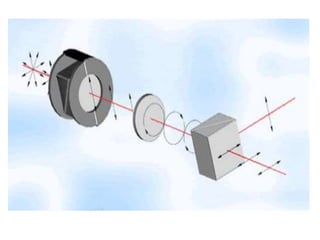
A Nicol prism is a type of polarizer, an optical device
made from calcite crystal used to produce and analyse
plane polarized light. It is made in such a way that it
eliminates one of the rays by total internal reflection, i.e.
the ordinary ray is eliminated and only the extraordinary
ray is transmitted through the prism. It was the first type
of polarizing prism, invented in 1828 by William
Nicol (1770–1851) of Edinburgh. It consists of
a rhombohedral crystal of Iceland spar (a variety
of calcite) that has been cut at an angle of 68° with
respect to the crystal axis, cut again diagonally, and then
rejoined as shown, using a layer of transparent Canada
balsam as a glue.
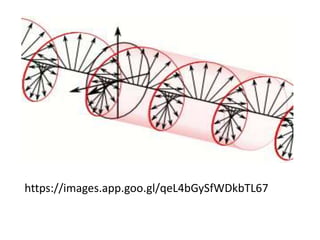
https://images.app.goo.gl/qeL4bGySfWDkbTL67
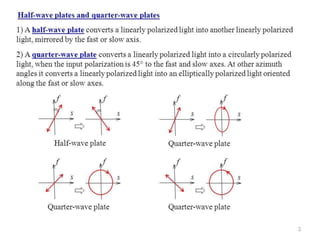
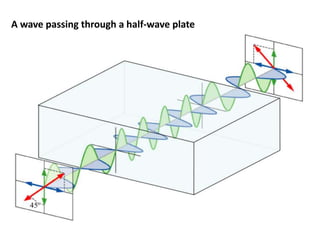
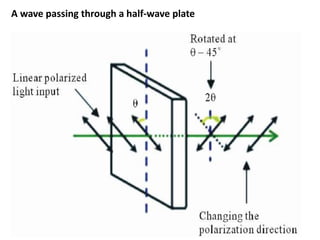
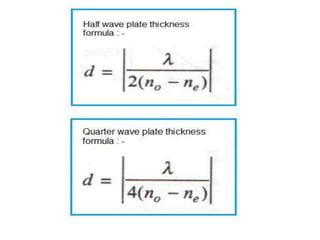
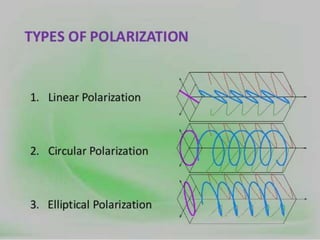
Two common types of waveplates are the half-wave plate,
which shifts the polarization direction of linearly polarized
light, and the quarter-wave plate, which converts linearly
polarized light into circularly polarized light and vice versa.
A quarter-wave plate can be used to produce elliptical
polarization as well.
Definition of half-wave plate. : a crystal plate that reduces
by ¹/₂ cycle the phase difference between the two
components of polarized light traversing it
Definition of quarter-wave plate : a crystal plate that
changes the phase difference between the two
components of polarized light traversing it by one-fourth
cycle
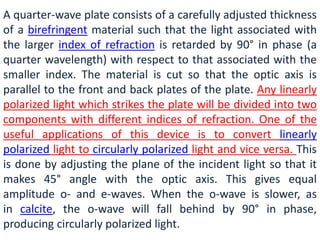
A quarter-wave plate consists of a carefully adjusted thickness
of a birefringent material such that the light associated with
the larger index of refraction is retarded by 90° in phase (a
quarter wavelength) with respect to that associated with the
smaller index. The material is cut so that the optic axis is
parallel to the front and back plates of the plate. Any linearly
polarized light which strikes the plate will be divided into two
components with different indices of refraction. One of the
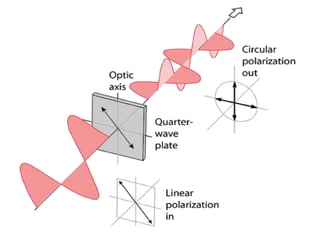
useful applications of this device is to convert linearly
polarized light to circularly polarized light and vice versa. This
is done by adjusting the plane of the incident light so that it
makes 45° angle with the optic axis. This gives equal
amplitude o- and e-waves. When the o-wave is slower, as
in calcite, the o-wave will fall behind by 90° in phase,
producing circularly polarized light.
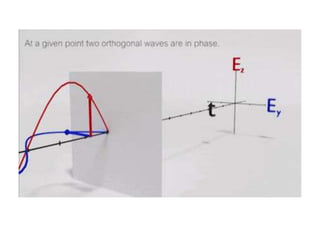
A wave passing through a half-wave plate
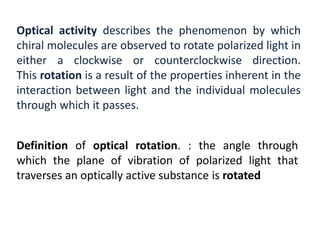
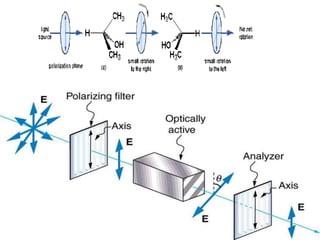
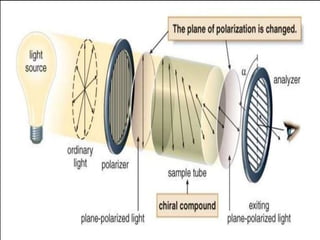
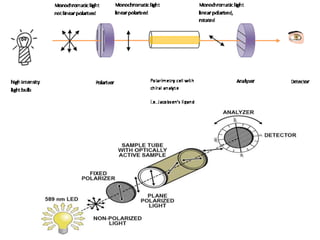
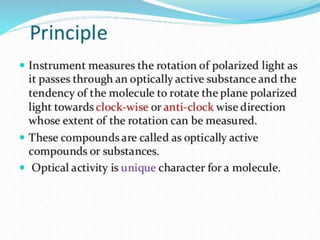
Optical activity describes the phenomenon by which
chiral molecules are observed to rotate polarized light in
either a clockwise or counterclockwise direction.
This rotation is a result of the properties inherent in the
interaction between light and the individual molecules
through which it passes.
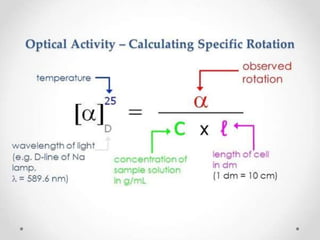
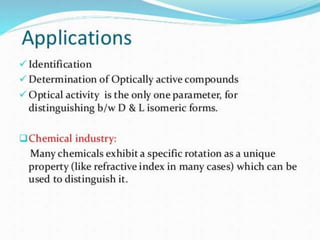
Definition of optical rotation. : the angle through
which the plane of vibration of polarized light that
traverses an optically active substance is rotated
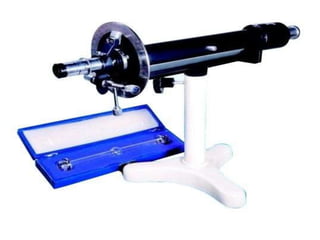
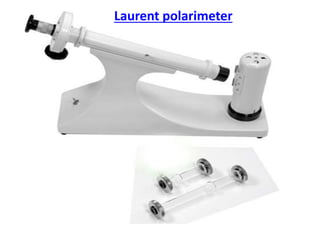
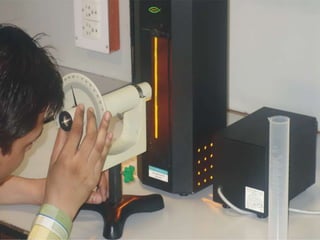
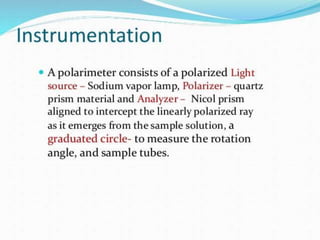
Laurent polarimeter
polarization of light

polarization of light

  • 1.
    POLARISATION Dr A.S. Madhusudanacharyulu AssociateProfessor in Physics Raghu Institute of Technology
  • 5.
    If the sunglassesare polarized, you will notice the glare disappears. When you look through one of the lenses, it should be very dark and you should see little to no glare, but it will still look like the light is shining on the surface.
  • 14.
     The reasonwe tend to concentrate on the electric field is that it interacts strongly with charges, e.g. electrons, and there are a lot of electrons around. The magnetic field would interact strongly with magnetic charges, i.e. magnetic monopoles, but as far as we know magnetic monopoles don't exist. So generally speaking it's the electric field that dominates the interaction of light with matter  B=E/c here c is very large ie, approx= 3*10^8 so magnetic field magnitude is one by 3*10^8 times the electric field intensity... so compared to electric field magnitude, magnetic field magnitude is very low, hence negligible
  • 16.
    A light wavethat is vibrating in more than one plane is referred to as unpolarized light. Light emitted by the sun, by a lamp in the classroom, or by a candle flame is unpolarized light.
  • 18.
    material in thinplastic sheets that produces a high degree of plane polarization in light passing through it.
  • 22.
    Polarization by Reflection.If light strikes an interface so that there is a 90o angle between the reflected and refracted rays, the reflected light will be linearly polarized
  • 28.
    Polarization by SelectiveAbsorption A polarized light can be obtained by using a material which transmits waves whose electric fields vibrate in a plane parallel to a certain direction of orientation and absorbs waves whose electric fields vibrate in all other directions.
  • 30.
    Polarization by doublerefraction - definition When the unpolarized light ray falls on certain crystals like calcite, quartz etc. then it is found that 2 refracted rays are produced. This phenomena is called double refraction. Light passing through a calcite crystal is split into two rays. This process, first reported by Erasmus Bartholinus in 1669, is called double refraction. The two rays of light are each plane polarized by the calcite such that the planes of polarization are mutually perpendicular.
  • 36.
    A Nicol prismis a type of polarizer, an optical device made from calcite crystal used to produce and analyse plane polarized light. It is made in such a way that it eliminates one of the rays by total internal reflection, i.e. the ordinary ray is eliminated and only the extraordinary ray is transmitted through the prism. It was the first type of polarizing prism, invented in 1828 by William Nicol (1770–1851) of Edinburgh. It consists of a rhombohedral crystal of Iceland spar (a variety of calcite) that has been cut at an angle of 68° with respect to the crystal axis, cut again diagonally, and then rejoined as shown, using a layer of transparent Canada balsam as a glue.
  • 43.
  • 46.
    Two common typesof waveplates are the half-wave plate, which shifts the polarization direction of linearly polarized light, and the quarter-wave plate, which converts linearly polarized light into circularly polarized light and vice versa. A quarter-wave plate can be used to produce elliptical polarization as well. Definition of half-wave plate. : a crystal plate that reduces by ¹/₂ cycle the phase difference between the two components of polarized light traversing it Definition of quarter-wave plate : a crystal plate that changes the phase difference between the two components of polarized light traversing it by one-fourth cycle
  • 48.
    A quarter-wave plateconsists of a carefully adjusted thickness of a birefringent material such that the light associated with the larger index of refraction is retarded by 90° in phase (a quarter wavelength) with respect to that associated with the smaller index. The material is cut so that the optic axis is parallel to the front and back plates of the plate. Any linearly polarized light which strikes the plate will be divided into two components with different indices of refraction. One of the useful applications of this device is to convert linearly polarized light to circularly polarized light and vice versa. This is done by adjusting the plane of the incident light so that it makes 45° angle with the optic axis. This gives equal amplitude o- and e-waves. When the o-wave is slower, as in calcite, the o-wave will fall behind by 90° in phase, producing circularly polarized light.
  • 52.
    A wave passingthrough a half-wave plate
  • 53.
    A wave passingthrough a half-wave plate
  • 56.
    Optical activity describesthe phenomenon by which chiral molecules are observed to rotate polarized light in either a clockwise or counterclockwise direction. This rotation is a result of the properties inherent in the interaction between light and the individual molecules through which it passes. Definition of optical rotation. : the angle through which the plane of vibration of polarized light that traverses an optically active substance is rotated
  • 61.