Introduction to Chopper
/DC-DC Converter
By
Ashvani Shukla
Manager(c&i)
Bgr energy
 DC to DC converter is very much needed nowadays as many industrial
applications are dependent upon DC voltage source. The performance of these
applications will be improved if we use a variable DC supply. It will help to
improve controllability of the equipments also. Examples of such applications are
subway cars, trolley buses, battery operated vehicles etc. We can control and
vary a constant dc voltage with the help of a chopper.
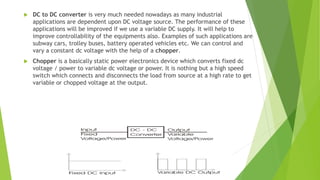
 Chopper is a basically static power electronics device which converts fixed dc
voltage / power to variable dc voltage or power. It is nothing but a high speed
switch which connects and disconnects the load from source at a high rate to get
variable or chopped voltage at the output.
 Chopper can increase or decrease the dc voltage level at its opposite side. So,
chopper serves the same purpose in dc circuit transfers in case of ac circuit. So it
is also known as DC transformer.
 Devices used in Chopper
 Low power application : GTO, IGBT, Power BJT, Power MOSFET etc. High power
application : Thyristor or SCR.
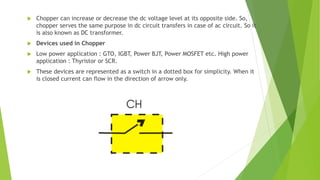
 These devices are represented as a switch in a dotted box for simplicity. When it
is closed current can flow in the direction of arrow only.
 ) Step down Chopper : Step down chopper as Buck converted is used to reduce
the i/p voltage level at the output side. Circuit diagram of a step down chopper
is shown in the adjacent figure.
 When CH is turned ON, Vs directly appears across the load as shown in figure. So
VO = VS.
 When CH is turned off, Vs is disconnected from the load. So output voltage VO = 0.
 The voltage waveform of step down chopper is shown below:
 TON → It is the interval in which chopper is in ON state. TOFF → It is the interval in
which chopper is in OFF state. VS → Source or input voltage. VO → Output or load
voltage. T → Chopping period = TON + TOFF
 Operation of Step Down Chopper with Resistive Load
 When CH is ON, VO = VS When CH is OFF, VO = 0
Where, D is duty cycle = TON/T. TON can be varied from 0 to T, so 0 ≤ D ≤ 1. Hence
output voltage VO can be varied from 0 to VS.
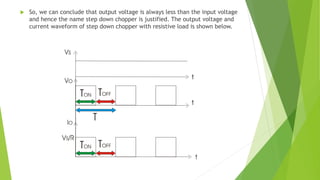
 So, we can conclude that output voltage is always less than the input voltage
and hence the name step down chopper is justified. The output voltage and
current waveform of step down chopper with resistive load is shown below.
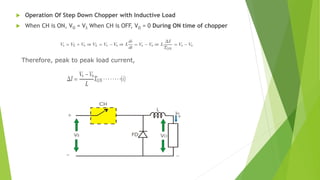
 Operation Of Step Down Chopper with Inductive Load
 When CH is ON, VO = VS When CH is OFF, VO = 0 During ON time of chopper
Therefore, peak to peak load current,
 During OFF Time of Chopper
 If inductance value of L is very large, so load current will be continuous in
nature. When CH is OFF inductor reverses its polarity and discharges. This
current freewheels through diode FD.
By equating (i) and (ii)
 So, from (i) we get
The output voltage and current waveform of step down chopper with
inductive load is shown below
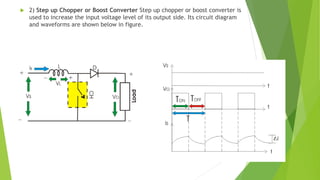
 2) Step up Chopper or Boost Converter Step up chopper or boost converter is
used to increase the input voltage level of its output side. Its circuit diagram
and waveforms are shown below in figure.
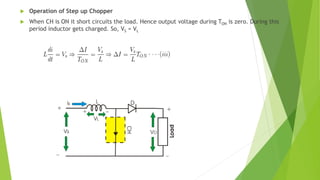
 Operation of Step up Chopper
 When CH is ON it short circuits the load. Hence output voltage during TON is zero. During this
period inductor gets charged. So, VS = VL
 Where ΔI is the peak to peak inductor current. When CH is OFF inductor L discharges through
the load. So, we will get summation of both source voltage VS and inductor Voltage VL as
output voltage, i.e.
 Now, by equating (iii) & (iv),
 As we can vary TON from 0 to T, so 0 ≤ D ≤ 1.
Hence VO can be varied from VS to ∞. It is clear
that output voltage is always greater than the
input voltage and hence it boost up or increase the
voltage level.
 Buck-Boost Converter or Step Up Step Down
Converter
 With the help of Buck-Boost converter we can
increase or decrease the input voltage level at its
output side as per our requirement. The circuit
diagram of this converter is shown below.
 Operation of Buck-Boost Converter
 When CH is ON source voltage will be applied
across inductor L and it will be charged. So VL = VS
Vo = Vs/(1-D)
 When chopper is OFF inductor L reverses its polarity and discharges through load and
diode, So.
 Vo= -VL
 By calculation and equation
 Vo = D/(1-D)*Vs
 D can be varied from 0 to one. When, D = 0; VO = 0 When D = 0.5, VO = VS When, D = 1, VO
= ∞ Hence, in the interval 0 ≤ D ≤ 0.5, output voltage varies in the range 0 ≤ VO ≤ VS and
we get step down or Buck operation. Whereas, in the interval 0.5 ≤ D ≤ 1, output voltage
varies in the range VS ≤ VO ≤ ∞ and we get step up or Boost operation.
 According to direction of output voltage and current
 Semiconductors devices used in chopper circuit are unidirectional. But arranging the
devices in proper way we can get output voltage as well as output current from chopper
in our required direction. So, on the basis of this features chopper can be categorized as
follows :
 Before detailed analysis some basic idea regarding VO – IO quadrant is required here. The
directions of IO and VO marked in the figure – 1 is taken as positive direction.
If output voltage (VO) and output current (IO) follows the
direction as marked in figures then the chopper operation will be
restricted in the first quadrant of VO – IO plane. This type of
operation is also known as forward motoring.
When output voltage (VO) follows the marked direction in fig. 1 but current
flows in the opposite direction then VO is taken positive but IO as negative.
Hence the chopper operates in the second quadrant of VO – IO plane. This type
of operation is also known as forward braking.
 It may also happen that both output voltage and current is opposite to the marked direction in
figure – 1. In t his case both VO and IO are taken as negative. Hence chopper operation is
restricted in third quadrant of VO-IO plane. This operation is called reverse motoring.
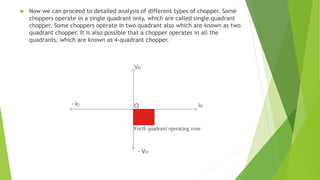
 If output voltage is opposite to the marked direction in fig. 1. then it is taken as negative.
But output current follows the direction as marked in fig. 1 and considered as positive.
Hence chopper operates in 4th quadrant of VO – IO plane. This mode of operation is called
reverse braking.
 Now we can proceed to detailed analysis of different types of chopper. Some
choppers operate in a single quadrant only, which are called single quadrant
chopper. Some choppers operate in two quadrant also which are known as two
quadrant chopper. It is also possible that a chopper operates in all the
quadrants, which are known as 4-quadrant chopper.
 Type-A Chopper
 It is a single quadrant chopper whose operation is restricted in first quadrant
of VO – IO plane. The circuit diagram is shown as below : When CH is ON both
VO & IO follows the direction as marked in the figures. So, both are taken as
positive hence load power is positive which means power is delivered from
source to land. When CH is OFF current freewheels through diode. Hence VO is
zero and IO is positive. In type-A chopper it is seen that average value of VO
and IO is always positive. This is also called step down chopper as average
value of VO is less than the input voltage. This type of chopper is suitable for
motoring operation.
 Type-B Chopper
 This is also a single quadrant chopper operating in second quadrant of VO – IO
plane. The circuit diagram is shown in the following figure.
 It is interesting to note that load must have a dc voltage
source E for this kind of operation. When CH is ON VO is zero
but current flows in the opposite direction as marked in
figure. When chopper is OFF
 Which exceeds the source voltage VS. So current flows through
diode D and treated as negative. Hence current IO is always
negative here but VO is positive (sometimes zero). So, power
flows from load to source and operation of type-B chopper is
restricted in second quadrant of VO – IO plane. This type of
chopper is suitable for forward braking operation.
 Type-C Chopper
 This is a two quadrant chopper whose operation is bounded
between first and second quadrant of VO - IO plane. This type
of chopper obtained by connecting type-A and type-B chopper
in parallel as shown in the figure.
 When CH1 is ON current flows through abcdefa and inductor L will be charged.
Hence output voltage VO and current IO both will be positive. When CH1 is OFF,
induction will discharge through D1 and current IO will flow through same
direction with zero output voltage. So, we can see the operation of CH1 is
nothing but the operation of type-A chopper by which we can operate a
chopper in the first quadrant. When CH2 is ON, output voltage VO will be zero
but output current IO will flow in opposite direction of current shown in the
figure and inductor will be charged up. When CH2 is OFF Output voltage
 Which exceeds the value of source voltage VS. So current flows through diode
D2 and treated as negative. Hence output voltage VO is always positive and
output current IO is always negative here. We can see operation of CH2 is
nothing but operation of type-B chopper by which we can operate the
chopper in the second quadrant. We can conclude that the operation of type-
c chopper is the combined operation of type-A and type-B chopper. This type
of chopper is suitable for both forward motoring and forward braking
operation.

Chopper

  • 1.
    Introduction to Chopper /DC-DCConverter By Ashvani Shukla Manager(c&i) Bgr energy
  • 2.
     DC toDC converter is very much needed nowadays as many industrial applications are dependent upon DC voltage source. The performance of these applications will be improved if we use a variable DC supply. It will help to improve controllability of the equipments also. Examples of such applications are subway cars, trolley buses, battery operated vehicles etc. We can control and vary a constant dc voltage with the help of a chopper.  Chopper is a basically static power electronics device which converts fixed dc voltage / power to variable dc voltage or power. It is nothing but a high speed switch which connects and disconnects the load from source at a high rate to get variable or chopped voltage at the output.
  • 3.
     Chopper canincrease or decrease the dc voltage level at its opposite side. So, chopper serves the same purpose in dc circuit transfers in case of ac circuit. So it is also known as DC transformer.  Devices used in Chopper  Low power application : GTO, IGBT, Power BJT, Power MOSFET etc. High power application : Thyristor or SCR.  These devices are represented as a switch in a dotted box for simplicity. When it is closed current can flow in the direction of arrow only.
  • 4.
     ) Stepdown Chopper : Step down chopper as Buck converted is used to reduce the i/p voltage level at the output side. Circuit diagram of a step down chopper is shown in the adjacent figure.
  • 5.
     When CHis turned ON, Vs directly appears across the load as shown in figure. So VO = VS.
  • 6.
     When CHis turned off, Vs is disconnected from the load. So output voltage VO = 0.
  • 7.
     The voltagewaveform of step down chopper is shown below:
  • 8.
     TON →It is the interval in which chopper is in ON state. TOFF → It is the interval in which chopper is in OFF state. VS → Source or input voltage. VO → Output or load voltage. T → Chopping period = TON + TOFF  Operation of Step Down Chopper with Resistive Load  When CH is ON, VO = VS When CH is OFF, VO = 0
  • 9.
    Where, D isduty cycle = TON/T. TON can be varied from 0 to T, so 0 ≤ D ≤ 1. Hence output voltage VO can be varied from 0 to VS.
  • 10.
     So, wecan conclude that output voltage is always less than the input voltage and hence the name step down chopper is justified. The output voltage and current waveform of step down chopper with resistive load is shown below.
  • 11.
     Operation OfStep Down Chopper with Inductive Load  When CH is ON, VO = VS When CH is OFF, VO = 0 During ON time of chopper Therefore, peak to peak load current,
  • 12.
     During OFFTime of Chopper  If inductance value of L is very large, so load current will be continuous in nature. When CH is OFF inductor reverses its polarity and discharges. This current freewheels through diode FD. By equating (i) and (ii)
  • 13.
     So, from(i) we get The output voltage and current waveform of step down chopper with inductive load is shown below
  • 14.
     2) Stepup Chopper or Boost Converter Step up chopper or boost converter is used to increase the input voltage level of its output side. Its circuit diagram and waveforms are shown below in figure.
  • 15.
     Operation ofStep up Chopper  When CH is ON it short circuits the load. Hence output voltage during TON is zero. During this period inductor gets charged. So, VS = VL
  • 16.
     Where ΔIis the peak to peak inductor current. When CH is OFF inductor L discharges through the load. So, we will get summation of both source voltage VS and inductor Voltage VL as output voltage, i.e.
  • 17.
     Now, byequating (iii) & (iv),  As we can vary TON from 0 to T, so 0 ≤ D ≤ 1. Hence VO can be varied from VS to ∞. It is clear that output voltage is always greater than the input voltage and hence it boost up or increase the voltage level.  Buck-Boost Converter or Step Up Step Down Converter  With the help of Buck-Boost converter we can increase or decrease the input voltage level at its output side as per our requirement. The circuit diagram of this converter is shown below.  Operation of Buck-Boost Converter  When CH is ON source voltage will be applied across inductor L and it will be charged. So VL = VS Vo = Vs/(1-D)
  • 18.
     When chopperis OFF inductor L reverses its polarity and discharges through load and diode, So.  Vo= -VL  By calculation and equation  Vo = D/(1-D)*Vs  D can be varied from 0 to one. When, D = 0; VO = 0 When D = 0.5, VO = VS When, D = 1, VO = ∞ Hence, in the interval 0 ≤ D ≤ 0.5, output voltage varies in the range 0 ≤ VO ≤ VS and we get step down or Buck operation. Whereas, in the interval 0.5 ≤ D ≤ 1, output voltage varies in the range VS ≤ VO ≤ ∞ and we get step up or Boost operation.  According to direction of output voltage and current  Semiconductors devices used in chopper circuit are unidirectional. But arranging the devices in proper way we can get output voltage as well as output current from chopper in our required direction. So, on the basis of this features chopper can be categorized as follows :  Before detailed analysis some basic idea regarding VO – IO quadrant is required here. The directions of IO and VO marked in the figure – 1 is taken as positive direction.
  • 19.
    If output voltage(VO) and output current (IO) follows the direction as marked in figures then the chopper operation will be restricted in the first quadrant of VO – IO plane. This type of operation is also known as forward motoring.
  • 20.
    When output voltage(VO) follows the marked direction in fig. 1 but current flows in the opposite direction then VO is taken positive but IO as negative. Hence the chopper operates in the second quadrant of VO – IO plane. This type of operation is also known as forward braking.
  • 21.
     It mayalso happen that both output voltage and current is opposite to the marked direction in figure – 1. In t his case both VO and IO are taken as negative. Hence chopper operation is restricted in third quadrant of VO-IO plane. This operation is called reverse motoring.
  • 22.
     If outputvoltage is opposite to the marked direction in fig. 1. then it is taken as negative. But output current follows the direction as marked in fig. 1 and considered as positive. Hence chopper operates in 4th quadrant of VO – IO plane. This mode of operation is called reverse braking.
  • 23.
     Now wecan proceed to detailed analysis of different types of chopper. Some choppers operate in a single quadrant only, which are called single quadrant chopper. Some choppers operate in two quadrant also which are known as two quadrant chopper. It is also possible that a chopper operates in all the quadrants, which are known as 4-quadrant chopper.
  • 24.
     Type-A Chopper It is a single quadrant chopper whose operation is restricted in first quadrant of VO – IO plane. The circuit diagram is shown as below : When CH is ON both VO & IO follows the direction as marked in the figures. So, both are taken as positive hence load power is positive which means power is delivered from source to land. When CH is OFF current freewheels through diode. Hence VO is zero and IO is positive. In type-A chopper it is seen that average value of VO and IO is always positive. This is also called step down chopper as average value of VO is less than the input voltage. This type of chopper is suitable for motoring operation.
  • 26.
     Type-B Chopper This is also a single quadrant chopper operating in second quadrant of VO – IO plane. The circuit diagram is shown in the following figure.
  • 28.
     It isinteresting to note that load must have a dc voltage source E for this kind of operation. When CH is ON VO is zero but current flows in the opposite direction as marked in figure. When chopper is OFF  Which exceeds the source voltage VS. So current flows through diode D and treated as negative. Hence current IO is always negative here but VO is positive (sometimes zero). So, power flows from load to source and operation of type-B chopper is restricted in second quadrant of VO – IO plane. This type of chopper is suitable for forward braking operation.  Type-C Chopper  This is a two quadrant chopper whose operation is bounded between first and second quadrant of VO - IO plane. This type of chopper obtained by connecting type-A and type-B chopper in parallel as shown in the figure.
  • 30.
     When CH1is ON current flows through abcdefa and inductor L will be charged. Hence output voltage VO and current IO both will be positive. When CH1 is OFF, induction will discharge through D1 and current IO will flow through same direction with zero output voltage. So, we can see the operation of CH1 is nothing but the operation of type-A chopper by which we can operate a chopper in the first quadrant. When CH2 is ON, output voltage VO will be zero but output current IO will flow in opposite direction of current shown in the figure and inductor will be charged up. When CH2 is OFF Output voltage  Which exceeds the value of source voltage VS. So current flows through diode D2 and treated as negative. Hence output voltage VO is always positive and output current IO is always negative here. We can see operation of CH2 is nothing but operation of type-B chopper by which we can operate the chopper in the second quadrant. We can conclude that the operation of type- c chopper is the combined operation of type-A and type-B chopper. This type of chopper is suitable for both forward motoring and forward braking operation.