Presented by,
B. Naveen 207215001
Akhil S. 207215002
1
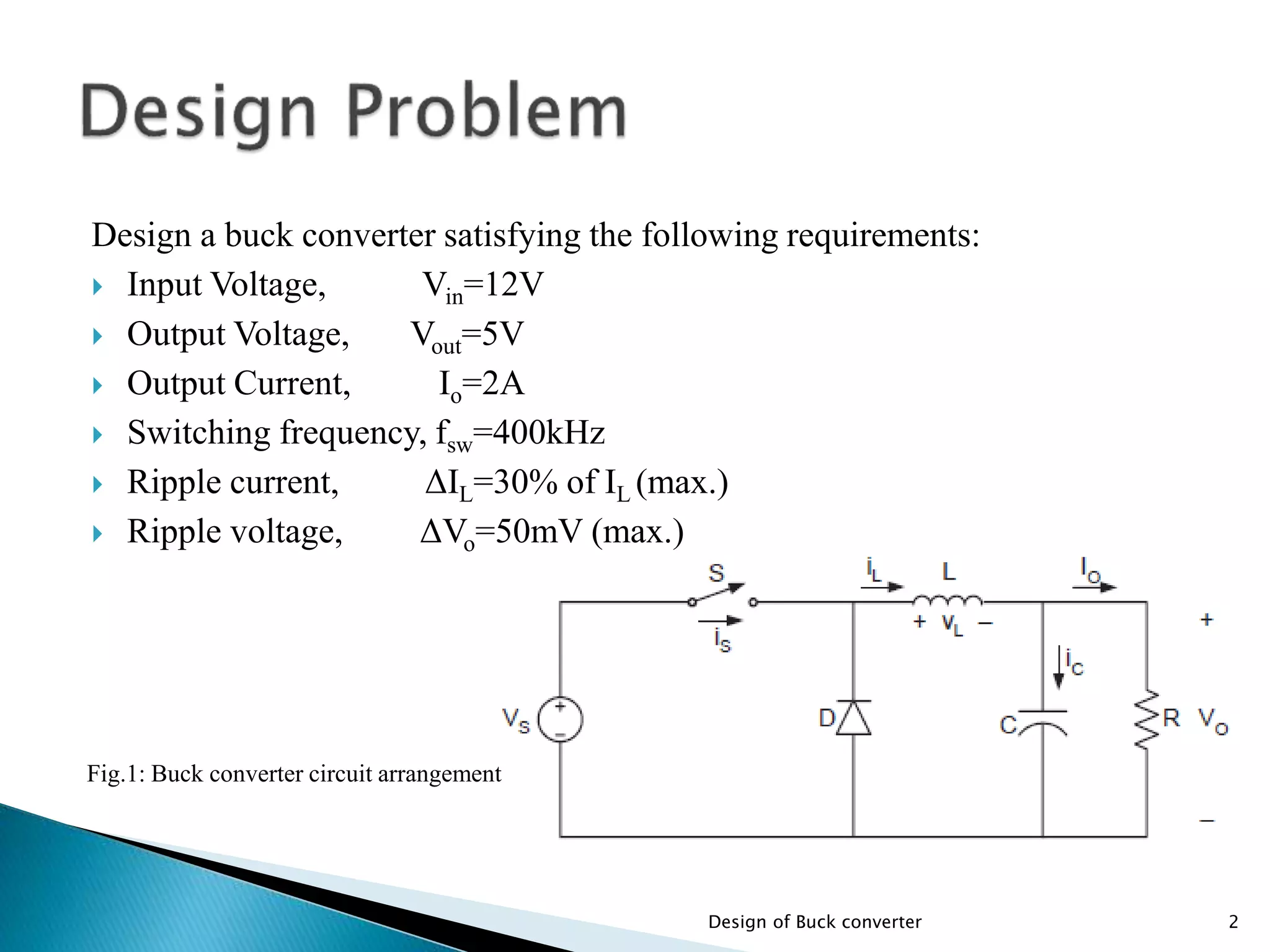
Design a buck converter satisfying the following requirements:
 Input Voltage, Vin=12V
 Output Voltage, Vout=5V
 Output Current, Io=2A
 Switching frequency, fsw=400kHz
 Ripple current, ΔIL=30% of IL (max.)
 Ripple voltage, ΔVo=50mV (max.)
2Design of Buck converter
Fig.1: Buck converter circuit arrangement
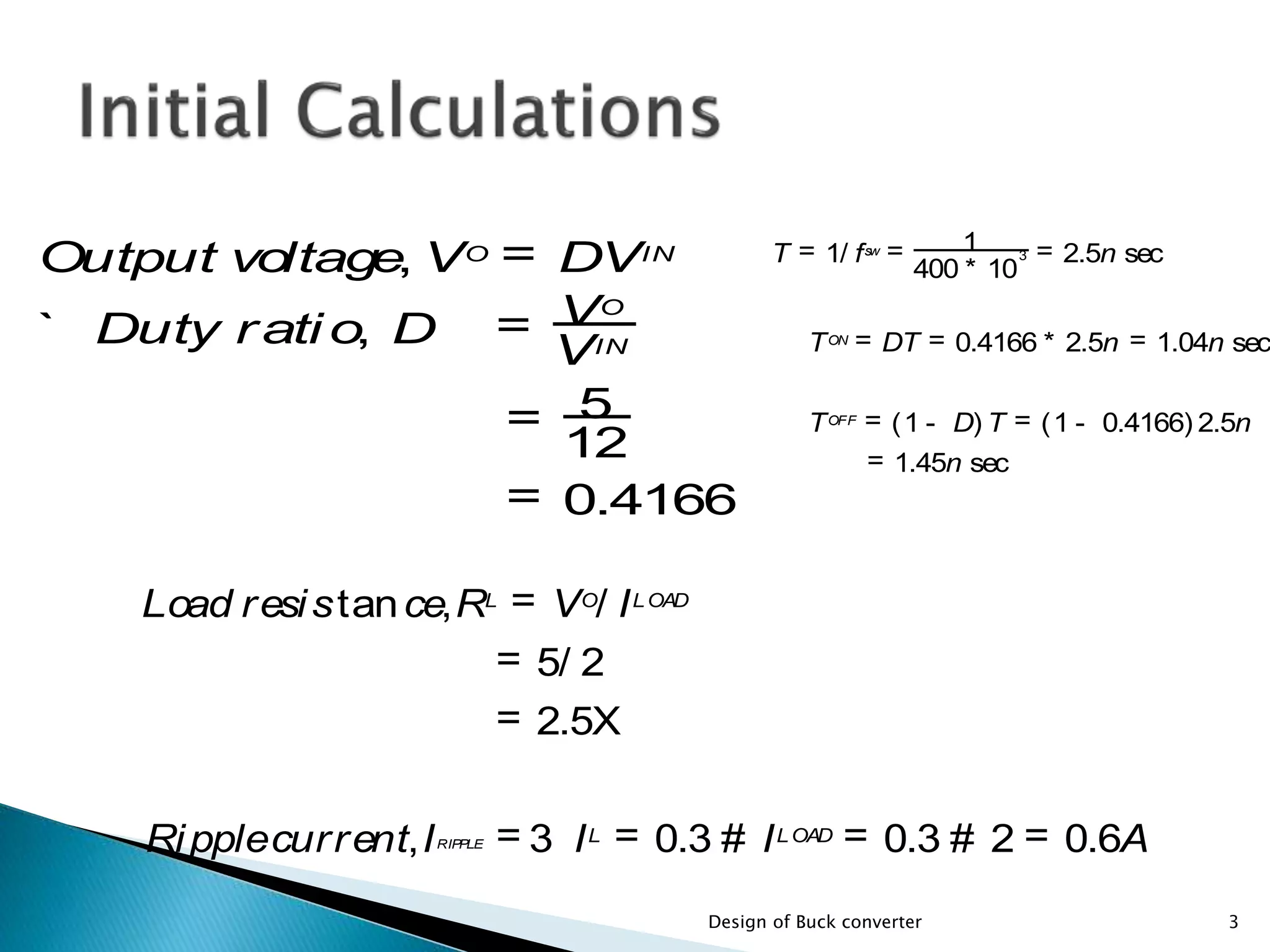
Load resistance,RL = VO
/ ILOAD
= 5/ 2
= 2.5X
Ripplecurrent,IRIPPLE = 3 IL = 0.3 # ILOAD = 0.3 # 2 = 0.6A
Output voltage, VO = DVIN
` Duty rati o, D =
VIN
VO
=
12
5
= 0.4166
T = 1/ fsw =
400 * 10
3
1 = 2.5n sec
TON = DT = 0.4166 * 2.5n = 1.04n sec
TOFF = (1 - D) T = (1 - 0.4166) 2.5n
= 1.45n sec
3Design of Buck converter
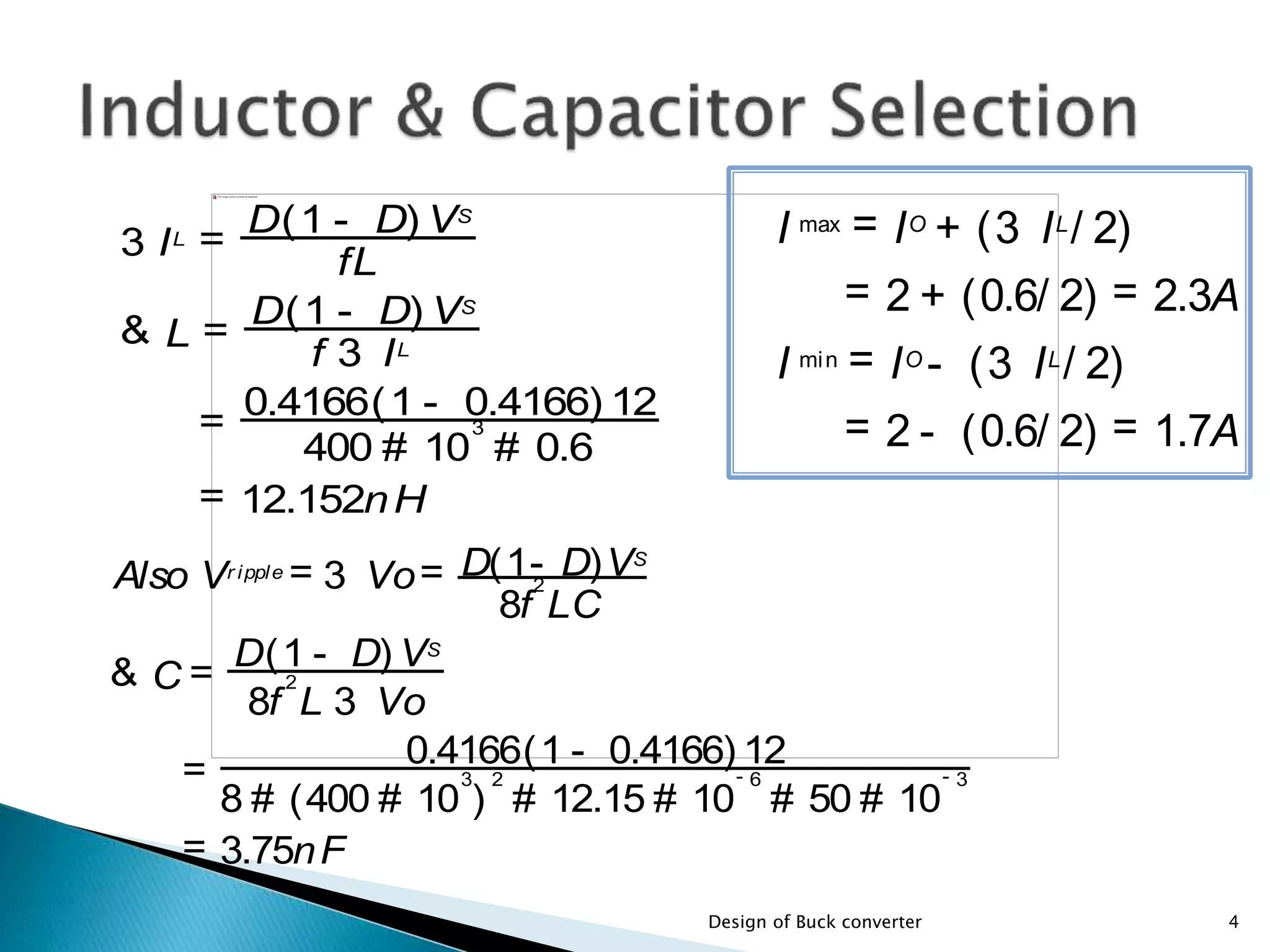
3 IL =
fL
D(1 - D) VS
& L =
f 3 IL
D(1 - D) VS
=
400 # 10
3
# 0.6
0.4166(1 - 0.4166) 12
= 12.152nH
Also Vr ipple = 3 Vo=
8f
2
LC
D(1- D)VS
& C =
8f
2
L 3 Vo
D(1 - D) VS
=
8 # (400 # 10
3
)
2
# 12.15 # 10
- 6
# 50 # 10
- 3
0.4166(1 - 0.4166) 12
= 3.75nF
4Design of Buck converter
I max = IO
+ (3 IL
/ 2)
= 2 + (0.6/ 2) = 2.3A
I min = IO
- (3 IL
/ 2)
= 2 - (0.6/ 2) = 1.7A
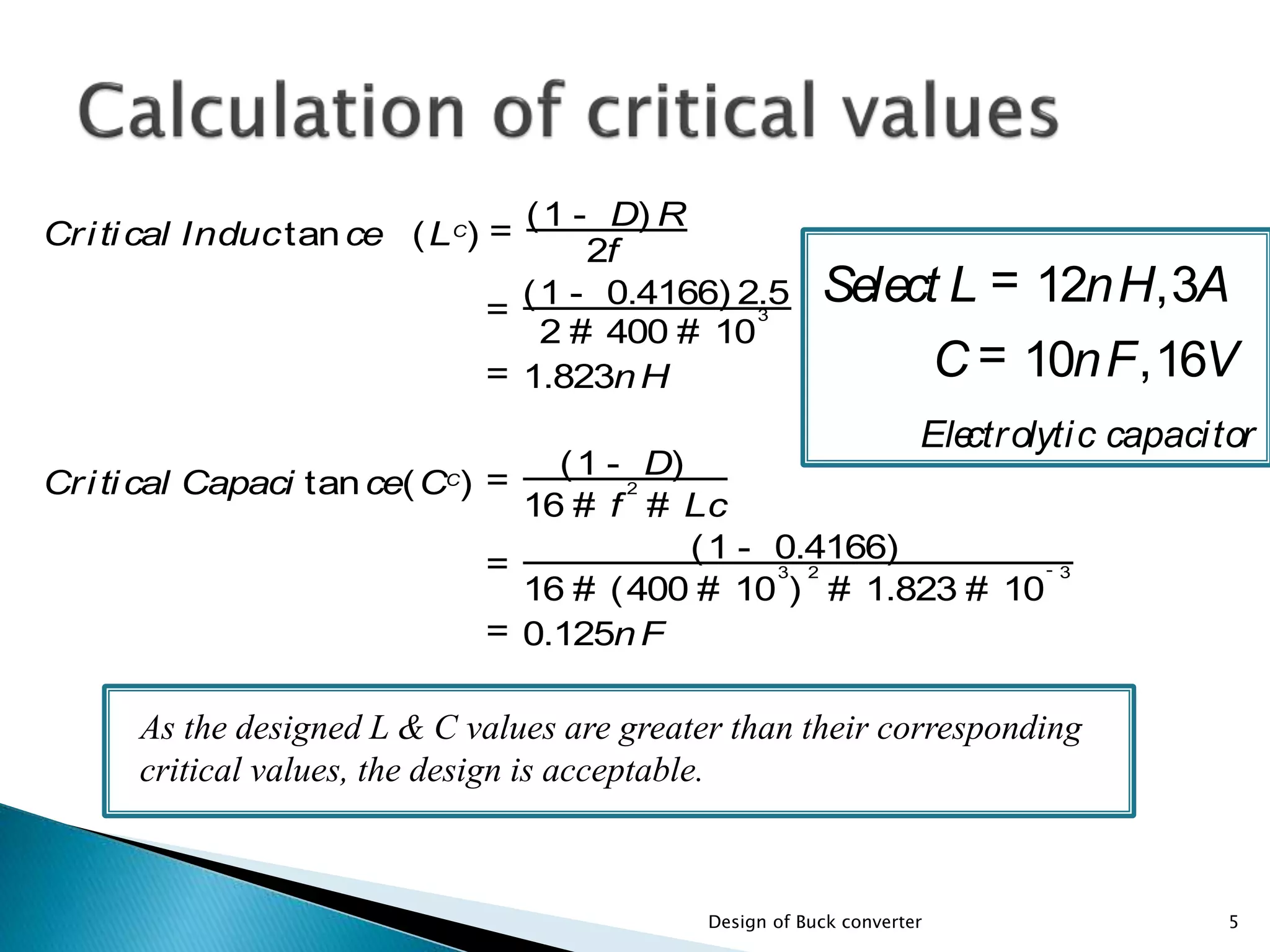
Critical Inductance (LC
) =
2f
(1 - D) R
=
2 # 400 # 10
3
(1 - 0.4166) 2.5
= 1.823nH
Critical Capaci tance(CC
) =
16 # f
2
# Lc
(1 - D)
=
16 # (400 # 10
3
)
2
# 1.823 # 10
- 3
(1 - 0.4166)
= 0.125nF
As the designed L & C values are greater than their corresponding
critical values, the design is acceptable.
5Design of Buck converter
Select L = 12nH,3A
C = 10nF,16V
Electrolytic capacitor
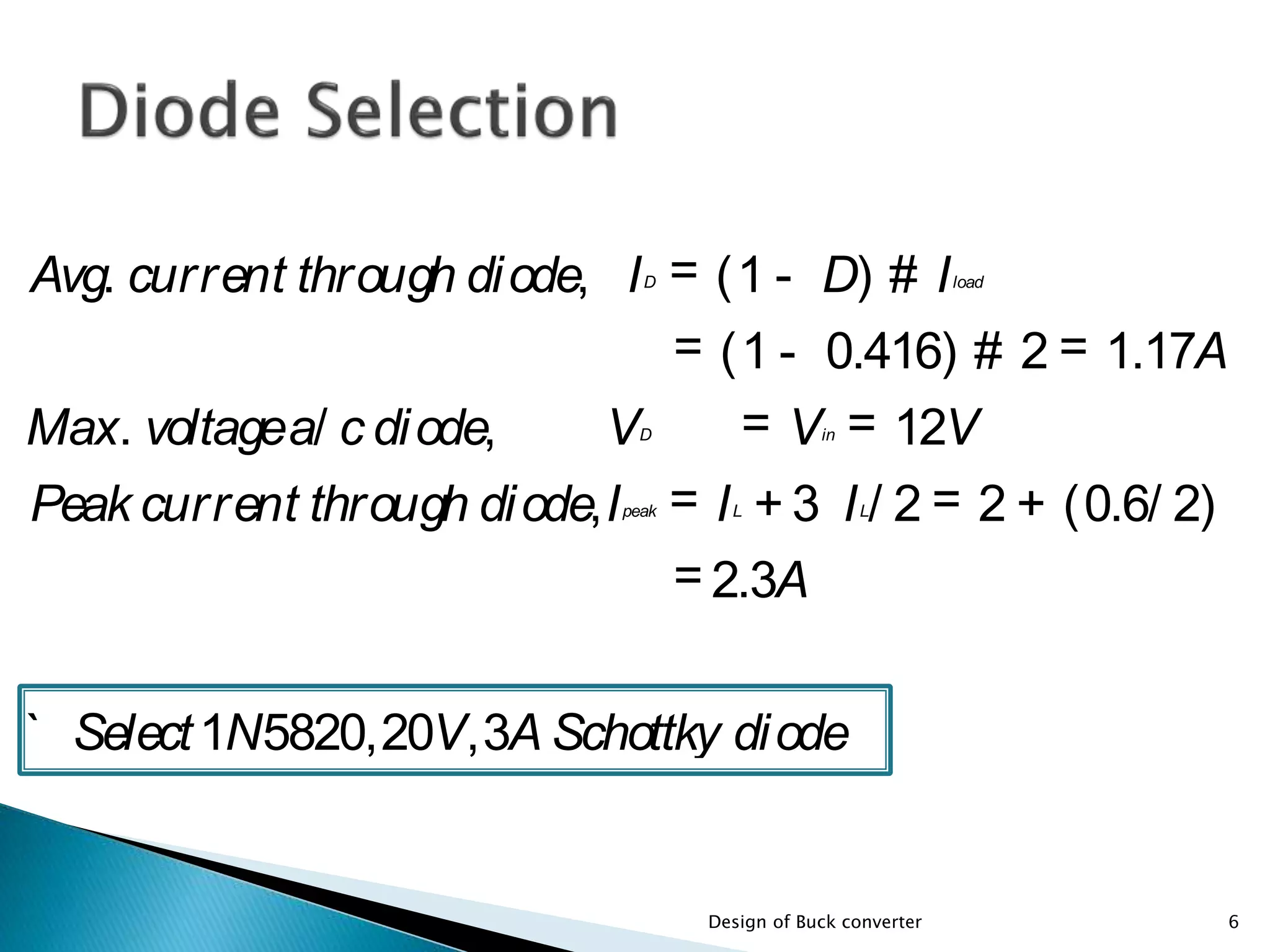
Avg. current through diode, ID = (1 - D) # Iload
= (1 - 0.416) # 2 = 1.17A
Max. voltagea/ c diode, VD = Vin = 12V
Peak current through diode,Ipeak = IL + 3 IL/ 2 = 2 + (0.6/ 2)
= 2.3A
` Select1N5820,20V,3A Schottky diode
6Design of Buck converter
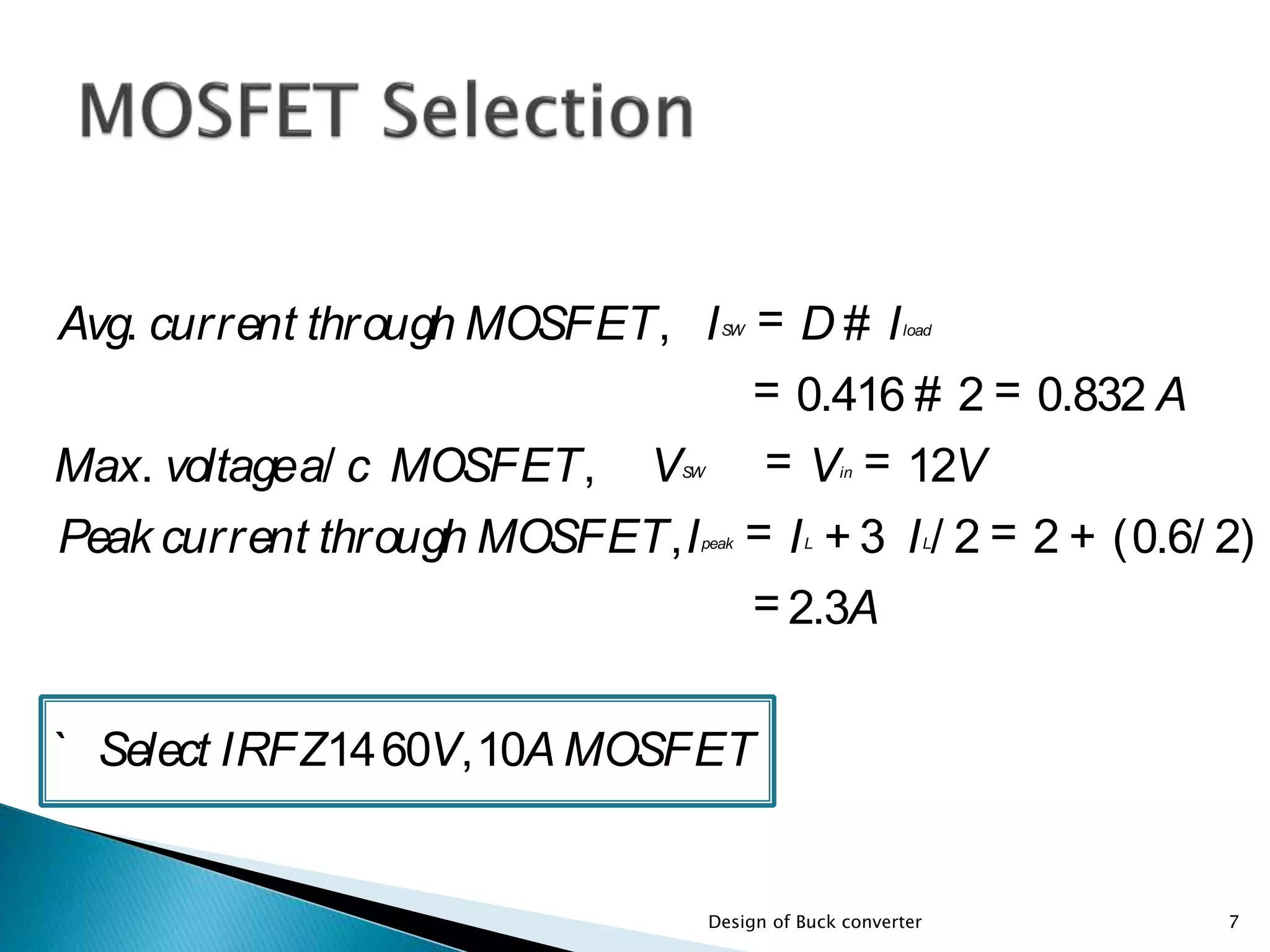
Avg. current through MOSFET, ISW = D # Iload
= 0.416 # 2 = 0.832 A
Max. voltagea/ c MOSFET, VSW = Vin = 12V
Peak current through MOSFET,Ipeak = IL + 3 IL/ 2 = 2 + (0.6/ 2)
= 2.3A
` Select IRFZ1460V,10A MOSFET
7Design of Buck converter
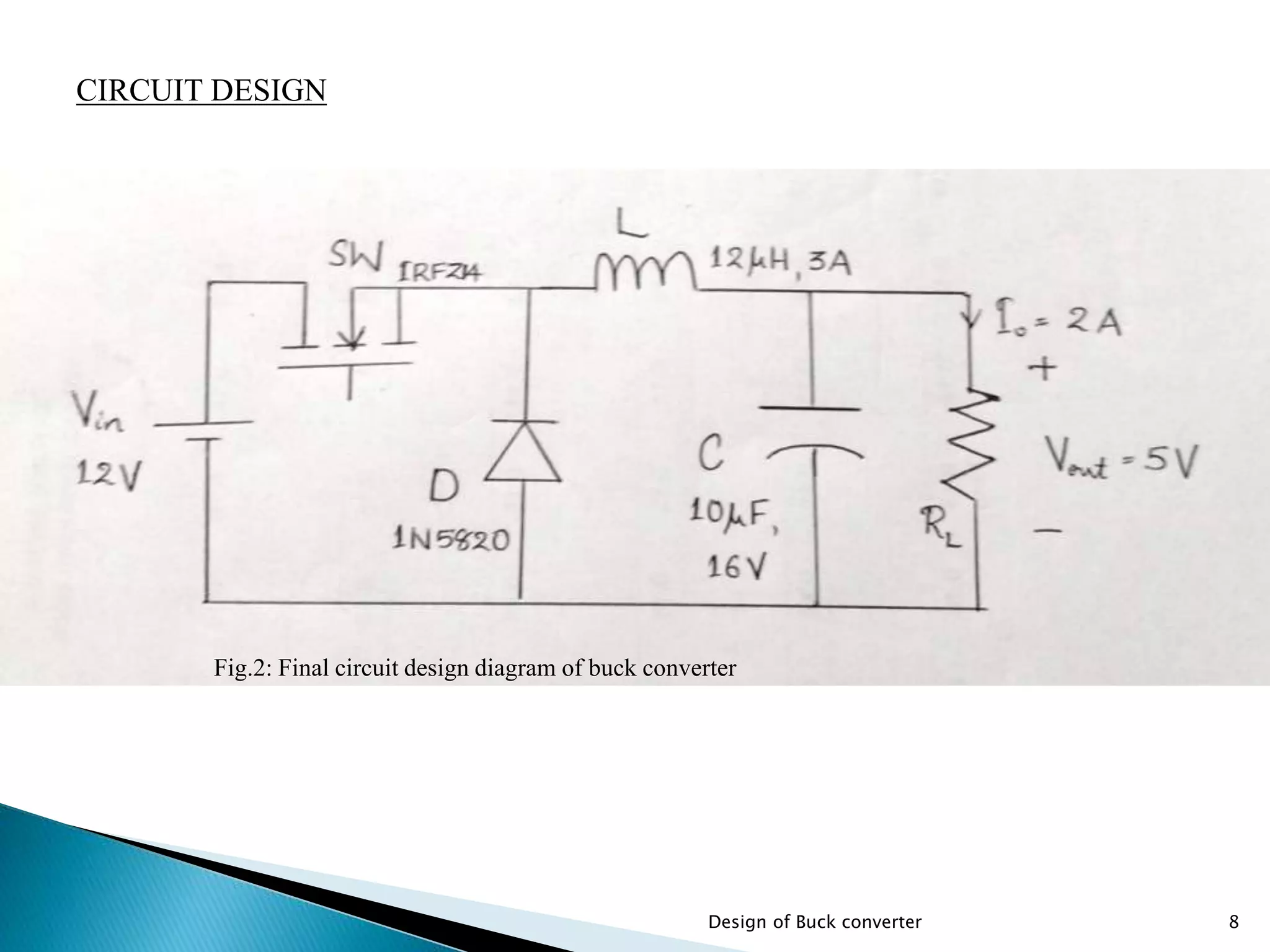
CIRCUIT DESIGN
8Design of Buck converter
Fig.2: Final circuit design diagram of buck converter
WAVEFORMS
9Design of Buck converter
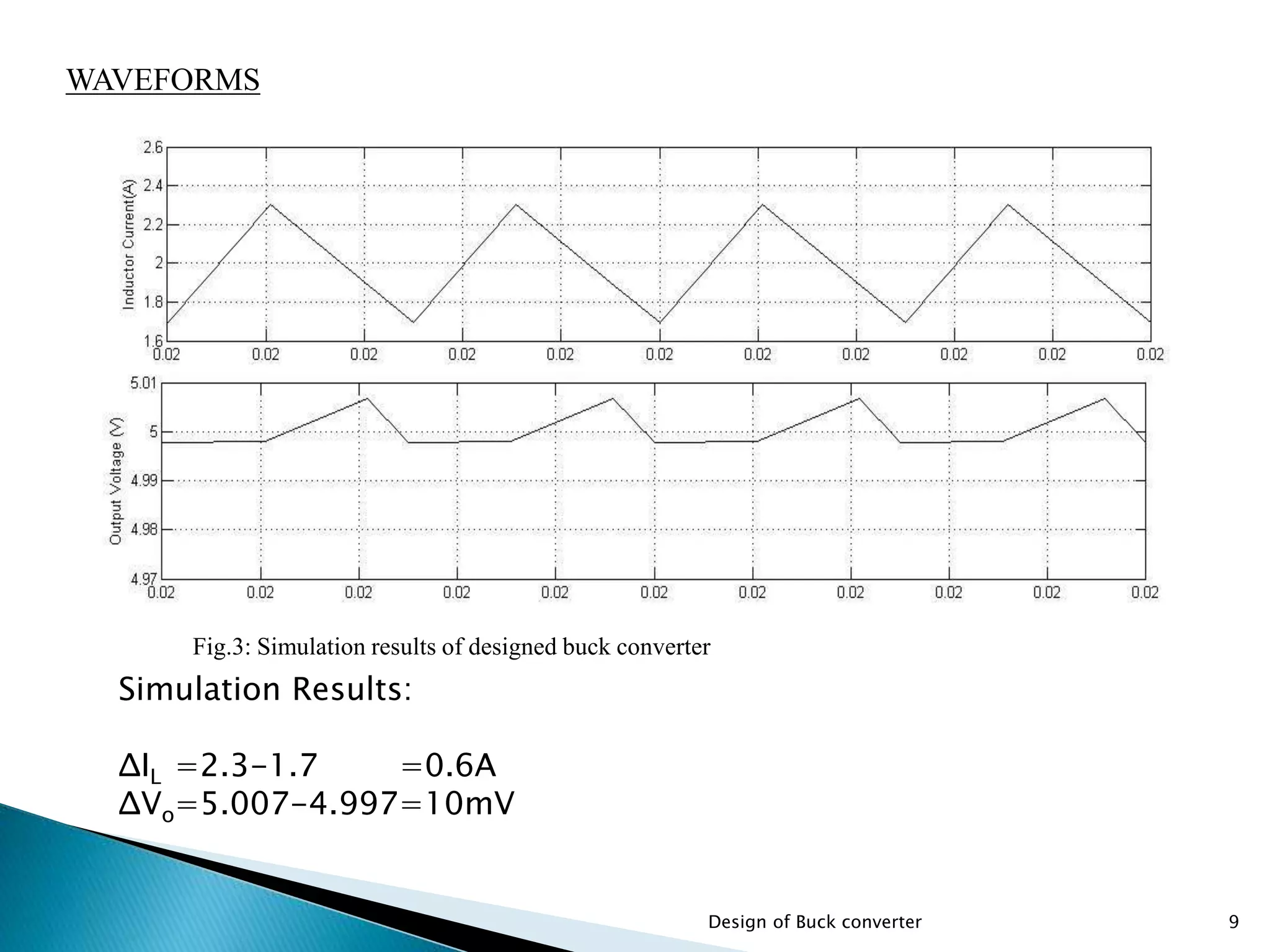
Fig.3: Simulation results of designed buck converter
Simulation Results:
ΔIL =2.3-1.7 =0.6A
ΔVo=5.007-4.997=10mV
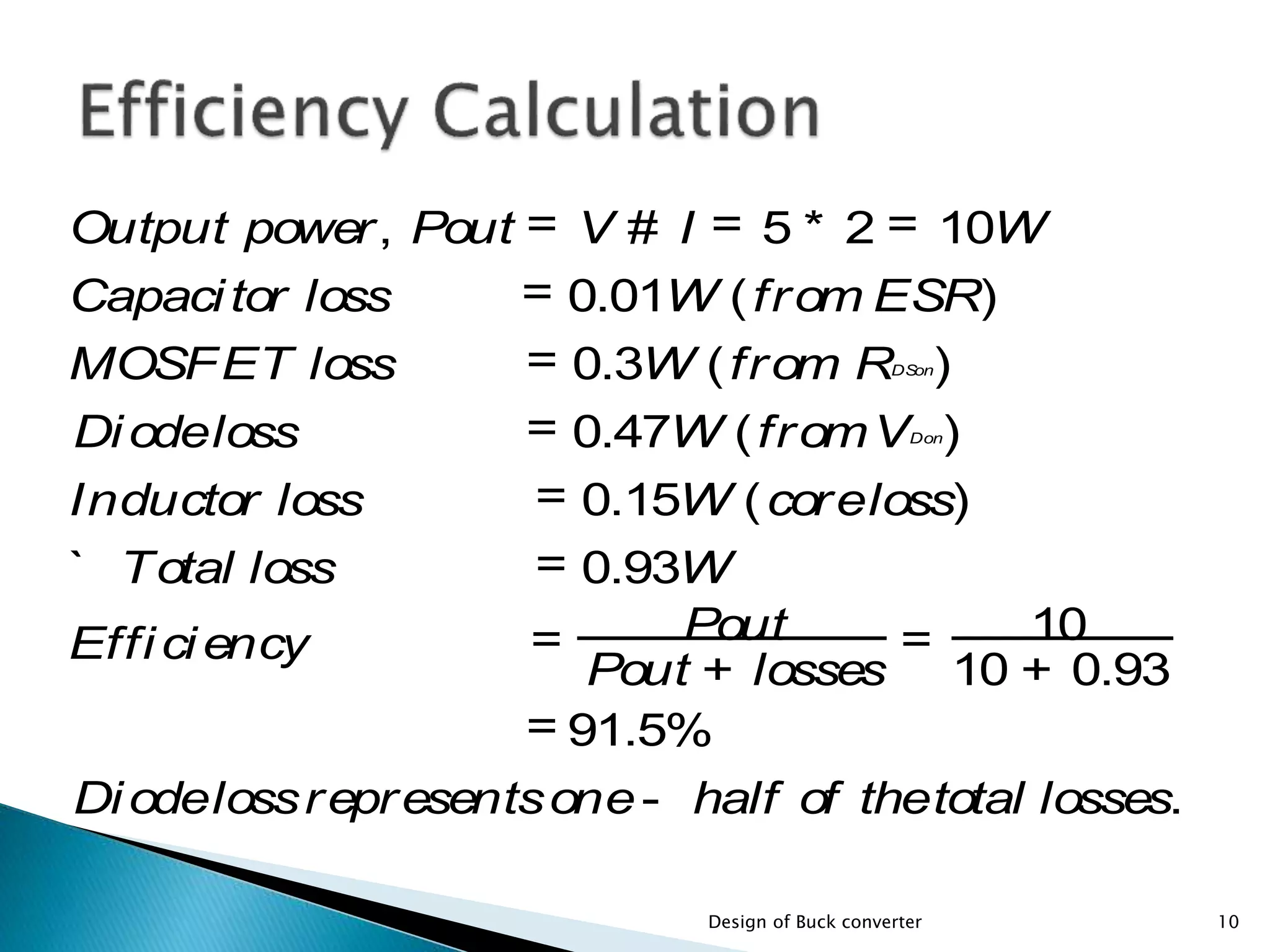
Output power, Pout = V # I = 5 * 2 = 10W
Capacitor loss = 0.01W (from ESR)
MOSFET loss = 0.3W (from RDSon)
Diodeloss = 0.47W (fromVDon)
Inductor loss = 0.15W (coreloss)
` Total loss = 0.93W
Efficiency =
Pout + losses
Pout =
10 + 0.93
10
= 91.5%
Diodelossrepresentsone- half of thetotal losses.
10Design of Buck converter
[1] Ned Mohan, Undeland and Robbin, ‘Power Electronics: Converters,
Application and Design’, John Wiley and sons Inc., Newyork,2006.
[2] Rashid M.H., ‘Power Electronics- Circuits, Device and Applications’,
Prentice Hall India, New Delhi, 2009.
[3] Datasheets
 1N5820 http://www.farnell.com/datasheets/107972.pdf
 IRFZ14 http://www.irf.com/product-info/datasheets/data/irfz14.pdf
 Capacitor http://www.farnell.com/datasheets/1558295.pdf
11Design of Buck converter
Design of Buck converter 12

Design of Buck Converter

  • 1.
    Presented by, B. Naveen207215001 Akhil S. 207215002 1
  • 2.
    Design a buckconverter satisfying the following requirements:  Input Voltage, Vin=12V  Output Voltage, Vout=5V  Output Current, Io=2A  Switching frequency, fsw=400kHz  Ripple current, ΔIL=30% of IL (max.)  Ripple voltage, ΔVo=50mV (max.) 2Design of Buck converter Fig.1: Buck converter circuit arrangement
  • 3.
    Load resistance,RL =VO / ILOAD = 5/ 2 = 2.5X Ripplecurrent,IRIPPLE = 3 IL = 0.3 # ILOAD = 0.3 # 2 = 0.6A Output voltage, VO = DVIN ` Duty rati o, D = VIN VO = 12 5 = 0.4166 T = 1/ fsw = 400 * 10 3 1 = 2.5n sec TON = DT = 0.4166 * 2.5n = 1.04n sec TOFF = (1 - D) T = (1 - 0.4166) 2.5n = 1.45n sec 3Design of Buck converter
  • 4.
    3 IL = fL D(1- D) VS & L = f 3 IL D(1 - D) VS = 400 # 10 3 # 0.6 0.4166(1 - 0.4166) 12 = 12.152nH Also Vr ipple = 3 Vo= 8f 2 LC D(1- D)VS & C = 8f 2 L 3 Vo D(1 - D) VS = 8 # (400 # 10 3 ) 2 # 12.15 # 10 - 6 # 50 # 10 - 3 0.4166(1 - 0.4166) 12 = 3.75nF 4Design of Buck converter I max = IO + (3 IL / 2) = 2 + (0.6/ 2) = 2.3A I min = IO - (3 IL / 2) = 2 - (0.6/ 2) = 1.7A
  • 5.
    Critical Inductance (LC )= 2f (1 - D) R = 2 # 400 # 10 3 (1 - 0.4166) 2.5 = 1.823nH Critical Capaci tance(CC ) = 16 # f 2 # Lc (1 - D) = 16 # (400 # 10 3 ) 2 # 1.823 # 10 - 3 (1 - 0.4166) = 0.125nF As the designed L & C values are greater than their corresponding critical values, the design is acceptable. 5Design of Buck converter Select L = 12nH,3A C = 10nF,16V Electrolytic capacitor
  • 6.
    Avg. current throughdiode, ID = (1 - D) # Iload = (1 - 0.416) # 2 = 1.17A Max. voltagea/ c diode, VD = Vin = 12V Peak current through diode,Ipeak = IL + 3 IL/ 2 = 2 + (0.6/ 2) = 2.3A ` Select1N5820,20V,3A Schottky diode 6Design of Buck converter
  • 7.
    Avg. current throughMOSFET, ISW = D # Iload = 0.416 # 2 = 0.832 A Max. voltagea/ c MOSFET, VSW = Vin = 12V Peak current through MOSFET,Ipeak = IL + 3 IL/ 2 = 2 + (0.6/ 2) = 2.3A ` Select IRFZ1460V,10A MOSFET 7Design of Buck converter
  • 8.
    CIRCUIT DESIGN 8Design ofBuck converter Fig.2: Final circuit design diagram of buck converter
  • 9.
    WAVEFORMS 9Design of Buckconverter Fig.3: Simulation results of designed buck converter Simulation Results: ΔIL =2.3-1.7 =0.6A ΔVo=5.007-4.997=10mV
  • 10.
    Output power, Pout= V # I = 5 * 2 = 10W Capacitor loss = 0.01W (from ESR) MOSFET loss = 0.3W (from RDSon) Diodeloss = 0.47W (fromVDon) Inductor loss = 0.15W (coreloss) ` Total loss = 0.93W Efficiency = Pout + losses Pout = 10 + 0.93 10 = 91.5% Diodelossrepresentsone- half of thetotal losses. 10Design of Buck converter
  • 11.
    [1] Ned Mohan,Undeland and Robbin, ‘Power Electronics: Converters, Application and Design’, John Wiley and sons Inc., Newyork,2006. [2] Rashid M.H., ‘Power Electronics- Circuits, Device and Applications’, Prentice Hall India, New Delhi, 2009. [3] Datasheets  1N5820 http://www.farnell.com/datasheets/107972.pdf  IRFZ14 http://www.irf.com/product-info/datasheets/data/irfz14.pdf  Capacitor http://www.farnell.com/datasheets/1558295.pdf 11Design of Buck converter
  • 12.
    Design of Buckconverter 12