
Mechanical Couplings
By
Ashvani Kumar Shukla
Manager(C&I)
Reliance
Index

Introduction

Type of couplings

Flexible coupling

Rigid coupling
Introduction

A coupling is a device used to connect two shafts
together at their ends for the purpose of transmitting
power. Couplings do not normally allow
disconnection of shafts during operation, however
there are torque limiting couplings which can slip or
disconnect when some torque limit is exceeded.

The primary purpose of couplings is to join two
pieces of rotating equipment while permitting some
degree of misalignment or end movement or both.
By careful selection, installation and maintenance of
couplings, substantial savings can be made in
reduced maintenance costs and downtime.

Couplings are devices used to connect two shafts
Type of coupling

Flexible coupling

Rigid coupling

Flexible coupling
Most small to medium size couplings are basically one of three types.
1.Universal Joints:-
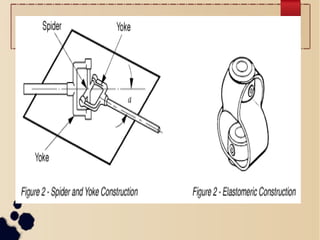
A universal joint is a linkage consisting of two yokes, one on each shaft,
connected by spider as shown on Figure. Since universal joints are
frequently used, and thee r analysis is complex, a separate section is
devoted to them following this section.

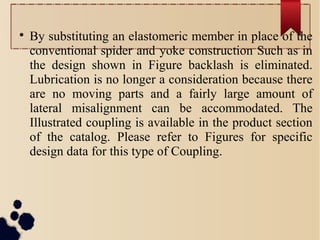
By substituting an elastomeric member in place of the
conventional spider and yoke construction Such as in
the design shown in Figure backlash is eliminated.
Lubrication is no longer a consideration because there
are no moving parts and a fairly large amount of
lateral misalignment can be accommodated. The
Illustrated coupling is available in the product section
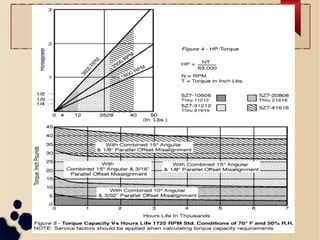
of the catalog. Please refer to Figures for specific
design data for this type of Coupling.

Oldham Coupling:-
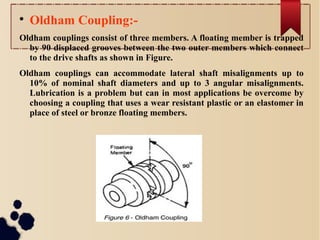
Oldham couplings consist of three members. A floating member is trapped
by 90 displaced grooves between the two outer members which connect
to the drive shafts as shown in Figure.
Oldham couplings can accommodate lateral shaft misalignments up to
10% of nominal shaft diameters and up to 3 angular misalignments.
Lubrication is a problem but can in most applications be overcome by
choosing a coupling that uses a wear resistant plastic or an elastomer in
place of steel or bronze floating members.

Oldham couplings have the following
advantages:

a. No velocity variation as with universal joints

b. High lateral misalignments possible

c. High torque capacity

d. Ease of dismantling
Disadvantages:

a. Limited angular displacement of shafts

b. Need for periodic lubrication due to relative sliding motion unless nylon
or rubber construction is employed

c. Possible loss of loose members during disassembly

Flexible Shafts
Flexible shafts are stiff in torsion and very compliant in bending and
lateral misalignments. A good example of this is in their use on
automotive speedometer drives.

Flexible shafts Consist of:
Shaft – the rotating element consisting of a center wire With several wire
layers wrapped around it in alternating directions.

Casing – the sleeve made from metal or non-metals to guide and protect
the shaft and retain lubricants.

Case End Fitting – connects the casing to the housing of the driver and
driven equipment.

Shaft End Fitting – connects the shaft to the driving and driven
members.

Flexible shafts are also supplied without a casing
when used for hand operated controls or intermittent
powered appiications. Flexible shafts as shown in
the product section of the catalog are often
substituted in place of more expensive gear trains
and universal joints in applications where the toad
must be moved in many directions. They are
extremely useful where the load Is located in a
remote position requiring many gear and shafting
combinations. The basic design considerations are
torque capacity, speed, direction of rotation, bend
radii and service conditions.

Torque capacity is a function of the shaft size.
Operating conditions must be considered in power
drive applications such as starting torque, reversing

Flexible shafting for power transmission is wound
for maximum efficiency when rotating in only one
direction – the direction which tends to tighten the
outer layer of wires on the shaft. Direction of
rotation is identified from the power source end of
the shaft. Torque capacity in the opposite direction is
approximately 60% of the "wind" direction.
Therefore if the power drive shaft must be operated
in both directions, the reduced torque capacity will
require a larger shaft than would normally be
selected for operation in the wind direction.

Because flexible shafts were developed primarily as
a means of transmitting power where Solid Shafts
cannot be used, most applications involve curves.

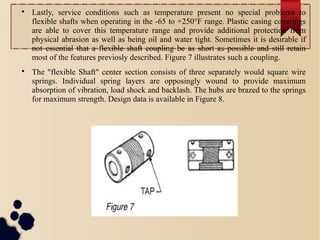
Lastly, service conditions such as temperature present no special problems to
flexible shafts when operating in the -65 to +250°F range. Plastic casing coverings
are able to cover this temperature range and provide additional protection from
physical abrasion as well as being oil and water tight. Sometimes it is desirable if
not essential that a flexible shaft coupling be as short as possible and still retain
most of the features previosly described. Figure 7 illustrates such a coupling.

The "flexible Shaft" center section consists of three separately would square wire
springs. Individual spring layers are opposingly wound to provide maximum
absorption of vibration, load shock and backlash. The hubs are brazed to the springs
for maximum strength. Design data is available in Figure 8.

Miscellaneous Couplings:-

This group of couplings incorporate design features which are frequently
unique, approximations or combinations of universal, Oldham and flexible
shaft couplings. Two widely used couplings in this category are the Jaw and
Sleeve types, both of which are available in the Product Section of our catalog.

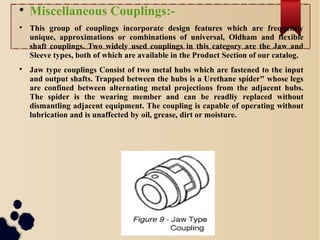
Jaw type couplings Consist of two metal hubs which are fastened to the input
and output shafts. Trapped between the hubs is a Urethane spider" whose legs
are confined between alternating metal projections from the adjacent hubs.
The spider is the wearing member and can be readliy replaced without
dismantling adjacent equipment. The coupling is capable of operating without
lubrication and is unaffected by oil, grease, dirt or moisture.

Thank You................................

Mechanical coupling

  • 1.
    Mechanical Couplings By Ashvani KumarShukla Manager(C&I) Reliance
  • 2.
  • 3.
    Introduction  A coupling isa device used to connect two shafts together at their ends for the purpose of transmitting power. Couplings do not normally allow disconnection of shafts during operation, however there are torque limiting couplings which can slip or disconnect when some torque limit is exceeded.  The primary purpose of couplings is to join two pieces of rotating equipment while permitting some degree of misalignment or end movement or both. By careful selection, installation and maintenance of couplings, substantial savings can be made in reduced maintenance costs and downtime.  Couplings are devices used to connect two shafts
  • 4.
    Type of coupling  Flexiblecoupling  Rigid coupling  Flexible coupling Most small to medium size couplings are basically one of three types. 1.Universal Joints:- A universal joint is a linkage consisting of two yokes, one on each shaft, connected by spider as shown on Figure. Since universal joints are frequently used, and thee r analysis is complex, a separate section is devoted to them following this section.
  • 6.
     By substituting anelastomeric member in place of the conventional spider and yoke construction Such as in the design shown in Figure backlash is eliminated. Lubrication is no longer a consideration because there are no moving parts and a fairly large amount of lateral misalignment can be accommodated. The Illustrated coupling is available in the product section of the catalog. Please refer to Figures for specific design data for this type of Coupling.
  • 8.
     Oldham Coupling:- Oldham couplingsconsist of three members. A floating member is trapped by 90 displaced grooves between the two outer members which connect to the drive shafts as shown in Figure. Oldham couplings can accommodate lateral shaft misalignments up to 10% of nominal shaft diameters and up to 3 angular misalignments. Lubrication is a problem but can in most applications be overcome by choosing a coupling that uses a wear resistant plastic or an elastomer in place of steel or bronze floating members.
  • 9.
     Oldham couplings havethe following advantages:  a. No velocity variation as with universal joints  b. High lateral misalignments possible  c. High torque capacity  d. Ease of dismantling Disadvantages:  a. Limited angular displacement of shafts  b. Need for periodic lubrication due to relative sliding motion unless nylon or rubber construction is employed  c. Possible loss of loose members during disassembly
  • 10.
     Flexible Shafts Flexible shaftsare stiff in torsion and very compliant in bending and lateral misalignments. A good example of this is in their use on automotive speedometer drives.  Flexible shafts Consist of: Shaft – the rotating element consisting of a center wire With several wire layers wrapped around it in alternating directions.  Casing – the sleeve made from metal or non-metals to guide and protect the shaft and retain lubricants.  Case End Fitting – connects the casing to the housing of the driver and driven equipment.  Shaft End Fitting – connects the shaft to the driving and driven members.
  • 11.
     Flexible shafts arealso supplied without a casing when used for hand operated controls or intermittent powered appiications. Flexible shafts as shown in the product section of the catalog are often substituted in place of more expensive gear trains and universal joints in applications where the toad must be moved in many directions. They are extremely useful where the load Is located in a remote position requiring many gear and shafting combinations. The basic design considerations are torque capacity, speed, direction of rotation, bend radii and service conditions.  Torque capacity is a function of the shaft size. Operating conditions must be considered in power drive applications such as starting torque, reversing
  • 12.
     Flexible shafting forpower transmission is wound for maximum efficiency when rotating in only one direction – the direction which tends to tighten the outer layer of wires on the shaft. Direction of rotation is identified from the power source end of the shaft. Torque capacity in the opposite direction is approximately 60% of the "wind" direction. Therefore if the power drive shaft must be operated in both directions, the reduced torque capacity will require a larger shaft than would normally be selected for operation in the wind direction.  Because flexible shafts were developed primarily as a means of transmitting power where Solid Shafts cannot be used, most applications involve curves.
  • 13.
     Lastly, service conditionssuch as temperature present no special problems to flexible shafts when operating in the -65 to +250°F range. Plastic casing coverings are able to cover this temperature range and provide additional protection from physical abrasion as well as being oil and water tight. Sometimes it is desirable if not essential that a flexible shaft coupling be as short as possible and still retain most of the features previosly described. Figure 7 illustrates such a coupling.  The "flexible Shaft" center section consists of three separately would square wire springs. Individual spring layers are opposingly wound to provide maximum absorption of vibration, load shock and backlash. The hubs are brazed to the springs for maximum strength. Design data is available in Figure 8.
  • 14.
     Miscellaneous Couplings:-  This groupof couplings incorporate design features which are frequently unique, approximations or combinations of universal, Oldham and flexible shaft couplings. Two widely used couplings in this category are the Jaw and Sleeve types, both of which are available in the Product Section of our catalog.  Jaw type couplings Consist of two metal hubs which are fastened to the input and output shafts. Trapped between the hubs is a Urethane spider" whose legs are confined between alternating metal projections from the adjacent hubs. The spider is the wearing member and can be readliy replaced without dismantling adjacent equipment. The coupling is capable of operating without lubrication and is unaffected by oil, grease, dirt or moisture.
  • 15.