EE‐321 N
Lecture‐7
Gate Turn OFF (GTO) Thyristor
Introduction
• The conventional SCR is the ruling device for
the power electronics industry due to very
high ratings
• However, it is a semi‐controlled device
because it can’t be turned OFF by the gate
terminal
• GTO achieves this objective of being turned
OFF by –ve gate current and thus is a fully
controlled switch
27‐Jun‐15 EE‐321N, Lec‐7 2
Contd...
• Two configurations available: asymmetric and
symmetric
• Available ratings up to : 6 kV, 6 kA (Mitsubishi)
27‐Jun‐15 EE‐321N, Lec‐7 3
Popular
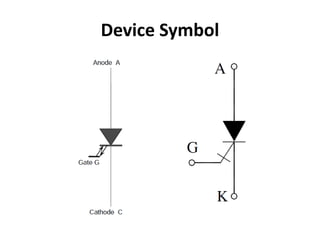
Device Symbol
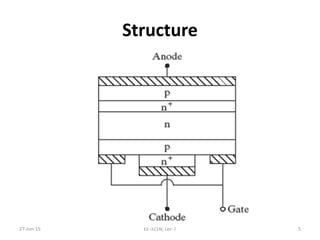
Structure
27‐Jun‐15 EE‐321N, Lec‐7 5
Contd...
• Turn OFF capability by supplying –ve IG can be
guaranteed if the access resistance from the
gate to all parts of the device cathode is very
low
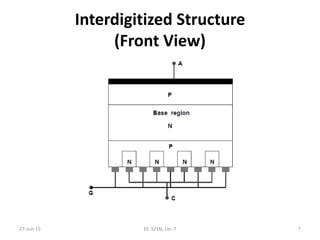
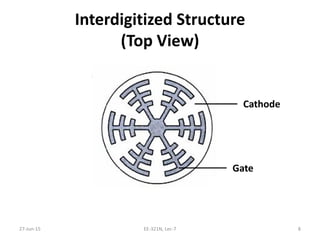
• This is done by using an “interdigitated”
structure in which the gate‐cathode area is
distributed over the whole pellet and
interleaving their respective regions
27‐Jun‐15 EE‐321N, Lec‐7 6
Interdigitized Structure
(Front View)
27‐Jun‐15 EE‐321N, Lec‐7 7
Interdigitized Structure
(Top View)
27‐Jun‐15 EE‐321N, Lec‐7 8
Cathode
Gate
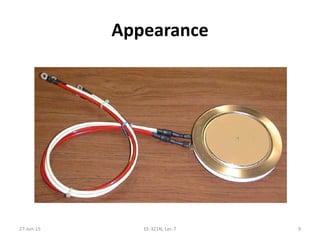
Appearance
27‐Jun‐15 EE‐321N, Lec‐7 9
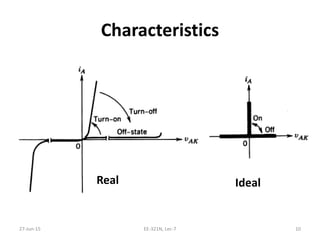
Characteristics
27‐Jun‐15 EE‐321N, Lec‐7 10
Real Ideal
Turn OFF Mechanism 
27‐Jun‐15 EE‐321N, Lec‐7 11
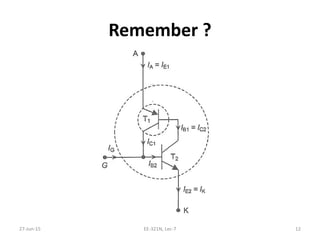
Remember ?
27‐Jun‐15 EE‐321N, Lec‐7 12
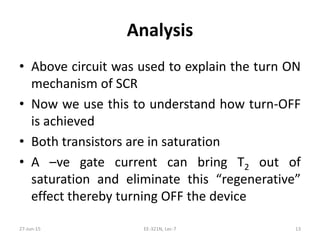
Analysis
• Above circuit was used to explain the turn ON
mechanism of SCR
• Now we use this to understand how turn‐OFF
is achieved
• Both transistors are in saturation
• A –ve gate current can bring T2 out of
saturation and eliminate this “regenerative”
effect thereby turning OFF the device
27‐Jun‐15 EE‐321N, Lec‐7 13
Contd...
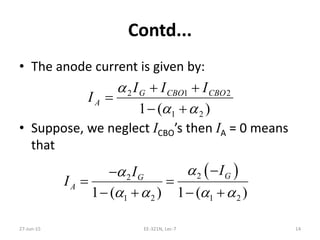
• The anode current is given by:
• Suppose, we neglect ICBO’s then IA = 0 means 
that 
27‐Jun‐15 EE‐321N, Lec‐7 14
)(1 21
212
αα
α
+−
++
= CBOCBOG
A
III
I
( )22
1 2 1 21 ( ) 1 ( )
GG
A
II
I
αα
α α α α
−−
= =
− + − +
Contd...
• Turn‐OFF gain βOFF for the turn‐OFF process of
a GTO is defined as:
• βOFF lies in the range 4‐5 (low) but this calls for
a very high –IG. E. g. if IA = 2000 A then –IG =
500 A (around)
• A high value of βOFF can be obtained by
making α2 high and α1 low
27‐Jun‐15 EE‐321N, Lec‐7 15
( )
2
OFF
1 2 1
A
G
I
I
α
β
α α
= =
+ −
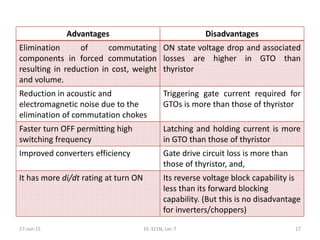
Comparison with Conventional SCR
27‐Jun‐15 EE‐321N, Lec‐7 16
Advantages Disadvantages
Elimination of commutating
components in forced commutation
resulting in reduction in cost, weight
and volume.
ON state voltage drop and associated
losses are higher in GTO than
thyristor
Reduction in acoustic and 
electromagnetic noise due to the
elimination of commutation chokes
Triggering gate current required for
GTOs is more than those of thyristor
Faster turn OFF permitting high
switching frequency
Latching and holding current is more
in GTO than those of thyristor
Improved converters efficiency Gate drive circuit loss is more than
those of thyristor, and,
It has more di/dt rating at turn ON Its reverse voltage block capability is
less than its forward blocking
capability. (But this is no disadvantage
for inverters/choppers)
1727‐Jun‐15 EE‐321N, Lec‐7
HOME ASSIGNMENT
Q1. Discuss the switching characteristics of SCR.
Emphasize on the following terms: Delay
time, rise time, spread time, turn‐OFF time,
circuit turn OFF time.
Q2. Discuss briefly other devices of the thyristor
family. Highlight their circuit symbol,
characteristics, ideal characteristics, main
applications
27‐Jun‐15 EE‐321N, Lec‐7 18
Reminder
• Internet connection is now available
• Please complete the Today’s Task assigned in 
lecture‐2
• Will be checked randomly
27‐Jun‐15 19EE‐321N, Lec‐7
End of Unit‐1
27‐Jun‐15 EE‐321N, Lec‐7 20
☺

L7 gto