Chopper (DC – DC Converter)
ER. FARUK BIN POYEN
ASST. PROFESSOR
DEPT. OF AEIE
FARUK.POYEN@GMAIL.COM
Contents:
 Features
 Elementary Principles
 Classification
 Principle of Chopper Action
 Buck Chopper
 Boost Chopper
 Buck Boost Chopper
 Different Quadrant Operations of Chopper
2
Features of Choppers
 Chopper is a static device that converts fixed DC input voltage to a variable DC output
voltage directly.
 DC equivalent of an AC transformer as it behaves in an identical manner.
 More efficient than AC transformers as they involve in one stage conversion.
 They offer smooth control, high – efficiency, fast response and regeneration.
 A chopper can act as a step – up or step down DC device.
 Chopper can be operated in either a continuous or continuous current conduction mode.
 Choppers can be built with and without electrical isolation.
 They find application in trolley cars, marine hoists, forklift trucks and mine haulers.
3
Elementary Principle
 High speed on/off semiconductor switch.
 It connects source to load and disconnects the load from source at high speed.
 Continuous triggering ON and triggering OFF at rapid switching speed.
 By varying ON and OFF time of the SCR, the average voltage across the load can be
varied.
4
Classification of Choppers
 Depending upon the direction of the output current and voltage, choppers are classified
into five classes viz.
 Class A (One Quadrant Operation)
 Class B (One Quadrant Operation)
 Class C (Two Quadrant Operation)
 Class D (Two Quadrant Operation)
 Class E (Four Quadrant Operation)
 Based on the output voltage, choppers are classified into
 Step Up (Boost) Chopper
 Step Down (Buck) Chopper
 Buck – Boost Chopper
5
Further Classification of Choppers
 Depending upon the power loss occurred during turn ON/OFF of the switching device,
the choppers are classified into two categories viz.
1. Hard switched Converter: Here the power loss is high during the switching (ON to OFF
and OFF to ON) as a result of the non zero voltage and current on the power switches.
2. Soft switched or resonant Converters: In this type of choppers, the power loss is low at
the time of switching as a result of zero voltage and/or zero current on the switches.
6
DC/DC Converter Technology
 Linear Regulators
 Switching Regulators
 Charge Pumps
7
DC/DC Converter Technology Comparison
Parameter Linear regulator
Switching
regulator
Charge pump
Efficiency Low High Medium
EMI Noise Low High Medium
Output current Low to medium Low to High Low
Boost (step-up) No Yes Yes
Buck (step-down) Yes Yes Yes
Solution size Small Large Medium
Chopper: Methods of Control
 The output dc voltage can be verified by the following methods.
1. Constant Frequency Control or Pulse Width Modulation (PWM) Control
2. Variable Frequency Control
PULSE WIDTH MODULATION
In PWM, the pulse width ton of the output waveform is varied keeping chopping frequency
’f’ and hence chopping period ‘T’ constant. Therefore output voltage is varied by varying the
ON time, ton . Figure shows the output voltage waveform for different ON times.
VARIABLE FREQUENCY CONTROL
In this method of control, chopping frequency f is varied keeping either ton or t off constant.
This method is also known as frequency modulation.
In frequency modulation to obtain full output voltage, range of frequency has to be varied
over a wide range. This method produces harmonics in the output and for large t off load
current may be discontinuous.
8
Chopper: Methods of Control 9
V0
V
V
V0
t
t
tON
tON tOFF
tOFF
T
v0
V
V
v0
t
t
tON
tON
T
T
tOFF
tOFF
PWM Control Variable Frequency Control
Principle of Chopper Operation:
 A switch is connected in series with a DC voltage source and load.
 The switch can be a power transistor, an SCR or a GTO.
 Ideal switch will offer zero resistance (ON), infinite resistance (OFF) and instantaneous
switching (no lag).
 The switch can be turned ON and turned OFF with the help of triggering circuit and
commutating circuit respectively.
 It can be turned on or turned off as desired at very high frequency.
 During the TON period, chopper is in ON condition and load voltage is equal to source
voltage Vs.
 During the TOFF period, chopper is OFF condition, load current flows through the
freewheeling diode FD.
10
Principle of Chopper Operation:
 As a result, load terminals are short circuited by freewheeling diode FD.
 Thus the load voltage is zero during TOFF period.
 In this manner, a chopped DC voltage is produced across the load terminals.
 From the T=TON +TOFF equation, it is clear that the load voltage depends on two factors.
a) The supply voltage.
b) The duty cycle of the chopper
 Since the supply voltage is constant, load voltage is governed by the duty-cycle of the
chopper.
 In other words, the load voltage is dependent on two factors TON and TOFF.
11
Principle of Chopper Operation:
 Hence it is concluded that the average load voltage can be controlled by varying the value
of TON and/of TOFF in the following two ways.
a) Varying TON and keeping the periodic time T constant. This is called constant frequency
system.
b) Variable frequency system. i.e. keeping either TON constant and varying TOFF or keeping
TOFF constant and varying TON.
VO = (TON/[TON+TOFF] )VS = (TON/T )VS = α. VS
Here α = Duty cycle = (TON/T); where T = TON +TOFF ;Chopper frequency f = 1/T
𝐸𝑓𝑓𝑒𝑐𝑡𝑖𝑣𝑒 𝑅𝑀𝑆 𝑂𝑢𝑝𝑢𝑡 𝑉𝑜𝑙𝑡𝑎𝑔𝑒 𝑉𝑂(𝑅𝑀𝑆) =
𝑉𝑖
2
𝑇𝑂𝑁
𝑇
= 𝑉𝑖
𝑇𝑂𝑁
𝑇
= 𝑉𝑖 𝑑
12
Principle of Chopper Operation:
 The representations of the chopper circuit during different phases are shown below.
13
Step Down (Buck) Chopper
 Output Voltage is less than input voltage.
 The thyristor in the circuit acts as a switch.
 When thyristor is ON, supply voltage appears across the load
 When thyristor is OFF, the voltage across the load will be zero.
 Practical arrangement includes an inductor (L) and a diode which are used to eliminate
current pulsations providing a smooth DC current.
 With S closed, D is Off and it remains Off as long as S in On.
 The i/p current builds up exponentially and flows through L and load.
 V O equals V I.
 With S OFF or open, the current through L decays to zero.
 This causes an inductive voltage with opposite polarity across L.
14
Step Down (Buck) Chopper
 V L forward biases diode D.
 Current flows through L, Load and D.
 This arrangement permits the use of simple filter inductance L to provide a satisfactorily
smooth DC load current.
 With higher switching frequency, smaller inductance is sufficient to get desired O/P.
15
Step Down (Buck) Chopper
 The o/p voltage is equal to the i/p voltage when the switch is ON and D is reverse biased.
 Diode current is same as the load current during T OFF.
 During T ON, I O is same as I I.
16
Step Down (Buck) Chopper – Continuous Current
 The average value of inductor current is:
𝐼𝐿 =
𝐼 𝑚𝑎𝑥 + 𝐼 𝑚𝑖𝑛
2
= 𝐼 𝑂 =
𝑉𝑂
𝑅
 Again
𝑉𝐿 = 𝑉𝑂 = 𝐿
𝑑𝑖 𝑂
𝑑𝑡
→
𝑑𝑖 𝑂
𝑑𝑡
=
𝑉𝑂
𝐿
→ ∆𝑖 𝑂 =
𝑉𝑂
𝐿
∆𝑡
 With Switch Open,
𝑃𝑒𝑎𝑘 𝑡𝑜 𝑃𝑒𝑎𝑘 𝑅𝑖𝑝𝑝𝑙𝑒 𝐶𝑢𝑟𝑟𝑒𝑛𝑡 𝐼 𝑃−𝑃 = ∆𝑖 𝑂 = 𝐼 𝑚𝑎𝑥 − 𝐼 𝑚𝑖𝑛 =
𝑉𝑂
𝐿
𝑇𝑂𝐹𝐹
 Hence,
𝐼 𝑚𝑎𝑥 =
𝑉𝑂
𝑅
+
𝑉𝑂
2𝐿
𝑇𝑂𝐹𝐹; 𝐼 𝑚𝑖𝑛 =
𝑉𝑂
𝑅
−
𝑉𝑂
2𝐿
𝑇𝑂𝐹𝐹
𝐼 𝐷 =
𝐼 𝑂𝐹𝐹. 𝑇𝑂
𝑇
; 𝐼 𝑂 =
𝐼𝑖
𝑑
; 𝑑 = 𝑑𝑢𝑡𝑦 𝑐𝑦𝑐𝑙𝑒
17
Step Down (Buck) Chopper – Continuous Current
 As elements are ideal, DC power drawn from source must equal the DC power absorbed
by load.
𝑃𝑂 = 𝑃𝑖 → 𝑉𝑜 𝐼 𝑜 = 𝑉𝑖 𝐼𝑖
18
Step Down (Buck) Chopper – Discontinuous Current
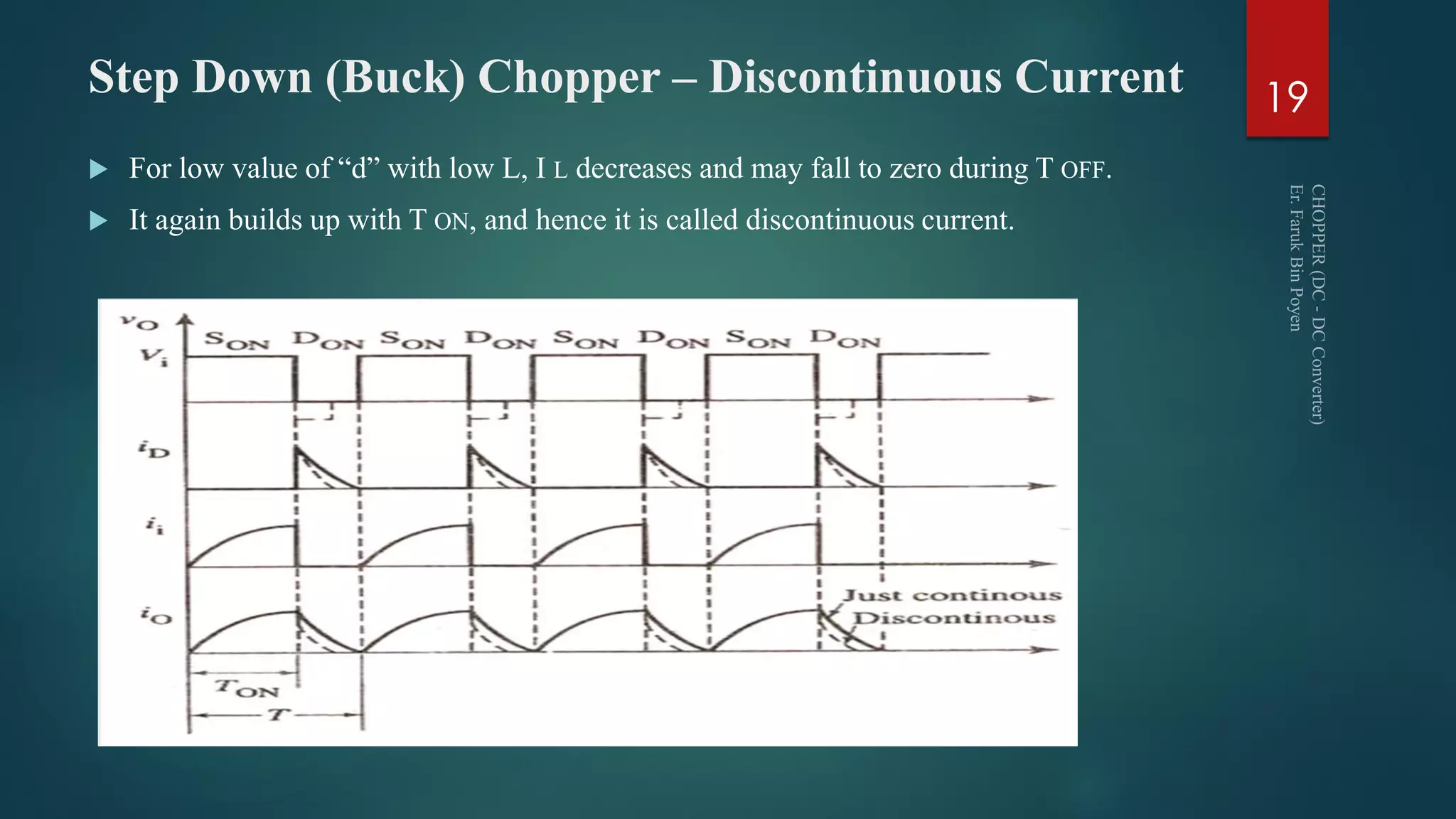
 For low value of “d” with low L, I L decreases and may fall to zero during T OFF.
 It again builds up with T ON, and hence it is called discontinuous current.
19
Step Down (Buck) Chopper – Discontinuous Current
 This mode is undesirable and is avoided by proper selection of chopping frequency and L.
 The minimum value of L for continuous current mode is ensured by setting I min = 0.
𝐼 𝑚𝑖𝑛 = 0 =
𝑉𝑂
𝑅
−
𝑉𝑂
𝑅
𝑇𝑂𝐹𝐹
𝑉𝑂
𝑅
= 𝑇𝑂𝐹𝐹.
𝑉𝑂
2𝐿
2𝐿 = 𝑇𝑂𝐹𝐹 𝑅
𝐿 =
𝑇𝑂𝐹𝐹
2
𝑅
20
Types of Choppers:
 Type A Chopper or First–Quadrant Chopper
 Type B Chopper or Second-Quadrant Chopper
 Type-C chopper or Two-quadrant type-A Chopper
 Type-D Chopper or Two-Quadrant Type–B Chopper
 Type-E chopper or the Fourth-Quadrant Chopper
21
Step Up (Boost) Chopper:
 The output voltage is more than the input voltage by several times.
 L is used to provide a smooth i/p current.
 The SCR (S) acts as the switch which works in the PWM mode.
 With S On, the L is connected to the supply.
 Load voltage V L jumps instantaneously to V I, but current through L increases linearly &
stores energy.
 When S is Open, the current collapses and energy stored in L is transferred to C through
D.
 The induced voltage across the inductor reverses and adds to the source voltage increasing
the O/P voltage.
 The current that was flowing through S now flows through L, D and C to the load.
 Energy stored in the inductor is released to the load.
22
Step Up (Boost) Chopper:
 With S closed again, D becomes reverse biased, the capacitor energy supplies the load
voltage and the cycle repeats.
𝑉𝑂 = 𝑉𝑖 + 𝑉𝐿
 V O is always higher than V I as polarity of inductor voltage V L is same as V I.
 If inductor L is very large, source current I I is ripple free and is considered constant.
𝑊𝑂𝑁 = 𝑉𝑖 𝐼𝑖 𝑇𝑂𝑁
 Assuming C to be large enough to neglect the voltage ripples, V O is considered constant.
𝑊𝑂𝐹𝐹 = 𝑉𝑜 − 𝑉𝑖 ∗ 𝐼𝑖 ∗ 𝑇𝑂𝐹𝐹
 Since losses are neglected, the energy transferred during T OFF by L mist be equal to
energy gained during T ON.
𝑊𝑂𝑁 = 𝑊𝑂𝐹𝐹 = 𝑉𝑖 𝐼𝑖 𝑇𝑂𝑁 = 𝑉𝑜 − 𝑉𝑖 ∗ 𝐼𝑖 ∗ 𝑇𝑂𝐹𝐹
𝑉𝑂 = 𝑉𝐼 1 +
𝑇𝑂𝑁
𝑇𝑂𝐹𝐹
= 𝑉𝐼
𝑇
𝑇 − 𝑇𝑂𝑁
= 𝑉𝑖
1
1 −
𝑇𝑂𝑁
𝑇
= 𝑉𝐼
1
1 − 𝑑
 Thus V O is always greater than V I.
23
Step Up (Boost) Chopper:
 𝑃𝐼 = 𝑃𝑂 → 𝑉𝐼 𝐼𝐼 =
𝑉 𝑂
2
𝑅
→ 𝐼𝐼 =
𝑉 𝑂
2
𝑉 𝐼
∗
1
𝑅
 𝐼 𝑂 = 𝐼𝐼 ∗
𝑇 𝑂𝐹𝐹
𝑇
=> 𝐼 𝑂 = 𝐼𝐼 1 − 𝑑
 𝑃𝑂 = 𝑃𝐼 => 𝑉𝐼 𝐼𝐼 =
𝑉 𝑂
2
𝑅
=
𝑉𝐼
2
1−𝑑 2 ∗
1
𝑅
 𝐼𝐼 =
𝑉 𝐼
1−𝑑 2 ∗
1
𝑅
 𝐼𝐿 =
𝐼 𝑚𝑎𝑥+𝐼 𝑚𝑖𝑛
2
= 𝐼𝐼
 ∴ 𝐼 𝑚𝑎𝑥 + 𝐼 𝑚𝑖𝑛 = 2 ∗ 𝐼𝐼
24
Step Up (Boost) Chopper:
 Voltage across L is
 𝑉𝐿 = 𝑉𝐼 = 𝐿 ∗
𝑑𝑖 𝐼
𝑑𝑡
𝑜𝑟
𝑑𝑖 𝐼
𝑑𝑡
=
𝑉 𝐼
𝐿
 ∆𝐼𝐼 =
𝑉 𝐼
𝐿
𝑇𝑂𝑁 𝑜𝑟 𝐼 𝑚𝑎𝑥 − 𝐼 𝑚𝑖𝑛 =
𝑉 𝐼
𝐿
𝑇𝑂𝑁; 𝐴𝑔𝑎𝑖𝑛 𝐼 𝑚𝑎𝑥 + 𝐼 𝑚𝑖𝑛 = 2 ∗ 𝐼𝐼
 Solving
𝐼 𝑚𝑎𝑥 = 𝑉𝐼
1
𝑅 1 − 𝑑 2
+
𝑇𝑂𝑁
2𝐿
; 𝐼 𝑚𝑖𝑛 = 𝑉𝐼
1
𝑅 1 − 𝑑 2
−
𝑇𝑂𝑁
2𝐿
 𝐼 𝑝−𝑝 = 𝐼 𝑚𝑎𝑥 − 𝐼 𝑚𝑖𝑛 =
𝑉 𝐼 𝑇 𝑂𝑁
𝐿
 For continuous current mode: 𝐼 𝑚𝑖𝑛 = 0 = 𝑉𝐼
1
𝑅 1−𝑑 2 −
𝑇 𝑂𝑁
2𝐿
 =>
1
𝑅 1−𝑑 2 =
𝑇 𝑂𝑁
2𝐿
=> 𝐿 =
𝑅𝑇𝑂𝑁
2
1 − 𝑑 2
25
Buck – Boost Chopper:
 It combines the concept of both the step – up and step – down choppers.
 The output voltage is either higher or lower than the input voltage.
 The output voltage polarity can also be reversed.
 The switch is either an SCR or GTO or IGBT.
 When S in ON, D is reverse biased & I D is zero.
 The voltage across L is equal to the i/p voltage.
 The capacitor supplies energy to the output load
 The current through the inductor increases linearly with time.
 With S OFF, the source is disconnected.
 The current through inductor does not change instantaneously and it forward biases the
diode, providing a path for the load current.
 O/P voltage becomes equal to the inductor voltage.
26
Buck – Boost Chopper:
 With S = ON (T ON); W ON = VI*II*TON
 With S = OFF (T OFF); W ON = VI*II*TOFF
 Ignoring losses, W ON = W OFF => VI*II*TON = VI*II*TOFF
 𝑉𝑂 = 𝑉𝐼
𝑑𝑇
𝑖−𝑑 𝑇
= 𝑉𝐼
𝑑
𝑖−𝑑
(O/P voltage is controlled by changing duty cycle d)
 𝐼𝐿 =
𝐼 𝑚𝑎𝑥+𝐼 𝑚𝑖𝑛
2
; 𝐼𝐼 = 𝐼𝐿 𝑑 =
𝐼 𝑚𝑎𝑥+𝐼 𝑚𝑖𝑛
2
𝑑
27
Buck – Boost Chopper:
 The average O/P power is given as 𝑃𝐼 = 𝑉𝐼 𝐼𝐼 =
𝐼 𝑚𝑎𝑥+𝐼 𝑚𝑖𝑛
2
𝑑𝑉𝐼 = 𝑃𝑂 =
𝑉 𝑂
2
𝑅
 𝐼 𝑚𝑎𝑥 + 𝐼 𝑚𝑖𝑛 =
2𝑑𝑉 𝐼
𝑅 1−𝑑 2 ; 𝐼 𝑚𝑎𝑥 − 𝐼 𝑚𝑖𝑛 =
𝑉 𝐼
𝐿
𝑑𝑇
 𝐼 𝑚𝑎𝑥 = 𝑉𝐼
1
𝑅 1−𝑑 2 +
𝑇
2𝐿
𝑑; 𝐼 𝑚𝑖𝑛 = 𝑉𝐼
1
𝑅 1−𝑑 2 −
𝑇
2𝐿
𝑑; 𝐼 𝑝−𝑝 =
𝑉 𝐼 𝑇𝑑
𝐿
 For continuous current condition,
𝐼 𝑚𝑖𝑛 = 0 = 𝑉𝐼
1
𝑅 1 − 𝑑 2
−
𝑇
2𝐿
𝑑 => 𝐿 =
𝑅𝑇𝑑
2
1 − 𝑑 2
28
Type A Chopper or First–Quadrant Chopper
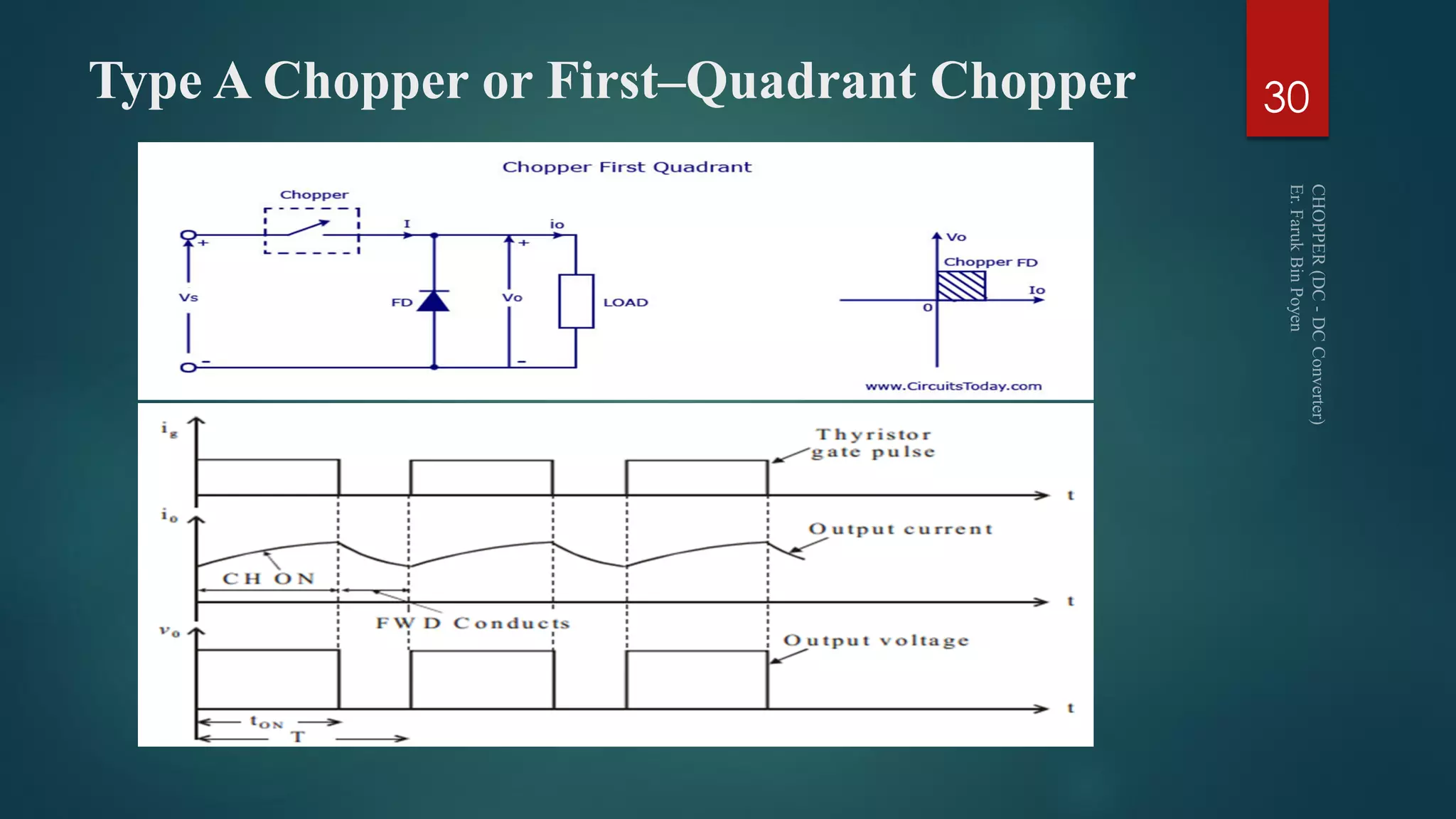
 When chopper is ON, supply voltage V is connected across the load.
 When chopper is OFF, V 0 = 0 and the load current continues to flow in the same
direction through the FWD.
 The average values of output voltage and current are always positive.
 Class A Chopper is a step-down chopper in which power always flows form source to
load.
 It is used to control the speed of dc motor.
 The output current equations obtained in step down chopper
 with R-L load can be used to study the performance of Class A Chopper
29
Type A Chopper or First–Quadrant Chopper 30
Type B Chopper or Second-Quadrant Chopper
 Load contains a DC source E like a battery.
 When chopper is ON, E drives a current through L and R in a direction opposite to that
shown in figure.
 During the ON period of the chopper, the inductance L stores energy.
 When Chopper is OFF, diode D conducts, and part of the energy stored in inductor L is
returned to the supply.
 Average output voltage is positive and average output current is negative.
 In this chopper, power flows from load to source. O/P current is –ve.
 Class B Chopper is used for regenerative braking of dc motor.
 Class B Chopper is a step-up chopper.
𝑉0 = 𝐸 + 𝐿
𝑑𝑖
𝑑𝑡
> 𝑉𝑠
31
Type B Chopper or Second-Quadrant Chopper 32
Type – C or Two – Quadrant Type – A Chopper
 Class C Chopper is a combination of Class A and Class B Choppers in parallel.
 CH1 (ON) and FD (conducting) operate together as Type A chopper (1st quadrant).
 CH2 (ON) and D2 (conducting) operate together as Type B chopper (2nd quadrant).
 When CH1 is ON, the load current is positive.
 The output voltage is equal to ‘V’ & the load receives power from the source.
 When CH1 is turned OFF, energy stored in inductance L forces current to flow through
the diode D2 and the output voltage is zero.
 Current continues to flow in positive direction.
 When CH2 is triggered, the voltage E forces current to flow in opposite direction through
L and CH2
 The output voltage is zero
33
Type – C or Two – Quadrant Type – A Chopper
 On turning OFF CH2, the energy stored in the inductance drives current through diode D1
and the supply Output voltage is V, the input current becomes negative and power flows
from load to source.
 Average output voltage is positive because of the presence of FD diode.
 Average output current can take both positive and negative values.
 Choppers CH1 & CH2 should not be turned ON simultaneously as it would result in short
circuiting the supply.
 Class C Chopper can be used both for dc motor control and regenerative braking of dc
motor.
 Class C Chopper can be used as a step-up or step-down chopper.
34
Type – C or Two – Quadrant Type – A Chopper 35
Type-D or Two-Quadrant Type –B Chopper
 Class D is a two quadrant chopper.
 When both CH1 and CH2 are triggered simultaneously, the output voltage V O = V S and
output current flows through the load.
 When CH1 and CH2 are turned OFF, the load current continues to flow in the same
direction through load, D1 and D2, due to the energy stored in the inductor L.
 Output voltage V O = - V S.
 Average load voltage is positive if chopper ON time is more than the OFF time
 Average output voltage becomes negative if t ON < t OFF .
 Hence the direction of load current is always positive but load voltage can be positive or
negative.
36
Type-D or Two-Quadrant Type –B Chopper
 T ON > 0.5, average value of V 0 and I 0 are positive, power flows from source to load.
 T OFF > 0.5, average value of V 0 is –ve and I 0 is +ve, power flows from load to source.
𝑉𝑜 =
𝑉𝑆 𝑇𝑂𝑁 − 𝑉𝑆 𝑇𝑂𝐹𝐹
𝑇
= 𝑉𝑆.
𝑇𝑂𝑁 − 𝑇𝑂𝐹𝐹
𝑇
 V 0 is +ve, for 𝑇𝑂𝑁 > 𝑇𝑂𝐹𝐹
 V 0 is –ve, for 𝑇𝑂𝑁 < 𝑇𝑂𝐹𝐹
 V 0 = 0, 𝑇𝑂𝑁 = 𝑇𝑂𝐹𝐹
37
Type-D or Two-Quadrant Type –B Chopper 38
Type-D or Two-Quadrant Type –B Chopper 39
Forward Motoring Operation (Rectifying operation):
 It is the first quadrant operation.
 When switches T1 and T2 are conducting, both the output current (I0) and output voltage
(Vo) are positive.
 Now the circuit path will be, Vs - T1 - Load - T2 - Vs.
 The power is flows from the source to load.
 This is known as rectifying operation.
 This operation occurs in first quadrant.(as the current and voltage are positive)
Type-D or Two-Quadrant Type –B Chopper 40
Reverse Braking Mode Operation (Inverting operation):
 It is the fourth quadrant operation.
 When switches T1 and T2 are switched OFF, the load inductance generates a huge
amount voltage to maintain the current in the same direction.
 The inductance voltage forward biases both diodes D1 and D2.
 Now the circuit path will be Load - D1 - Vs - D2 - Load.
 Here the output current is positive but the output voltage is negative. i.e., the power
flows from load to source.
 Thus we can achieve reverse breaking operation.
 Here the motor speed can be controlled by changing the duty cycle of the switches.
Type – E or the Four – Quadrant Chopper
 It consists of four switches and four diodes in anti – parallel.
 Numbering of choppers is done corresponding to their quadrant operation.
 When CH1 and CH4 are triggered, output current I 0 flows in positive direction through
CH1 and CH4 , and with output voltage V O = V S.
 This gives the first quadrant operation.
 When both CH1 and CH4 are OFF, the energy stored in the inductor L drives I O through
D2 and D3 in the same direction, but output voltage V O = - V.
 Therefore the chopper operates in the fourth quadrant.
41
Type – E or the Four – Quadrant Chopper
 When CH2 and CH3 are triggered, the load current I O flows in opposite direction &
output voltage V O = -V.
 Since both I O and V O are negative, the chopper operates in third quadrant.
 When both CH2 and CH3 are OFF, the load current I O continues to flow in the same
direction D1 andD4 and the output voltage V O = V.
 Therefore the chopper operates in second quadrant as V O is positive but I O is negative.
42
Type – E or the Four – Quadrant Chopper 43
Type – E or the Four – Quadrant Chopper
1st Quadrant:
 CH2 and CH3 are OFF.
 CH4 is ON, CH1 is operated.
 CH1 and CH4 being ON, V O = V S, I O starts flowing.
 Both V O and I O are +ve.
 With CH1 = OFF, +ve current freewheels through CH4 and D2.
 Both V O and I O are controlled in the 1st quadrant.
 Acts as Step – Down chopper.
44
Type – E or the Four – Quadrant Chopper
2nd Quadrant:
 CH2 is operated and CH1, CH3 and Ch4 are kept OFF.
 With CH2 ON, reverse current flows through L, CH2, D4 and E.
 L stores energy during the ON state on CH2.
 CH2 = OFF, current is fed to the source through D1 and D4.
 V O > V S resulting –ve I O.
 Chopper is in Step Up mode and load must contain E.
45
Type – E or the Four – Quadrant Chopper
3rd Quadrant:
 CH1 is OFF, CH2 is ON.
 CH3 is operating.
 Polarity of E is reversed.
 With CH3 ON, load gets connected to source V S, hence both V O and I O are –ve.
 With CH3 OFF, -ve current freewheels through CH2 and D4.
 V O and I O are controlled in 3rd quadrant.
 Chopper operates as a Step Down chopper.
46
Type – E or the Four – Quadrant Chopper
4th Quadrant:
 CH4 is operated here while other devices are OFF.
 Load E has its polarity reversed to that of the source.
 With CH4 ON, +ve current flows through CH4, D2, L and E.
 L stores energy when CH4 is ON.
 With CH4 OFF, current is fed back to source through D2 and D3.
 Load voltage is –ve but load current is +ve leading the chopper to operate in the 4th
quadrant.
 Power is fed back from load to source.
 Here chopper operates as Step – Up chopper.
47
Thyrsitor Chopper Circuits:
 In chopper circuit with thyristors, the process of turning off is termed as Commutation.
 These commutation techniques are broadly classified into the following.
1. Forced Commutation: External elements (L & C) which do not carry load current are
used.
a) Voltage Commutation: Application of large pulse reverse voltage usually by
switching a previously charged capacitor.
b) Current Commutation: External pulse current > load current is applied in reversed
direction.
2. Load Commutation: Thyrsitor is turned off when load current flowing through either
a) Becomes zero due to the nature of the load circuit.
b) Is transferred to another device from the conducting thyristor.
48
Voltage Commutated Chopper
 It generally finds application in high power circuits where load fluctuations are not very
large.
 This chopper is also known as “parallel capacitor turn – off chopper or impulse –
commutated chopper or classical chopper.
 Thyristor T1 is the main power switch.
 Commutation circuitry is made up of an auxiliary thyristor TA, capacitor C, diode D and
inductor L.
 FD is connected across RLE type load.
 Working of this chopper can start only of the C is charged with polarities as marked in
figure.
 Jones chopper employes the principle of voltage commutation.
49
Voltage Commutated Chopper
 This is achieved in one of the following two ways.
1. Close switch S so that the capacitor s gets charged to voltage V S through V S, C S and R
C. Switch S is then opened.
2. Auxiliary thyristor TA is triggered so that C gets charged through source voltage V S, C,
TA and the load. The charging current through C decays and as it reaches to zero, V C =
V S and TA is turned OFF.
50
Voltage Commutated Chopper
 This is achieved in one of the following two ways.
1. Close switch S so that the capacitor s gets charged to voltage V S through V S, C, S and
R C. Switch S is then opened.
2. Auxiliary thyristor TA is triggered so that C gets charged through source voltage V S, C,
TA and the load. The charging current through C decays and as it reaches to zero, V C =
V S and TA is turned OFF.
51
Voltage Commutated Chopper - Operation
 Similar to step down chopper.
 T1 = Main thyristor, TA = Auxiliary thyristor, L,C = commutating components, Rc =
charging resistor
 Assume output current is constant.
 Close the switch, initially capacitor short circuited, after 4 - 5 time constants, Vc = Vs.
 At t = 0, T1 is on, load is connected across the supply Vo = Vs.
 Tank circuit starts conduction ( diode forward bias).
 After conduction polarities across capacitor are changed.
 D is reverse biased polarities across capacitor are changed.
 Upto t2 we completed now we have to turn off the main thyristor.
52
Voltage Commutated Chopper - Operation
 Make TA on, T1 to be off (applying reverse voltage).
 To make the conduction continues use free wheeling diode.
 In order to make the output continuous, the existing path will be changed as Vs, C, TA
and the load.
 Voltage across the capacitor changes.
 Now make the voltage across capacitor > Vs.
 Free wheeling diode conducts, output voltage becomes zero.
 To start next cycle, no need to close switch 's'.
 A reverse voltage is applied across conducting SCR due to which current through SCR
becomes zero and it is getting off. Hence it is called voltage commutation.
53
Voltage Commutated Chopper - Operation 54
Voltage Commutated (VC) Chopper
 It is simple however it has the following disadvantages.
1. A starting circuit is required.
2. Load voltage at once rises to 2* V S at the instant commutation of main thyristor is
initiated. FD is therefore subject to twice the supply voltage.
3. It can not work at no load because C would not get charged from – V S to V S when
auxiliary SCR is triggered for commutating the main SCR.
55
V C Chopper – Design Consideration
 Commutating Capacitor C: Its value depends on the turn off time t OFF of T1. during turn
off, V C linearly changes from (- V S) to zero.
 𝐼 𝐶 = 𝐶
𝑑𝑉
𝑑𝑡
; 𝑓𝑜𝑟 𝑐𝑜𝑛𝑠𝑡𝑎𝑛𝑡 𝐼 𝑂, 𝐼 𝐶 = 𝐶
𝑉 𝑆
𝑡 𝑂𝐹𝐹
= > 𝑪 =
𝒕 𝑶𝑭𝑭 𝑰 𝑶
𝑽 𝑺
 Commutating Inductor L: it is designed with the consideration that when T1 is On, an
oscillatory current is established. The current I C flows through the ringing circuit forced
by C, T1, L, D and is given by
𝐼 𝐶 =
𝑉 𝑆
𝜔0 𝐿
sin 𝜔0 𝑡 𝑤ℎ𝑒𝑟𝑒 𝜔0 =
1
𝐿𝐶
 𝑃𝑒𝑎𝑘 𝐶𝑎𝑝𝑎𝑐𝑖𝑡𝑜𝑟 𝐶𝑢𝑟𝑟𝑒𝑛𝑡 𝐼 𝐶𝑃 =
𝑉 𝑆
𝜔0 𝐿
= 𝑉 𝑆
𝐶
𝐿
 𝐼 𝐶𝑃 ≤ 𝐼0 𝑜𝑟 𝑉 𝑆
𝐶
𝐿
≤ 𝐼0 => 𝑳 ≥
𝑽 𝑺
𝑰 𝑶
𝟐
𝑪
56
Current Commutating (C C) Chopper:
 The circuit for Current Commutating Chopper is shown below.
 T1 is the main thyristor.
 The commutating components comprise TA, C, L, D1 and D2.
 FD is the freewheeling and R C is the charging resistor.
 Morgan's chopper based on the principle of current commutation.
57
Current Commutating Chopper:
 Simplified assumptions for this chopper are as follows.
1. Load current is constant.
2. SCRs and diodes are ideal switches.
3. Charging capacitor is so large that it can be treated as open circuit during the
commutation interval.
 The merits of this chopper are given as below.
1. Commutation is reliable as long as the load current is less than the peak commutating
current I CP.
2. Capacitor is always charged with the correct polarity.
3. TA is naturally commutated as its commutating current passes through zero value in the
ringing circuit formed by L and C.
58
Current Commutating Chopper: Operation
 Capacitor is charged to V S through V S, C and R C, main thyristor T1 is fired at t = 0.
 So that load voltage V O = V S.
 At t = t1, auxiliary thyristor TA is turned ON to commutate the main thyristor.
 With turning on of TA, an oscillatory current I C is set up in the circuit.
 At t2, V C = - V S and I C tends to reverse in the auxiliary thyristor TA, it gets naturally
commutated.
 As TA is reverse biased and turned off at t2, oscillatory current I C begins to flow through
C, L, D2 and T1.
 At t3 I C rises to I O so that IT1 = 0. As a result main SCR T1 is turned off at t3. Since
oscillating current through T1 turns it off it is called current commutated chopper.
 After t3 I C supplies load current I O and the excess current. ID1 = I C - I O is conducted
through diode D1.
 After t4, a constant current equal to Io flows through V S, C, L, D2 and load.
59
Current Commutating Chopper: Operation
 Capacitor C is charged linearly to source voltage V S at t5,
 So during time ( t5 - t4 ) I C = I O.
 In this commutation an opposite current pulse will be injected through SCR. As a result
currents decreases and finally comes to zero if both the currents would be equal and
opposite.
 Anti parallel diode is useful to apply the reverse voltage after current through SCR
becomes to zero. The value of reverse voltage is low. So
1. Turn off time increases.
2. Turn off power loss increases.
 Current I C, I T1, I FD and I O are treated as positive.
 Voltages V C, V T1, V TA and V O are taken as positive with polarities as marked.
60
C C Chopper – Design Consideration
 L and C values should be calculated for reliable commutation for this chopper.
 The governing conditions for the values of L and C are provided as below.
1. Peak Commutating Current I CP must be more than the maximum possible load current I
O. This is essential for reliable commutation of main SCR.
 The oscillating current in the commutation circuit is given by
𝐼 𝐶 = 𝑉 𝑆
𝐶
𝐿
sin 𝜔0 𝑡 = 𝐼 𝐶𝑃 sin 𝜔0 𝑡
 As per design requirement, 𝐼 𝐶𝑃 = 𝑉 𝑆
𝐶
𝐿
> 𝐼0 => 𝑉 𝑆
𝐶
𝐿
= 𝑥𝐼0; 𝑥 =
𝐼 𝐶𝑃
𝐼0
 𝑥 varies between 1.4 and 3.
61
C C Chopper – Design Consideration
 Circuit Turn Off time T C must be grater than thyristor Turn Off time T OFF.
 T C = T OFF + Δt.
 𝜔0 𝑇 𝐶 = 𝜋 − 2𝜃1; 𝐴𝑙𝑠𝑜 𝐼 𝐶𝑃 sin 𝜃1 = 𝐼0 => 𝜃1 = 𝑠𝑖𝑛−1 𝐼 𝑂
𝐼 𝐶𝑃
= 𝑠𝑖𝑛−1 1
𝑥
 Circuit Turn Off time for main SCR 𝑇 𝐶 =
1
𝜔0
𝜋 − 2𝜃1 =
1
𝜔0
𝜋 − 2𝑠𝑖𝑛−1 𝐼 𝑂
𝐼 𝐶𝑃
 As load current increases, T OFF decreases.
 𝑇 𝐶 = 𝜋 − 2𝑠𝑖𝑛−1 𝐼 𝑂
𝐼 𝐶𝑃
𝐿𝐶
 ∴ 𝐶 =
𝑇 𝐶
𝜋−2𝑠𝑖𝑛−1 𝐼 𝑂
𝐼 𝐶𝑃
𝐿
62
C C Chopper – Design Consideration
 Substituting the value of 𝐶 in 𝑉 𝑆
𝐶
𝐿
= 𝑥𝐼0, we get

𝑉 𝑆
𝐿
.
𝑇 𝐶
[𝜋−2𝑠𝑖𝑛−1 1
𝑥 ]
= 𝑥. 𝐼0
∴ 𝑳 =
𝑽 𝑺 𝑻 𝑪
𝒙. 𝑰 𝟎[𝝅 − 𝟐𝒔𝒊𝒏−𝟏 𝟏
𝒙 ]
 𝐴𝑔𝑎𝑖𝑛 𝐿 =
1
𝑇 𝐶
[𝜋 − 2𝑠𝑖𝑛−1 1
𝑥 ] 𝐶
𝑪 =
𝒙. 𝑰 𝟎 𝑻 𝑪
𝑽 𝑺[𝝅 − 𝟐𝒔𝒊𝒏−𝟏 𝟏
𝒙 ]
63
Load Commutated Capacitor:
 It consists of four SCRs T1 – T4 and one commutating capacitor C.
 T1, T2 act together as one pair and T3 and T4 act as the second pair.
 FD is the freewheeling diode across load.
 With T1, T2 conducting, they act as the main pair and T3, T4 along with C act as
commutating components and likewise when T3, T4 are conducting.
 The capacitor is initially charged to V S with upper –ve and lower +ve plates.
64
Load Commutated Capacitor: Mode I & II
 Mode I:
 With C having lower plate as +ve and charged, the load commutated chopper is ready to
operate.
 When T1, T2 pair is triggered, load voltage passes through V S, T1, C, T2 and load.
 V O = V S + V C = 2 V S.
 Capacitor C is charged linearly by constant load current I O from V S to – V S.
 When capacitor voltage becomes – V S, V O = 0, T3, T4 pair gets triggered.
 Mode II:
 Capacitor C is slightly overcharged resulting FD getting forward biased and load current
is transferred through T1, T2 to FD.
 Load current freewheels through FD.
 In the next time span, V C = - V S, V O = 0, I C = 0, I FD = 0, I T1 = I T2 = 0.
 V T3 = V T4 = V S and V T1 = V T2 = - ΔV S as capacitor is overcharged by a small voltage
ΔV S.
65
Load Commutated Capacitor: Mode III
 Thyrisotr pair T3, T4 is triggered and voltage becomes V O = V S + V C = 2 V S.
 T1, T2 pair is reverse biased and therefore OFF.
 Load current flows through V S, T4, C, T3 and load charging the capacitor linearly form –
V S to V S.
 Load voltage falls form 2 V S to zero.
 I C = - I O, I T3 = I T4 = I O.
 V T1 = V T2 = - V S.
 In the next time span, C is overcharged and FD gets forward biased and load current
freewheels through FD and load.
66
Design of Load Commutating Capacitor:
 For constant load current I O, capacitor voltage changes from – V S to V S in time T ON.
 𝐼 𝑂 = 𝐶
2𝑉 𝑆
𝑇 𝑂𝑁
=> 𝐶 =
𝐼 𝑂.𝑇 𝑂𝑁
2𝑉 𝑆
 𝑉𝑂 =
1
2
2𝑉𝑆 𝑇𝑂𝑁.
1
𝑇
= 𝑉𝑆. 𝑇𝑂𝑁. 𝑓
 𝑆𝑢𝑏𝑠𝑡𝑖𝑡𝑢𝑡𝑖𝑛𝑔 𝑇𝑂𝑁 =
2.𝑉 𝑆.𝐶
𝐼 𝑂
𝑔𝑖𝑣𝑒𝑠 𝑉𝑂 = 𝑉𝑆. 𝑓.
2𝑉 𝑆 𝐶
𝐼 𝑂
=
2.𝑉𝑆
2
.𝐶.𝑓
𝐼 𝑂
 Minimum chopper time period T min = T ON. Max chopping frequency f max = 1/T ON.
𝐶 =
𝐼 𝑂
2𝑉𝑆
.
1
𝑓𝑚𝑎𝑥
 Circuit Turn Off time for each thyristor is
𝑡 𝐶 =
1
2
𝑇𝑂𝑁 =
1
2
𝐶
2. 𝑉𝑆
𝐼 𝑂
=
𝐶. 𝑉𝑆
𝐼 𝑂
 𝑇𝑜𝑡𝑎𝑙 𝐶𝑜𝑚𝑚𝑢𝑡𝑎𝑡𝑖𝑜𝑛 𝐼𝑛𝑡𝑒𝑟𝑣𝑎𝑙 𝑇𝑂𝑁 =
2𝐶.𝑉 𝑆
𝐼 𝑂
67
Chopper Merits and Demerits:
 Merits:
1. Capable of commutating any amount of load current.
2. No commutating inductor is required.
3. Filtering requirements are minimum as it can work at high frequencies (KHz).
 Demerits:
1. Peak load voltage is twice the supply.
2. Higher switching losses hence lesser efficiency.
3. FD is subject to twice the supply.
4. Commutating capacitor has to carry full load current at a frequency that is half of the
chopping frequency.
68
Chopper Applications:
 Chopper are used for DC motor control( battery - supplied vehicles),
 Solar and Wind energy conservation
 It’s also used in electric cars.
 Airplane and spaceships ,where onboard-regulated DC power supplies are required.
 Chopper circuits are used as power supplies in computers, commercial electronics,
electronics instruments.
69
References:
 www.circuitstoday.com
 Choppers, Aniruddha Kr. Gautam, Slideshare.
 www.completepowerelectronics.com
 https://engineeringwrittennotes.blogspot.in/2016/07/voltage-commutated-chopper-
voltage.html
 https://engineeringwrittennotes.blogspot.in/2016/07/current-commutated-chopper-
engineering.html
70

Power Electronics Chopper (dc – dc converter)

  • 1.
    Chopper (DC –DC Converter) ER. FARUK BIN POYEN ASST. PROFESSOR DEPT. OF AEIE FARUK.POYEN@GMAIL.COM
  • 2.
    Contents:  Features  ElementaryPrinciples  Classification  Principle of Chopper Action  Buck Chopper  Boost Chopper  Buck Boost Chopper  Different Quadrant Operations of Chopper 2
  • 3.
    Features of Choppers Chopper is a static device that converts fixed DC input voltage to a variable DC output voltage directly.  DC equivalent of an AC transformer as it behaves in an identical manner.  More efficient than AC transformers as they involve in one stage conversion.  They offer smooth control, high – efficiency, fast response and regeneration.  A chopper can act as a step – up or step down DC device.  Chopper can be operated in either a continuous or continuous current conduction mode.  Choppers can be built with and without electrical isolation.  They find application in trolley cars, marine hoists, forklift trucks and mine haulers. 3
  • 4.
    Elementary Principle  Highspeed on/off semiconductor switch.  It connects source to load and disconnects the load from source at high speed.  Continuous triggering ON and triggering OFF at rapid switching speed.  By varying ON and OFF time of the SCR, the average voltage across the load can be varied. 4
  • 5.
    Classification of Choppers Depending upon the direction of the output current and voltage, choppers are classified into five classes viz.  Class A (One Quadrant Operation)  Class B (One Quadrant Operation)  Class C (Two Quadrant Operation)  Class D (Two Quadrant Operation)  Class E (Four Quadrant Operation)  Based on the output voltage, choppers are classified into  Step Up (Boost) Chopper  Step Down (Buck) Chopper  Buck – Boost Chopper 5
  • 6.
    Further Classification ofChoppers  Depending upon the power loss occurred during turn ON/OFF of the switching device, the choppers are classified into two categories viz. 1. Hard switched Converter: Here the power loss is high during the switching (ON to OFF and OFF to ON) as a result of the non zero voltage and current on the power switches. 2. Soft switched or resonant Converters: In this type of choppers, the power loss is low at the time of switching as a result of zero voltage and/or zero current on the switches. 6
  • 7.
    DC/DC Converter Technology Linear Regulators  Switching Regulators  Charge Pumps 7 DC/DC Converter Technology Comparison Parameter Linear regulator Switching regulator Charge pump Efficiency Low High Medium EMI Noise Low High Medium Output current Low to medium Low to High Low Boost (step-up) No Yes Yes Buck (step-down) Yes Yes Yes Solution size Small Large Medium
  • 8.
    Chopper: Methods ofControl  The output dc voltage can be verified by the following methods. 1. Constant Frequency Control or Pulse Width Modulation (PWM) Control 2. Variable Frequency Control PULSE WIDTH MODULATION In PWM, the pulse width ton of the output waveform is varied keeping chopping frequency ’f’ and hence chopping period ‘T’ constant. Therefore output voltage is varied by varying the ON time, ton . Figure shows the output voltage waveform for different ON times. VARIABLE FREQUENCY CONTROL In this method of control, chopping frequency f is varied keeping either ton or t off constant. This method is also known as frequency modulation. In frequency modulation to obtain full output voltage, range of frequency has to be varied over a wide range. This method produces harmonics in the output and for large t off load current may be discontinuous. 8
  • 9.
    Chopper: Methods ofControl 9 V0 V V V0 t t tON tON tOFF tOFF T v0 V V v0 t t tON tON T T tOFF tOFF PWM Control Variable Frequency Control
  • 10.
    Principle of ChopperOperation:  A switch is connected in series with a DC voltage source and load.  The switch can be a power transistor, an SCR or a GTO.  Ideal switch will offer zero resistance (ON), infinite resistance (OFF) and instantaneous switching (no lag).  The switch can be turned ON and turned OFF with the help of triggering circuit and commutating circuit respectively.  It can be turned on or turned off as desired at very high frequency.  During the TON period, chopper is in ON condition and load voltage is equal to source voltage Vs.  During the TOFF period, chopper is OFF condition, load current flows through the freewheeling diode FD. 10
  • 11.
    Principle of ChopperOperation:  As a result, load terminals are short circuited by freewheeling diode FD.  Thus the load voltage is zero during TOFF period.  In this manner, a chopped DC voltage is produced across the load terminals.  From the T=TON +TOFF equation, it is clear that the load voltage depends on two factors. a) The supply voltage. b) The duty cycle of the chopper  Since the supply voltage is constant, load voltage is governed by the duty-cycle of the chopper.  In other words, the load voltage is dependent on two factors TON and TOFF. 11
  • 12.
    Principle of ChopperOperation:  Hence it is concluded that the average load voltage can be controlled by varying the value of TON and/of TOFF in the following two ways. a) Varying TON and keeping the periodic time T constant. This is called constant frequency system. b) Variable frequency system. i.e. keeping either TON constant and varying TOFF or keeping TOFF constant and varying TON. VO = (TON/[TON+TOFF] )VS = (TON/T )VS = α. VS Here α = Duty cycle = (TON/T); where T = TON +TOFF ;Chopper frequency f = 1/T 𝐸𝑓𝑓𝑒𝑐𝑡𝑖𝑣𝑒 𝑅𝑀𝑆 𝑂𝑢𝑝𝑢𝑡 𝑉𝑜𝑙𝑡𝑎𝑔𝑒 𝑉𝑂(𝑅𝑀𝑆) = 𝑉𝑖 2 𝑇𝑂𝑁 𝑇 = 𝑉𝑖 𝑇𝑂𝑁 𝑇 = 𝑉𝑖 𝑑 12
  • 13.
    Principle of ChopperOperation:  The representations of the chopper circuit during different phases are shown below. 13
  • 14.
    Step Down (Buck)Chopper  Output Voltage is less than input voltage.  The thyristor in the circuit acts as a switch.  When thyristor is ON, supply voltage appears across the load  When thyristor is OFF, the voltage across the load will be zero.  Practical arrangement includes an inductor (L) and a diode which are used to eliminate current pulsations providing a smooth DC current.  With S closed, D is Off and it remains Off as long as S in On.  The i/p current builds up exponentially and flows through L and load.  V O equals V I.  With S OFF or open, the current through L decays to zero.  This causes an inductive voltage with opposite polarity across L. 14
  • 15.
    Step Down (Buck)Chopper  V L forward biases diode D.  Current flows through L, Load and D.  This arrangement permits the use of simple filter inductance L to provide a satisfactorily smooth DC load current.  With higher switching frequency, smaller inductance is sufficient to get desired O/P. 15
  • 16.
    Step Down (Buck)Chopper  The o/p voltage is equal to the i/p voltage when the switch is ON and D is reverse biased.  Diode current is same as the load current during T OFF.  During T ON, I O is same as I I. 16
  • 17.
    Step Down (Buck)Chopper – Continuous Current  The average value of inductor current is: 𝐼𝐿 = 𝐼 𝑚𝑎𝑥 + 𝐼 𝑚𝑖𝑛 2 = 𝐼 𝑂 = 𝑉𝑂 𝑅  Again 𝑉𝐿 = 𝑉𝑂 = 𝐿 𝑑𝑖 𝑂 𝑑𝑡 → 𝑑𝑖 𝑂 𝑑𝑡 = 𝑉𝑂 𝐿 → ∆𝑖 𝑂 = 𝑉𝑂 𝐿 ∆𝑡  With Switch Open, 𝑃𝑒𝑎𝑘 𝑡𝑜 𝑃𝑒𝑎𝑘 𝑅𝑖𝑝𝑝𝑙𝑒 𝐶𝑢𝑟𝑟𝑒𝑛𝑡 𝐼 𝑃−𝑃 = ∆𝑖 𝑂 = 𝐼 𝑚𝑎𝑥 − 𝐼 𝑚𝑖𝑛 = 𝑉𝑂 𝐿 𝑇𝑂𝐹𝐹  Hence, 𝐼 𝑚𝑎𝑥 = 𝑉𝑂 𝑅 + 𝑉𝑂 2𝐿 𝑇𝑂𝐹𝐹; 𝐼 𝑚𝑖𝑛 = 𝑉𝑂 𝑅 − 𝑉𝑂 2𝐿 𝑇𝑂𝐹𝐹 𝐼 𝐷 = 𝐼 𝑂𝐹𝐹. 𝑇𝑂 𝑇 ; 𝐼 𝑂 = 𝐼𝑖 𝑑 ; 𝑑 = 𝑑𝑢𝑡𝑦 𝑐𝑦𝑐𝑙𝑒 17
  • 18.
    Step Down (Buck)Chopper – Continuous Current  As elements are ideal, DC power drawn from source must equal the DC power absorbed by load. 𝑃𝑂 = 𝑃𝑖 → 𝑉𝑜 𝐼 𝑜 = 𝑉𝑖 𝐼𝑖 18
  • 19.
    Step Down (Buck)Chopper – Discontinuous Current  For low value of “d” with low L, I L decreases and may fall to zero during T OFF.  It again builds up with T ON, and hence it is called discontinuous current. 19
  • 20.
    Step Down (Buck)Chopper – Discontinuous Current  This mode is undesirable and is avoided by proper selection of chopping frequency and L.  The minimum value of L for continuous current mode is ensured by setting I min = 0. 𝐼 𝑚𝑖𝑛 = 0 = 𝑉𝑂 𝑅 − 𝑉𝑂 𝑅 𝑇𝑂𝐹𝐹 𝑉𝑂 𝑅 = 𝑇𝑂𝐹𝐹. 𝑉𝑂 2𝐿 2𝐿 = 𝑇𝑂𝐹𝐹 𝑅 𝐿 = 𝑇𝑂𝐹𝐹 2 𝑅 20
  • 21.
    Types of Choppers: Type A Chopper or First–Quadrant Chopper  Type B Chopper or Second-Quadrant Chopper  Type-C chopper or Two-quadrant type-A Chopper  Type-D Chopper or Two-Quadrant Type–B Chopper  Type-E chopper or the Fourth-Quadrant Chopper 21
  • 22.
    Step Up (Boost)Chopper:  The output voltage is more than the input voltage by several times.  L is used to provide a smooth i/p current.  The SCR (S) acts as the switch which works in the PWM mode.  With S On, the L is connected to the supply.  Load voltage V L jumps instantaneously to V I, but current through L increases linearly & stores energy.  When S is Open, the current collapses and energy stored in L is transferred to C through D.  The induced voltage across the inductor reverses and adds to the source voltage increasing the O/P voltage.  The current that was flowing through S now flows through L, D and C to the load.  Energy stored in the inductor is released to the load. 22
  • 23.
    Step Up (Boost)Chopper:  With S closed again, D becomes reverse biased, the capacitor energy supplies the load voltage and the cycle repeats. 𝑉𝑂 = 𝑉𝑖 + 𝑉𝐿  V O is always higher than V I as polarity of inductor voltage V L is same as V I.  If inductor L is very large, source current I I is ripple free and is considered constant. 𝑊𝑂𝑁 = 𝑉𝑖 𝐼𝑖 𝑇𝑂𝑁  Assuming C to be large enough to neglect the voltage ripples, V O is considered constant. 𝑊𝑂𝐹𝐹 = 𝑉𝑜 − 𝑉𝑖 ∗ 𝐼𝑖 ∗ 𝑇𝑂𝐹𝐹  Since losses are neglected, the energy transferred during T OFF by L mist be equal to energy gained during T ON. 𝑊𝑂𝑁 = 𝑊𝑂𝐹𝐹 = 𝑉𝑖 𝐼𝑖 𝑇𝑂𝑁 = 𝑉𝑜 − 𝑉𝑖 ∗ 𝐼𝑖 ∗ 𝑇𝑂𝐹𝐹 𝑉𝑂 = 𝑉𝐼 1 + 𝑇𝑂𝑁 𝑇𝑂𝐹𝐹 = 𝑉𝐼 𝑇 𝑇 − 𝑇𝑂𝑁 = 𝑉𝑖 1 1 − 𝑇𝑂𝑁 𝑇 = 𝑉𝐼 1 1 − 𝑑  Thus V O is always greater than V I. 23
  • 24.
    Step Up (Boost)Chopper:  𝑃𝐼 = 𝑃𝑂 → 𝑉𝐼 𝐼𝐼 = 𝑉 𝑂 2 𝑅 → 𝐼𝐼 = 𝑉 𝑂 2 𝑉 𝐼 ∗ 1 𝑅  𝐼 𝑂 = 𝐼𝐼 ∗ 𝑇 𝑂𝐹𝐹 𝑇 => 𝐼 𝑂 = 𝐼𝐼 1 − 𝑑  𝑃𝑂 = 𝑃𝐼 => 𝑉𝐼 𝐼𝐼 = 𝑉 𝑂 2 𝑅 = 𝑉𝐼 2 1−𝑑 2 ∗ 1 𝑅  𝐼𝐼 = 𝑉 𝐼 1−𝑑 2 ∗ 1 𝑅  𝐼𝐿 = 𝐼 𝑚𝑎𝑥+𝐼 𝑚𝑖𝑛 2 = 𝐼𝐼  ∴ 𝐼 𝑚𝑎𝑥 + 𝐼 𝑚𝑖𝑛 = 2 ∗ 𝐼𝐼 24
  • 25.
    Step Up (Boost)Chopper:  Voltage across L is  𝑉𝐿 = 𝑉𝐼 = 𝐿 ∗ 𝑑𝑖 𝐼 𝑑𝑡 𝑜𝑟 𝑑𝑖 𝐼 𝑑𝑡 = 𝑉 𝐼 𝐿  ∆𝐼𝐼 = 𝑉 𝐼 𝐿 𝑇𝑂𝑁 𝑜𝑟 𝐼 𝑚𝑎𝑥 − 𝐼 𝑚𝑖𝑛 = 𝑉 𝐼 𝐿 𝑇𝑂𝑁; 𝐴𝑔𝑎𝑖𝑛 𝐼 𝑚𝑎𝑥 + 𝐼 𝑚𝑖𝑛 = 2 ∗ 𝐼𝐼  Solving 𝐼 𝑚𝑎𝑥 = 𝑉𝐼 1 𝑅 1 − 𝑑 2 + 𝑇𝑂𝑁 2𝐿 ; 𝐼 𝑚𝑖𝑛 = 𝑉𝐼 1 𝑅 1 − 𝑑 2 − 𝑇𝑂𝑁 2𝐿  𝐼 𝑝−𝑝 = 𝐼 𝑚𝑎𝑥 − 𝐼 𝑚𝑖𝑛 = 𝑉 𝐼 𝑇 𝑂𝑁 𝐿  For continuous current mode: 𝐼 𝑚𝑖𝑛 = 0 = 𝑉𝐼 1 𝑅 1−𝑑 2 − 𝑇 𝑂𝑁 2𝐿  => 1 𝑅 1−𝑑 2 = 𝑇 𝑂𝑁 2𝐿 => 𝐿 = 𝑅𝑇𝑂𝑁 2 1 − 𝑑 2 25
  • 26.
    Buck – BoostChopper:  It combines the concept of both the step – up and step – down choppers.  The output voltage is either higher or lower than the input voltage.  The output voltage polarity can also be reversed.  The switch is either an SCR or GTO or IGBT.  When S in ON, D is reverse biased & I D is zero.  The voltage across L is equal to the i/p voltage.  The capacitor supplies energy to the output load  The current through the inductor increases linearly with time.  With S OFF, the source is disconnected.  The current through inductor does not change instantaneously and it forward biases the diode, providing a path for the load current.  O/P voltage becomes equal to the inductor voltage. 26
  • 27.
    Buck – BoostChopper:  With S = ON (T ON); W ON = VI*II*TON  With S = OFF (T OFF); W ON = VI*II*TOFF  Ignoring losses, W ON = W OFF => VI*II*TON = VI*II*TOFF  𝑉𝑂 = 𝑉𝐼 𝑑𝑇 𝑖−𝑑 𝑇 = 𝑉𝐼 𝑑 𝑖−𝑑 (O/P voltage is controlled by changing duty cycle d)  𝐼𝐿 = 𝐼 𝑚𝑎𝑥+𝐼 𝑚𝑖𝑛 2 ; 𝐼𝐼 = 𝐼𝐿 𝑑 = 𝐼 𝑚𝑎𝑥+𝐼 𝑚𝑖𝑛 2 𝑑 27
  • 28.
    Buck – BoostChopper:  The average O/P power is given as 𝑃𝐼 = 𝑉𝐼 𝐼𝐼 = 𝐼 𝑚𝑎𝑥+𝐼 𝑚𝑖𝑛 2 𝑑𝑉𝐼 = 𝑃𝑂 = 𝑉 𝑂 2 𝑅  𝐼 𝑚𝑎𝑥 + 𝐼 𝑚𝑖𝑛 = 2𝑑𝑉 𝐼 𝑅 1−𝑑 2 ; 𝐼 𝑚𝑎𝑥 − 𝐼 𝑚𝑖𝑛 = 𝑉 𝐼 𝐿 𝑑𝑇  𝐼 𝑚𝑎𝑥 = 𝑉𝐼 1 𝑅 1−𝑑 2 + 𝑇 2𝐿 𝑑; 𝐼 𝑚𝑖𝑛 = 𝑉𝐼 1 𝑅 1−𝑑 2 − 𝑇 2𝐿 𝑑; 𝐼 𝑝−𝑝 = 𝑉 𝐼 𝑇𝑑 𝐿  For continuous current condition, 𝐼 𝑚𝑖𝑛 = 0 = 𝑉𝐼 1 𝑅 1 − 𝑑 2 − 𝑇 2𝐿 𝑑 => 𝐿 = 𝑅𝑇𝑑 2 1 − 𝑑 2 28
  • 29.
    Type A Chopperor First–Quadrant Chopper  When chopper is ON, supply voltage V is connected across the load.  When chopper is OFF, V 0 = 0 and the load current continues to flow in the same direction through the FWD.  The average values of output voltage and current are always positive.  Class A Chopper is a step-down chopper in which power always flows form source to load.  It is used to control the speed of dc motor.  The output current equations obtained in step down chopper  with R-L load can be used to study the performance of Class A Chopper 29
  • 30.
    Type A Chopperor First–Quadrant Chopper 30
  • 31.
    Type B Chopperor Second-Quadrant Chopper  Load contains a DC source E like a battery.  When chopper is ON, E drives a current through L and R in a direction opposite to that shown in figure.  During the ON period of the chopper, the inductance L stores energy.  When Chopper is OFF, diode D conducts, and part of the energy stored in inductor L is returned to the supply.  Average output voltage is positive and average output current is negative.  In this chopper, power flows from load to source. O/P current is –ve.  Class B Chopper is used for regenerative braking of dc motor.  Class B Chopper is a step-up chopper. 𝑉0 = 𝐸 + 𝐿 𝑑𝑖 𝑑𝑡 > 𝑉𝑠 31
  • 32.
    Type B Chopperor Second-Quadrant Chopper 32
  • 33.
    Type – Cor Two – Quadrant Type – A Chopper  Class C Chopper is a combination of Class A and Class B Choppers in parallel.  CH1 (ON) and FD (conducting) operate together as Type A chopper (1st quadrant).  CH2 (ON) and D2 (conducting) operate together as Type B chopper (2nd quadrant).  When CH1 is ON, the load current is positive.  The output voltage is equal to ‘V’ & the load receives power from the source.  When CH1 is turned OFF, energy stored in inductance L forces current to flow through the diode D2 and the output voltage is zero.  Current continues to flow in positive direction.  When CH2 is triggered, the voltage E forces current to flow in opposite direction through L and CH2  The output voltage is zero 33
  • 34.
    Type – Cor Two – Quadrant Type – A Chopper  On turning OFF CH2, the energy stored in the inductance drives current through diode D1 and the supply Output voltage is V, the input current becomes negative and power flows from load to source.  Average output voltage is positive because of the presence of FD diode.  Average output current can take both positive and negative values.  Choppers CH1 & CH2 should not be turned ON simultaneously as it would result in short circuiting the supply.  Class C Chopper can be used both for dc motor control and regenerative braking of dc motor.  Class C Chopper can be used as a step-up or step-down chopper. 34
  • 35.
    Type – Cor Two – Quadrant Type – A Chopper 35
  • 36.
    Type-D or Two-QuadrantType –B Chopper  Class D is a two quadrant chopper.  When both CH1 and CH2 are triggered simultaneously, the output voltage V O = V S and output current flows through the load.  When CH1 and CH2 are turned OFF, the load current continues to flow in the same direction through load, D1 and D2, due to the energy stored in the inductor L.  Output voltage V O = - V S.  Average load voltage is positive if chopper ON time is more than the OFF time  Average output voltage becomes negative if t ON < t OFF .  Hence the direction of load current is always positive but load voltage can be positive or negative. 36
  • 37.
    Type-D or Two-QuadrantType –B Chopper  T ON > 0.5, average value of V 0 and I 0 are positive, power flows from source to load.  T OFF > 0.5, average value of V 0 is –ve and I 0 is +ve, power flows from load to source. 𝑉𝑜 = 𝑉𝑆 𝑇𝑂𝑁 − 𝑉𝑆 𝑇𝑂𝐹𝐹 𝑇 = 𝑉𝑆. 𝑇𝑂𝑁 − 𝑇𝑂𝐹𝐹 𝑇  V 0 is +ve, for 𝑇𝑂𝑁 > 𝑇𝑂𝐹𝐹  V 0 is –ve, for 𝑇𝑂𝑁 < 𝑇𝑂𝐹𝐹  V 0 = 0, 𝑇𝑂𝑁 = 𝑇𝑂𝐹𝐹 37
  • 38.
    Type-D or Two-QuadrantType –B Chopper 38
  • 39.
    Type-D or Two-QuadrantType –B Chopper 39 Forward Motoring Operation (Rectifying operation):  It is the first quadrant operation.  When switches T1 and T2 are conducting, both the output current (I0) and output voltage (Vo) are positive.  Now the circuit path will be, Vs - T1 - Load - T2 - Vs.  The power is flows from the source to load.  This is known as rectifying operation.  This operation occurs in first quadrant.(as the current and voltage are positive)
  • 40.
    Type-D or Two-QuadrantType –B Chopper 40 Reverse Braking Mode Operation (Inverting operation):  It is the fourth quadrant operation.  When switches T1 and T2 are switched OFF, the load inductance generates a huge amount voltage to maintain the current in the same direction.  The inductance voltage forward biases both diodes D1 and D2.  Now the circuit path will be Load - D1 - Vs - D2 - Load.  Here the output current is positive but the output voltage is negative. i.e., the power flows from load to source.  Thus we can achieve reverse breaking operation.  Here the motor speed can be controlled by changing the duty cycle of the switches.
  • 41.
    Type – Eor the Four – Quadrant Chopper  It consists of four switches and four diodes in anti – parallel.  Numbering of choppers is done corresponding to their quadrant operation.  When CH1 and CH4 are triggered, output current I 0 flows in positive direction through CH1 and CH4 , and with output voltage V O = V S.  This gives the first quadrant operation.  When both CH1 and CH4 are OFF, the energy stored in the inductor L drives I O through D2 and D3 in the same direction, but output voltage V O = - V.  Therefore the chopper operates in the fourth quadrant. 41
  • 42.
    Type – Eor the Four – Quadrant Chopper  When CH2 and CH3 are triggered, the load current I O flows in opposite direction & output voltage V O = -V.  Since both I O and V O are negative, the chopper operates in third quadrant.  When both CH2 and CH3 are OFF, the load current I O continues to flow in the same direction D1 andD4 and the output voltage V O = V.  Therefore the chopper operates in second quadrant as V O is positive but I O is negative. 42
  • 43.
    Type – Eor the Four – Quadrant Chopper 43
  • 44.
    Type – Eor the Four – Quadrant Chopper 1st Quadrant:  CH2 and CH3 are OFF.  CH4 is ON, CH1 is operated.  CH1 and CH4 being ON, V O = V S, I O starts flowing.  Both V O and I O are +ve.  With CH1 = OFF, +ve current freewheels through CH4 and D2.  Both V O and I O are controlled in the 1st quadrant.  Acts as Step – Down chopper. 44
  • 45.
    Type – Eor the Four – Quadrant Chopper 2nd Quadrant:  CH2 is operated and CH1, CH3 and Ch4 are kept OFF.  With CH2 ON, reverse current flows through L, CH2, D4 and E.  L stores energy during the ON state on CH2.  CH2 = OFF, current is fed to the source through D1 and D4.  V O > V S resulting –ve I O.  Chopper is in Step Up mode and load must contain E. 45
  • 46.
    Type – Eor the Four – Quadrant Chopper 3rd Quadrant:  CH1 is OFF, CH2 is ON.  CH3 is operating.  Polarity of E is reversed.  With CH3 ON, load gets connected to source V S, hence both V O and I O are –ve.  With CH3 OFF, -ve current freewheels through CH2 and D4.  V O and I O are controlled in 3rd quadrant.  Chopper operates as a Step Down chopper. 46
  • 47.
    Type – Eor the Four – Quadrant Chopper 4th Quadrant:  CH4 is operated here while other devices are OFF.  Load E has its polarity reversed to that of the source.  With CH4 ON, +ve current flows through CH4, D2, L and E.  L stores energy when CH4 is ON.  With CH4 OFF, current is fed back to source through D2 and D3.  Load voltage is –ve but load current is +ve leading the chopper to operate in the 4th quadrant.  Power is fed back from load to source.  Here chopper operates as Step – Up chopper. 47
  • 48.
    Thyrsitor Chopper Circuits: In chopper circuit with thyristors, the process of turning off is termed as Commutation.  These commutation techniques are broadly classified into the following. 1. Forced Commutation: External elements (L & C) which do not carry load current are used. a) Voltage Commutation: Application of large pulse reverse voltage usually by switching a previously charged capacitor. b) Current Commutation: External pulse current > load current is applied in reversed direction. 2. Load Commutation: Thyrsitor is turned off when load current flowing through either a) Becomes zero due to the nature of the load circuit. b) Is transferred to another device from the conducting thyristor. 48
  • 49.
    Voltage Commutated Chopper It generally finds application in high power circuits where load fluctuations are not very large.  This chopper is also known as “parallel capacitor turn – off chopper or impulse – commutated chopper or classical chopper.  Thyristor T1 is the main power switch.  Commutation circuitry is made up of an auxiliary thyristor TA, capacitor C, diode D and inductor L.  FD is connected across RLE type load.  Working of this chopper can start only of the C is charged with polarities as marked in figure.  Jones chopper employes the principle of voltage commutation. 49
  • 50.
    Voltage Commutated Chopper This is achieved in one of the following two ways. 1. Close switch S so that the capacitor s gets charged to voltage V S through V S, C S and R C. Switch S is then opened. 2. Auxiliary thyristor TA is triggered so that C gets charged through source voltage V S, C, TA and the load. The charging current through C decays and as it reaches to zero, V C = V S and TA is turned OFF. 50
  • 51.
    Voltage Commutated Chopper This is achieved in one of the following two ways. 1. Close switch S so that the capacitor s gets charged to voltage V S through V S, C, S and R C. Switch S is then opened. 2. Auxiliary thyristor TA is triggered so that C gets charged through source voltage V S, C, TA and the load. The charging current through C decays and as it reaches to zero, V C = V S and TA is turned OFF. 51
  • 52.
    Voltage Commutated Chopper- Operation  Similar to step down chopper.  T1 = Main thyristor, TA = Auxiliary thyristor, L,C = commutating components, Rc = charging resistor  Assume output current is constant.  Close the switch, initially capacitor short circuited, after 4 - 5 time constants, Vc = Vs.  At t = 0, T1 is on, load is connected across the supply Vo = Vs.  Tank circuit starts conduction ( diode forward bias).  After conduction polarities across capacitor are changed.  D is reverse biased polarities across capacitor are changed.  Upto t2 we completed now we have to turn off the main thyristor. 52
  • 53.
    Voltage Commutated Chopper- Operation  Make TA on, T1 to be off (applying reverse voltage).  To make the conduction continues use free wheeling diode.  In order to make the output continuous, the existing path will be changed as Vs, C, TA and the load.  Voltage across the capacitor changes.  Now make the voltage across capacitor > Vs.  Free wheeling diode conducts, output voltage becomes zero.  To start next cycle, no need to close switch 's'.  A reverse voltage is applied across conducting SCR due to which current through SCR becomes zero and it is getting off. Hence it is called voltage commutation. 53
  • 54.
  • 55.
    Voltage Commutated (VC)Chopper  It is simple however it has the following disadvantages. 1. A starting circuit is required. 2. Load voltage at once rises to 2* V S at the instant commutation of main thyristor is initiated. FD is therefore subject to twice the supply voltage. 3. It can not work at no load because C would not get charged from – V S to V S when auxiliary SCR is triggered for commutating the main SCR. 55
  • 56.
    V C Chopper– Design Consideration  Commutating Capacitor C: Its value depends on the turn off time t OFF of T1. during turn off, V C linearly changes from (- V S) to zero.  𝐼 𝐶 = 𝐶 𝑑𝑉 𝑑𝑡 ; 𝑓𝑜𝑟 𝑐𝑜𝑛𝑠𝑡𝑎𝑛𝑡 𝐼 𝑂, 𝐼 𝐶 = 𝐶 𝑉 𝑆 𝑡 𝑂𝐹𝐹 = > 𝑪 = 𝒕 𝑶𝑭𝑭 𝑰 𝑶 𝑽 𝑺  Commutating Inductor L: it is designed with the consideration that when T1 is On, an oscillatory current is established. The current I C flows through the ringing circuit forced by C, T1, L, D and is given by 𝐼 𝐶 = 𝑉 𝑆 𝜔0 𝐿 sin 𝜔0 𝑡 𝑤ℎ𝑒𝑟𝑒 𝜔0 = 1 𝐿𝐶  𝑃𝑒𝑎𝑘 𝐶𝑎𝑝𝑎𝑐𝑖𝑡𝑜𝑟 𝐶𝑢𝑟𝑟𝑒𝑛𝑡 𝐼 𝐶𝑃 = 𝑉 𝑆 𝜔0 𝐿 = 𝑉 𝑆 𝐶 𝐿  𝐼 𝐶𝑃 ≤ 𝐼0 𝑜𝑟 𝑉 𝑆 𝐶 𝐿 ≤ 𝐼0 => 𝑳 ≥ 𝑽 𝑺 𝑰 𝑶 𝟐 𝑪 56
  • 57.
    Current Commutating (CC) Chopper:  The circuit for Current Commutating Chopper is shown below.  T1 is the main thyristor.  The commutating components comprise TA, C, L, D1 and D2.  FD is the freewheeling and R C is the charging resistor.  Morgan's chopper based on the principle of current commutation. 57
  • 58.
    Current Commutating Chopper: Simplified assumptions for this chopper are as follows. 1. Load current is constant. 2. SCRs and diodes are ideal switches. 3. Charging capacitor is so large that it can be treated as open circuit during the commutation interval.  The merits of this chopper are given as below. 1. Commutation is reliable as long as the load current is less than the peak commutating current I CP. 2. Capacitor is always charged with the correct polarity. 3. TA is naturally commutated as its commutating current passes through zero value in the ringing circuit formed by L and C. 58
  • 59.
    Current Commutating Chopper:Operation  Capacitor is charged to V S through V S, C and R C, main thyristor T1 is fired at t = 0.  So that load voltage V O = V S.  At t = t1, auxiliary thyristor TA is turned ON to commutate the main thyristor.  With turning on of TA, an oscillatory current I C is set up in the circuit.  At t2, V C = - V S and I C tends to reverse in the auxiliary thyristor TA, it gets naturally commutated.  As TA is reverse biased and turned off at t2, oscillatory current I C begins to flow through C, L, D2 and T1.  At t3 I C rises to I O so that IT1 = 0. As a result main SCR T1 is turned off at t3. Since oscillating current through T1 turns it off it is called current commutated chopper.  After t3 I C supplies load current I O and the excess current. ID1 = I C - I O is conducted through diode D1.  After t4, a constant current equal to Io flows through V S, C, L, D2 and load. 59
  • 60.
    Current Commutating Chopper:Operation  Capacitor C is charged linearly to source voltage V S at t5,  So during time ( t5 - t4 ) I C = I O.  In this commutation an opposite current pulse will be injected through SCR. As a result currents decreases and finally comes to zero if both the currents would be equal and opposite.  Anti parallel diode is useful to apply the reverse voltage after current through SCR becomes to zero. The value of reverse voltage is low. So 1. Turn off time increases. 2. Turn off power loss increases.  Current I C, I T1, I FD and I O are treated as positive.  Voltages V C, V T1, V TA and V O are taken as positive with polarities as marked. 60
  • 61.
    C C Chopper– Design Consideration  L and C values should be calculated for reliable commutation for this chopper.  The governing conditions for the values of L and C are provided as below. 1. Peak Commutating Current I CP must be more than the maximum possible load current I O. This is essential for reliable commutation of main SCR.  The oscillating current in the commutation circuit is given by 𝐼 𝐶 = 𝑉 𝑆 𝐶 𝐿 sin 𝜔0 𝑡 = 𝐼 𝐶𝑃 sin 𝜔0 𝑡  As per design requirement, 𝐼 𝐶𝑃 = 𝑉 𝑆 𝐶 𝐿 > 𝐼0 => 𝑉 𝑆 𝐶 𝐿 = 𝑥𝐼0; 𝑥 = 𝐼 𝐶𝑃 𝐼0  𝑥 varies between 1.4 and 3. 61
  • 62.
    C C Chopper– Design Consideration  Circuit Turn Off time T C must be grater than thyristor Turn Off time T OFF.  T C = T OFF + Δt.  𝜔0 𝑇 𝐶 = 𝜋 − 2𝜃1; 𝐴𝑙𝑠𝑜 𝐼 𝐶𝑃 sin 𝜃1 = 𝐼0 => 𝜃1 = 𝑠𝑖𝑛−1 𝐼 𝑂 𝐼 𝐶𝑃 = 𝑠𝑖𝑛−1 1 𝑥  Circuit Turn Off time for main SCR 𝑇 𝐶 = 1 𝜔0 𝜋 − 2𝜃1 = 1 𝜔0 𝜋 − 2𝑠𝑖𝑛−1 𝐼 𝑂 𝐼 𝐶𝑃  As load current increases, T OFF decreases.  𝑇 𝐶 = 𝜋 − 2𝑠𝑖𝑛−1 𝐼 𝑂 𝐼 𝐶𝑃 𝐿𝐶  ∴ 𝐶 = 𝑇 𝐶 𝜋−2𝑠𝑖𝑛−1 𝐼 𝑂 𝐼 𝐶𝑃 𝐿 62
  • 63.
    C C Chopper– Design Consideration  Substituting the value of 𝐶 in 𝑉 𝑆 𝐶 𝐿 = 𝑥𝐼0, we get  𝑉 𝑆 𝐿 . 𝑇 𝐶 [𝜋−2𝑠𝑖𝑛−1 1 𝑥 ] = 𝑥. 𝐼0 ∴ 𝑳 = 𝑽 𝑺 𝑻 𝑪 𝒙. 𝑰 𝟎[𝝅 − 𝟐𝒔𝒊𝒏−𝟏 𝟏 𝒙 ]  𝐴𝑔𝑎𝑖𝑛 𝐿 = 1 𝑇 𝐶 [𝜋 − 2𝑠𝑖𝑛−1 1 𝑥 ] 𝐶 𝑪 = 𝒙. 𝑰 𝟎 𝑻 𝑪 𝑽 𝑺[𝝅 − 𝟐𝒔𝒊𝒏−𝟏 𝟏 𝒙 ] 63
  • 64.
    Load Commutated Capacitor: It consists of four SCRs T1 – T4 and one commutating capacitor C.  T1, T2 act together as one pair and T3 and T4 act as the second pair.  FD is the freewheeling diode across load.  With T1, T2 conducting, they act as the main pair and T3, T4 along with C act as commutating components and likewise when T3, T4 are conducting.  The capacitor is initially charged to V S with upper –ve and lower +ve plates. 64
  • 65.
    Load Commutated Capacitor:Mode I & II  Mode I:  With C having lower plate as +ve and charged, the load commutated chopper is ready to operate.  When T1, T2 pair is triggered, load voltage passes through V S, T1, C, T2 and load.  V O = V S + V C = 2 V S.  Capacitor C is charged linearly by constant load current I O from V S to – V S.  When capacitor voltage becomes – V S, V O = 0, T3, T4 pair gets triggered.  Mode II:  Capacitor C is slightly overcharged resulting FD getting forward biased and load current is transferred through T1, T2 to FD.  Load current freewheels through FD.  In the next time span, V C = - V S, V O = 0, I C = 0, I FD = 0, I T1 = I T2 = 0.  V T3 = V T4 = V S and V T1 = V T2 = - ΔV S as capacitor is overcharged by a small voltage ΔV S. 65
  • 66.
    Load Commutated Capacitor:Mode III  Thyrisotr pair T3, T4 is triggered and voltage becomes V O = V S + V C = 2 V S.  T1, T2 pair is reverse biased and therefore OFF.  Load current flows through V S, T4, C, T3 and load charging the capacitor linearly form – V S to V S.  Load voltage falls form 2 V S to zero.  I C = - I O, I T3 = I T4 = I O.  V T1 = V T2 = - V S.  In the next time span, C is overcharged and FD gets forward biased and load current freewheels through FD and load. 66
  • 67.
    Design of LoadCommutating Capacitor:  For constant load current I O, capacitor voltage changes from – V S to V S in time T ON.  𝐼 𝑂 = 𝐶 2𝑉 𝑆 𝑇 𝑂𝑁 => 𝐶 = 𝐼 𝑂.𝑇 𝑂𝑁 2𝑉 𝑆  𝑉𝑂 = 1 2 2𝑉𝑆 𝑇𝑂𝑁. 1 𝑇 = 𝑉𝑆. 𝑇𝑂𝑁. 𝑓  𝑆𝑢𝑏𝑠𝑡𝑖𝑡𝑢𝑡𝑖𝑛𝑔 𝑇𝑂𝑁 = 2.𝑉 𝑆.𝐶 𝐼 𝑂 𝑔𝑖𝑣𝑒𝑠 𝑉𝑂 = 𝑉𝑆. 𝑓. 2𝑉 𝑆 𝐶 𝐼 𝑂 = 2.𝑉𝑆 2 .𝐶.𝑓 𝐼 𝑂  Minimum chopper time period T min = T ON. Max chopping frequency f max = 1/T ON. 𝐶 = 𝐼 𝑂 2𝑉𝑆 . 1 𝑓𝑚𝑎𝑥  Circuit Turn Off time for each thyristor is 𝑡 𝐶 = 1 2 𝑇𝑂𝑁 = 1 2 𝐶 2. 𝑉𝑆 𝐼 𝑂 = 𝐶. 𝑉𝑆 𝐼 𝑂  𝑇𝑜𝑡𝑎𝑙 𝐶𝑜𝑚𝑚𝑢𝑡𝑎𝑡𝑖𝑜𝑛 𝐼𝑛𝑡𝑒𝑟𝑣𝑎𝑙 𝑇𝑂𝑁 = 2𝐶.𝑉 𝑆 𝐼 𝑂 67
  • 68.
    Chopper Merits andDemerits:  Merits: 1. Capable of commutating any amount of load current. 2. No commutating inductor is required. 3. Filtering requirements are minimum as it can work at high frequencies (KHz).  Demerits: 1. Peak load voltage is twice the supply. 2. Higher switching losses hence lesser efficiency. 3. FD is subject to twice the supply. 4. Commutating capacitor has to carry full load current at a frequency that is half of the chopping frequency. 68
  • 69.
    Chopper Applications:  Chopperare used for DC motor control( battery - supplied vehicles),  Solar and Wind energy conservation  It’s also used in electric cars.  Airplane and spaceships ,where onboard-regulated DC power supplies are required.  Chopper circuits are used as power supplies in computers, commercial electronics, electronics instruments. 69
  • 70.
    References:  www.circuitstoday.com  Choppers,Aniruddha Kr. Gautam, Slideshare.  www.completepowerelectronics.com  https://engineeringwrittennotes.blogspot.in/2016/07/voltage-commutated-chopper- voltage.html  https://engineeringwrittennotes.blogspot.in/2016/07/current-commutated-chopper- engineering.html 70