DC-DC CONVERTER OR CHOPPER
M&V Patel Department of Electrical Engineering
Faculty of Technology and Engineering
Charotar University of Science and Technology – Changa
Prepared by: Dharmesh A Dabhi
Assistant Professor
INTRODUCTION
 DC-DC converter (chopper) is used to convert constant DC
voltage into variable DC voltage.
 In DC-DC conversion circuits, thyristors are used as switching
elements. Here thyristors must be turned off using forced
commutation as they lack facility of natural commutation that is
available in AC circuits.
 Buck chopper produces output that is less than or equal to input
voltage.
 Boost chopper provides an output voltage that is greater than or
equal to input voltage.
 Typical application of DC choppers is DC motor speed control.
2
PRINCIPLES OF BASIC DC CHOPPERS
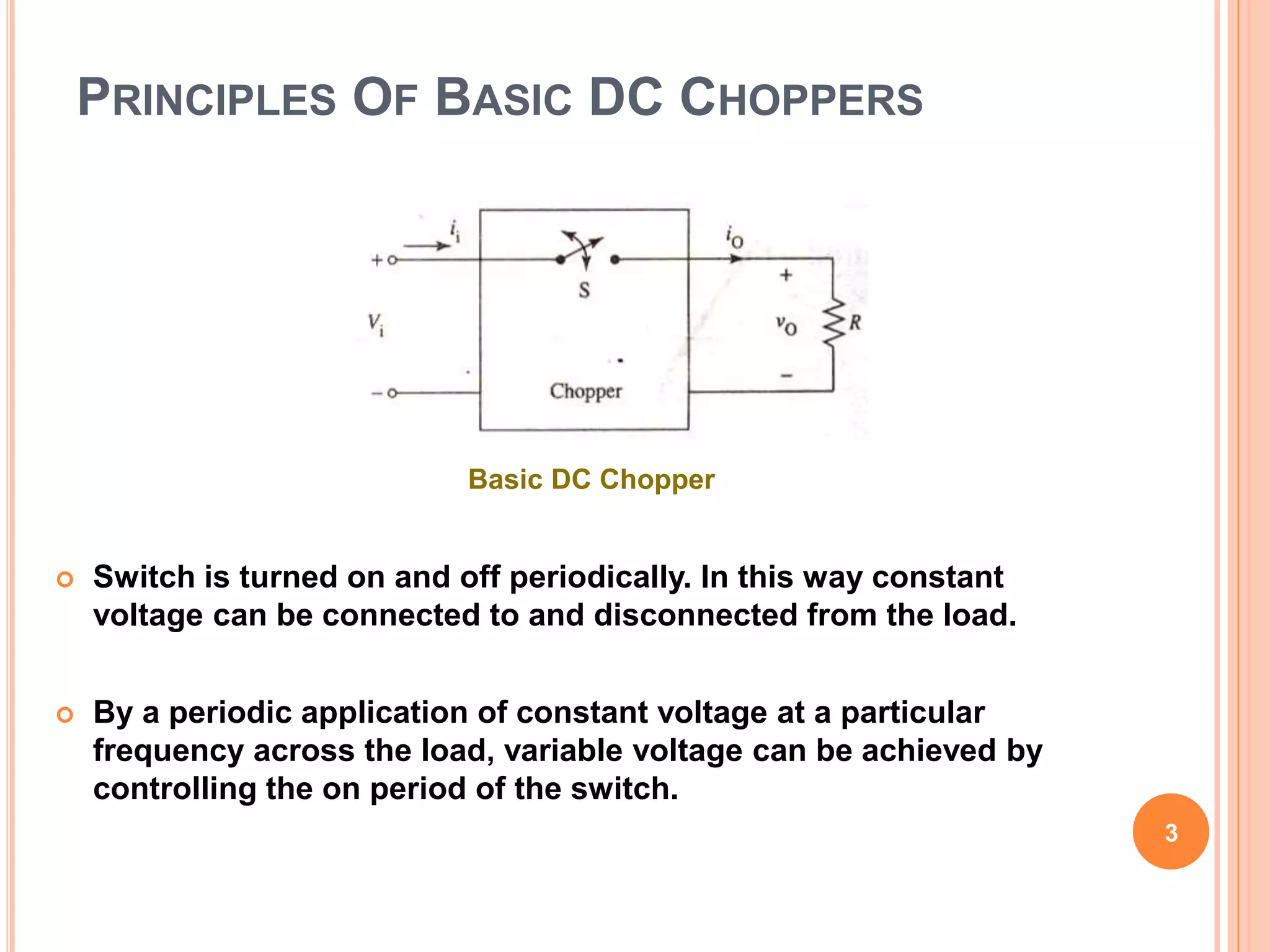
 Switch is turned on and off periodically. In this way constant
voltage can be connected to and disconnected from the load.
 By a periodic application of constant voltage at a particular
frequency across the load, variable voltage can be achieved by
controlling the on period of the switch.
3
Basic DC Chopper
 Instantaneous voltage across load is either zero (S off) or Vi
(S on).
 Average (DC) output voltage over a cycle is:
V0= TON Vi
TON+TOFF
V0=TON Vi
T
V0=d Vi 4
5
Output voltage as function of duty cycle
Output voltage varies linearly with duty cycle.
It is possible to control output voltage from zero to Vi as duty cycle
varies from zero to 1.
METHODS FOR VARYING AVERAGE OUTPUT
VOLTAGE
 Pulse width TON is varied
while overall switching
period is kept constant.
 Pulse width TON or Toff is
kept constant while the
period (frequency) is
varied.
Pulse-Width Modulation Pulse-Frequency Modulation
6
STEP-DOWN (BUCK) CHOPPER
7
8
Basic Step-Down Chopper circuit
Equivalent circuit for on state Equivalent Circuit for off state
9
Continous Current Mode
 As elements are ideal, DC
power drawn from source
must equal the DC power
absorbed by load.
P0 = Pi
V0 I0 = Vi Ii
I0 =Vi * Ii
V0
=Vi * Ii
Vi d
I0 = Ii_
d
10
Discontinous Current Mode
11
STEP-UP (BOOST) CHOPPER
12
Basic Step-Up Chopper Circuit
On State Off state
 When S is on (D is off),
capacitor energy supplies the
load voltage.
Vo=Vc (if capacitor is charged)
 During on-state of switch S,
voltage across inductor
instantly becomes equal to
input supply voltage. Current
through it increases gradually
and stores energy in its
magnetic field.
 For very first time, when S is
closed Vo=0, as capacitor is
not charged.
 When S is off (D is on),
inductor voltage reverses its
polarity and adds in input
voltage to provide output
voltage which is equal to:
V0=Vi+VL
 During off state of S, capacitor
charges and voltage at it
gradually build up to Vi+VL
(This capacitor voltages serves
as load voltage when next time
S in on)
 If S is off forever, inductor acts
as short circuit. It does not
develop any voltage and
Vo= Vi
On-State Off-State
13
14
Voltage and current
waveforms for duty cycle
50%
d= 0.5 means Switch is on and
off for equal time intervals.
Energy that inductor develops
during on-state is completely
dessipated during off-state.
If duty cycle increases above
0.5, inductor will not
dessipate its energy
completely in off-states. The
remaining inductor voltage
(due to left-over energy) adds
up next time when switch is
off and more increased
voltage appears at output.
15
If duty cycle increases above 0.5, inductor will not dessipate its
energy completely in off-states. The remaining inductor voltage (due
to left-over energy) adds up next time when switch is off and more
increased voltage appears at output.
Neglecting losses, energy transferred by inductance during TOFF
must equal the energy gained by it during period TON
Final expression for output load voltage is:
Vo=Vi [1/(1-d)]
If switch is open (d=0), output voltage is equal to input
voltage. As d increases, output voltage becomes larger than
input voltage.
So output voltage is always higher than input voltage if switch
is operated at an appropriately high frequency.
BUCK-BOOST CHOPPER
16
17
On State Off State
18

Chopper

  • 1.
    DC-DC CONVERTER ORCHOPPER M&V Patel Department of Electrical Engineering Faculty of Technology and Engineering Charotar University of Science and Technology – Changa Prepared by: Dharmesh A Dabhi Assistant Professor
  • 2.
    INTRODUCTION  DC-DC converter(chopper) is used to convert constant DC voltage into variable DC voltage.  In DC-DC conversion circuits, thyristors are used as switching elements. Here thyristors must be turned off using forced commutation as they lack facility of natural commutation that is available in AC circuits.  Buck chopper produces output that is less than or equal to input voltage.  Boost chopper provides an output voltage that is greater than or equal to input voltage.  Typical application of DC choppers is DC motor speed control. 2
  • 3.
    PRINCIPLES OF BASICDC CHOPPERS  Switch is turned on and off periodically. In this way constant voltage can be connected to and disconnected from the load.  By a periodic application of constant voltage at a particular frequency across the load, variable voltage can be achieved by controlling the on period of the switch. 3 Basic DC Chopper
  • 4.
     Instantaneous voltageacross load is either zero (S off) or Vi (S on).  Average (DC) output voltage over a cycle is: V0= TON Vi TON+TOFF V0=TON Vi T V0=d Vi 4
  • 5.
    5 Output voltage asfunction of duty cycle Output voltage varies linearly with duty cycle. It is possible to control output voltage from zero to Vi as duty cycle varies from zero to 1.
  • 6.
    METHODS FOR VARYINGAVERAGE OUTPUT VOLTAGE  Pulse width TON is varied while overall switching period is kept constant.  Pulse width TON or Toff is kept constant while the period (frequency) is varied. Pulse-Width Modulation Pulse-Frequency Modulation 6
  • 7.
  • 8.
    8 Basic Step-Down Choppercircuit Equivalent circuit for on state Equivalent Circuit for off state
  • 9.
    9 Continous Current Mode As elements are ideal, DC power drawn from source must equal the DC power absorbed by load. P0 = Pi V0 I0 = Vi Ii I0 =Vi * Ii V0 =Vi * Ii Vi d I0 = Ii_ d
  • 10.
  • 11.
  • 12.
    12 Basic Step-Up ChopperCircuit On State Off state
  • 13.
     When Sis on (D is off), capacitor energy supplies the load voltage. Vo=Vc (if capacitor is charged)  During on-state of switch S, voltage across inductor instantly becomes equal to input supply voltage. Current through it increases gradually and stores energy in its magnetic field.  For very first time, when S is closed Vo=0, as capacitor is not charged.  When S is off (D is on), inductor voltage reverses its polarity and adds in input voltage to provide output voltage which is equal to: V0=Vi+VL  During off state of S, capacitor charges and voltage at it gradually build up to Vi+VL (This capacitor voltages serves as load voltage when next time S in on)  If S is off forever, inductor acts as short circuit. It does not develop any voltage and Vo= Vi On-State Off-State 13
  • 14.
    14 Voltage and current waveformsfor duty cycle 50% d= 0.5 means Switch is on and off for equal time intervals. Energy that inductor develops during on-state is completely dessipated during off-state. If duty cycle increases above 0.5, inductor will not dessipate its energy completely in off-states. The remaining inductor voltage (due to left-over energy) adds up next time when switch is off and more increased voltage appears at output.
  • 15.
    15 If duty cycleincreases above 0.5, inductor will not dessipate its energy completely in off-states. The remaining inductor voltage (due to left-over energy) adds up next time when switch is off and more increased voltage appears at output. Neglecting losses, energy transferred by inductance during TOFF must equal the energy gained by it during period TON Final expression for output load voltage is: Vo=Vi [1/(1-d)] If switch is open (d=0), output voltage is equal to input voltage. As d increases, output voltage becomes larger than input voltage. So output voltage is always higher than input voltage if switch is operated at an appropriately high frequency.
  • 16.
  • 17.
  • 18.