MULTIQUADRANT CONTROL OF
CHOPPER-FED DC MOTORS
Institute of Industrial Electronics Engineering-Karachi
Presentation by
Muhammad Ahsan Ali (1915)
CHOPPER
• Chopper is a static device.
• A variable dc voltage is obtained from a constant dc
voltage source.
• Also known as dc-to-dc converter.
• Widely used for motor control.
• Also used in regenerative braking.
• Thyristor converter offers greater efficiency, faster
response, lower maintenance, smaller size and smooth
control.
CHOPPER FED DC DRIVES
• A dc chopper is connected between a fixed-voltage dc
source and dc motor to vary the armature voltage.
• A chopper is a high speed on/off semiconductor switch
which connects source to load and disconnects the load
from source at a fast speed.
• Choppers are used to get variable dc voltage from a dc
source of fixed voltage.
• Chopper circuits are used to control both separately
excited and Series circuits.
ADVANTAGES OF CHOPPER CIRCUITS
• Ripple content in the output is small.
• Peak/average and rms/average current ratios are small.
• The chopper is supplied from a constant dc voltage using
batteries.
• Current drawn by the chopper is smaller than in phase
controlled converters.
• Chopper circuit is simple and can be modified to provide
regeneration and the control is also simple.
CONTROL MODES OF DC CHOPPER DRIVE
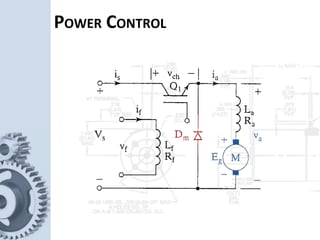
1. Power(or acceleration) control
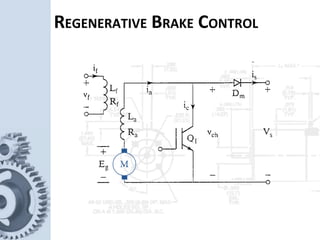
2. Regenerative brake control
3. Rheostatic brake control
4. Combined Regenerative and Rheostatic Brake Control
POWER CONTROL
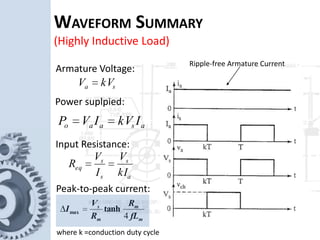
WAVEFORM SUMMARY
(Highly Inductive Load)
Ripple-free Armature Current
sa kVV 
asaao IkVIVP 
a
s
s
s
eq
kI
V
I
V
R 
m
m
m
s
fL
R
R
V
I
4
tanhmax 
Armature Voltage:
Power suplpied:
Input Resistance:
Peak-to-peak current:
where k =conduction duty cycle
REGENERATIVE BRAKE CONTROL
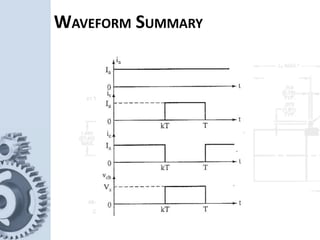
WAVEFORM SUMMARY
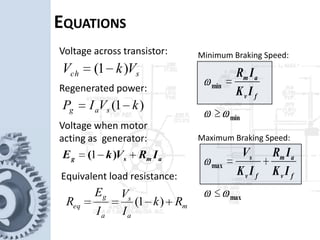
EQUATIONS
sch VkV )1( 
)1( kVIP sag 
amsg IRVkE  )(1
m
a
s
a
g
eq Rk
I
V
I
E
R  )1( max
max
min
min








fv
am
fv
s
fv
am
IK
IR
IK
V
IK
IR
Voltage across transistor:
Regenerated power:
Voltage when motor
acting as generator:
Equivalent load resistance:
Minimum Braking Speed:
Maximum Braking Speed:
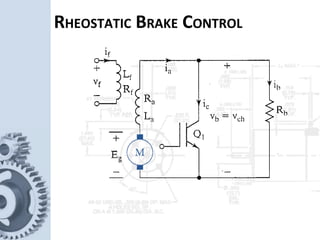
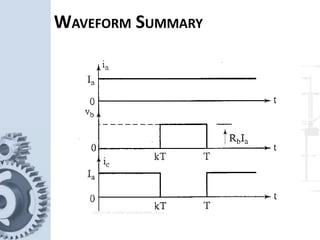
RHEOSTATIC BRAKE CONTROL
WAVEFORM SUMMARY
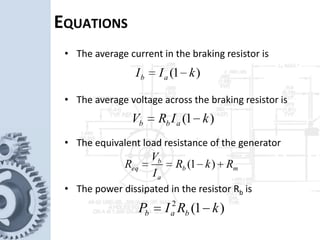
EQUATIONS
• The average current in the braking resistor is
• The average voltage across the braking resistor is
)1( kII ab 
)1( kIRV abb 
• The equivalent load resistance of the generator
• The power dissipated in the resistor Rb is
mb
a
b
eq RkR
I
V
R  )1(
)1(2
kRIP bab 
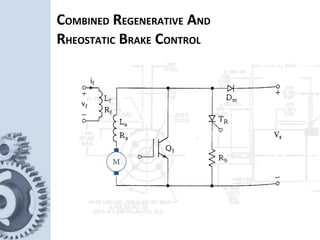
COMBINED REGENERATIVE AND
RHEOSTATIC BRAKE CONTROL
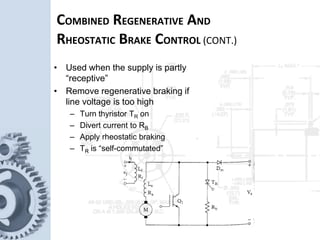
• Used when the supply is partly
“receptive”
• Remove regenerative braking if
line voltage is too high
– Turn thyristor TR on
– Divert current to RB
– Apply rheostatic braking
– TR is “self-commutated”
COMBINED REGENERATIVE AND
RHEOSTATIC BRAKE CONTROL (CONT.)
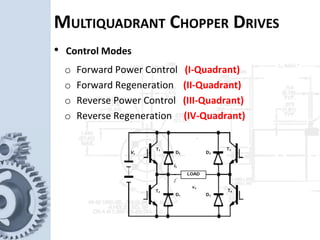
MULTIQUADRANT CHOPPER DRIVES
o Forward Power Control (I-Quadrant)
o Forward Regeneration (II-Quadrant)
o Reverse Power Control (III-Quadrant)
o Reverse Regeneration (IV-Quadrant)
• Control Modes
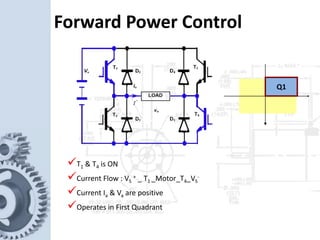
Forward Power Control
Q1
T1 & T4 is ON
Current Flow : VS
+ _ T1 _Motor_T4_VS
-
Current Ia & Va are positive
Operates in First Quadrant
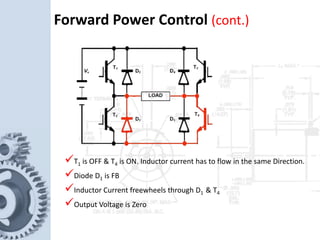
T1 is OFF & T4 is ON. Inductor current has to flow in the same Direction.
Diode D1 is FB
Inductor Current freewheels through D1 & T4
Output Voltage is Zero
Forward Power Control (cont.)
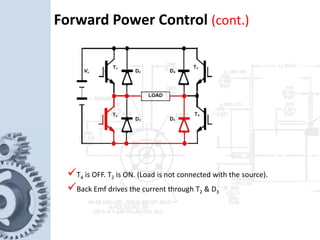
T4 is OFF. T2 is ON. (Load is not connected with the source).
Back Emf drives the current through T2 & D3
Forward Power Control (cont.)
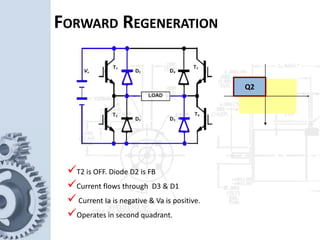
Q2
T2 is OFF. Diode D2 is FB
Current flows through D3 & D1
 Current Ia is negative & Va is positive.
Operates in second quadrant.
FORWARD REGENERATION
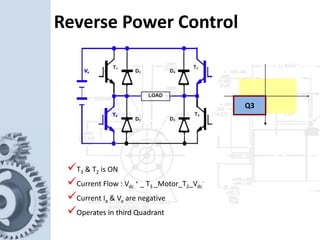
Q3
T3 & T2 is ON
Current Flow : Vdc
+ _ T3 _Motor_T2_Vdc
-
Current Ia & Va are negative
Operates in third Quadrant
Reverse Power Control
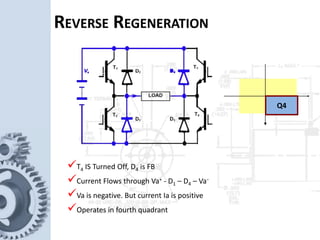
Q4
T4 IS Turned Off, D4 is FB
Current Flows through Va+ - D1 – D4 – Va-
Va is negative. But current Ia is positive
Operates in fourth quadrant
REVERSE REGENERATION
References
• Power Electronics: Circuit Devices and Application By Haroon Rashid
• Digital Power Electronics and Applications By Ling Luo, M. Rashid
THANK YOU

Dc fed chopper

  • 1.
    MULTIQUADRANT CONTROL OF CHOPPER-FEDDC MOTORS Institute of Industrial Electronics Engineering-Karachi Presentation by Muhammad Ahsan Ali (1915)
  • 2.
    CHOPPER • Chopper isa static device. • A variable dc voltage is obtained from a constant dc voltage source. • Also known as dc-to-dc converter. • Widely used for motor control. • Also used in regenerative braking. • Thyristor converter offers greater efficiency, faster response, lower maintenance, smaller size and smooth control.
  • 3.
    CHOPPER FED DCDRIVES • A dc chopper is connected between a fixed-voltage dc source and dc motor to vary the armature voltage. • A chopper is a high speed on/off semiconductor switch which connects source to load and disconnects the load from source at a fast speed. • Choppers are used to get variable dc voltage from a dc source of fixed voltage. • Chopper circuits are used to control both separately excited and Series circuits.
  • 4.
    ADVANTAGES OF CHOPPERCIRCUITS • Ripple content in the output is small. • Peak/average and rms/average current ratios are small. • The chopper is supplied from a constant dc voltage using batteries. • Current drawn by the chopper is smaller than in phase controlled converters. • Chopper circuit is simple and can be modified to provide regeneration and the control is also simple.
  • 5.
    CONTROL MODES OFDC CHOPPER DRIVE 1. Power(or acceleration) control 2. Regenerative brake control 3. Rheostatic brake control 4. Combined Regenerative and Rheostatic Brake Control
  • 6.
  • 7.
    WAVEFORM SUMMARY (Highly InductiveLoad) Ripple-free Armature Current sa kVV  asaao IkVIVP  a s s s eq kI V I V R  m m m s fL R R V I 4 tanhmax  Armature Voltage: Power suplpied: Input Resistance: Peak-to-peak current: where k =conduction duty cycle
  • 8.
  • 9.
  • 10.
    EQUATIONS sch VkV )1( )1( kVIP sag  amsg IRVkE  )(1 m a s a g eq Rk I V I E R  )1( max max min min         fv am fv s fv am IK IR IK V IK IR Voltage across transistor: Regenerated power: Voltage when motor acting as generator: Equivalent load resistance: Minimum Braking Speed: Maximum Braking Speed:
  • 11.
  • 12.
  • 13.
    EQUATIONS • The averagecurrent in the braking resistor is • The average voltage across the braking resistor is )1( kII ab  )1( kIRV abb  • The equivalent load resistance of the generator • The power dissipated in the resistor Rb is mb a b eq RkR I V R  )1( )1(2 kRIP bab 
  • 14.
  • 15.
    • Used whenthe supply is partly “receptive” • Remove regenerative braking if line voltage is too high – Turn thyristor TR on – Divert current to RB – Apply rheostatic braking – TR is “self-commutated” COMBINED REGENERATIVE AND RHEOSTATIC BRAKE CONTROL (CONT.)
  • 16.
    MULTIQUADRANT CHOPPER DRIVES oForward Power Control (I-Quadrant) o Forward Regeneration (II-Quadrant) o Reverse Power Control (III-Quadrant) o Reverse Regeneration (IV-Quadrant) • Control Modes
  • 17.
    Forward Power Control Q1 T1& T4 is ON Current Flow : VS + _ T1 _Motor_T4_VS - Current Ia & Va are positive Operates in First Quadrant
  • 18.
    T1 is OFF& T4 is ON. Inductor current has to flow in the same Direction. Diode D1 is FB Inductor Current freewheels through D1 & T4 Output Voltage is Zero Forward Power Control (cont.)
  • 19.
    T4 is OFF.T2 is ON. (Load is not connected with the source). Back Emf drives the current through T2 & D3 Forward Power Control (cont.)
  • 20.
    Q2 T2 is OFF.Diode D2 is FB Current flows through D3 & D1  Current Ia is negative & Va is positive. Operates in second quadrant. FORWARD REGENERATION
  • 21.
    Q3 T3 & T2is ON Current Flow : Vdc + _ T3 _Motor_T2_Vdc - Current Ia & Va are negative Operates in third Quadrant Reverse Power Control
  • 22.
    Q4 T4 IS TurnedOff, D4 is FB Current Flows through Va+ - D1 – D4 – Va- Va is negative. But current Ia is positive Operates in fourth quadrant REVERSE REGENERATION
  • 23.
    References • Power Electronics:Circuit Devices and Application By Haroon Rashid • Digital Power Electronics and Applications By Ling Luo, M. Rashid
  • 24.

Editor's Notes

  • #4 [3rd point]Self commutated devices such as MOSFET’s, Power transistors, IGBT’s, GTO’s and IGCT’s are used for building choppers because they can be commutated by a low power control signal and do not need communication circuit and can be operated at a higher frequency for the same rating.
  • #5 [2nd point] This improves the commutation and decreases the harmonic heating of the motor. [3rd point] The problem of power factor does not occur at all. The conventional phase control method suffers from a poor power factor as the angle is delayed.
  • #7 Note: In this circuit SCR is not suitable since once the device is latched on in this dc supply application, it remains on.
  • #17 LOAD in figure implies to the Motor.