LESSON 3: DRAWING LEWIS
STRUCTURES
Covalent Bonding Unit
TARGETS
   I can draw Lewis Structures for covalent
    compounds.
DEFINITION
 Lewis Structures – visual representation of
  covalent bonding that indicates where the
  valence shell electrons are in the molecule.
 Shared electron pairs are shown as lines and
  lone pairs (pairs of electrons not involved in
  bonding) are shown as dots
OCTET RULE
   Atoms tend to gain, lose, or share electrons
    until they are surrounded by eight valence
    electrons (octet). An octet consists of full s and p
    orbitals.
EXCEPTIONS TO THE OCTET RULE
 Duet Rule - hydrogen only has 2 valence
  electrons after bonding
 Boron only has 6 valence electrons after bonding
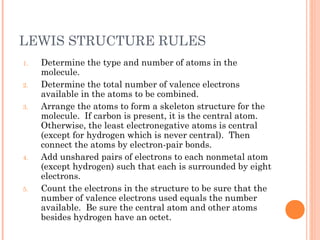
LEWIS STRUCTURE RULES
1.   Determine the type and number of atoms in the
     molecule.
2.   Determine the total number of valence electrons
     available in the atoms to be combined.
3.   Arrange the atoms to form a skeleton structure for the
     molecule. If carbon is present, it is the central atom.
     Otherwise, the least electronegative atoms is central
     (except for hydrogen which is never central). Then
     connect the atoms by electron-pair bonds.
4.   Add unshared pairs of electrons to each nonmetal atom
     (except hydrogen) such that each is surrounded by eight
     electrons.
5.   Count the electrons in the structure to be sure that the
     number of valence electrons used equals the number
     available. Be sure the central atom and other atoms
     besides hydrogen have an octet.
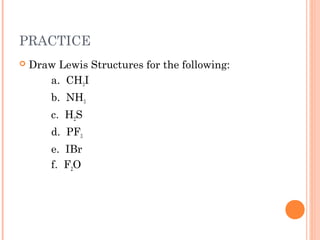
PRACTICE
   Draw Lewis Structures for the following:
       a. CH3I
        b. NH3
        c. H2S
        d. PF3
        e. IBr
        f. F2O
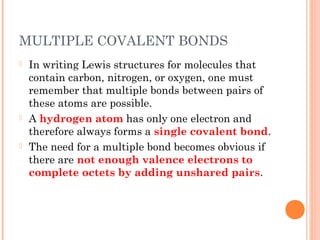
MULTIPLE COVALENT BONDS
   In writing Lewis structures for molecules that
    contain carbon, nitrogen, or oxygen, one must
    remember that multiple bonds between pairs of
    these atoms are possible.
   A hydrogen atom has only one electron and
    therefore always forms a single covalent bond.
   The need for a multiple bond becomes obvious if
    there are not enough valence electrons to
    complete octets by adding unshared pairs.
LEWIS STRUCTURE RULES
1.   Determine the type and number of atoms in the molecule.
2.   Determine the total number of valence electrons available in the
     atoms to be combined.
3.   Arrange the atoms to form a skeleton structure for the molecule.
     If carbon is present, it is the central atom. Otherwise, the least
     electronegative atoms is central (except for hydrogen which is
     never central). Then connect the atoms by electron-pair bonds.
4.   Add unshared pairs of electrons to each nonmetal atom (except
     hydrogen) such that each is surrounded by eight electrons.
5.   Count the electrons in the structure to be sure that the number of
     valence electrons used equals the number available.
6.   If too many electrons have been used, subtract one or more
     lone pairs until the total number of valence electrons is
     correct. Then move one or more lone electron pairs to
     existing bonds between non-hydrogen atoms until the
     outer shells of all atoms are completely filled.
PRACTICE
   Draw Lewis structures for
       a. CH2O
        b. CO2
        c. HCN
        d. C2H2

Lewis structuregood

  • 1.
    LESSON 3: DRAWINGLEWIS STRUCTURES Covalent Bonding Unit
  • 2.
    TARGETS  I can draw Lewis Structures for covalent compounds.
  • 3.
    DEFINITION  Lewis Structures– visual representation of covalent bonding that indicates where the valence shell electrons are in the molecule.  Shared electron pairs are shown as lines and lone pairs (pairs of electrons not involved in bonding) are shown as dots
  • 4.
    OCTET RULE  Atoms tend to gain, lose, or share electrons until they are surrounded by eight valence electrons (octet). An octet consists of full s and p orbitals.
  • 5.
    EXCEPTIONS TO THEOCTET RULE  Duet Rule - hydrogen only has 2 valence electrons after bonding  Boron only has 6 valence electrons after bonding
  • 6.
    LEWIS STRUCTURE RULES 1. Determine the type and number of atoms in the molecule. 2. Determine the total number of valence electrons available in the atoms to be combined. 3. Arrange the atoms to form a skeleton structure for the molecule. If carbon is present, it is the central atom. Otherwise, the least electronegative atoms is central (except for hydrogen which is never central). Then connect the atoms by electron-pair bonds. 4. Add unshared pairs of electrons to each nonmetal atom (except hydrogen) such that each is surrounded by eight electrons. 5. Count the electrons in the structure to be sure that the number of valence electrons used equals the number available. Be sure the central atom and other atoms besides hydrogen have an octet.
  • 7.
    PRACTICE  Draw Lewis Structures for the following: a. CH3I b. NH3 c. H2S d. PF3 e. IBr f. F2O
  • 9.
    MULTIPLE COVALENT BONDS  In writing Lewis structures for molecules that contain carbon, nitrogen, or oxygen, one must remember that multiple bonds between pairs of these atoms are possible.  A hydrogen atom has only one electron and therefore always forms a single covalent bond.  The need for a multiple bond becomes obvious if there are not enough valence electrons to complete octets by adding unshared pairs.
  • 10.
    LEWIS STRUCTURE RULES 1. Determine the type and number of atoms in the molecule. 2. Determine the total number of valence electrons available in the atoms to be combined. 3. Arrange the atoms to form a skeleton structure for the molecule. If carbon is present, it is the central atom. Otherwise, the least electronegative atoms is central (except for hydrogen which is never central). Then connect the atoms by electron-pair bonds. 4. Add unshared pairs of electrons to each nonmetal atom (except hydrogen) such that each is surrounded by eight electrons. 5. Count the electrons in the structure to be sure that the number of valence electrons used equals the number available. 6. If too many electrons have been used, subtract one or more lone pairs until the total number of valence electrons is correct. Then move one or more lone electron pairs to existing bonds between non-hydrogen atoms until the outer shells of all atoms are completely filled.
  • 11.
    PRACTICE  Draw Lewis structures for a. CH2O b. CO2 c. HCN d. C2H2