Twitter: @LilyKotze
Function Bring nutrients and oxygen to cells.
Remove waste products so it can be excreted
Blood
Living tissue that circulates
through the body.
Transports oxygen,
nutrients, hormones and
waste.
Liquid part:
Consists of
mainly
water.
Transports
nutrients,
waste
products
and gases
in dissolved
form.
;kajno;nd
Humans have a
closed circulatory
system.
This means blood
circulates around
the body without
ever leaving the
blood vessels.
Artery Vein
Arteriole Venule
Capillary network
Capillaries: Many small, narrow tubes.
Walls are very thin – cells come into close contact with the blood.
Capillaries supply cells with O2 and nutrients, and removes waste
products and CO2.
Capillaries combine again to form veins.
Veins: Transport deoxygenated blood back to lungs via the heart.
Thinner, less muscled walls.
The pulmonary vein transports oxygen-rich blood from the lungs to the
heart. It is the only vein that transports oxygen-rich blood.
Arteries: Transport oxygen-rich blood from the heart to the cells of
the body.
Walls are thick, muscled and elastic - The aorta is the main artery.
The pulmonary artery transports deoxygenated blood from the heart to
the lungs. It is the only artery that transports deoxygenated blood.
Functionsof
Pumps deoxygenated blood to the lungs where
it gets rid of CO2.
Blood enriched with O2 flows back to the heart
from the lungs.
From where it is pumped to the rest of the body.
In this way the rest of the body is supplied with
O2.
Title slide: http://3dprint.com/wp-content/uploads/2014/02/heart-feat-real.jpg
Slide 2: https://media.giphy.com/media/kR1cjIwNPatjO/giphy.gif
Slide 3: http://marketingresearchbureau.com/wordpress/wp-
content/uploads/2012/09/iStock_000006455765XSmall.jpg
Slide 4: Plasma:
http://www.healthcarepackaging.com/sites/default/files/styles/lightbox/public/field/image/AD_Plasma_Bag_1.jpg?i
tok=oB8Yn_zF Red blood corpuscles: http://www.interactive-biology.com/wp-
content/uploads/2012/07/RedBloodCells3.jpg White blood cells: http://cx.aos.ask.com/question/aq/700px-
394px/functions-white-blood-cells_63a18a771a2dcf5e.jpg Platelets: http://genelon.in/images/new/R-and-D/In-
Vitro-Production-of-Platelets-from-Human-Umbilical.jpg
Slide 5: Full body: http://cdn.rainbowresource.netdna-cdn.com/products/009014.jpg Diagram:
http://carignanapbio.weebly.com/uploads/1/8/3/9/18395499/___721555.jpg
Slide 6: http://whatishiv.weebly.com/uploads/2/0/6/5/20650868/757834418.png?383
Slide 7: Artery: http://www.full-health.com/image_artery_plaque_atheroma.jpg Vein: http://biology-
forums.com/gallery/14755_10_09_12_7_22_10_85222242.jpeg Capillaries:
http://www.shockwavetherapy.ca/capillaries.jpg
Slide 8: Cross section: http://www.investinlibya.org/wp-content/uploads/2015/03/Surgical-anatomy-the-inferior-
vena-cava.jpg Gif: http://www.niusnews.com/upload/imgs/default/14MarG/TransMedics/3.gif
Slide 9: http://www.netanimations.net/Moving-picture-heart-beating-gif-animation.gif
TEXT: du Plessis et al: DocScientia Textbook and Workbook Grade 9 Natural Sciences CAPS; 2013
info@docscientia.co.za

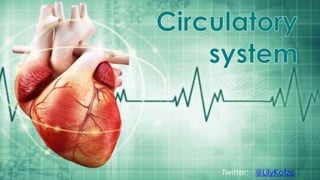
Circulatory system

  • 1.
  • 2.
    Function Bring nutrientsand oxygen to cells. Remove waste products so it can be excreted
  • 3.
    Blood Living tissue thatcirculates through the body. Transports oxygen, nutrients, hormones and waste.
  • 4.
  • 6.
    ;kajno;nd Humans have a closedcirculatory system. This means blood circulates around the body without ever leaving the blood vessels. Artery Vein Arteriole Venule Capillary network
  • 7.
    Capillaries: Many small,narrow tubes. Walls are very thin – cells come into close contact with the blood. Capillaries supply cells with O2 and nutrients, and removes waste products and CO2. Capillaries combine again to form veins. Veins: Transport deoxygenated blood back to lungs via the heart. Thinner, less muscled walls. The pulmonary vein transports oxygen-rich blood from the lungs to the heart. It is the only vein that transports oxygen-rich blood. Arteries: Transport oxygen-rich blood from the heart to the cells of the body. Walls are thick, muscled and elastic - The aorta is the main artery. The pulmonary artery transports deoxygenated blood from the heart to the lungs. It is the only artery that transports deoxygenated blood.
  • 9.
    Functionsof Pumps deoxygenated bloodto the lungs where it gets rid of CO2. Blood enriched with O2 flows back to the heart from the lungs. From where it is pumped to the rest of the body. In this way the rest of the body is supplied with O2.
  • 10.
    Title slide: http://3dprint.com/wp-content/uploads/2014/02/heart-feat-real.jpg Slide2: https://media.giphy.com/media/kR1cjIwNPatjO/giphy.gif Slide 3: http://marketingresearchbureau.com/wordpress/wp- content/uploads/2012/09/iStock_000006455765XSmall.jpg Slide 4: Plasma: http://www.healthcarepackaging.com/sites/default/files/styles/lightbox/public/field/image/AD_Plasma_Bag_1.jpg?i tok=oB8Yn_zF Red blood corpuscles: http://www.interactive-biology.com/wp- content/uploads/2012/07/RedBloodCells3.jpg White blood cells: http://cx.aos.ask.com/question/aq/700px- 394px/functions-white-blood-cells_63a18a771a2dcf5e.jpg Platelets: http://genelon.in/images/new/R-and-D/In- Vitro-Production-of-Platelets-from-Human-Umbilical.jpg Slide 5: Full body: http://cdn.rainbowresource.netdna-cdn.com/products/009014.jpg Diagram: http://carignanapbio.weebly.com/uploads/1/8/3/9/18395499/___721555.jpg Slide 6: http://whatishiv.weebly.com/uploads/2/0/6/5/20650868/757834418.png?383 Slide 7: Artery: http://www.full-health.com/image_artery_plaque_atheroma.jpg Vein: http://biology- forums.com/gallery/14755_10_09_12_7_22_10_85222242.jpeg Capillaries: http://www.shockwavetherapy.ca/capillaries.jpg Slide 8: Cross section: http://www.investinlibya.org/wp-content/uploads/2015/03/Surgical-anatomy-the-inferior- vena-cava.jpg Gif: http://www.niusnews.com/upload/imgs/default/14MarG/TransMedics/3.gif Slide 9: http://www.netanimations.net/Moving-picture-heart-beating-gif-animation.gif TEXT: du Plessis et al: DocScientia Textbook and Workbook Grade 9 Natural Sciences CAPS; 2013 info@docscientia.co.za

Editor's Notes

  • #5 Image 1: Plasma Image 2: Blood corpuscules Image 3: White cells Image 4: Platelets
  • #9 The heart is centrally situated in the chest between the lungs. It is protected by the chest and ribs. Your heart is approx. the size of your fist. The two sides of the heart are separated by a muscular wall (septum). Both sides are also divided into two chambers. The human heart therefore consists of four chambers. The upper two heart chambers (atria) receive blood from the veins. The lower two chambers (ventricles) pump blood to the rest of the body through the arteries. The heart is actually a hollow muscle that alternately contracts and relaxes continuously.