Atmosphere
Twitter: @LilyKotze
Our Atmosphereis a layer of gases which surrounds the earth.
These gases are held in place by the earth’s
gravitational force.
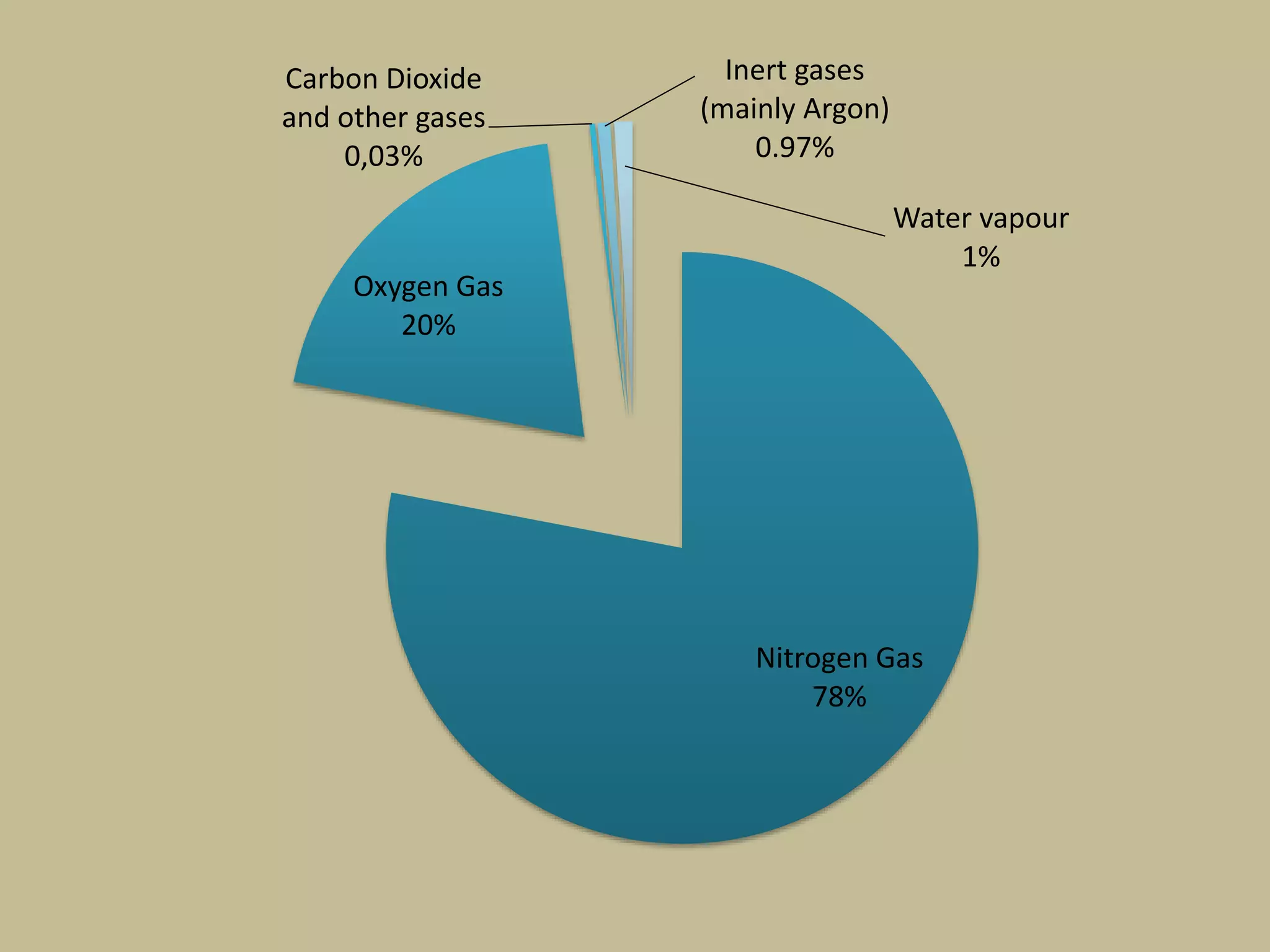
This mixture of gases consist mainly of Nitrogen (78 %),
Oxygen (20 %), Inert gases – mainly Argon (0,93 %) and
Carbon dioxide and other gases (0,03 %). Water vapour
makes up the last 1 %, but is only present in the lower
atmosphere, where weather phenomena occurs.
Nitrogen Gas
78%
Oxygen Gas
20%
Carbon Dioxide
and other gases
0,03%
Inert gases
(mainly Argon)
0.97%
Water vapour
1%
most dense
The atmosphere is
close to earth.
The density decreases as the height above sea-
level increases, until in outer space where the
density is zero.
This means there is no air in outer space.
Theatmosphere
maintainslifeonearth
Source of O2 -
supports life
Nitrogen is
unreactive, and
dilutes the oxygen.
Nitrogen is fixed in
the air by lightning
and bacteria in the
ground and is then
absorbed by plant
roots for maximum
plant growth.
CO2 is needed
for
photosynthesis.
Protection from
UV rays. (See
Ozone layer)
Temperature fluctuation between day and
night are less severe, otherwise we would be
KFC in the daytime and icicles at night.
The atmosphere is divided into
four layers
(some say five).
This division is based upon temperature differences.
Each layer has a transition point.
These transition points are known as a pause.
Sometimes the top part of the thermosphere is referred to as the exosphere.
sfdgsd
Closest to the earth (6km – 20 km):
Responsible for maintaining life and weather
systems . (Contains all the water vapour present in the
atmosphere.)
Is the most dense – contains 70 % of the mass
of the atmosphere.
Temperature decreases with height. This is called
a positive lapse rate.
Tropopause is the upper layer of the
troposphere and transitions into the
stratosphere.
‘psdfj;aoidjf
Contains 24 % of the atmospheric mass – the
atmosphere here is very thin. (20 – 50 km)
Contains the ozone layer (O3): Ozone converts
harmful UV rays from the sun into heat. This
causes and increase in temperature as the
height increases, which is called a temperature
inversion.
;alsfd;qoa
50 – 85 km
Coldest part of the atmosphere – known as the
mesopheric temperature minimum. The
temperature decreases as the height increases.
Protective function: these is still enough air so
small rocks and substances from space are
incinerated – this is usually known as
‘shooting stars’.
Temperature increases with height (85 – 690 km)
Extremely high
temperatures
due to the
absorption of
energetic UV-
and X-rays at
the bottom of
the
thermosphere.
Air is VERY thin.
Radio and T.V. transmissions
reflected to the earth here.
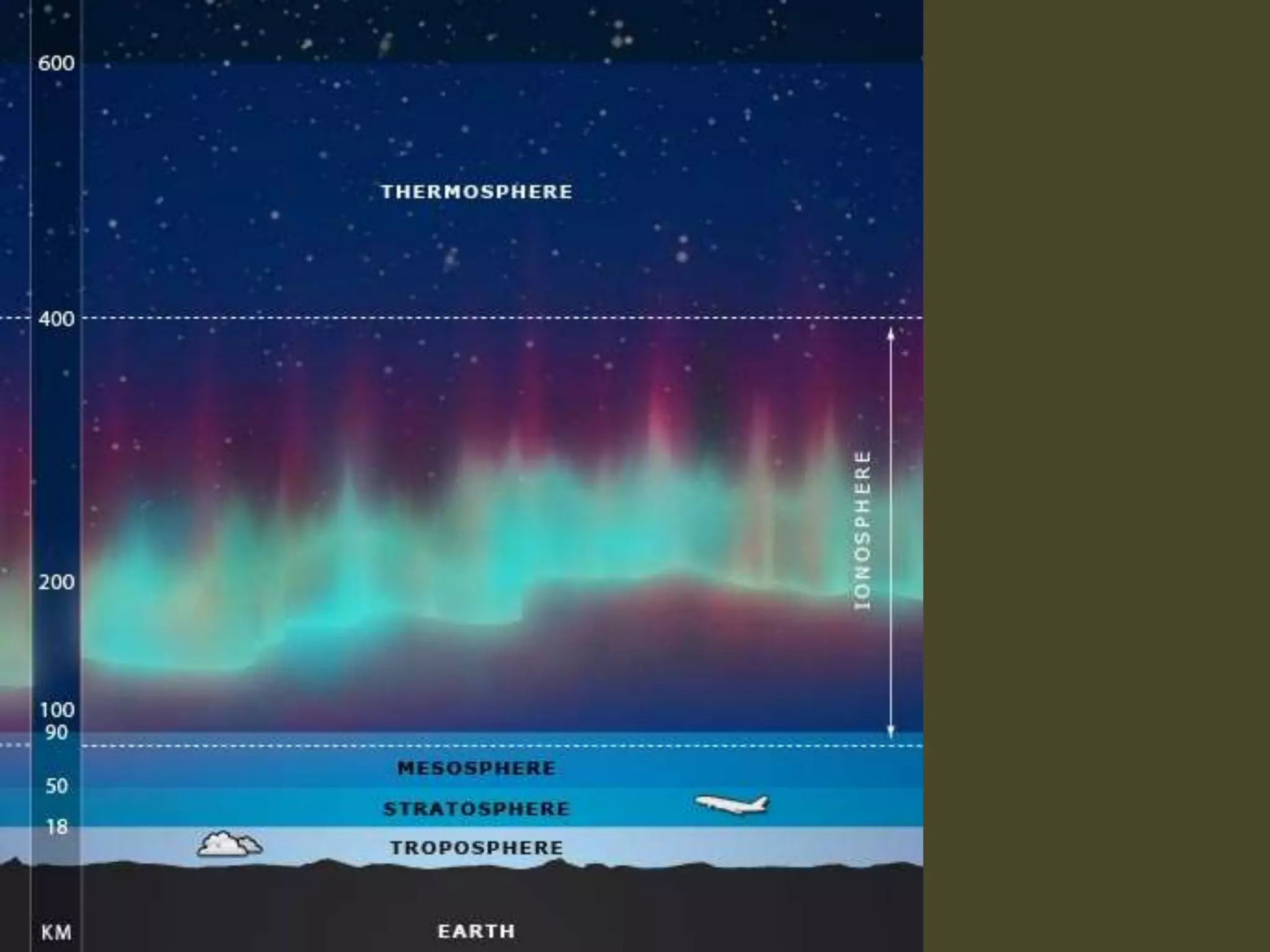
Ionosphere is part of the
Thermosphere. This is
where charged particles
interact with the
magnetosphere to for the
Northern (or Southern)
Lights.
ISS orbits at approximately 370 km
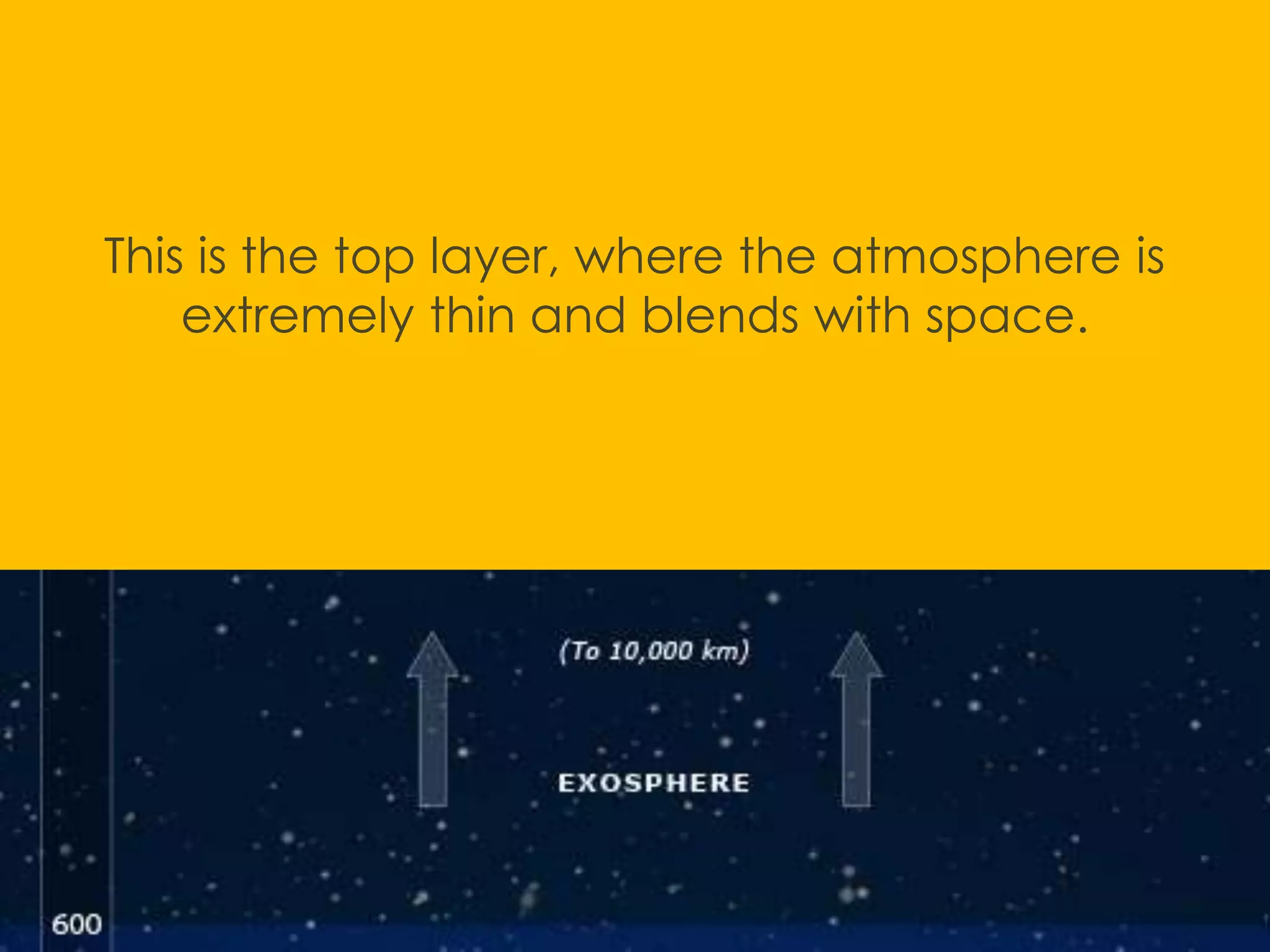
This is the top layer, where the atmosphere is
extremely thin and blends with space.
Each layer has a different
temperature gradient.
Definition
is the change
in temperature
with height above sea level.
Title slide: http://www.mediafactory.org.au/matthew-jowett/files/2014/08/atmosphere-
tn5co9.jpg
Slide 5: http://hendrix2.uoregon.edu/~imamura/102/images/Sea-Level-Barometric-
Pressure.jpg
Slide 8 – 12: http://www.teara.govt.nz/files/di-6132-enz.jpg
Slide 15: http://www.weatheronline.co.uk/reports/wxfacts/atmo200.jpg
DocScientia Grade 9 Natural Sciences CAPS. Textbook and workbook. Third edition 2013

3. atmosphere

  • 1.
  • 2.
    Our Atmosphereis alayer of gases which surrounds the earth. These gases are held in place by the earth’s gravitational force. This mixture of gases consist mainly of Nitrogen (78 %), Oxygen (20 %), Inert gases – mainly Argon (0,93 %) and Carbon dioxide and other gases (0,03 %). Water vapour makes up the last 1 %, but is only present in the lower atmosphere, where weather phenomena occurs.
  • 3.
    Nitrogen Gas 78% Oxygen Gas 20% CarbonDioxide and other gases 0,03% Inert gases (mainly Argon) 0.97% Water vapour 1%
  • 4.
    most dense The atmosphereis close to earth. The density decreases as the height above sea- level increases, until in outer space where the density is zero. This means there is no air in outer space.
  • 6.
    Theatmosphere maintainslifeonearth Source of O2- supports life Nitrogen is unreactive, and dilutes the oxygen. Nitrogen is fixed in the air by lightning and bacteria in the ground and is then absorbed by plant roots for maximum plant growth. CO2 is needed for photosynthesis. Protection from UV rays. (See Ozone layer) Temperature fluctuation between day and night are less severe, otherwise we would be KFC in the daytime and icicles at night.
  • 7.
    The atmosphere isdivided into four layers (some say five). This division is based upon temperature differences. Each layer has a transition point. These transition points are known as a pause. Sometimes the top part of the thermosphere is referred to as the exosphere.
  • 9.
    sfdgsd Closest to theearth (6km – 20 km): Responsible for maintaining life and weather systems . (Contains all the water vapour present in the atmosphere.) Is the most dense – contains 70 % of the mass of the atmosphere. Temperature decreases with height. This is called a positive lapse rate. Tropopause is the upper layer of the troposphere and transitions into the stratosphere.
  • 10.
    ‘psdfj;aoidjf Contains 24 %of the atmospheric mass – the atmosphere here is very thin. (20 – 50 km) Contains the ozone layer (O3): Ozone converts harmful UV rays from the sun into heat. This causes and increase in temperature as the height increases, which is called a temperature inversion.
  • 11.
    ;alsfd;qoa 50 – 85km Coldest part of the atmosphere – known as the mesopheric temperature minimum. The temperature decreases as the height increases. Protective function: these is still enough air so small rocks and substances from space are incinerated – this is usually known as ‘shooting stars’.
  • 12.
    Temperature increases withheight (85 – 690 km) Extremely high temperatures due to the absorption of energetic UV- and X-rays at the bottom of the thermosphere. Air is VERY thin. Radio and T.V. transmissions reflected to the earth here. Ionosphere is part of the Thermosphere. This is where charged particles interact with the magnetosphere to for the Northern (or Southern) Lights. ISS orbits at approximately 370 km
  • 13.
    This is thetop layer, where the atmosphere is extremely thin and blends with space.
  • 14.
    Each layer hasa different temperature gradient. Definition is the change in temperature with height above sea level.
  • 16.
    Title slide: http://www.mediafactory.org.au/matthew-jowett/files/2014/08/atmosphere- tn5co9.jpg Slide5: http://hendrix2.uoregon.edu/~imamura/102/images/Sea-Level-Barometric- Pressure.jpg Slide 8 – 12: http://www.teara.govt.nz/files/di-6132-enz.jpg Slide 15: http://www.weatheronline.co.uk/reports/wxfacts/atmo200.jpg DocScientia Grade 9 Natural Sciences CAPS. Textbook and workbook. Third edition 2013