Chapter 8

The Cellular Basis of Reproduction
and Inheritance

PowerPoint Lectures for

Campbell Biology: Concepts & Connections, Seventh Edition
Reece, Taylor, Simon, and Dickey
© 2012 Pearson Education, Inc.

Lecture by Edward J. Zalisko
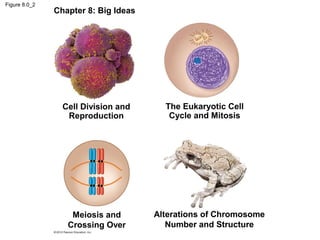
Figure 8.0_2

Chapter 8: Big Ideas

Cell Division and
Reproduction

Meiosis and
Crossing Over

The Eukaryotic Cell
Cycle and Mitosis

Alterations of Chromosome
Number and Structure
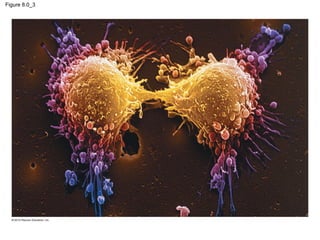
Figure 8.0_3
8.1 Cell division plays many important roles in
the lives of organisms
 Organisms reproduce their own kind, a key
characteristic of life.
 Cell division
– is reproduction at the cellular level,
– requires the duplication of chromosomes, and
– sorts new sets of chromosomes into the resulting pair
of daughter cells.

© 2012 Pearson Education, Inc.
8.1
 Cell division is used
– for reproduction of single-celled organisms,
– growth of multicellular organisms from a fertilized egg
into an adult,
– repair and replacement of cells, and
– sperm and egg production.

© 2012 Pearson Education, Inc.
8.1
 Living organisms reproduce by two methods.
– Asexual reproduction
– produces offspring that are identical to the original cell or
organism and
– involves inheritance of all genes from one parent.

– Sexual reproduction
– produces offspring that are similar to the parents, but show
variations in traits and
– involves inheritance of unique sets of genes from two parents.

© 2012 Pearson Education, Inc.
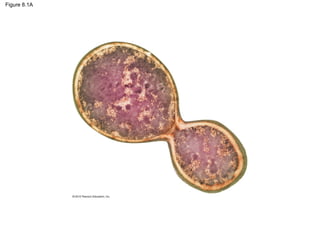
Figure 8.1A
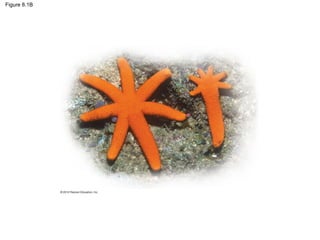
Figure 8.1B
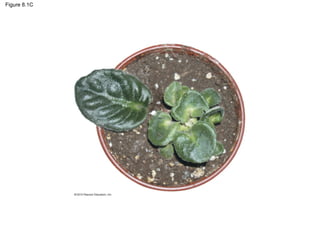
Figure 8.1C
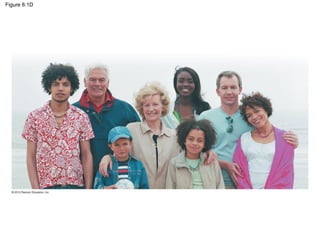
Figure 8.1D
8.2 Prokaryotes reproduce by binary fission
 Prokaryotes (bacteria and archaea) reproduce by
binary fission (“dividing in half”).
 The chromosome of a prokaryote is
– a singular circular DNA molecule
– much smaller than those of eukaryotes.

© 2012 Pearson Education, Inc.
8.2 Prokaryotes reproduce by binary fission
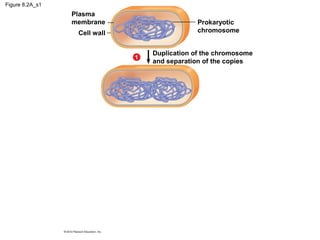
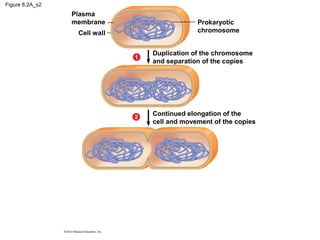
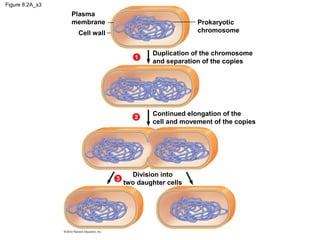
 Binary fission of a prokaryote occurs in three stages:
1. duplication of the chromosome and separation of the
copies,
2. continued elongation of the cell and movement of the
copies, and
3. division into two daughter cells.

© 2012 Pearson Education, Inc.
Figure 8.2A_s1

Plasma
membrane

Prokaryotic
chromosome

Cell wall

1

Duplication of the chromosome
and separation of the copies
Figure 8.2A_s2

Plasma
membrane

Prokaryotic
chromosome

Cell wall

1

Duplication of the chromosome
and separation of the copies

2

Continued elongation of the
cell and movement of the copies
Figure 8.2A_s3

Plasma
membrane

Prokaryotic
chromosome

Cell wall

1

2

3

Duplication of the chromosome
and separation of the copies

Continued elongation of the
cell and movement of the copies

Division into
two daughter cells
8.3 The large, complex chromosomes of
eukaryotes duplicate with each cell division
 Eukaryotic cells
– are more complex and larger than prokaryotic cells,
– have more genes, and
– store most of their genes on multiple chromosomes within
the nucleus.

© 2012 Pearson Education, Inc.
8.3
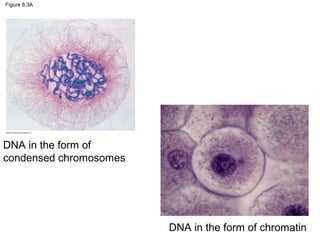
 Eukaryotic chromosomes are composed of
chromatin consisting of
– one long DNA molecule and proteins

 To prepare for division, the chromatin becomes
highly compacted chromosomes

© 2012 Pearson Education, Inc.
Figure 8.3A

DNA in the form of
condensed chromosomes

DNA in the form of chromatin
8.3
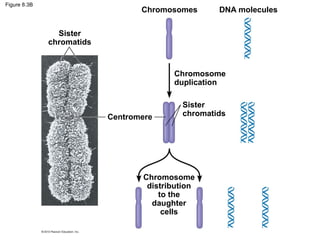
 Before a eukaryotic cell begins to divide, it
duplicates all of its chromosomes, resulting in
– two copies called sister chromatids joined together by a
narrowed “waist” called the centromere.

 When a cell divides, the sister chromatids
– separate from each other, now each is called a
chromosome
– Each chromosome (single chromatid) is distributed into
separate daughter cells.

© 2012 Pearson Education, Inc.
Figure 8.3B

Chromosomes

DNA molecules

Sister
chromatids

Chromosome
duplication

Centromere

Sister
chromatids

Chromosome
distribution
to the
daughter
cells
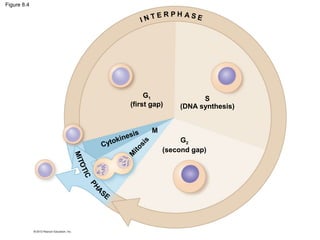
8.4 The cell cycle multiplies cells
 An ordered sequence of events that divide a cell
 The cell cycle consists of two stages,
characterized as follows:
1. Interphase: duplication of cell contents
– G1—growth, increase in cytoplasm
– S—duplication of chromosomes
– G2—growth, preparation for division

1. Mitotic phase: division
– Mitosis—division of the nucleus
– Cytokinesis—division of cytoplasm
© 2012 Pearson Education, Inc.
Figure 8.4

INT

ERPH ASE

G1
(first gap)

O
MIT

M
ito
si
s

si s
kine
o
Cyt

TIC
A
PH

SE

S
(DNA synthesis)

M
G2
(second gap)
8.5 Cell division is a continuum of dynamic
changes
 Mitosis progresses through a series of stages:
– prophase,
– prometaphase,
– metaphase,
– anaphase, and
– telophase.

 Cytokinesis often overlaps telophase.

© 2012 Pearson Education, Inc.
8.5 Cell division is a continuum of dynamic
changes
 A mitotic spindle (spindle fibers) is
– required to divide the chromosomes, and composed of
microtubules
– produced by centrosomes
– contain a pair of centrioles in animal cells.

© 2012 Pearson Education, Inc.
8.5 Cell division is a continuum of dynamic
changes
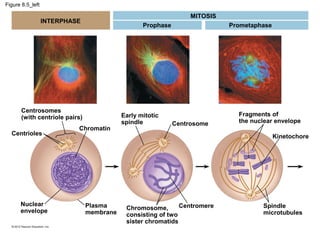
 Interphase
– The cytoplasmic contents double,
– two centrosomes form,
– chromosomes duplicate in the nucleus during the S
phase, and
– nucleoli, sites of ribosome assembly, are visible.

© 2012 Pearson Education, Inc.
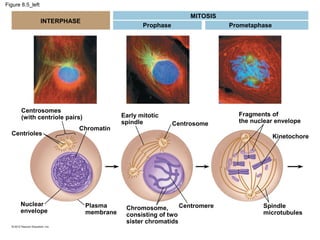
Figure 8.5_left

MITOSIS

INTERPHASE

Prophase

Centrosomes
(with centriole pairs)
Centrioles

Nuclear
envelope

Chromatin

Early mitotic
spindle

Prometaphase

Centrosome

Fragments of
the nuclear envelope
Kinetochore

Plasma
membrane

Centromere
Chromosome,
consisting of two
sister chromatids

Spindle
microtubules
8.5 Cell division is a continuum of dynamic
changes
 Prophase
– In the cytoplasm microtubules begin to emerge from
centrosomes, forming the spindle.
– In the nucleus
– chromosomes coil and become compact and
– nucleoli disappear.

© 2012 Pearson Education, Inc.
Figure 8.5_left

MITOSIS

INTERPHASE

Prophase

Centrosomes
(with centriole pairs)
Centrioles

Nuclear
envelope

Chromatin

Early mitotic
spindle

Prometaphase

Centrosome

Fragments of
the nuclear envelope
Kinetochore

Plasma
membrane

Centromere
Chromosome,
consisting of two
sister chromatids

Spindle
microtubules
8.5 Cell division is a continuum of dynamic
changes
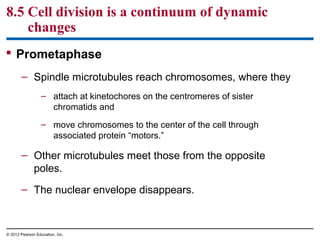
 Prometaphase
– Spindle microtubules reach chromosomes, where they
– attach at kinetochores on the centromeres of sister
chromatids and
– move chromosomes to the center of the cell through
associated protein “motors.”

– Other microtubules meet those from the opposite
poles.
– The nuclear envelope disappears.

© 2012 Pearson Education, Inc.
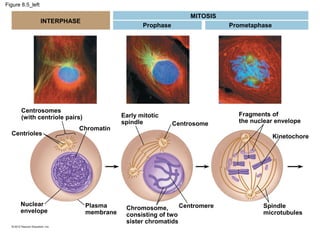
Figure 8.5_left

MITOSIS

INTERPHASE

Prophase

Centrosomes
(with centriole pairs)
Centrioles

Nuclear
envelope

Chromatin

Early mitotic
spindle

Prometaphase

Centrosome

Fragments of
the nuclear envelope
Kinetochore

Plasma
membrane

Centromere
Chromosome,
consisting of two
sister chromatids

Spindle
microtubules
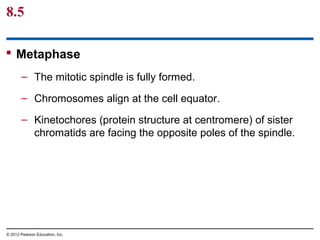
8.5
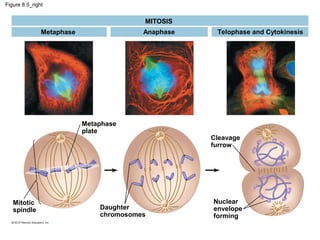
 Metaphase
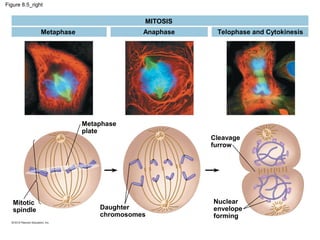
– The mitotic spindle is fully formed.
– Chromosomes align at the cell equator.
– Kinetochores (protein structure at centromere) of sister
chromatids are facing the opposite poles of the spindle.

© 2012 Pearson Education, Inc.
Figure 8.5_right

MITOSIS
Anaphase

Metaphase

Metaphase
plate

Mitotic
spindle

Daughter
chromosomes

Telophase and Cytokinesis

Cleavage
furrow

Nuclear
envelope
forming
8.5
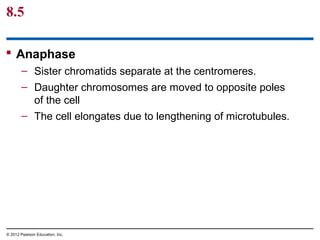
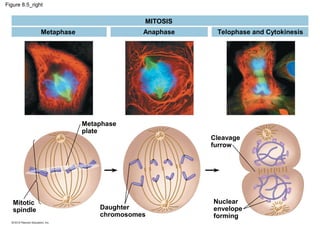
 Anaphase
– Sister chromatids separate at the centromeres.
– Daughter chromosomes are moved to opposite poles
of the cell
– The cell elongates due to lengthening of microtubules.

© 2012 Pearson Education, Inc.
Figure 8.5_right

MITOSIS
Anaphase

Metaphase

Metaphase
plate

Mitotic
spindle

Daughter
chromosomes

Telophase and Cytokinesis

Cleavage
furrow

Nuclear
envelope
forming
8.5
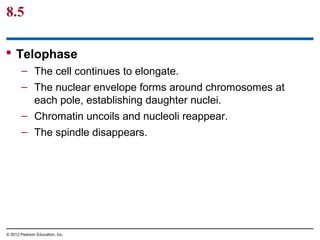
 Telophase
– The cell continues to elongate.
– The nuclear envelope forms around chromosomes at
each pole, establishing daughter nuclei.
– Chromatin uncoils and nucleoli reappear.
– The spindle disappears.

© 2012 Pearson Education, Inc.
Figure 8.5_right

MITOSIS
Anaphase

Metaphase

Metaphase
plate

Mitotic
spindle

Daughter
chromosomes

Telophase and Cytokinesis

Cleavage
furrow

Nuclear
envelope
forming
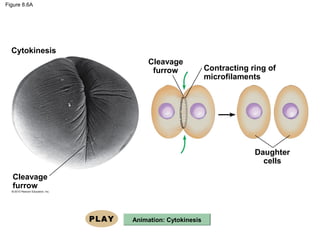
8.6 Cytokinesis differs for plant and animal cells
 During cytokinesis, the cytoplasm is divided into
separate cells.
 In animal cells, cytokinesis occurs as
1. a cleavage furrow forms from a contracting ring of
microfilaments, interacting with myosin, and
2. the cleavage furrow deepens to separate the contents
into two cells.

© 2012 Pearson Education, Inc.
Figure 8.6A

Cytokinesis
Cleavage
furrow

Contracting ring of
microfilaments

Daughter
cells
Cleavage
furrow

Animation: Cytokinesis
8.6
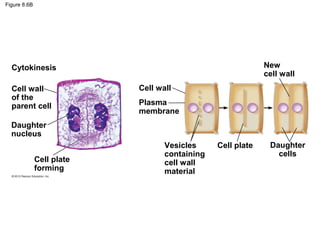
 In plant cells, cytokinesis occurs as
1. a cell plate forms in the middle, from vesicles
containing cell wall material,
2. the cell plate grows outward to reach the edges,
dividing the contents into two cells,
3. each cell now possesses a plasma membrane and cell
wall.

© 2012 Pearson Education, Inc.
Figure 8.6B

New
cell wall

Cytokinesis
Cell wall
of the
parent cell

Cell wall
Plasma
membrane

Daughter
nucleus
Cell plate
forming

Vesicles
containing
cell wall
material

Cell plate

Daughter
cells
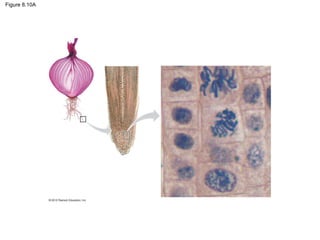
Figure 8.10A
8.11 Chromosomes are matched in homologous
pairs
 In humans, somatic cells have
– 23 pairs of homologous chromosomes
– one chromosome of each pair from each parent.

 The human sex chromosomes X and Y differ in
size and genetic composition.
 The other 22 pairs of chromosomes are
autosomes with the same size and genetic
composition.

© 2012 Pearson Education, Inc.
8.11
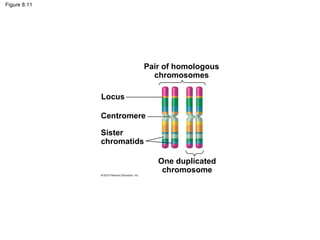
 Homologous chromosomes are matched in
– length,
– centromere position, and
– gene locations.

 A locus (plural, loci) is the position of a gene.
 Different versions of a gene may be found at the
same locus on maternal and paternal
chromosomes.
© 2012 Pearson Education, Inc.
Figure 8.11

Pair of homologous
chromosomes
Locus
Centromere
Sister
chromatids
One duplicated
chromosome
8.12 Gametes have a single set of chromosomes
 Humans and many animals and plants are diploid,
with body cells that have
– two sets of chromosomes,
– one from each parent.

© 2012 Pearson Education, Inc.
8.12
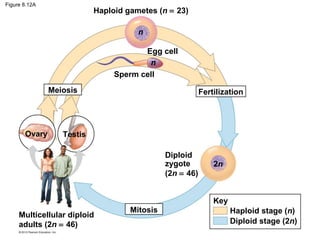
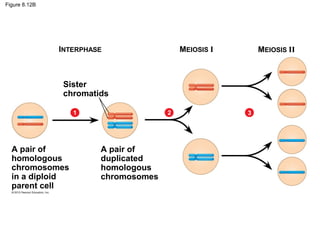
 Meiosis is a process that converts diploid nuclei to
haploid nuclei.
– Diploid cells have two homologous sets of
chromosomes.
– Haploid cells have one set of chromosomes.
– Meiosis occurs in the sex organs, producing gametes
—sperm and eggs.

 Fertilization is the union of sperm and egg.
 The zygote has a diploid chromosome number,
one set from each parent.
© 2012 Pearson Education, Inc.
Figure 8.12A

Haploid gametes (n = 23)
n
Egg cell
n
Sperm cell
Meiosis

Ovary

Fertilization

Testis
Diploid
zygote
(2n = 46)

2n

Key
Multicellular diploid
adults (2n = 46)

Mitosis

Haploid stage (n)
Diploid stage (2n)
Figure 8.12B

INTERPHASE

MEIOSIS I

MEIOSIS II

Sister
chromatids
2

1

A pair of
homologous
chromosomes
in a diploid
parent cell

A pair of
duplicated
homologous
chromosomes

3
8.13 Meiosis reduces the chromosome number
from diploid to haploid
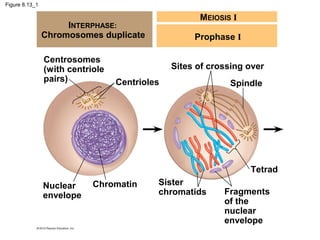
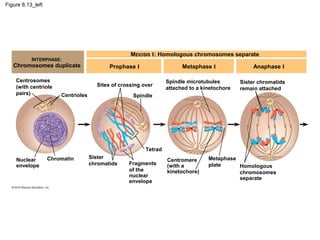
 Meiosis I – Prophase I – events occurring in the
nucleus.
– Chromosomes coil and become compact.
– Homologous chromosomes come together as pairs
– Each pair, with four chromatids, is called a tetrad.
– Nonsister chromatids exchange genetic material by
crossing over.

© 2012 Pearson Education, Inc.
Figure 8.13_1

MEIOSIS I

INTERPHASE:
Chromosomes duplicate
Centrosomes
(with centriole
pairs)

Prophase I
Sites of crossing over

Centrioles

Spindle

Tetrad
Nuclear
envelope

Chromatin

Sister
chromatids

Fragments
of the
nuclear
envelope
8.13
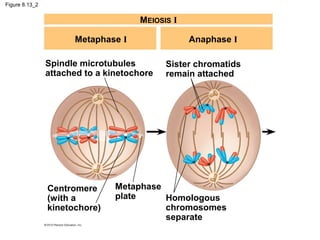
 Meiosis I – Metaphase I – Tetrads align at the cell
equator.
 Meiosis I – Anaphase I – Homologous pairs
separate and move toward opposite poles of the cell.

© 2012 Pearson Education, Inc.
Figure 8.13_2

MEIOSIS I
Metaphase I
Spindle microtubules
attached to a kinetochore

Centromere
(with a
kinetochore)

Anaphase I
Sister chromatids
remain attached

Metaphase
plate
Homologous
chromosomes
separate
Figure 8.13_left

MEIOSIS I: Homologous chromosomes separate

INTERPHASE:

Chromosomes duplicate
Centrosomes
(with centriole
pairs)

Prophase I

Metaphase I

Sites of crossing over

Spindle microtubules
attached to a kinetochore

Centrioles

Anaphase I
Sister chromatids
remain attached

Spindle

Tetrad
Nuclear
envelope

Chromatin

Sister
chromatids

Fragments
of the
nuclear
envelope

Centromere
(with a
kinetochore)

Metaphase
plate
Homologous
chromosomes
separate
8.13
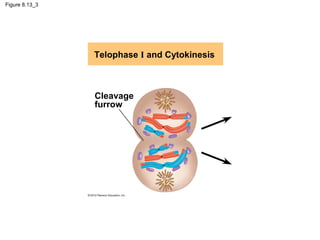
 Meiosis I – Telophase I
– Duplicated chromosomes have reached the poles.
– A nuclear envelope re-forms around chromosomes in
some species.
– Each nucleus has the haploid number of
chromosomes.

© 2012 Pearson Education, Inc.
Figure 8.13_3

Telophase I and Cytokinesis

Cleavage
furrow
8.13
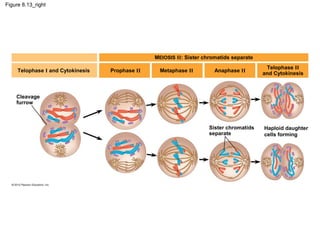
 Meiosis II follows meiosis I without chromosome
duplication.
 Each of the two haploid products enters meiosis II.
 Meiosis II – Prophase II
– Chromosomes coil and become compact (if uncoiled
after telophase I).
– Nuclear envelope, if re-formed, breaks up again.

© 2012 Pearson Education, Inc.
Figure 8.13_right

MEIOSIS II: Sister chromatids separate
Telophase I and Cytokinesis

Prophase II

Metaphase II

Anaphase II

Telophase II
and Cytokinesis

Cleavage
furrow

Sister chromatids
separate

Haploid daughter
cells forming
8.13
 Meiosis II – Metaphase II – Duplicated
chromosomes align at the cell equator.
 Meiosis II – Anaphase II
– Sister chromatids separate and
– chromosomes move toward opposite poles.

© 2012 Pearson Education, Inc.
8.13 Meiosis reduces the chromosome number
from diploid to haploid
 Meiosis II – Telophase II
– Chromosomes have reached the poles of the cell.
– A nuclear envelope forms around each set of
chromosomes.
– With cytokinesis, four haploid cells are produced.

© 2012 Pearson Education, Inc.
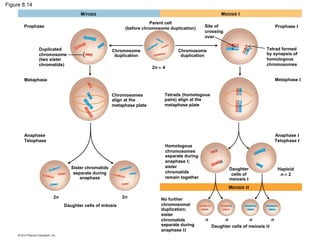
8.14 Mitosis and meiosis have important
similarities and differences
 Mitosis and meiosis both
– begin with diploid parent cells that
– have chromosomes duplicated during the previous
interphase.

 However the end products differ.
– Mitosis produces two genetically identical diploid somatic
daughter cells.
– Meiosis produces four genetically unique haploid
gametes.

© 2012 Pearson Education, Inc.
Figure 8.14
MEIOSIS I

MITOSIS
Parent cell
(before chromosome duplication)

Prophase

Duplicated
chromosome
(two sister
chromatids)

Chromosome
duplication

Site of
crossing
over

Prophase I

Tetrad formed
by synapsis of
homologous
chromosomes

Chromosome
duplication
2n = 4

Metaphase I

Metaphase
Chromosomes
align at the
metaphase plate

Tetrads (homologous
pairs) align at the
metaphase plate

Anaphase
Telophase

Anaphase I
Telophase I
Homologous
chromosomes
separate during
anaphase I;
sister
chromatids
remain together

Sister chromatids
separate during
anaphase

Daughter
cells of
meiosis I
MEIOSIS II

2n

2n
Daughter cells of mitosis

No further
chromosomal
duplication;
sister
chromatids
separate during
anaphase II

n

n
n
n
Daughter cells of meiosis II

Haploid
n= 2
8.15 Independent orientation of chromosomes in
meiosis and random fertilization lead to
varied offspring
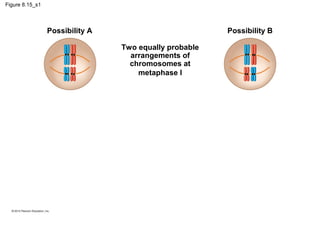
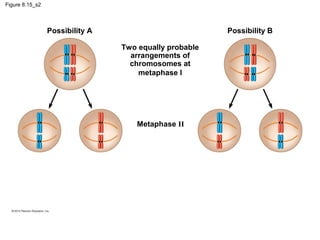
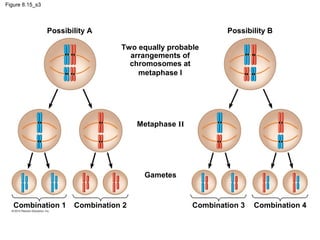
 Genetic variation in gametes results from
– independent orientation at metaphase I
– Each pair of chromosomes independently aligns
at the cell equator.
– random fertilization
– Combination of a unique sperm with a unique egg

© 2012 Pearson Education, Inc.
Figure 8.15_s1

Possibility A

Possibility B
Two equally probable
arrangements of
chromosomes at
metaphase I
Figure 8.15_s2

Possibility A

Possibility B
Two equally probable
arrangements of
chromosomes at
metaphase I

Metaphase II
Figure 8.15_s3

Possibility A

Possibility B
Two equally probable
arrangements of
chromosomes at
metaphase I

Metaphase II

Gametes

Combination 1

Combination 2

Combination 3

Combination 4
8.17 Crossing over further increases genetic
variability
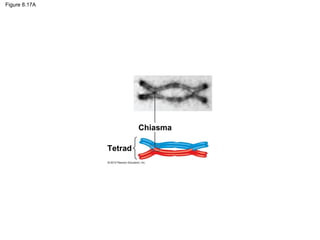
 Genetic recombination is the production of new
combinations of genes due to crossing over.
 Crossing over is an exchange of corresponding
segments between separate (nonsister)
chromatids on homologous chromosomes.
– Nonsister chromatids join at a chiasma (plural,
chiasmata), the site of attachment and crossing over.
– Corresponding amounts of genetic material are
exchanged between maternal and paternal (nonsister)
chromatids.
Animation: Crossing Over
© 2012 Pearson Education, Inc.
Figure 8.17A

Chiasma
Tetrad
8.18 A karyotype is a photographic inventory of
an individual’s chromosomes
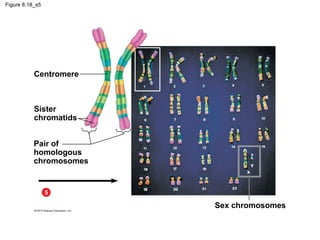
 A karyotype is an ordered display of magnified
images of an individual’s chromosomes arranged
in pairs.
 Karyotypes
– are often produced from dividing cells arrested at
metaphase of mitosis and
– allow for the observation of
– homologous chromosome pairs,
– chromosome number, and
– chromosome structure.
© 2012 Pearson Education, Inc.
Figure 8.18_s5

Centromere

Sister
chromatids
Pair of
homologous
chromosomes

5

Sex chromosomes
8.20 Accidents during meiosis can alter
chromosome number
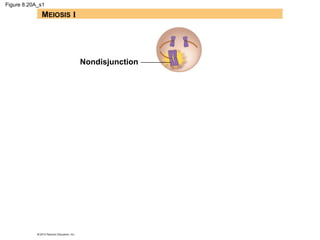
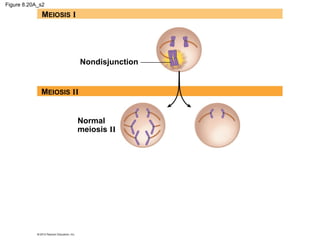
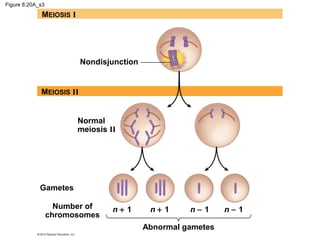
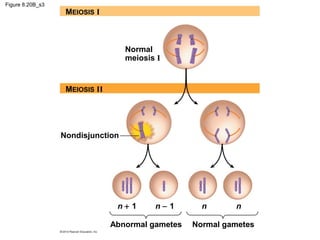
 Nondisjunction is the failure of chromosomes or
chromatids to separate normally during meiosis.
This can happen during
– meiosis I, if both members of a homologous pair go to
one pole or
– meiosis II if both sister chromatids go to one pole.

 Fertilization after nondisjunction yields zygotes with
altered numbers of chromosomes.

© 2012 Pearson Education, Inc.
Figure 8.20A_s1

MEIOSIS I

Nondisjunction
Figure 8.20A_s2

MEIOSIS I

Nondisjunction

MEIOSIS II
Normal
meiosis II
Figure 8.20A_s3

MEIOSIS I

Nondisjunction

MEIOSIS II
Normal
meiosis II

Gametes
Number of
chromosomes

n+ 1

n+ 1

n− 1

Abnormal gametes

n−1
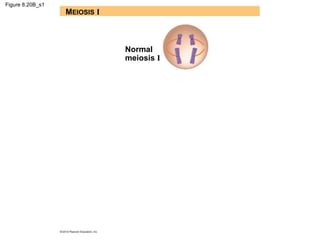
Figure 8.20B_s1

MEIOSIS I

Normal
meiosis I
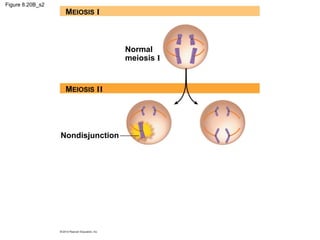
Figure 8.20B_s2

MEIOSIS I

Normal
meiosis I

MEIOSIS II

Nondisjunction
Figure 8.20B_s3

MEIOSIS I

Normal
meiosis I

MEIOSIS II

Nondisjunction

n+ 1

n−1

Abnormal gametes

n

n

Normal gametes
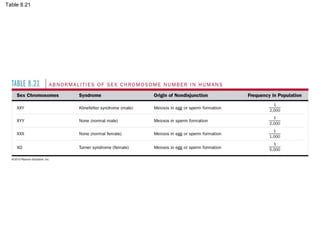
Table 8.21
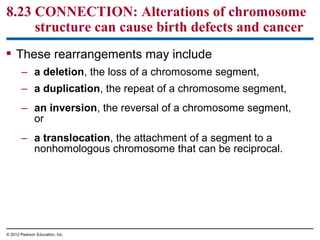
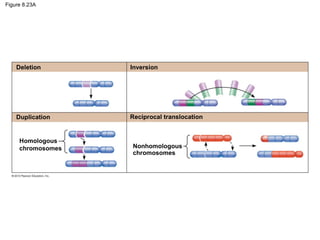
8.23 CONNECTION: Alterations of chromosome
structure can cause birth defects and cancer
 These rearrangements may include
– a deletion, the loss of a chromosome segment,
– a duplication, the repeat of a chromosome segment,
– an inversion, the reversal of a chromosome segment,
or
– a translocation, the attachment of a segment to a
nonhomologous chromosome that can be reciprocal.
© 2012 Pearson Education, Inc.
Figure 8.23A

Deletion

Inversion

Duplication

Reciprocal translocation

Homologous
chromosomes

Nonhomologous
chromosomes
You should now be able to
1.

Compare the parent-offspring relationship in asexual and sexual
reproduction.

2.

Explain why cell division is essential for prokaryotic and eukaryotic life.

3.

Explain how daughter prokaryotic chromosomes are separated from
each other during binary fission.

4.

Compare the structure of prokaryotic and eukaryotic chromosomes.

5.

Describe the stages of the cell cycle.

6.

List the phases of mitosis and describe the events characteristic of each
phase.

7.

Compare cytokinesis in animal and plant cells.

8.

Describe the functions of mitosis.

© 2012 Pearson Education, Inc.
You should now be able to
9.

Explain how chromosomes are paired.

10. Distinguish between somatic cells and gametes and between diploid
cells and haploid cells.
11. Explain why sexual reproduction requires meiosis.
12. List the phases of meiosis I and meiosis II and describe the events
characteristic of each phase.
13. Compare mitosis and meiosis noting similarities and differences.
14. Explain how genetic variation is produced in sexually reproducing
organisms.
15. Explain how and why karyotyping is performed.
16. Define nondisjunction, explain how it can occur, and describe what can
result.
© 2012 Pearson Education, Inc.

Chapter 8 notes

  • 1.
    Chapter 8 The CellularBasis of Reproduction and Inheritance PowerPoint Lectures for Campbell Biology: Concepts & Connections, Seventh Edition Reece, Taylor, Simon, and Dickey © 2012 Pearson Education, Inc. Lecture by Edward J. Zalisko
  • 2.
    Figure 8.0_2 Chapter 8:Big Ideas Cell Division and Reproduction Meiosis and Crossing Over The Eukaryotic Cell Cycle and Mitosis Alterations of Chromosome Number and Structure
  • 3.
  • 4.
    8.1 Cell divisionplays many important roles in the lives of organisms  Organisms reproduce their own kind, a key characteristic of life.  Cell division – is reproduction at the cellular level, – requires the duplication of chromosomes, and – sorts new sets of chromosomes into the resulting pair of daughter cells. © 2012 Pearson Education, Inc.
  • 5.
    8.1  Cell divisionis used – for reproduction of single-celled organisms, – growth of multicellular organisms from a fertilized egg into an adult, – repair and replacement of cells, and – sperm and egg production. © 2012 Pearson Education, Inc.
  • 6.
    8.1  Living organismsreproduce by two methods. – Asexual reproduction – produces offspring that are identical to the original cell or organism and – involves inheritance of all genes from one parent. – Sexual reproduction – produces offspring that are similar to the parents, but show variations in traits and – involves inheritance of unique sets of genes from two parents. © 2012 Pearson Education, Inc.
  • 7.
  • 8.
  • 9.
  • 10.
  • 11.
    8.2 Prokaryotes reproduceby binary fission  Prokaryotes (bacteria and archaea) reproduce by binary fission (“dividing in half”).  The chromosome of a prokaryote is – a singular circular DNA molecule – much smaller than those of eukaryotes. © 2012 Pearson Education, Inc.
  • 12.
    8.2 Prokaryotes reproduceby binary fission  Binary fission of a prokaryote occurs in three stages: 1. duplication of the chromosome and separation of the copies, 2. continued elongation of the cell and movement of the copies, and 3. division into two daughter cells. © 2012 Pearson Education, Inc.
  • 13.
  • 14.
    Figure 8.2A_s2 Plasma membrane Prokaryotic chromosome Cell wall 1 Duplicationof the chromosome and separation of the copies 2 Continued elongation of the cell and movement of the copies
  • 15.
    Figure 8.2A_s3 Plasma membrane Prokaryotic chromosome Cell wall 1 2 3 Duplicationof the chromosome and separation of the copies Continued elongation of the cell and movement of the copies Division into two daughter cells
  • 16.
    8.3 The large,complex chromosomes of eukaryotes duplicate with each cell division  Eukaryotic cells – are more complex and larger than prokaryotic cells, – have more genes, and – store most of their genes on multiple chromosomes within the nucleus. © 2012 Pearson Education, Inc.
  • 17.
    8.3  Eukaryotic chromosomesare composed of chromatin consisting of – one long DNA molecule and proteins  To prepare for division, the chromatin becomes highly compacted chromosomes © 2012 Pearson Education, Inc.
  • 18.
    Figure 8.3A DNA inthe form of condensed chromosomes DNA in the form of chromatin
  • 19.
    8.3  Before aeukaryotic cell begins to divide, it duplicates all of its chromosomes, resulting in – two copies called sister chromatids joined together by a narrowed “waist” called the centromere.  When a cell divides, the sister chromatids – separate from each other, now each is called a chromosome – Each chromosome (single chromatid) is distributed into separate daughter cells. © 2012 Pearson Education, Inc.
  • 20.
  • 21.
    8.4 The cellcycle multiplies cells  An ordered sequence of events that divide a cell  The cell cycle consists of two stages, characterized as follows: 1. Interphase: duplication of cell contents – G1—growth, increase in cytoplasm – S—duplication of chromosomes – G2—growth, preparation for division 1. Mitotic phase: division – Mitosis—division of the nucleus – Cytokinesis—division of cytoplasm © 2012 Pearson Education, Inc.
  • 22.
    Figure 8.4 INT ERPH ASE G1 (firstgap) O MIT M ito si s si s kine o Cyt TIC A PH SE S (DNA synthesis) M G2 (second gap)
  • 23.
    8.5 Cell divisionis a continuum of dynamic changes  Mitosis progresses through a series of stages: – prophase, – prometaphase, – metaphase, – anaphase, and – telophase.  Cytokinesis often overlaps telophase. © 2012 Pearson Education, Inc.
  • 24.
    8.5 Cell divisionis a continuum of dynamic changes  A mitotic spindle (spindle fibers) is – required to divide the chromosomes, and composed of microtubules – produced by centrosomes – contain a pair of centrioles in animal cells. © 2012 Pearson Education, Inc.
  • 25.
    8.5 Cell divisionis a continuum of dynamic changes  Interphase – The cytoplasmic contents double, – two centrosomes form, – chromosomes duplicate in the nucleus during the S phase, and – nucleoli, sites of ribosome assembly, are visible. © 2012 Pearson Education, Inc.
  • 26.
    Figure 8.5_left MITOSIS INTERPHASE Prophase Centrosomes (with centriolepairs) Centrioles Nuclear envelope Chromatin Early mitotic spindle Prometaphase Centrosome Fragments of the nuclear envelope Kinetochore Plasma membrane Centromere Chromosome, consisting of two sister chromatids Spindle microtubules
  • 27.
    8.5 Cell divisionis a continuum of dynamic changes  Prophase – In the cytoplasm microtubules begin to emerge from centrosomes, forming the spindle. – In the nucleus – chromosomes coil and become compact and – nucleoli disappear. © 2012 Pearson Education, Inc.
  • 28.
    Figure 8.5_left MITOSIS INTERPHASE Prophase Centrosomes (with centriolepairs) Centrioles Nuclear envelope Chromatin Early mitotic spindle Prometaphase Centrosome Fragments of the nuclear envelope Kinetochore Plasma membrane Centromere Chromosome, consisting of two sister chromatids Spindle microtubules
  • 29.
    8.5 Cell divisionis a continuum of dynamic changes  Prometaphase – Spindle microtubules reach chromosomes, where they – attach at kinetochores on the centromeres of sister chromatids and – move chromosomes to the center of the cell through associated protein “motors.” – Other microtubules meet those from the opposite poles. – The nuclear envelope disappears. © 2012 Pearson Education, Inc.
  • 30.
    Figure 8.5_left MITOSIS INTERPHASE Prophase Centrosomes (with centriolepairs) Centrioles Nuclear envelope Chromatin Early mitotic spindle Prometaphase Centrosome Fragments of the nuclear envelope Kinetochore Plasma membrane Centromere Chromosome, consisting of two sister chromatids Spindle microtubules
  • 31.
    8.5  Metaphase – Themitotic spindle is fully formed. – Chromosomes align at the cell equator. – Kinetochores (protein structure at centromere) of sister chromatids are facing the opposite poles of the spindle. © 2012 Pearson Education, Inc.
  • 32.
  • 33.
    8.5  Anaphase – Sisterchromatids separate at the centromeres. – Daughter chromosomes are moved to opposite poles of the cell – The cell elongates due to lengthening of microtubules. © 2012 Pearson Education, Inc.
  • 34.
  • 35.
    8.5  Telophase – Thecell continues to elongate. – The nuclear envelope forms around chromosomes at each pole, establishing daughter nuclei. – Chromatin uncoils and nucleoli reappear. – The spindle disappears. © 2012 Pearson Education, Inc.
  • 36.
  • 37.
    8.6 Cytokinesis differsfor plant and animal cells  During cytokinesis, the cytoplasm is divided into separate cells.  In animal cells, cytokinesis occurs as 1. a cleavage furrow forms from a contracting ring of microfilaments, interacting with myosin, and 2. the cleavage furrow deepens to separate the contents into two cells. © 2012 Pearson Education, Inc.
  • 38.
    Figure 8.6A Cytokinesis Cleavage furrow Contracting ringof microfilaments Daughter cells Cleavage furrow Animation: Cytokinesis
  • 39.
    8.6  In plantcells, cytokinesis occurs as 1. a cell plate forms in the middle, from vesicles containing cell wall material, 2. the cell plate grows outward to reach the edges, dividing the contents into two cells, 3. each cell now possesses a plasma membrane and cell wall. © 2012 Pearson Education, Inc.
  • 40.
    Figure 8.6B New cell wall Cytokinesis Cellwall of the parent cell Cell wall Plasma membrane Daughter nucleus Cell plate forming Vesicles containing cell wall material Cell plate Daughter cells
  • 41.
  • 42.
    8.11 Chromosomes arematched in homologous pairs  In humans, somatic cells have – 23 pairs of homologous chromosomes – one chromosome of each pair from each parent.  The human sex chromosomes X and Y differ in size and genetic composition.  The other 22 pairs of chromosomes are autosomes with the same size and genetic composition. © 2012 Pearson Education, Inc.
  • 43.
    8.11  Homologous chromosomesare matched in – length, – centromere position, and – gene locations.  A locus (plural, loci) is the position of a gene.  Different versions of a gene may be found at the same locus on maternal and paternal chromosomes. © 2012 Pearson Education, Inc.
  • 44.
    Figure 8.11 Pair ofhomologous chromosomes Locus Centromere Sister chromatids One duplicated chromosome
  • 45.
    8.12 Gametes havea single set of chromosomes  Humans and many animals and plants are diploid, with body cells that have – two sets of chromosomes, – one from each parent. © 2012 Pearson Education, Inc.
  • 46.
    8.12  Meiosis isa process that converts diploid nuclei to haploid nuclei. – Diploid cells have two homologous sets of chromosomes. – Haploid cells have one set of chromosomes. – Meiosis occurs in the sex organs, producing gametes —sperm and eggs.  Fertilization is the union of sperm and egg.  The zygote has a diploid chromosome number, one set from each parent. © 2012 Pearson Education, Inc.
  • 47.
    Figure 8.12A Haploid gametes(n = 23) n Egg cell n Sperm cell Meiosis Ovary Fertilization Testis Diploid zygote (2n = 46) 2n Key Multicellular diploid adults (2n = 46) Mitosis Haploid stage (n) Diploid stage (2n)
  • 48.
    Figure 8.12B INTERPHASE MEIOSIS I MEIOSISII Sister chromatids 2 1 A pair of homologous chromosomes in a diploid parent cell A pair of duplicated homologous chromosomes 3
  • 49.
    8.13 Meiosis reducesthe chromosome number from diploid to haploid  Meiosis I – Prophase I – events occurring in the nucleus. – Chromosomes coil and become compact. – Homologous chromosomes come together as pairs – Each pair, with four chromatids, is called a tetrad. – Nonsister chromatids exchange genetic material by crossing over. © 2012 Pearson Education, Inc.
  • 50.
    Figure 8.13_1 MEIOSIS I INTERPHASE: Chromosomesduplicate Centrosomes (with centriole pairs) Prophase I Sites of crossing over Centrioles Spindle Tetrad Nuclear envelope Chromatin Sister chromatids Fragments of the nuclear envelope
  • 51.
    8.13  Meiosis I– Metaphase I – Tetrads align at the cell equator.  Meiosis I – Anaphase I – Homologous pairs separate and move toward opposite poles of the cell. © 2012 Pearson Education, Inc.
  • 52.
    Figure 8.13_2 MEIOSIS I MetaphaseI Spindle microtubules attached to a kinetochore Centromere (with a kinetochore) Anaphase I Sister chromatids remain attached Metaphase plate Homologous chromosomes separate
  • 53.
    Figure 8.13_left MEIOSIS I:Homologous chromosomes separate INTERPHASE: Chromosomes duplicate Centrosomes (with centriole pairs) Prophase I Metaphase I Sites of crossing over Spindle microtubules attached to a kinetochore Centrioles Anaphase I Sister chromatids remain attached Spindle Tetrad Nuclear envelope Chromatin Sister chromatids Fragments of the nuclear envelope Centromere (with a kinetochore) Metaphase plate Homologous chromosomes separate
  • 54.
    8.13  Meiosis I– Telophase I – Duplicated chromosomes have reached the poles. – A nuclear envelope re-forms around chromosomes in some species. – Each nucleus has the haploid number of chromosomes. © 2012 Pearson Education, Inc.
  • 55.
    Figure 8.13_3 Telophase Iand Cytokinesis Cleavage furrow
  • 56.
    8.13  Meiosis IIfollows meiosis I without chromosome duplication.  Each of the two haploid products enters meiosis II.  Meiosis II – Prophase II – Chromosomes coil and become compact (if uncoiled after telophase I). – Nuclear envelope, if re-formed, breaks up again. © 2012 Pearson Education, Inc.
  • 57.
    Figure 8.13_right MEIOSIS II:Sister chromatids separate Telophase I and Cytokinesis Prophase II Metaphase II Anaphase II Telophase II and Cytokinesis Cleavage furrow Sister chromatids separate Haploid daughter cells forming
  • 58.
    8.13  Meiosis II– Metaphase II – Duplicated chromosomes align at the cell equator.  Meiosis II – Anaphase II – Sister chromatids separate and – chromosomes move toward opposite poles. © 2012 Pearson Education, Inc.
  • 59.
    8.13 Meiosis reducesthe chromosome number from diploid to haploid  Meiosis II – Telophase II – Chromosomes have reached the poles of the cell. – A nuclear envelope forms around each set of chromosomes. – With cytokinesis, four haploid cells are produced. © 2012 Pearson Education, Inc.
  • 60.
    8.14 Mitosis andmeiosis have important similarities and differences  Mitosis and meiosis both – begin with diploid parent cells that – have chromosomes duplicated during the previous interphase.  However the end products differ. – Mitosis produces two genetically identical diploid somatic daughter cells. – Meiosis produces four genetically unique haploid gametes. © 2012 Pearson Education, Inc.
  • 61.
    Figure 8.14 MEIOSIS I MITOSIS Parentcell (before chromosome duplication) Prophase Duplicated chromosome (two sister chromatids) Chromosome duplication Site of crossing over Prophase I Tetrad formed by synapsis of homologous chromosomes Chromosome duplication 2n = 4 Metaphase I Metaphase Chromosomes align at the metaphase plate Tetrads (homologous pairs) align at the metaphase plate Anaphase Telophase Anaphase I Telophase I Homologous chromosomes separate during anaphase I; sister chromatids remain together Sister chromatids separate during anaphase Daughter cells of meiosis I MEIOSIS II 2n 2n Daughter cells of mitosis No further chromosomal duplication; sister chromatids separate during anaphase II n n n n Daughter cells of meiosis II Haploid n= 2
  • 62.
    8.15 Independent orientationof chromosomes in meiosis and random fertilization lead to varied offspring  Genetic variation in gametes results from – independent orientation at metaphase I – Each pair of chromosomes independently aligns at the cell equator. – random fertilization – Combination of a unique sperm with a unique egg © 2012 Pearson Education, Inc.
  • 63.
    Figure 8.15_s1 Possibility A PossibilityB Two equally probable arrangements of chromosomes at metaphase I
  • 64.
    Figure 8.15_s2 Possibility A PossibilityB Two equally probable arrangements of chromosomes at metaphase I Metaphase II
  • 65.
    Figure 8.15_s3 Possibility A PossibilityB Two equally probable arrangements of chromosomes at metaphase I Metaphase II Gametes Combination 1 Combination 2 Combination 3 Combination 4
  • 66.
    8.17 Crossing overfurther increases genetic variability  Genetic recombination is the production of new combinations of genes due to crossing over.  Crossing over is an exchange of corresponding segments between separate (nonsister) chromatids on homologous chromosomes. – Nonsister chromatids join at a chiasma (plural, chiasmata), the site of attachment and crossing over. – Corresponding amounts of genetic material are exchanged between maternal and paternal (nonsister) chromatids. Animation: Crossing Over © 2012 Pearson Education, Inc.
  • 67.
  • 68.
    8.18 A karyotypeis a photographic inventory of an individual’s chromosomes  A karyotype is an ordered display of magnified images of an individual’s chromosomes arranged in pairs.  Karyotypes – are often produced from dividing cells arrested at metaphase of mitosis and – allow for the observation of – homologous chromosome pairs, – chromosome number, and – chromosome structure. © 2012 Pearson Education, Inc.
  • 69.
  • 70.
    8.20 Accidents duringmeiosis can alter chromosome number  Nondisjunction is the failure of chromosomes or chromatids to separate normally during meiosis. This can happen during – meiosis I, if both members of a homologous pair go to one pole or – meiosis II if both sister chromatids go to one pole.  Fertilization after nondisjunction yields zygotes with altered numbers of chromosomes. © 2012 Pearson Education, Inc.
  • 71.
  • 72.
  • 73.
    Figure 8.20A_s3 MEIOSIS I Nondisjunction MEIOSISII Normal meiosis II Gametes Number of chromosomes n+ 1 n+ 1 n− 1 Abnormal gametes n−1
  • 74.
  • 75.
    Figure 8.20B_s2 MEIOSIS I Normal meiosisI MEIOSIS II Nondisjunction
  • 76.
    Figure 8.20B_s3 MEIOSIS I Normal meiosisI MEIOSIS II Nondisjunction n+ 1 n−1 Abnormal gametes n n Normal gametes
  • 77.
  • 78.
    8.23 CONNECTION: Alterationsof chromosome structure can cause birth defects and cancer  These rearrangements may include – a deletion, the loss of a chromosome segment, – a duplication, the repeat of a chromosome segment, – an inversion, the reversal of a chromosome segment, or – a translocation, the attachment of a segment to a nonhomologous chromosome that can be reciprocal. © 2012 Pearson Education, Inc.
  • 79.
  • 80.
    You should nowbe able to 1. Compare the parent-offspring relationship in asexual and sexual reproduction. 2. Explain why cell division is essential for prokaryotic and eukaryotic life. 3. Explain how daughter prokaryotic chromosomes are separated from each other during binary fission. 4. Compare the structure of prokaryotic and eukaryotic chromosomes. 5. Describe the stages of the cell cycle. 6. List the phases of mitosis and describe the events characteristic of each phase. 7. Compare cytokinesis in animal and plant cells. 8. Describe the functions of mitosis. © 2012 Pearson Education, Inc.
  • 81.
    You should nowbe able to 9. Explain how chromosomes are paired. 10. Distinguish between somatic cells and gametes and between diploid cells and haploid cells. 11. Explain why sexual reproduction requires meiosis. 12. List the phases of meiosis I and meiosis II and describe the events characteristic of each phase. 13. Compare mitosis and meiosis noting similarities and differences. 14. Explain how genetic variation is produced in sexually reproducing organisms. 15. Explain how and why karyotyping is performed. 16. Define nondisjunction, explain how it can occur, and describe what can result. © 2012 Pearson Education, Inc.

Editor's Notes

  • #3 Figure 8.0_2 Chapter 8: Big Ideas
  • #4 Figure 8.0_3 Dividing cancer cells
  • #5 Student Misconceptions and Concerns 1. As the authors note in Module 8.1, biologists use the term daughter to indicate offspring and not gender. Students with little experience in this terminology can easily become confused. 2. Some basic familiarity or faint memory of mitosis and meiosis might result in a lack of enthusiasm for mitosis and meiosis in some of your students. Consider beginning such lectures with important topics related to cellular reproduction. For example, cancer cells reproduce uncontrollably, stem cells have the capacity to regenerate lost or damaged tissues, and the study of embryonic stem cells is variously restricted and regulated. Teaching Tips Sometimes the most basic questions can challenge students and get them focused on the subject at hand. Consider asking your students why we expect that dogs will produce dogs, cats will produce more cats, and chickens will only produce chickens. Why does like produce like?
  • #6 Student Misconceptions and Concerns 1. As the authors note in Module 8.1, biologists use the term daughter to indicate offspring and not gender. Students with little experience in this terminology can easily become confused. 2. Some basic familiarity or faint memory of mitosis and meiosis might result in a lack of enthusiasm for mitosis and meiosis in some of your students. Consider beginning such lectures with important topics related to cellular reproduction. For example, cancer cells reproduce uncontrollably, stem cells have the capacity to regenerate lost or damaged tissues, and the study of embryonic stem cells is variously restricted and regulated. Teaching Tips Sometimes the most basic questions can challenge students and get them focused on the subject at hand. Consider asking your students why we expect that dogs will produce dogs, cats will produce more cats, and chickens will only produce chickens. Why does like produce like?
  • #7 Student Misconceptions and Concerns 1. As the authors note in Module 8.1, biologists use the term daughter to indicate offspring and not gender. Students with little experience in this terminology can easily become confused. 2. Some basic familiarity or faint memory of mitosis and meiosis might result in a lack of enthusiasm for mitosis and meiosis in some of your students. Consider beginning such lectures with important topics related to cellular reproduction. For example, cancer cells reproduce uncontrollably, stem cells have the capacity to regenerate lost or damaged tissues, and the study of embryonic stem cells is variously restricted and regulated. Teaching Tips Sometimes the most basic questions can challenge students and get them focused on the subject at hand. Consider asking your students why we expect that dogs will produce dogs, cats will produce more cats, and chickens will only produce chickens. Why does like produce like?
  • #8 Figure 8.1A A yeast cell producing a genetically identical daughter cell by asexual reproduction
  • #9 Figure 8.1B A sea star reproducing asexually
  • #10 Figure 8.1C An African violet reproducing asexually from a cutting (the large leaf on the left)
  • #11 Figure 8.1D Sexual reproduction produces offspring with unique combinations of genes.
  • #12 Student Misconceptions and Concerns Some basic familiarity or faint memory of mitosis and meiosis might result in a lack of enthusiasm for mitosis and meiosis in some of your students. Consider beginning such lectures with important topics related to cellular reproduction. For example, cancer cells reproduce uncontrollably, stem cells have the capacity to regenerate lost or damaged tissues, and the study of embryonic stem cells is variously restricted and regulated. Teaching Tips 1. The principle that “every cell comes from another cell” is worth thinking through with your class. Students might expect that, like automobiles, computers, and cell phones, parts are constructed and cells are assembled. In our society, few nonliving products are generated only from existing products (try to think of such examples). For example, you do not need a painting to paint or a house to construct a house. Yet, this is a common expectation in biology. Further, students who think through this principle might ask how the first cells formed. They might wonder further whether the same environments that produced these cells are still in existence. The conditions on Earth when life first formed were very different from those we know today. Chapter 15 addresses the origin and early evolution of life on Earth. 2. Consider contrasting the timing of DNA replication and cytokinesis in prokaryotes and eukaryotes. In prokaryotes, addressed in Module 8.2, these processes are overlapping. However, as revealed in the next few modules, these events are separate in eukaryotes.
  • #13 Student Misconceptions and Concerns Some basic familiarity or faint memory of mitosis and meiosis might result in a lack of enthusiasm for mitosis and meiosis in some of your students. Consider beginning such lectures with important topics related to cellular reproduction. For example, cancer cells reproduce uncontrollably, stem cells have the capacity to regenerate lost or damaged tissues, and the study of embryonic stem cells is variously restricted and regulated. Teaching Tips 1. The principle that “every cell comes from another cell” is worth thinking through with your class. Students might expect that, like automobiles, computers, and cell phones, parts are constructed and cells are assembled. In our society, few nonliving products are generated only from existing products (try to think of such examples). For example, you do not need a painting to paint or a house to construct a house. Yet, this is a common expectation in biology. Further, students who think through this principle might ask how the first cells formed. They might wonder further whether the same environments that produced these cells are still in existence. The conditions on Earth when life first formed were very different from those we know today. Chapter 15 addresses the origin and early evolution of life on Earth. 2. Consider contrasting the timing of DNA replication and cytokinesis in prokaryotes and eukaryotes. In prokaryotes, addressed in Module 8.2, these processes are overlapping. However, as revealed in the next few modules, these events are separate in eukaryotes.
  • #14 Figure 8.2A_s1 Binary fission of a prokaryotic cell (step 1)
  • #15 Figure 8.2A_s2 Binary fission of a prokaryotic cell (step 2)
  • #16 Figure 8.2A_s3 Binary fission of a prokaryotic cell (step 3)
  • #17 Student Misconceptions and Concerns 1. Students often seem confused by the difference between a DNA molecule and a chromosome. This is especially problematic when discussing DNA replication. 2. Students are often confused by photographs of chromosomes. Such photographs, such as Figure 8.3B, typically show duplicated chromosomes during some aspect of cell division. It remains unclear to many why (a) chromosome structure is typically different between interphase G1 and the stages of division and (b) why chromosomes are not photographed during interphase (the stage in which chromosomes are typically first discussed) before the chromosomes duplicate. Teaching Tips 1. Figure 8.3B is an important point of reference for some basic terminology. Consider referring to it as you distinguish between a DNA molecule and a chromosome, unreplicated and replicated chromosomes, and the nature of sister chromatids. 2. The authors make an analogy between the precise packaging of DNA into chromosomes and packing a home for a move to another home. Tap into the intuitive advantages of packaging DNA using this or any other analogy of highly packaged materials (perhaps a boxed “desk” that requires some assembly). 3. The concepts of DNA replication and sister chromatids are often obstacles for many students. If you can find twist ties or other bendable wire, you can demonstrate or have students model the difference between (1) a chromosome before DNA replication and (2) sister chromatids after DNA replication. One piece of wire will represent a chromosome before replication. Two twist ties twisted about each other can represent sister chromatids. We have doubled the DNA, but the molecules remain attached (although not attached in the same way as the wire). You might also want to point out that when sister chromatids are separated, they are considered separate chromosomes.
  • #18 Student Misconceptions and Concerns 1. Students often seem confused by the difference between a DNA molecule and a chromosome. This is especially problematic when discussing DNA replication. 2. Students are often confused by photographs of chromosomes. Such photographs, such as Figure 8.3B, typically show duplicated chromosomes during some aspect of cell division. It remains unclear to many why (a) chromosome structure is typically different between interphase G1 and the stages of division and (b) why chromosomes are not photographed during interphase (the stage in which chromosomes are typically first discussed) before the chromosomes duplicate. Teaching Tips 1. Figure 8.3B is an important point of reference for some basic terminology. Consider referring to it as you distinguish between a DNA molecule and a chromosome, unreplicated and replicated chromosomes, and the nature of sister chromatids. 2. The authors make an analogy between the precise packaging of DNA into chromosomes and packing a home for a move to another home. Tap into the intuitive advantages of packaging DNA using this or any other analogy of highly packaged materials (perhaps a boxed “desk” that requires some assembly). 3. The concepts of DNA replication and sister chromatids are often obstacles for many students. If you can find twist ties or other bendable wire, you can demonstrate or have students model the difference between (1) a chromosome before DNA replication and (2) sister chromatids after DNA replication. One piece of wire will represent a chromosome before replication. Two twist ties twisted about each other can represent sister chromatids. We have doubled the DNA, but the molecules remain attached (although not attached in the same way as the wire). You might also want to point out that when sister chromatids are separated, they are considered separate chromosomes.
  • #19 Figure 8.3A A plant cell (from an African blood lily) just before cell division
  • #20 Student Misconceptions and Concerns 1. Students often seem confused by the difference between a DNA molecule and a chromosome. This is especially problematic when discussing DNA replication. 2. Students are often confused by photographs of chromosomes. Such photographs, such as Figure 8.3B, typically show duplicated chromosomes during some aspect of cell division. It remains unclear to many why (a) chromosome structure is typically different between interphase G1 and the stages of division and (b) why chromosomes are not photographed during interphase (the stage in which chromosomes are typically first discussed) before the chromosomes duplicate. Teaching Tips 1. Figure 8.3B is an important point of reference for some basic terminology. Consider referring to it as you distinguish between a DNA molecule and a chromosome, unreplicated and replicated chromosomes, and the nature of sister chromatids. 2. The authors make an analogy between the precise packaging of DNA into chromosomes and packing a home for a move to another home. Tap into the intuitive advantages of packaging DNA using this or any other analogy of highly packaged materials (perhaps a boxed “desk” that requires some assembly). 3. The concepts of DNA replication and sister chromatids are often obstacles for many students. If you can find twist ties or other bendable wire, you can demonstrate or have students model the difference between (1) a chromosome before DNA replication and (2) sister chromatids after DNA replication. One piece of wire will represent a chromosome before replication. Two twist ties twisted about each other can represent sister chromatids. We have doubled the DNA, but the molecules remain attached (although not attached in the same way as the wire). You might also want to point out that when sister chromatids are separated, they are considered separate chromosomes.
  • #21 Figure 8.3B Chromosome duplication and distribution
  • #22 Teaching Tips 1. The authors note in Module 8.4 that each of your students consists of about 10 trillion cells. It is likely that this number is beyond comprehension for most of your students. Consider sharing several simple examples of the enormity of that number to try to make it more meaningful. For example, the U.S. population in 2011 is about 312 million people. To give every one of those people about $32,000, we will need a total of 10 trillion dollars. Here is another example. If we gave you $32,000 every second, it would take 10 years to give you 10 trillion dollars. The US Debt Clock helps relate these large numbers to the US national debt at www.usdebtclock.org. 2. In G1, the chromosomes have not duplicated. But by G2, chromosomes consist of sister chromatids. If you have created a demonstration of sister chromatids, relate DNA replication and sister chromatids to the cell cycle.
  • #23 Figure 8.4 The eukaryotic cell cycle
  • #24 Teaching Tips Students might keep better track of the sequence of events in a cell cycle by simply memorizing the letters IPPMAT: the first letters of interphase, prophase, prometaphase, metaphase, anaphase, and telophase are represented in this acronym.
  • #25 Teaching Tips Students might keep better track of the sequence of events in a cell cycle by simply memorizing the letters IPPMAT: the first letters of interphase, prophase, prometaphase, metaphase, anaphase, and telophase are represented in this acronym.
  • #26 Teaching Tips Students might keep better track of the sequence of events in a cell cycle by simply memorizing the letters IPPMAT: the first letters of interphase, prophase, prometaphase, metaphase, anaphase, and telophase are represented in this acronym.
  • #27 Figure 8.5_left The stages of cell division by mitosis: Interphase through Prometaphase
  • #28 Teaching Tips Students might keep better track of the sequence of events in a cell cycle by simply memorizing the letters IPPMAT: the first letters of interphase, prophase, prometaphase, metaphase, anaphase, and telophase are represented in this acronym.
  • #29 Figure 8.5_left The stages of cell division by mitosis: Interphase through Prometaphase
  • #30 Teaching Tips Students might keep better track of the sequence of events in a cell cycle by simply memorizing the letters IPPMAT: the first letters of interphase, prophase, prometaphase, metaphase, anaphase, and telophase are represented in this acronym.
  • #31 Figure 8.5_left The stages of cell division by mitosis: Interphase through Prometaphase
  • #32 Teaching Tips Students might keep better track of the sequence of events in a cell cycle by simply memorizing the letters IPPMAT: the first letters of interphase, prophase, prometaphase, metaphase, anaphase, and telophase are represented in this acronym.
  • #33 Figure 8.5_right The stages of cell division by mitosis: Metaphase through Cytokenesis
  • #34 Teaching Tips Students might keep better track of the sequence of events in a cell cycle by simply memorizing the letters IPPMAT: the first letters of interphase, prophase, prometaphase, metaphase, anaphase, and telophase are represented in this acronym.
  • #35 Figure 8.5_right The stages of cell division by mitosis: Metaphase through Cytokenesis
  • #36 Teaching Tips Students might keep better track of the sequence of events in a cell cycle by simply memorizing the letters IPPMAT: the first letters of interphase, prophase, prometaphase, metaphase, anaphase, and telophase are represented in this acronym.
  • #37 Figure 8.5_right The stages of cell division by mitosis: Metaphase through Cytokenesis
  • #38 Teaching Tips Students might keep better track of the sequence of events in a cell cycle by simply memorizing the letters IPPMAT: the first letters of interphase, prophase, prometaphase, metaphase, anaphase, and telophase are represented in this acronym.
  • #39 Figure 8.6A Cleavage of an animal cell
  • #40 Teaching Tips 1. Many students think of mitosis and cytokinesis as one process. In some situations, mitosis occurs without subsequent cytokinesis. Challenge your students to predict the outcome of mitosis without cytokinesis (multinuclear cells called a syncytium). This occurs in human development during the formation of the placenta. 2. The authors make an analogy between a drawstring on a hooded sweatshirt and the mechanism of cytokinesis in animal cells. Students seem to appreciate this association. Have your students think of a person tightening the drawstring of sweatpants so tight that they pinch themselves in two, or perhaps nearly so! The analogy is especially good because, like the drawstring just beneath the surface of the sweat pants, the microfilaments are just beneath the surface of the cell’s plasma membrane.
  • #41 Figure 8.6B Cell plate formation in a plant cell
  • #42 Figure 8.10A Growth (in an onion root)
  • #43 Student Misconceptions and Concerns Some students might conclude that sex chromosomes function only in determining the sex of the individual. As the authors note, sex chromosomes contain genes not involved in sex determination. Teaching Tips Students might recall some basic genetics, remembering that for many traits a person receives a separate “signal” from mom and dad. These separate signals for the same trait are carried on the same portion of homologous chromosomes, such as the freckle trait noted in Module 8.11.
  • #44 Student Misconceptions and Concerns Some students might conclude that sex chromosomes function only in determining the sex of the individual. As the authors note, sex chromosomes contain genes not involved in sex determination. Teaching Tips Students might recall some basic genetics, remembering that for many traits a person receives a separate “signal” from mom and dad. These separate signals for the same trait are carried on the same portion of homologous chromosomes, such as the freckle trait noted in Module 8.11.
  • #45 Figure 8.11 A pair of homologous chromosomes
  • #46 Student Misconceptions and Concerns Students might not immediately see the need for meiosis in sexual reproduction. Consider an example of what would happen over many generations if gametes were produced by mitosis. The resulting genetic doubling is prevented if each gamete has only half the genetic material of the adult cells. Teaching Tips 1. Consider helping students through mitosis and meiosis by developing an analogy to pairs of shoes. In this case, any given species has a certain number of pairs of shoes, or homologous chromosomes. 2. In the shoe analogy, females have 23 pairs of matching shoes, while males have 22 matching pairs and 1 odd pair . . . maybe a sandal and a sneaker! 3. You might want to get your students thinking by asking them why eggs and sperm are different. (This depends upon the species, but within vertebrates, eggs and sperm are specialized for different tasks. Sperm are adapted to move to an egg and donate a nucleus. Eggs contain a nucleus and most of the cytoplasm of the future zygote. Thus eggs are typically larger, nonmotile, and full of cellular resources to sustain cell division and growth.)
  • #47 Student Misconceptions and Concerns Students might not immediately see the need for meiosis in sexual reproduction. Consider an example of what would happen over many generations if gametes were produced by mitosis. The resulting genetic doubling is prevented if each gamete has only half the genetic material of the adult cells. Teaching Tips 1. Consider helping students through mitosis and meiosis by developing an analogy to pairs of shoes. In this case, any given species has a certain number of pairs of shoes, or homologous chromosomes. 2. In the shoe analogy, females have 23 pairs of matching shoes, while males have 22 matching pairs and 1 odd pair . . . maybe a sandal and a sneaker! 3. You might want to get your students thinking by asking them why eggs and sperm are different. (This depends upon the species, but within vertebrates, eggs and sperm are specialized for different tasks. Sperm are adapted to move to an egg and donate a nucleus. Eggs contain a nucleus and most of the cytoplasm of the future zygote. Thus eggs are typically larger, nonmotile, and full of cellular resources to sustain cell division and growth.)
  • #48 Figure 8.12A The human life cycle
  • #49 Figure 8.12B How meiosis halves chromosome number
  • #50 Student Misconceptions and Concerns Students might not immediately see the need for meiosis in sexual reproduction. Consider an example of what would happen over many generations if gametes were produced by mitosis. The resulting genetic doubling is prevented if each gamete has only half the genetic material of the adult cells. Teaching Tips Challenge students to identify which stage of meiosis is most like mitosis. Comparing the specific events of mitosis, meiosis I, and meiosis II to each other allows students to identify essential differences.
  • #51 Figure 8.13_1 The stages of meiosis: Interphase to Prophase I
  • #52 Student Misconceptions and Concerns Students might not immediately see the need for meiosis in sexual reproduction. Consider an example of what would happen over many generations if gametes were produced by mitosis. The resulting genetic doubling is prevented if each gamete has only half the genetic material of the adult cells. Teaching Tips Challenge students to identify which stage of meiosis is most like mitosis. Comparing the specific events of mitosis, meiosis I, and meiosis II to each other allows students to identify essential differences.
  • #53 Figure 8.13_2 The stages of meiosis: Metaphase I to Anaphase I
  • #54 Figure 8.13_left The stages of meiosis: Interphase and Meiosis I
  • #55 Student Misconceptions and Concerns Students might not immediately see the need for meiosis in sexual reproduction. Consider an example of what would happen over many generations if gametes were produced by mitosis. The resulting genetic doubling is prevented if each gamete has only half the genetic material of the adult cells. Teaching Tips Challenge students to identify which stage of meiosis is most like mitosis. Comparing the specific events of mitosis, meiosis I, and meiosis II to each other allows students to identify essential differences.
  • #56 Figure 8.13_3 The stages of meiosis: Telophase I
  • #57 Student Misconceptions and Concerns Students might not immediately see the need for meiosis in sexual reproduction. Consider an example of what would happen over many generations if gametes were produced by mitosis. The resulting genetic doubling is prevented if each gamete has only half the genetic material of the adult cells. Teaching Tips Challenge students to identify which stage of meiosis is most like mitosis. Comparing the specific events of mitosis, meiosis I, and meiosis II to each other allows students to identify essential differences.
  • #58 Figure 8.13_right The stages of meiosis: Telophase I and Meiosis II
  • #59 Student Misconceptions and Concerns Students might not immediately see the need for meiosis in sexual reproduction. Consider an example of what would happen over many generations if gametes were produced by mitosis. The resulting genetic doubling is prevented if each gamete has only half the genetic material of the adult cells. Teaching Tips Challenge students to identify which stage of meiosis is most like mitosis. Comparing the specific events of mitosis, meiosis I, and meiosis II to each other allows students to identify essential differences.
  • #60 Student Misconceptions and Concerns Students might not immediately see the need for meiosis in sexual reproduction. Consider an example of what would happen over many generations if gametes were produced by mitosis. The resulting genetic doubling is prevented if each gamete has only half the genetic material of the adult cells. Teaching Tips Challenge students to identify which stage of meiosis is most like mitosis. Comparing the specific events of mitosis, meiosis I, and meiosis II to each other allows students to identify essential differences.
  • #61 Student Misconceptions and Concerns Students might not immediately see the need for meiosis in sexual reproduction. Consider an example of what would happen over many generations if gametes were produced by mitosis. The resulting genetic doubling is prevented if each gamete has only half the genetic material of the adult cells. Teaching Tips 1. How meiosis results in four haploid cells, yet mitosis yields two diploid cells, is often memorized but seldom understood. It can be explained like this. Consider a pair of chromosomes in a cell before any cell divisions. This pair of chromosomes duplicates such that two chromosomes become four (although each pair of sister chromatids are joined at their centromeres). Therefore, mitosis and meiosis each typically begin with four chromosomes. Mitosis divides once, producing two cells, each with two chromosomes. Meiosis divides twice, sorting the four chromosomes into four separate cells. 2. Consider emphasizing a crucial difference between the processes of mitosis and meiosis. In mitosis, sister chromatids separate at metaphase. In meiosis I metaphase, sister chromatids stay together, and homologous pairs of chromosomes separate. Consider sketching a comparison of the alignment of the chromosomes at mitosis metaphase and meiosis metaphase I. Figure 8.14 helps to make this important distinction. You might create a test question in which you ask students to draw several pairs of homologous chromosomes lined up at metaphase in mitosis versus meiosis I.
  • #62 Figure 8.14 Comparison of mitosis and meiosis
  • #63 Teaching Tips 1. The possible number of combinations produced by independent orientation of human chromosomes at meiosis metaphase I is 223 or 8,388,608. This number squared is more than 70 trillion. The authors rounded down to 8 million for 223 and squared this, to estimate 64 trillion possible combinations. But more precisely, the number of possible zygotes produced by a single pair of reproducing humans, based solely on independent assortment and random fertilization, is over 70 trillion! 2. Another way to represent the various combinations produced by independent orientation of chromosomes at meiosis metaphase I continues the shoe analogy. Imagine that you have two pairs of shoes. One pair is black, the other is white. You want to make a new pair drawing one shoe from each original pair. Four possible pairs can be made. You can have (1) the left black and left white, (2) the right black and right white, (3) the left black and right white, or (4) the right black and left white. Actually using two pairs of shoes from your students can inject humor and create a concrete example that reduces confusion. For an additional bit of humor, ask the class if 46 students want to contribute their shoes as you try to demonstrate all 8,388,608 combinations!
  • #64 Figure 8.15_s1 Results of the independent orientation of chromosomes at metaphase I (step 1)
  • #65 Figure 8.15_s2 Results of the independent orientation of chromosomes at metaphase I (step 2)
  • #66 Figure 8.15_s3 Results of the independent orientation of chromosomes at metaphase I (step 3)
  • #67 Teaching Tips 1. If you wish to continue the shoe analogy, crossing over is somewhat like exchanging the shoelaces in a pair of shoes (although this analogy is quite limited). A point to make is that the shoes (chromosomes) before crossing over are what you inherited . . . either from the sperm or the egg; but, as a result of crossing over, you no longer pass along exactly what you inherited. Instead, you pass along a combination of homologous chromosomes (think of shoes with switched shoelaces). Critiquing this limited analogy may also help students to think through the process of crossing over. 2. In the shoe analogy, after exchanging shoelaces, we have “recombinant shoes”! 3. Challenge students to consider the number of unique humans that can be formed by the processes of the independent orientation of chromosomes, random fertilization, and crossing over. Without crossing over, we already calculated over 70 trillion possibilities. But as the text notes in Module 8.17, there are typically one to three crossover events for each human chromosome, and these can occur at many different places along the length of the chromosome. The potential number of combinations far exceeds any number that humans can comprehend, representing the truly unique nature of each human being (an important point that delights many students!)
  • #68 Figure 8.17A Chiasmata, the sites of crossing over
  • #69 Student Misconceptions and Concerns Before addressing karyotyping and nondisjunction events, consider reviewing the general structure and terminology associated with replicated chromosomes and the arrangement of chromosomes during metaphase of mitosis, meiosis I, and meiosis II. Figures 8.3B and 8.14 will be particularly helpful. A firm foundation in chromosome basics is necessary to understand the irregularities discussed in Modules 8.19–8.23. Teaching Tips The Human Genome Website is a tremendous asset for nearly every discussion related to human genetics. It can be accessed at www.genomics.energy.gov.
  • #70 Figure 8.18_s5 Preparation of a karyotype from a blood sample (step 5)
  • #71 Student Misconceptions and Concerns Before addressing karyotyping and nondisjunction events, consider reviewing the general structure and terminology associated with replicated chromosomes and the arrangement of chromosomes during metaphase of mitosis, meiosis I, and meiosis II. Figures 8.3B and 8.14 will be particularly helpful. A firm foundation in chromosome basics is necessary to understand the irregularities discussed in Modules 8.19–8.23. Teaching Tips 1. The Human Genome Website is a tremendous asset for nearly every discussion related to human genetics. It can be accessed at www.genomics.energy.gov. 2. Students might be confused by the term nondisjunction. But simply put, it is an error in the sorting of chromosomes during mitosis or meiosis. Figure 8.20 illustrates two types of nondisjunction errors in meiosis.
  • #72 Figure 8.20A_s1 Nondisjunction in meiosis I (step 1)
  • #73 Figure 8.20A_s2 Nondisjunction in meiosis I (step 2)
  • #74 Figure 8.20A_s3 Nondisjunction in meiosis I (step 3)
  • #75 Figure 8.20B_s1 Nondisjunction in meiosis II (step 1)
  • #76 Figure 8.20B_s2 Nondisjunction in meiosis II (step 2)
  • #77 Figure 8.20B_s3 Nondisjunction in meiosis II (step 3)
  • #78 Table 8.21 Abnormalities of sex chromosome number in humans
  • #79 Student Misconceptions and Concerns Before addressing karyotyping and nondisjunction events, consider reviewing the general structure and terminology associated with replicated chromosomes and the arrangement of chromosomes during metaphase of mitosis, meiosis I, and meiosis II. Figures 8.3B and 8.14 will be particularly helpful. A firm foundation in chromosome basics is necessary to understand the irregularities discussed in Modules 8.19–8.23. Teaching Tips 1. The Human Genome Website is a tremendous asset for nearly every discussion related to human genetics. It can be accessed at www.genomics.energy.gov. 2. Challenge students to create a simple sentence and then modify that sentence to represent (a) a deletion, (b) a duplication, and (c) an inversion as an analogy to these changes to a chromosome.
  • #80 Figure 8.23A Alterations of chromosome structure