Cellular Reproduction
    (Cell Division)
   Mitosis and Meiosis
Cell Division
• Cells must divide after they reach a certain
  size.
     • Otherwise, their surface area becomes too small
       for their volume (Surface:Volume ratio)
• Before they divide, they must make copies
  of all the information they contain
     • It’s sort of like backing up your hard drive so you
       can copy the files to a new computer.
     • only using chromosomes instead of hard drives.
• That’s what the process of MITOSIS is all
  about... Copying information.
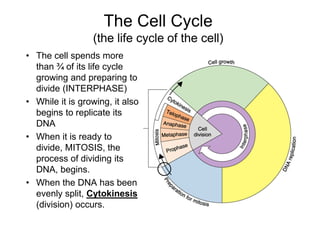
The Cell Cycle
                 (the life cycle of the cell)
• The cell spends more
  than ¾ of its life cycle
  growing and preparing to
  divide (INTERPHASE)
• While it is growing, it also
  begins to replicate its
  DNA
• When it is ready to
  divide, MITOSIS, the
  process of dividing its
  DNA, begins.
• When the DNA has been
  evenly split, Cytokinesis
  (division) occurs.
DNA and Chromosomes
• In humans, the information needed to build
  all the proteins and enzymes you need for
  your cells to function is stored in a
  chemical called DNA (Deoxyribose
  Nucleic Acid)
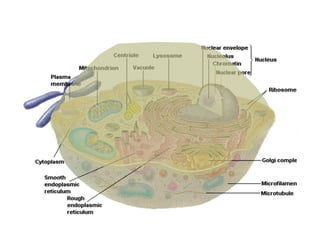
• This DNA is found in the nucleus of every
  cell of your body (except red blood cells)
• Every cell has (in theory) the information
  needed to make an entire body.
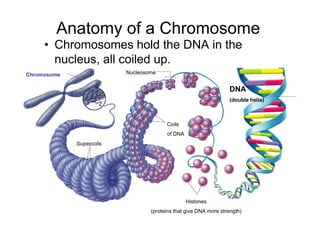
Anatomy of a Chromosome
     • Chromosomes hold the DNA in the
       nucleus, all coiled up.
Chromosome                Nucleosome


                                                                  DNA
                                                                  (double helix)


                                        Coils
                                        of DNA
             Supercoils


                                                 Histones
                                  (proteins that give DNA more strength)
YouTube Videos
• Zoom in on DNA
• Wrapped up DNA
• Nucleosomes & chromatin
Terminology preview
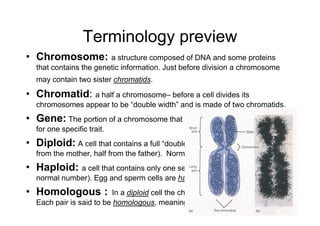
• Chromosome: a structure composed of DNA and some proteins
  that contains the genetic information. Just before division a chromosome
  may contain two sister chromatids.

• Chromatid: a half a chromosome– before a cell divides its
  chromosomes appear to be “double width” and is made of two chromatids.
• Gene: The portion of a chromosome that contains enough DNA to code
  for one specific trait.
• Diploid: A cell that contains a full “double set” of chromosomes (half
  from the mother, half from the father). Normal body cells are diploid.
• Haploid: a cell that contains only one set of chromosomes (half the
  normal number). Egg and sperm cells are haploid
• Homologous :           In a diploid cell the chromosomes are “paired”.
  Each pair is said to be homologous, meaning they resemble each other.
Enrichment: A bunches of “chromes” and “somes”

• In addition to the words defined before, you will
  find lots more words that either start with
  “chrom” or end with “some”
      • Chromatid, Chromosome, Chromatin, Chromatography
      • Chromosome, Centrosome, Lysosome, Ribosome.
• “Chromo” means “coloured”. Since DNA picks
  up dyes easily, anything made of DNA can be
  easily identified under the microscope. Many
  things made of, or containing, DNA start with
  chrom- or chromo-.
• “Soma” or “some” means “body”. In biology this
  is usually a tiny body, so organelles or cell
  structures often end in -some.
Cell Division in Eukaryotes
• Eukaryotes (organisms with complete
  cells) have two types of cell division:
  – Mitosis (normal cell division)
  – Meiosis (cell division for reproduction)
     • The examples are all from eukaryotes.
• Prokaryotes (simple cells like bacteria)
  undergo a similar, but slightly simpler,
  process called “binary fission”
  – This will not be studied in any detail this year,
    just think of binary fission as “mitosis-light”
Mitosis and normal cells
• Normal body cells are Diploid, which
  means that they have a double set of
  chromosomes
     • In humans, this is 2x23=46 chromosomes
     • 46 is the “human diploid number”
• In Mitosis, all chromosomes are duplicated
  before the cell divides.
     • In humans, this means that each cell starts with 46
       chromosomes before it divides, and the new cells
       each end up with 46 chromosomes after division.
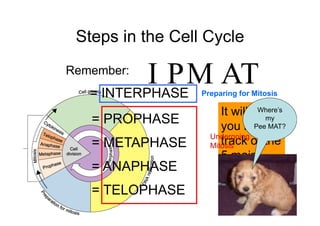
Steps in the Cell Cycle
Remember:
           I PM AT
   = INTERPHASE   Preparing for Mitosis

                       It will help
                                Where’s
   = PROPHASE                     my
                       you keepMAT?
                               Pee
                    Undergoing
   = METAPHASE         track of the
                    Mitosis
                       5 main
   = ANAPHASE          phases of
                       a cell’s life
   = TELOPHASE
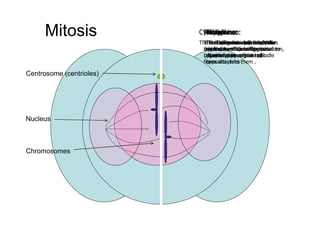
Animated Diagram of Mitosis


 The next slide shows an animated
 version of the main steps of
 mitosis. Just watch and follow what
 happens. More detailed
 descriptions will follow.
Mitosis             Cytokinesis:
                             Telophase:
                            Anaphase:
                           Metaphase:
                           Prophase:
                            Interphase:
                          The Thechomatids split the DNA
                           The nuclear into and reachcells
                               cellCell grows two into new
                                    chromosomes new near
                                    splits envelope up the
                            Thechromosomes linedisapears
                           and middle of nuclei begin to form,
                            chromosomes, and the new
                              poles, new the migrate to
                           the the centriolescellprepares to
                            replicates. The cell
                           (equatorial plane)the split.
                           opposite poles migratecell
                            chromosome of and to
                            divide. prepares to spindle
                              the cell
                           fibres attach to them .
                            opposite poles

Centrosome (centrioles)


Nucleus


Chromosomes
MITOSIS in Detail
• The following slides show more detail of
  how mitosis occurs. The photographs are
  of a plant cell. Animal cells are similar, but
  the centrosomes are visible in animals, but
  not in plant cells.
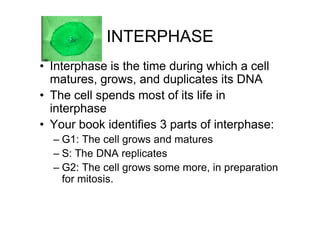
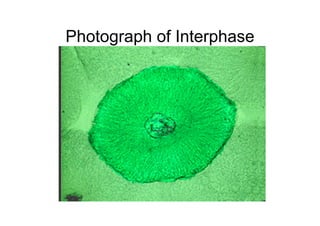
INTERPHASE
• Interphase is the time during which a cell
  matures, grows, and duplicates its DNA
• The cell spends most of its life in
  interphase
• Your book identifies 3 parts of interphase:
  – G1: The cell grows and matures
  – S: The DNA replicates
  – G2: The cell grows some more, in preparation
    for mitosis.
Photograph of Interphase
PROPHASE
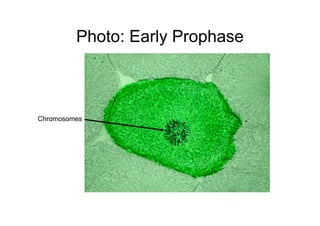
• DNA coils up to form chromosomes
     • each chromosome has 2 chromatids
• Two centrosomes appear.
     • These are fibre anchoring points near the nucleus.
     • In animal cells there are tiny organelles (centrioles) inside the
       centrosomes. Plant cells don’t have visible centrioles.
• The centrosomes move towards opposite ends
     • In this plant cell you won’t see them.
• The nuclear membrane disappears (breaks up)
• The centrosomes produce “spindle fibres” made
  of 2 varieties of microtubules.
     • Kinetochore fibres: attach to the chromosomes
     • Polar fibres: extend from one centrosome to the other.
Photo: Early Prophase


Chromosomes
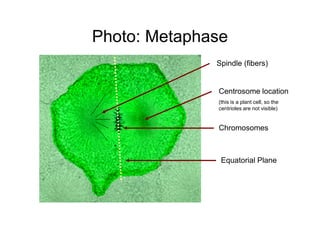
METAPHASE
• During metaphase the kinetochore
  (spindle) fibers move the chromosomes to
  the center of the dividing cell.
• The chromosomes line up along the
  equatorial plane (middle) of the cell.
• Kinetochore fibers are attached to each
  chromatid, near the centromere.
Photo: Metaphase
              Spindle (fibers)


              Centrosome location
              (this is a plant cell, so the
              centrioles are not visible)


              Chromosomes


               Equatorial Plane
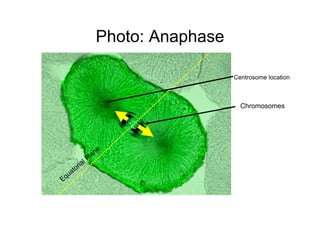
ANAPHASE
• The chromatids separate
• They move towards opposite ends of the
  cell
• From this point on, each chromatid is
  considered to be a new chromosome.
Photo: Anaphase

                  Centrosome location


                    Chromosomes
TELOPHASE
• Chromosomes reach the opposite ends of
  the cell.
• Chromosomes begin to uncoil, changing
  back into chromatin.
• Nuclear membranes begin to form on each
  side of the cell
• CYTOKINESIS begins.
CYTOKINESIS
• As TELOPHASE ends, the cell divides into
  two new cells.
• A cleavage furrow forms, and pinches the
  cell apart.
• There are now two cells, each with a full
  set of chromosomes (ie. Diploid)
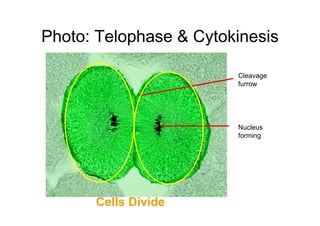
Photo: Telophase & Cytokinesis

                        Cleavage
                        furrow


                        Nucleus
                        forming


      Cells Divide
Videos

Serious MITOSIS Description
Mitosis introduction Mind Bites
The most annoying MITOSIS song ever!
MITOSIS animation.
Silent MITOSIS animation
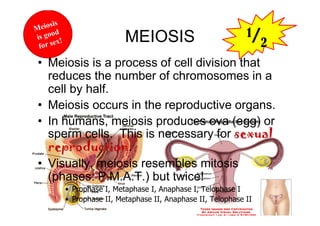
MEIOSIS                            1/
                                                              2
• Meiosis is a process of cell division that
  reduces the number of chromosomes in a
  cell by half.
• Meiosis occurs in the reproductive organs.
• In humans, meiosis produces ova (egg) or
  sperm cells. This is necessary for sexual
  reproduction.
• Visually, meiosis resembles mitosis
                           M                M

  (phases: P.M.A.T.) but twice!
     • Prophase I, Metaphase I, Anaphase I, Telophase I
     • Prophase II, Metaphase II, Anaphase II, Telophase II
Why is Meiosis so Important?
• It’s only important to organisms that
  reproduce sexually!
• If meiosis didn’t occur, then the egg and
  sperm cells would have the same number
  of chromosomes as the body cells
• When fertilization occurred, there would be
  too many chromosomes!
Meiosis, First Division.
  Homologous Chromosomes Line up
• Remember:
     • Humans have 46 chromosomes in each cell.
     • These are actually 23 pairs of homologous
       chromosomes (23 maternal, 23 paternal)
• During the first metaphase of MEIOSIS, the
  chromosomes line up in homolgous pairs.
• When anaphase starts, the chromatids
  don’t break apart (unlike mitosis), instead
  whole chromosomes (including both
  chromatids) move to each side of the cell.
Meiosis, Fist Division (continued)
            Crossing Over
• Normally the genes on one chromosome
  travel together...
• but sometimes during meiosis, a gene
  from one chromosome may switch places
  (or cross over) with the corresponding
  gene on the homologous chromosome
  that lines up beside it during the first
  division of meiosis.
    • Crossing over helps randomize the distribution of
      genes from parent to offspring
Meiosis, Second division
       Chromatids finally split.
• After the first division of meiosis, both
  human cells have 23 chromosomes
  (instead of the normal 46), but each
  chromosome still has two chromatids.
• A second division occurs, this time the
  chromatids do split (more like mitosis),
  giving four cells with 23 chromosomes
  each.
  For Diagrams of Meiosis, See pages 154 and 155
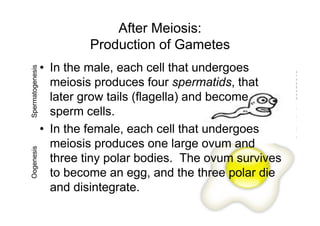
After Meiosis:
                           Production of Gametes
                  • In the male, each cell that undergoes
Spermatogenesis


                    meiosis produces four spermatids, that
                    later grow tails (flagella) and become
                    sperm cells.
                  • In the female, each cell that undergoes
                    meiosis produces one large ovum and
Oogenesis


                    three tiny polar bodies. The ovum survives
                    to become an egg, and the three polar die
                    and disintegrate.
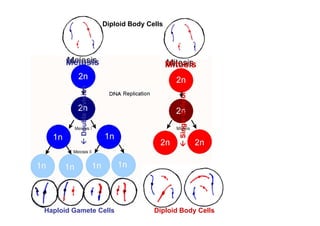
Diploid Body Cells


      Meiosis                                    Mitosis

          Double division


                                                    Single division


Haploid Gamete Cells                       Diploid Body Cells
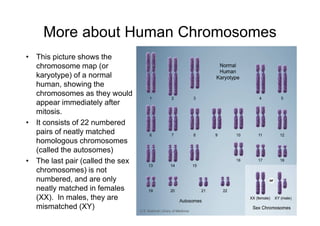
More about Human Chromosomes
• This picture shows the
  chromosome map (or
  karyotype) of a normal
  human, showing the
  chromosomes as they would
  appear immediately after
  mitosis.
• It consists of 22 numbered
  pairs of neatly matched
  homologous chromosomes
  (called the autosomes)
• The last pair (called the sex
  chromosomes) is not
  numbered, and are only
  neatly matched in females
  (XX). In males, they are
  mismatched (XY)
Assignments
• Read chapter summaries
  – Page 157
• Do End of Chapter Questions
  – Page 158 # 1 to 20
End of Chapter Questions
1. A chromosome is made of DNA and histone
   proteins, tightly wound into rod-shaped
   structures. Homologous chromosomes are
   pairs of morphologically similar chromosomes.
2. Mitosis is normal division of the cell nucleus.
   Meiosis is division of the cell nucleus to form
   gametes (sex cells). Cytokinesis is the division
   of the cell cytoplasm into two new cells.
3. Autosomes are the normal, paired homologous
   chromosomes. Sex chromosomes are a
   dissimilar pair of chromosomes used in sex
   determination (XX or XY)
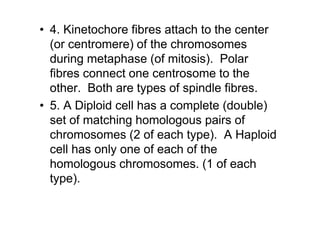
• 4. Kinetochore fibres attach to the center
  (or centromere) of the chromosomes
  during metaphase (of mitosis). Polar
  fibres connect one centrosome to the
  other. Both are types of spindle fibres.
• 5. A Diploid cell has a complete (double)
  set of matching homologous pairs of
  chromosomes (2 of each type). A Haploid
  cell has only one of each of the
  homologous chromosomes. (1 of each
  type).
6. D) Prokaryotic chromosomes consist of a
     circular DNA molecule.
7. C) A chromatid one of two identical parts that
     make up a (mature) chromosome.
8. B) Every species has a distinctive number of
     chromosomes per cell.
9. D) Binary fission is prokaryotic cell division
10.A) Mitosis can increase the number of body
     cells without changing the information
     contained in the cells’ DNA
11.D) Interphase is a time of cell growth and
     development (not A, since there is no G3 phase)
12. A) Cytokinesis differs in plant and
      animal cells.
13. A) Spermatogenesis produces four haploid
      cells (called sperm)
14. B) Oogenesis requires meiotic cell divisions.
15. D) Crossing over occurs during
      meiosis I

Mitosis p [compatibility mode]

  • 1.
    Cellular Reproduction (Cell Division) Mitosis and Meiosis
  • 2.
    Cell Division • Cellsmust divide after they reach a certain size. • Otherwise, their surface area becomes too small for their volume (Surface:Volume ratio) • Before they divide, they must make copies of all the information they contain • It’s sort of like backing up your hard drive so you can copy the files to a new computer. • only using chromosomes instead of hard drives. • That’s what the process of MITOSIS is all about... Copying information.
  • 3.
    The Cell Cycle (the life cycle of the cell) • The cell spends more than ¾ of its life cycle growing and preparing to divide (INTERPHASE) • While it is growing, it also begins to replicate its DNA • When it is ready to divide, MITOSIS, the process of dividing its DNA, begins. • When the DNA has been evenly split, Cytokinesis (division) occurs.
  • 4.
    DNA and Chromosomes •In humans, the information needed to build all the proteins and enzymes you need for your cells to function is stored in a chemical called DNA (Deoxyribose Nucleic Acid) • This DNA is found in the nucleus of every cell of your body (except red blood cells) • Every cell has (in theory) the information needed to make an entire body.
  • 6.
    Anatomy of aChromosome • Chromosomes hold the DNA in the nucleus, all coiled up. Chromosome Nucleosome DNA (double helix) Coils of DNA Supercoils Histones (proteins that give DNA more strength)
  • 7.
    YouTube Videos • Zoomin on DNA • Wrapped up DNA • Nucleosomes & chromatin
  • 8.
    Terminology preview • Chromosome:a structure composed of DNA and some proteins that contains the genetic information. Just before division a chromosome may contain two sister chromatids. • Chromatid: a half a chromosome– before a cell divides its chromosomes appear to be “double width” and is made of two chromatids. • Gene: The portion of a chromosome that contains enough DNA to code for one specific trait. • Diploid: A cell that contains a full “double set” of chromosomes (half from the mother, half from the father). Normal body cells are diploid. • Haploid: a cell that contains only one set of chromosomes (half the normal number). Egg and sperm cells are haploid • Homologous : In a diploid cell the chromosomes are “paired”. Each pair is said to be homologous, meaning they resemble each other.
  • 9.
    Enrichment: A bunchesof “chromes” and “somes” • In addition to the words defined before, you will find lots more words that either start with “chrom” or end with “some” • Chromatid, Chromosome, Chromatin, Chromatography • Chromosome, Centrosome, Lysosome, Ribosome. • “Chromo” means “coloured”. Since DNA picks up dyes easily, anything made of DNA can be easily identified under the microscope. Many things made of, or containing, DNA start with chrom- or chromo-. • “Soma” or “some” means “body”. In biology this is usually a tiny body, so organelles or cell structures often end in -some.
  • 10.
    Cell Division inEukaryotes • Eukaryotes (organisms with complete cells) have two types of cell division: – Mitosis (normal cell division) – Meiosis (cell division for reproduction) • The examples are all from eukaryotes. • Prokaryotes (simple cells like bacteria) undergo a similar, but slightly simpler, process called “binary fission” – This will not be studied in any detail this year, just think of binary fission as “mitosis-light”
  • 11.
    Mitosis and normalcells • Normal body cells are Diploid, which means that they have a double set of chromosomes • In humans, this is 2x23=46 chromosomes • 46 is the “human diploid number” • In Mitosis, all chromosomes are duplicated before the cell divides. • In humans, this means that each cell starts with 46 chromosomes before it divides, and the new cells each end up with 46 chromosomes after division.
  • 12.
    Steps in theCell Cycle Remember: I PM AT = INTERPHASE Preparing for Mitosis It will help Where’s = PROPHASE my you keepMAT? Pee Undergoing = METAPHASE track of the Mitosis 5 main = ANAPHASE phases of a cell’s life = TELOPHASE
  • 13.
    Animated Diagram ofMitosis The next slide shows an animated version of the main steps of mitosis. Just watch and follow what happens. More detailed descriptions will follow.
  • 14.
    Mitosis Cytokinesis: Telophase: Anaphase: Metaphase: Prophase: Interphase: The Thechomatids split the DNA The nuclear into and reachcells cellCell grows two into new chromosomes new near splits envelope up the Thechromosomes linedisapears and middle of nuclei begin to form, chromosomes, and the new poles, new the migrate to the the centriolescellprepares to replicates. The cell (equatorial plane)the split. opposite poles migratecell chromosome of and to divide. prepares to spindle the cell fibres attach to them . opposite poles Centrosome (centrioles) Nucleus Chromosomes
  • 15.
    MITOSIS in Detail •The following slides show more detail of how mitosis occurs. The photographs are of a plant cell. Animal cells are similar, but the centrosomes are visible in animals, but not in plant cells.
  • 16.
    INTERPHASE • Interphase isthe time during which a cell matures, grows, and duplicates its DNA • The cell spends most of its life in interphase • Your book identifies 3 parts of interphase: – G1: The cell grows and matures – S: The DNA replicates – G2: The cell grows some more, in preparation for mitosis.
  • 17.
  • 18.
    PROPHASE • DNA coilsup to form chromosomes • each chromosome has 2 chromatids • Two centrosomes appear. • These are fibre anchoring points near the nucleus. • In animal cells there are tiny organelles (centrioles) inside the centrosomes. Plant cells don’t have visible centrioles. • The centrosomes move towards opposite ends • In this plant cell you won’t see them. • The nuclear membrane disappears (breaks up) • The centrosomes produce “spindle fibres” made of 2 varieties of microtubules. • Kinetochore fibres: attach to the chromosomes • Polar fibres: extend from one centrosome to the other.
  • 19.
  • 20.
    METAPHASE • During metaphasethe kinetochore (spindle) fibers move the chromosomes to the center of the dividing cell. • The chromosomes line up along the equatorial plane (middle) of the cell. • Kinetochore fibers are attached to each chromatid, near the centromere.
  • 21.
    Photo: Metaphase Spindle (fibers) Centrosome location (this is a plant cell, so the centrioles are not visible) Chromosomes Equatorial Plane
  • 22.
    ANAPHASE • The chromatidsseparate • They move towards opposite ends of the cell • From this point on, each chromatid is considered to be a new chromosome.
  • 23.
    Photo: Anaphase Centrosome location Chromosomes
  • 24.
    TELOPHASE • Chromosomes reachthe opposite ends of the cell. • Chromosomes begin to uncoil, changing back into chromatin. • Nuclear membranes begin to form on each side of the cell • CYTOKINESIS begins.
  • 25.
    CYTOKINESIS • As TELOPHASEends, the cell divides into two new cells. • A cleavage furrow forms, and pinches the cell apart. • There are now two cells, each with a full set of chromosomes (ie. Diploid)
  • 26.
    Photo: Telophase &Cytokinesis Cleavage furrow Nucleus forming Cells Divide
  • 27.
    Videos Serious MITOSIS Description Mitosisintroduction Mind Bites The most annoying MITOSIS song ever! MITOSIS animation. Silent MITOSIS animation
  • 28.
    MEIOSIS 1/ 2 • Meiosis is a process of cell division that reduces the number of chromosomes in a cell by half. • Meiosis occurs in the reproductive organs. • In humans, meiosis produces ova (egg) or sperm cells. This is necessary for sexual reproduction. • Visually, meiosis resembles mitosis M M (phases: P.M.A.T.) but twice! • Prophase I, Metaphase I, Anaphase I, Telophase I • Prophase II, Metaphase II, Anaphase II, Telophase II
  • 29.
    Why is Meiosisso Important? • It’s only important to organisms that reproduce sexually! • If meiosis didn’t occur, then the egg and sperm cells would have the same number of chromosomes as the body cells • When fertilization occurred, there would be too many chromosomes!
  • 30.
    Meiosis, First Division. Homologous Chromosomes Line up • Remember: • Humans have 46 chromosomes in each cell. • These are actually 23 pairs of homologous chromosomes (23 maternal, 23 paternal) • During the first metaphase of MEIOSIS, the chromosomes line up in homolgous pairs. • When anaphase starts, the chromatids don’t break apart (unlike mitosis), instead whole chromosomes (including both chromatids) move to each side of the cell.
  • 31.
    Meiosis, Fist Division(continued) Crossing Over • Normally the genes on one chromosome travel together... • but sometimes during meiosis, a gene from one chromosome may switch places (or cross over) with the corresponding gene on the homologous chromosome that lines up beside it during the first division of meiosis. • Crossing over helps randomize the distribution of genes from parent to offspring
  • 32.
    Meiosis, Second division Chromatids finally split. • After the first division of meiosis, both human cells have 23 chromosomes (instead of the normal 46), but each chromosome still has two chromatids. • A second division occurs, this time the chromatids do split (more like mitosis), giving four cells with 23 chromosomes each. For Diagrams of Meiosis, See pages 154 and 155
  • 33.
    After Meiosis: Production of Gametes • In the male, each cell that undergoes Spermatogenesis meiosis produces four spermatids, that later grow tails (flagella) and become sperm cells. • In the female, each cell that undergoes meiosis produces one large ovum and Oogenesis three tiny polar bodies. The ovum survives to become an egg, and the three polar die and disintegrate.
  • 34.
    Diploid Body Cells Meiosis Mitosis Double division Single division Haploid Gamete Cells Diploid Body Cells
  • 35.
    More about HumanChromosomes • This picture shows the chromosome map (or karyotype) of a normal human, showing the chromosomes as they would appear immediately after mitosis. • It consists of 22 numbered pairs of neatly matched homologous chromosomes (called the autosomes) • The last pair (called the sex chromosomes) is not numbered, and are only neatly matched in females (XX). In males, they are mismatched (XY)
  • 36.
    Assignments • Read chaptersummaries – Page 157 • Do End of Chapter Questions – Page 158 # 1 to 20
  • 37.
    End of ChapterQuestions 1. A chromosome is made of DNA and histone proteins, tightly wound into rod-shaped structures. Homologous chromosomes are pairs of morphologically similar chromosomes. 2. Mitosis is normal division of the cell nucleus. Meiosis is division of the cell nucleus to form gametes (sex cells). Cytokinesis is the division of the cell cytoplasm into two new cells. 3. Autosomes are the normal, paired homologous chromosomes. Sex chromosomes are a dissimilar pair of chromosomes used in sex determination (XX or XY)
  • 38.
    • 4. Kinetochorefibres attach to the center (or centromere) of the chromosomes during metaphase (of mitosis). Polar fibres connect one centrosome to the other. Both are types of spindle fibres. • 5. A Diploid cell has a complete (double) set of matching homologous pairs of chromosomes (2 of each type). A Haploid cell has only one of each of the homologous chromosomes. (1 of each type).
  • 39.
    6. D) Prokaryoticchromosomes consist of a circular DNA molecule. 7. C) A chromatid one of two identical parts that make up a (mature) chromosome. 8. B) Every species has a distinctive number of chromosomes per cell. 9. D) Binary fission is prokaryotic cell division 10.A) Mitosis can increase the number of body cells without changing the information contained in the cells’ DNA 11.D) Interphase is a time of cell growth and development (not A, since there is no G3 phase)
  • 40.
    12. A) Cytokinesisdiffers in plant and animal cells. 13. A) Spermatogenesis produces four haploid cells (called sperm) 14. B) Oogenesis requires meiotic cell divisions. 15. D) Crossing over occurs during meiosis I