LECTURE PRESENTATIONS
For CAMPBELL BIOLOGY, NINTH EDITION
Jane B. Reece, Lisa A. Urry, Michael L. Cain, Steven A. Wasserman, Peter V. Minorsky, Robert B. Jackson
© 2011 Pearson Education, Inc.
Lectures by
Erin Barley
Kathleen Fitzpatrick
Angiosperm Reproduction
and Biotechnology
Chapter 38
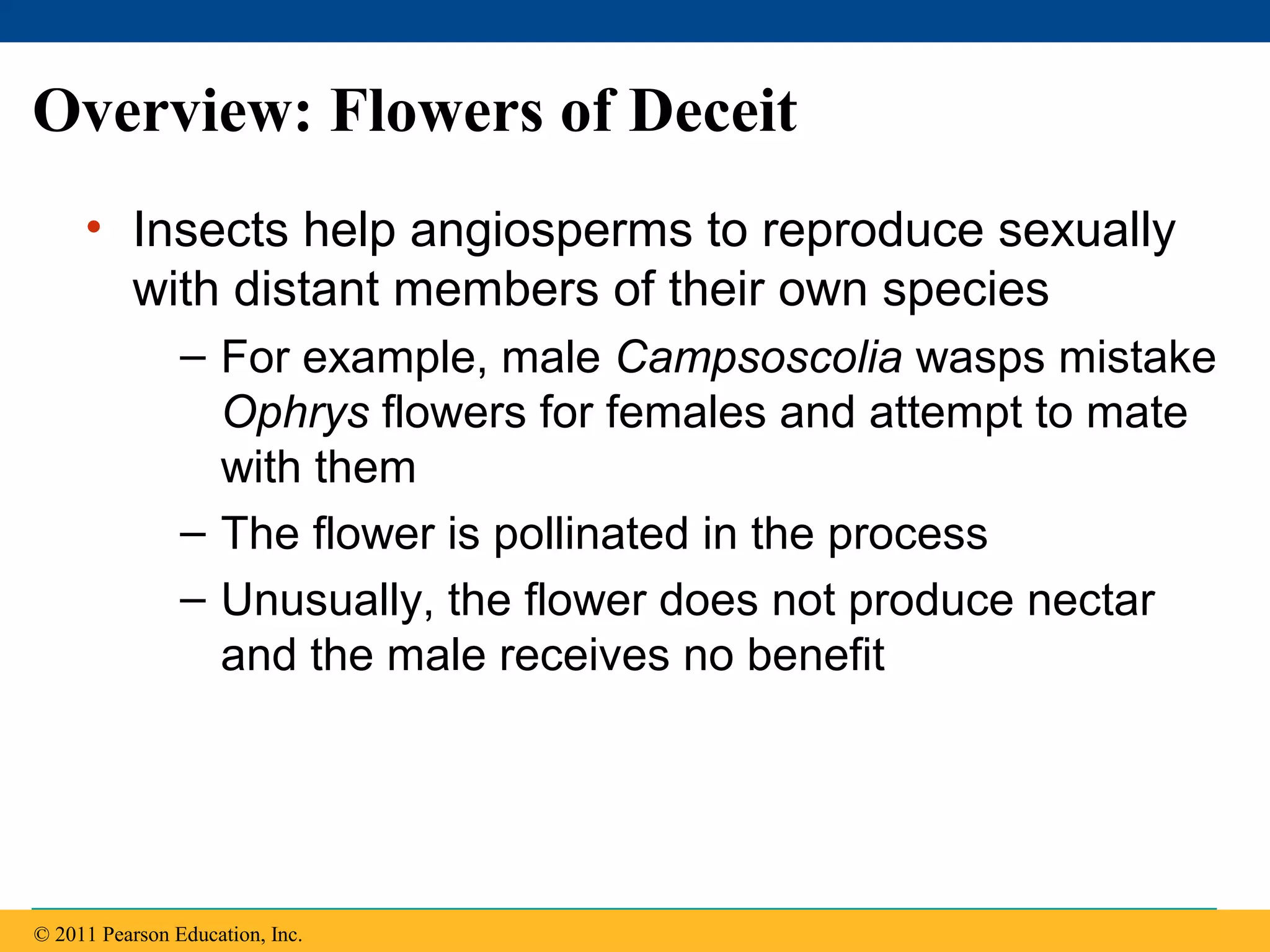
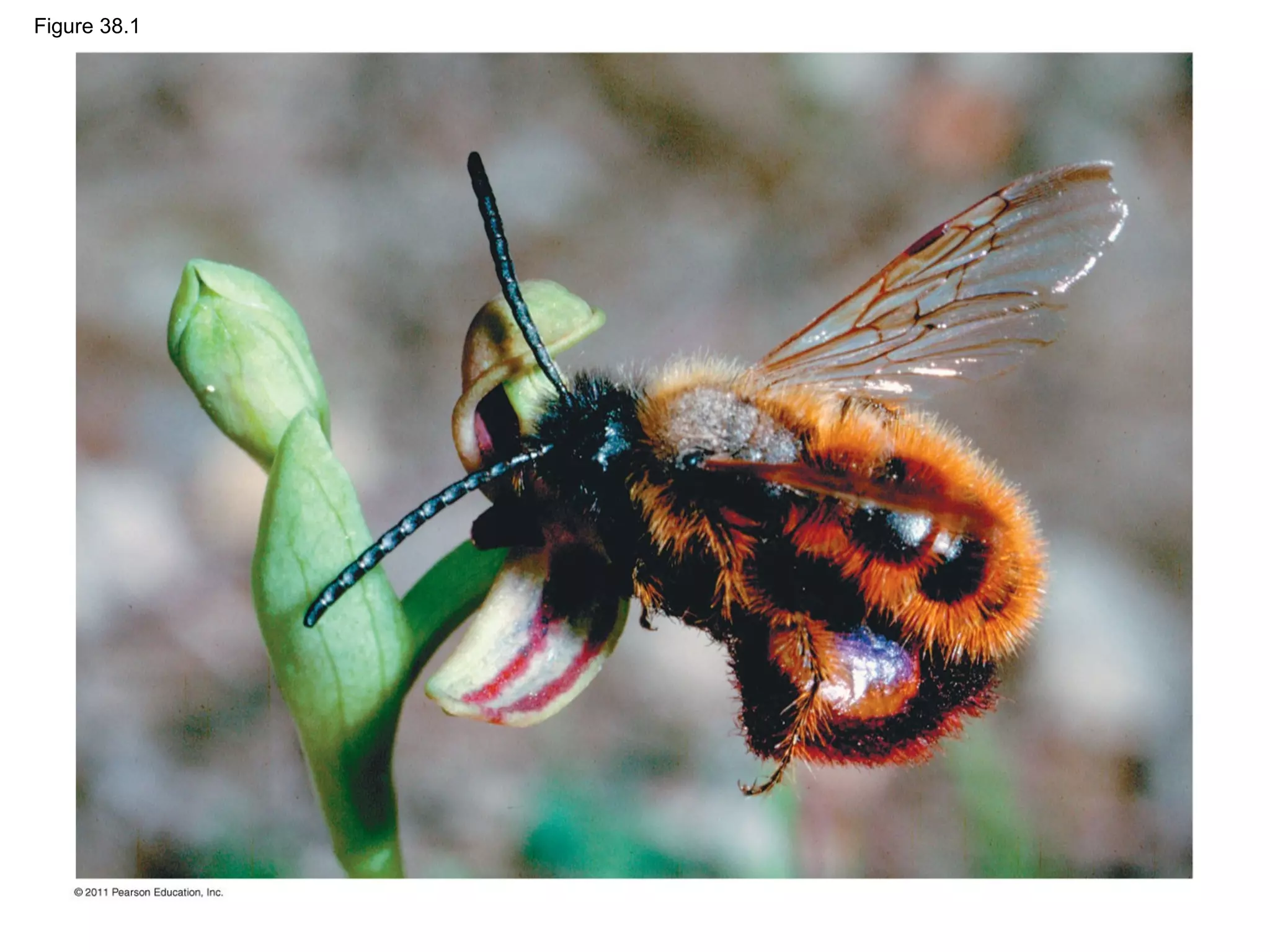
Overview: Flowers of Deceit
• Insects help angiosperms to reproduce sexually
with distant members of their own species
– For example, male Campsoscolia wasps mistake
Ophrys flowers for females and attempt to mate
with them
– The flower is pollinated in the process
– Unusually, the flower does not produce nectar
and the male receives no benefit
Copyright © 2008 Pearson Education, Inc., publishing as Pearson Benjamin Cummings© 2011 Pearson Education, Inc.
Figure 38.1
• Many angiosperms lure insects with nectar; both
plant and pollinator benefit
• Mutualistic symbioses are common between
plants and other species
• Angiosperms can reproduce sexually and
asexually
• Angiosperms are the most important group of
plants in terrestrial ecosystems and in agriculture
Copyright © 2008 Pearson Education, Inc., publishing as Pearson Benjamin Cummings© 2011 Pearson Education, Inc.
Concept 38.1: Flowers, double fertilization,
and fruits are unique features of the
angiosperm life cycle
• Plant lifecycles are characterized by the alternation
between a multicellular haploid (n) generation and
a multicellular diploid (2n) generation
• Diploid sporophytes (2n) produce spores (n) by
meiosis; these grow into haploid gametophytes (n)
• Gametophytes produce haploid gametes (n) by
mitosis; fertilization of gametes produces a
sporophyte
© 2011 Pearson Education, Inc.
• In angiosperms, the sporophyte is the dominant
generation, the large plant that we see
• The gametophytes are reduced in size and
depend on the sporophyte for nutrients
• The angiosperm life cycle is characterized by
“three Fs”: flowers, double fertilization, and fruits
© 2011 Pearson Education, Inc.
Figure 38.2
Stamen
Anther
Filament
Petal
Receptacle
Stigma
Style
Ovary
Carpel
Sepal
(a) Structure of an
idealized flower
Simplified angiosperm
life cycle
(b)
Key
Haploid (n)
Diploid (2n)
Anther
Pollen tube
Germinated pollen grain (n)
(male gametophyte)
Ovary
Ovule
Embryo sac (n)
(female gametophyte)
Egg (n)
Sperm (n)
FERTILIZATION
Zygote
(2n)
Mature sporophyte
plant (2n)
Germinating
seed
Seed
Seed
Simple
fruit
Embryo (2n)
(sporophyte)
Flower Structure and Function
• Flowers are the reproductive shoots of the
angiosperm sporophyte; they attach to a part of
the stem called the receptacle
• Flowers consist of four floral organs: sepals,
petals, stamens, and carpels
• Stamens and carpels are reproductive organs;
sepals and petals are sterile
© 2011 Pearson Education, Inc.
• A stamen consists of a filament topped by an
anther with pollen sacs that produce pollen
• A carpel has a long style with a stigma on which
pollen may land
• At the base of the style is an ovary containing one
or more ovules
• A single carpel or group of fused carpels is called
a pistil
© 2011 Pearson Education, Inc.
• Complete flowers contain all four floral organs
• Incomplete flowers lack one or more floral
organs, for example stamens or carpels
• Clusters of flowers are called inflorescences
© 2011 Pearson Education, Inc.
Development of Male Gametophytes in
Pollen Grains
• Pollen develops from microspores within
the microsporangia, or pollen sacs, of anthers
• Each microspore undergoes mitosis to produce
two cells: the generative cell and the tube cell
• A pollen grain consists of the two-celled male
gametophyte and the spore wall
© 2011 Pearson Education, Inc.
• If pollination succeeds, a pollen grain produces a
pollen tube that grows down into the ovary and
discharges two sperm cells near the embryo sac
© 2011 Pearson Education, Inc.
Development of a male
gametophyte
(in pollen grain)
(a)
Microsporangium
(pollen sac)
(b) Development of a female
gametophyte (embryo sac)
Microsporocyte
Microspores (4)
Each of 4
microspores
Generative cell
(will form 2
sperm)
(LM)
75 µm
20 µm
100µm
MEIOSIS
MITOSIS
Male
gametophyte
(in pollen grain)
Nucleus of tube cell
Ragweed
pollen
grain
(colorized
SEM)
Key to labels
Haploid (n)
Diploid (2n) (LM)
Embryo sac
Ovule
Megasporangium
Megasporocyte
Integuments
Micropyle
Surviving
megaspore
Antipodal cells (3)
Polar nuclei (2)
Egg (1)
Synergids (2)
Ovule
Integuments
Femalegametophyte
(embryosac)
Figure 38.3
Development of Female Gametophytes
(Embryo Sacs)
• The embryo sac, or female gametophyte,
develops within the ovule
• Within an ovule, two integuments surround a
megasporangium
• One cell in the megasporangium undergoes
meiosis, producing four megaspores, only one of
which survives
• The megaspore divides, producing a large cell
with eight nuclei
© 2011 Pearson Education, Inc.
• This cell is partitioned into a multicellular female
gametophyte, the embryo sac
© 2011 Pearson Education, Inc.
Pollination
• In angiosperms, pollination is the transfer of
pollen from an anther to a stigma
• Pollination can be by wind, water, or animals
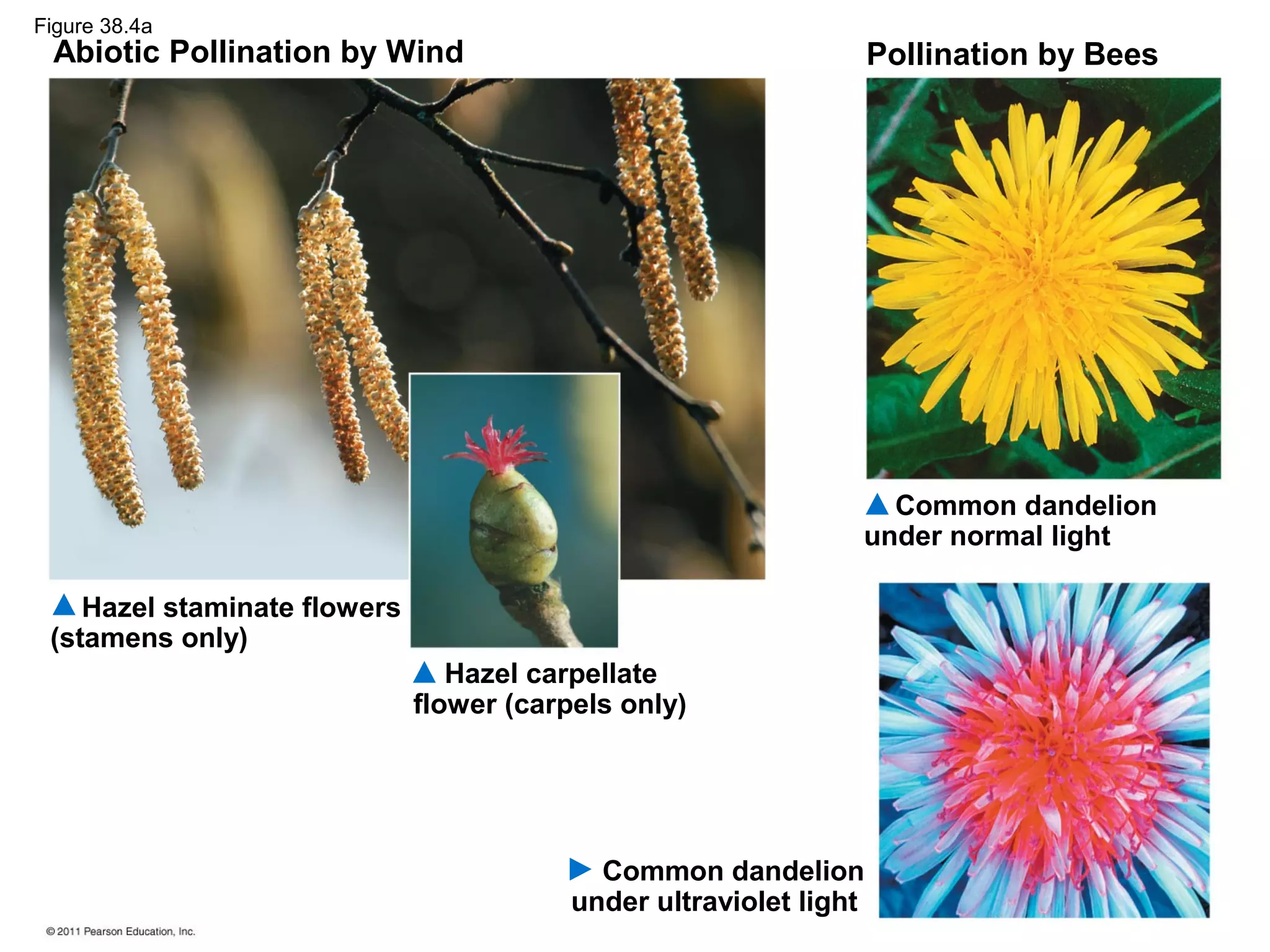
• Wind-pollinated species (e.g., grasses and many
trees) release large amounts of pollen
© 2011 Pearson Education, Inc.
Abiotic Pollination by Wind Pollination by Bees
Hazel staminate flowers
(stamens only)
Hazel carpellate
flower (carpels only)
Common dandelion
under normal light
Common dandelion
under ultraviolet light
Figure 38.4a
Pollination by Moths
and Butterflies
Blowfly on carrion
flower
Pollination by Flies Pollination by Bats
Moth on yucca flower
Long-nosed bat feeding
on cactus flower at night
Hummingbird
drinking nectar of
columbine flower
Pollination by Birds
Stigma
Anther
Moth
Fly egg
Figure 38.4b
Coevolution of Flower and Pollinator
• Coevolution is the evolution of interacting species
in response to changes in each other
• Many flowering plants have coevolved with
specific pollinators
• The shapes and sizes of flowers often correspond
to the pollen transporting parts of their animal
pollinators
– For example, Darwin correctly predicted a moth
with a 28 cm long tongue based on the
morphology of a particular flower
© 2011 Pearson Education, Inc.
Figure 38.5
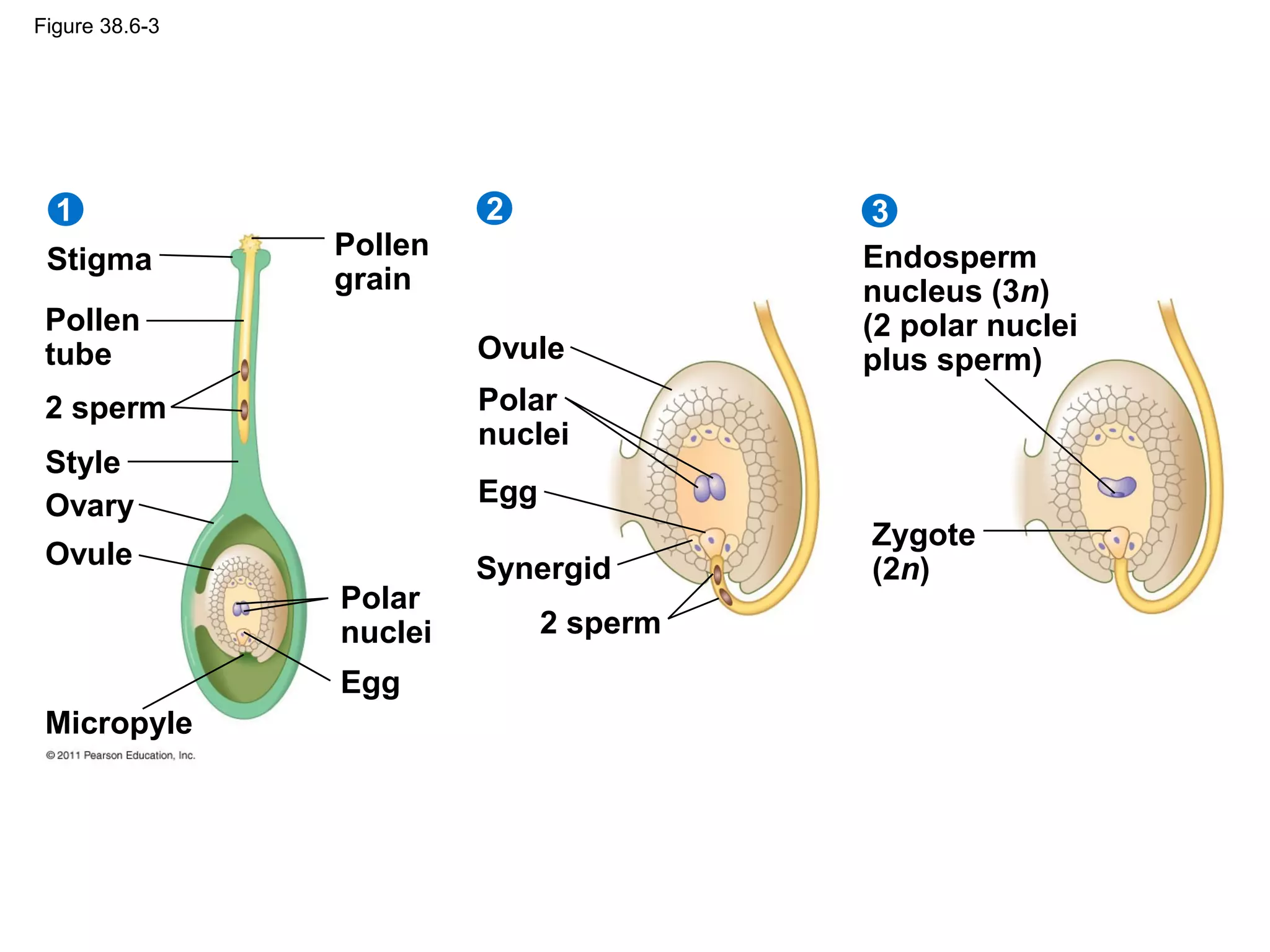
Double Fertilization
• After landing on a receptive stigma, a pollen grain
produces a pollen tube that extends between the
cells of the style toward the ovary
• Double fertilization results from the discharge of
two sperm from the pollen tube into the embryo
sac
• One sperm fertilizes the egg, and the other
combines with the polar nuclei, giving rise to the
triploid food-storing Plant Fertilization endosperm
(3n)
© 2011 Pearson Education, Inc.
Animation: Plant Fertilization
Right-click slide / select “Play”
Figure 38.6-3
Stigma
Pollen
tube
2 31
2 sperm
Style
Ovary
Ovule
Micropyle
Pollen
grain
Polar
nuclei
Egg
Ovule
Polar
nuclei
Egg
Synergid
2 sperm
Endosperm
nucleus (3n)
(2 polar nuclei
plus sperm)
Zygote
(2n)
Seed Development, Form, and Function
• After double fertilization, each ovule develops into
a seed
• The ovary develops into a fruit enclosing the
seed(s)
© 2011 Pearson Education, Inc.
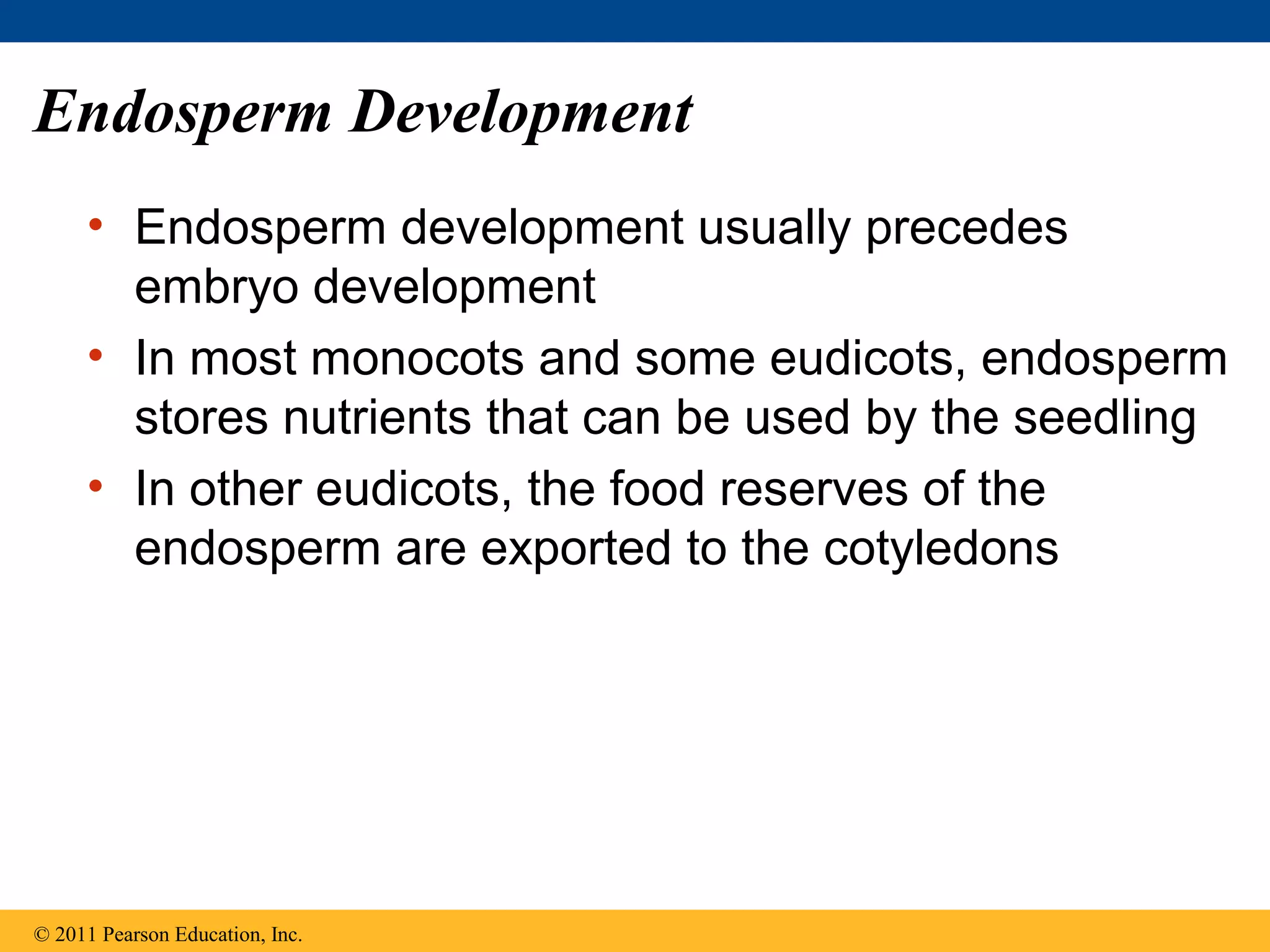
Endosperm Development
• Endosperm development usually precedes
embryo development
• In most monocots and some eudicots, endosperm
stores nutrients that can be used by the seedling
• In other eudicots, the food reserves of the
endosperm are exported to the cotyledons
© 2011 Pearson Education, Inc.
Embryo Development
• The first mitotic division of the zygote splits the
fertilized egg into a basal cell and a terminal cell
• The basal cell produces a multicellular suspensor,
which anchors the embryo to the parent plant
• The terminal cell gives rise to most of the embryo
• The cotyledons form and the embryo elongates
© 2011 Pearson Education, Inc.
Animation: Seed Development
Right-click slide / select “Play”
Figure 38.7
Ovule
Endosperm
nucleus
Integuments
Zygote
Zygote
Terminal cell
Basal cell
Proembryo
Suspensor
Basal
cell
Cotyledons
Shoot
apex
Root
apex
Suspensor
Seed
coat
Endosperm
Structure of the Mature Seed
• The embryo and its food supply are enclosed by a
hard, protective seed coat
• The seed enters a state of dormancy
• A mature seed is only about 5–15% water
© 2011 Pearson Education, Inc.
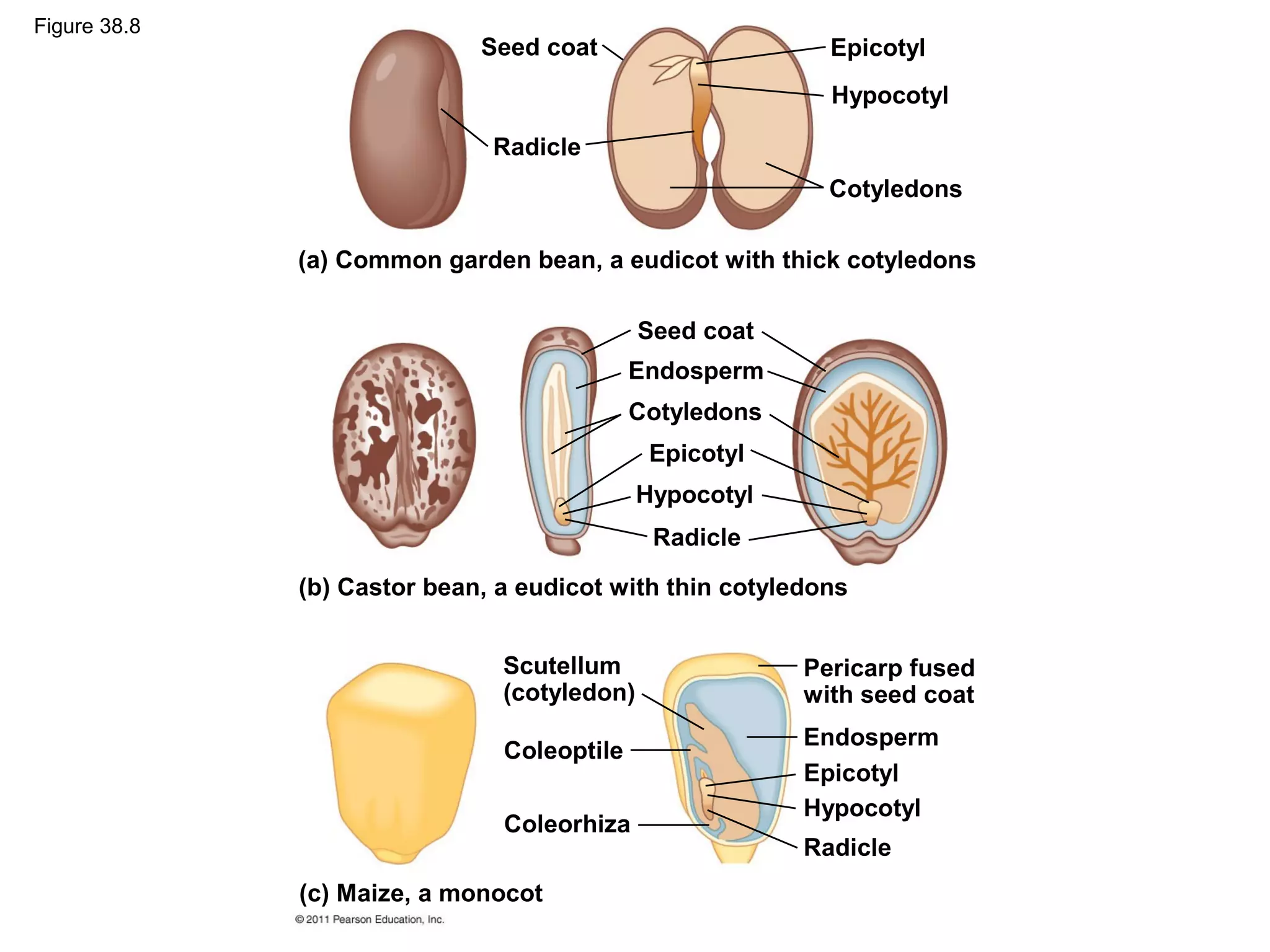
• In some eudicots, such as the common garden
bean, the embryo consists of the embryonic axis
attached to two thick cotyledons (seed leaves)
• Below the cotyledons the embryonic axis is called
the hypocotyl and terminates in the radicle
(embryonic root); above the cotyledons it is called
the epicotyl
• The plumule comprises the epicotyl, young leaves,
and shoot apical meristem
© 2011 Pearson Education, Inc.
Figure 38.8
Seed coat
Radicle
Epicotyl
Hypocotyl
Cotyledons
(a) Common garden bean, a eudicot with thick cotyledons
(b) Castor bean, a eudicot with thin cotyledons
(c) Maize, a monocot
Seed coat
Endosperm
Cotyledons
Epicotyl
Hypocotyl
Radicle
Radicle
Hypocotyl
Epicotyl
Endosperm
Pericarp fused
with seed coat
Scutellum
(cotyledon)
Coleoptile
Coleorhiza
• The seeds of some eudicots, such as castor
beans, have thin cotyledons
© 2011 Pearson Education, Inc.
• A monocot embryo has one cotyledon
• Grasses, such as maize and wheat, have a
special cotyledon called a scutellum
• Two sheathes enclose the embryo of a grass
seed: a coleoptile covering the young shoot and a
coleorhiza covering the young root
© 2011 Pearson Education, Inc.
Seed Dormancy: An Adaptation for Tough
Times
• Seed dormancy increases the chances that
germination will occur at a time and place most
advantageous to the seedling
• The breaking of seed dormancy often requires
environmental cues, such as temperature or
lighting changes
© 2011 Pearson Education, Inc.
Seed Germination and Seedling Development
• Germination depends on imbibition, the uptake of
water due to low water potential of the dry seed
• The radicle (embryonic root) emerges first
• Next, the shoot tip breaks through the soil surface
© 2011 Pearson Education, Inc.
• In many eudicots, a hook forms in the hypocotyl,
and growth pushes the hook above ground
• Light causes the hook to straighten and pull the
cotyledons and shoot tip up
© 2011 Pearson Education, Inc.
Figure 38.9
Foliage leaves
Cotyledon
Hypocotyl
Cotyledon
Hypocotyl
Radicle
Seed coat
Epicotyl
Cotyledon
Hypocotyl
(a) Common garden bean
Foliage leaves
Coleoptile Coleoptile
Radicle
(b) Maize
• In maize and other grasses, which are monocots,
the coleoptile pushes up through the soil
© 2011 Pearson Education, Inc.
Fruit Form and Function
• A fruit develops from the ovary
• It protects the enclosed seeds and aids in seed
dispersal by wind or animals
• A fruit may be classified as dry, if the ovary dries
out at maturity, or fleshy, if the ovary becomes
thick, soft, and sweet at maturity
© 2011 Pearson Education, Inc.
Animation: Fruit Development
Right-click slide / select “Play”
• Fruits are also classified by their development
– Simple, a single or several fused carpels
– Aggregate, a single flower with multiple separate
carpels
– Multiple, a group of flowers called an
inflorescence
© 2011 Pearson Education, Inc.
Figure 38.10
Stamen Ovary
Stigma
Ovule
Pea flower
Seed
Pea fruit
(a) Simple fruit (b) Aggregate fruit (c) Multiple fruit (d) Accessory fruit
Carpels Stamen
Raspberry flower
Carpel
(fruitlet)
Stigma
Ovary
Stamen
Raspberry fruit
Flower
Pineapple
inflorescence
Each segment
develops
from the
carpel
of one
flower
Pineapple fruit
Stigma
Petal
Style
Stamen
Sepal
Ovule
Ovary (in
receptacle)
Apple flower
Remains of
stamens and styles
Sepals
Seed
Receptacle
Apple fruit
• An accessory fruit contains other floral parts in
addition to ovaries
© 2011 Pearson Education, Inc.
• Fruit dispersal mechanisms include
– Water
– Wind
– Animals
© 2011 Pearson Education, Inc.
Dispersal by Wind
Dandelion “seeds” (actually one-seeded fruits)
Winged fruit of a maple
Dandelion fruit
Tumbleweed
Dispersal by Water
Winged seed of
the tropical Asian
climbing gourd
Alsomitra macrocarpa
Coconut seed embryo,
endosperm, and endocarp
inside buoyant husk
Figure 38.11a
Figure 38.11b
Dispersal by Animals
Fruit of puncture vine
(Tribulus terrestris)
Squirrel hoarding
seeds or fruits
underground
Ant carrying
seed with nutritious
“food body” to its
nest
Seeds dispersed in black bear feces
Concept 38.2: Flowering plants reproduce
sexually, asexually, or both
• Many angiosperm species reproduce both
asexually and sexually
• Sexual reproduction results in offspring that are
genetically different from their parents
• Asexual reproduction results in a clone of
genetically identical organisms
© 2011 Pearson Education, Inc.
Mechanisms of Asexual Reproduction
• Fragmentation, separation of a parent plant into
parts that develop into whole plants, is a very
common type of asexual reproduction
• In some species, a parent plant’s root system
gives rise to adventitious shoots that become
separate shoot systems
© 2011 Pearson Education, Inc.
Figure 38.12
• Apomixis is the asexual production of seeds from
a diploid cell
© 2011 Pearson Education, Inc.
Advantages and Disadvantages of Asexual
Versus Sexual Reproduction
• Asexual reproduction is also called vegetative
reproduction
• Asexual reproduction can be beneficial to a
successful plant in a stable environment
• However, a clone of plants is vulnerable to local
extinction if there is an environmental change
© 2011 Pearson Education, Inc.
• Sexual reproduction generates genetic variation
that makes evolutionary adaptation possible
• However, only a fraction of seedlings survive
• Some flowers can self-fertilize to ensure that every
ovule will develop into a seed
• Many species have evolved mechanisms to
prevent selfing
© 2011 Pearson Education, Inc.
Mechanisms That Prevent Self-Fertilization
• Many angiosperms have mechanisms that make it
difficult or impossible for a flower to self-fertilize
• Dioecious species have staminate and carpellate
flowers on separate plants
© 2011 Pearson Education, Inc.
Figure 38.13
Staminate flowers (left) and carpellate flowers (right)
of a dioecious species
(a)
(b) Thrum and pin flowers
Thrum flower Pin flower
Stamens
StamensStyles
Styles
• The most common is self-incompatibility, a
plant’s ability to reject its own pollen
• Researchers are unraveling the molecular
mechanisms involved in self-incompatibility
• Some plants reject pollen that has an S-gene
matching an allele in the stigma cells
• Recognition of self pollen triggers a signal
transduction pathway leading to a block in growth
of a pollen tube
© 2011 Pearson Education, Inc.
Vegetative Propagation and Agriculture
• Humans have devised methods for asexual
propagation of angiosperms
• Most methods are based on the ability of plants to
form adventitious roots or shoots
© 2011 Pearson Education, Inc.
Clones from Cuttings
• Many kinds of plants are asexually reproduced
from plant fragments called cuttings
• A callus is a mass of dividing undifferentiated
cells that forms where a stem is cut and produces
adventitious roots
Copyright © 2008 Pearson Education, Inc., publishing as Pearson Benjamin Cummings© 2011 Pearson Education, Inc.
Grafting
• A twig or bud can be grafted onto a plant of a
closely related species or variety
• The stock provides the root system
• The scion is grafted onto the stock
© 2011 Pearson Education, Inc.
Test-Tube Cloning and Related Techniques
• Plant biologists have adopted in vitro methods to
create and clone novel plant varieties
• A callus of undifferentiated cells can sprout shoots
and roots in response to plant hormones
© 2011 Pearson Education, Inc.
Figure 38.14
Developing root(a) (b) (c)
• Transgenic plants are genetically modified (GM)
to express a gene from another organism
• Protoplast fusion is used to create hybrid plants
by fusing protoplasts, plant cells with their cell
walls removed
© 2011 Pearson Education, Inc.
Figure 38.15
50 µm
Concept 38.3: Humans modify crops by
breeding and genetic engineering
• Humans have intervened in the reproduction and
genetic makeup of plants for thousands of years
• Hybridization is common in nature and has been
used by breeders to introduce new genes
• Maize, a product of artificial selection, is a staple
in many developing countries
© 2011 Pearson Education, Inc.
Figure 38.16
Plant Breeding
• Mutations can arise spontaneously or can be
induced by breeders
• Plants with beneficial mutations are used in
breeding experiments
• Desirable traits can be introduced from different
species or genera
• The grain triticale is derived from a successful
cross between wheat and rye
© 2011 Pearson Education, Inc.
Plant Biotechnology and Genetic
Engineering
• Plant biotechnology has two meanings
– In a general sense, it refers to innovations in the
use of plants to make useful products
– In a specific sense, it refers to use of GM
organisms in agriculture and industry
• Modern plant biotechnology is not limited to
transfer of genes between closely related species
or varieties of the same species
© 2011 Pearson Education, Inc.
Reducing World Hunger and Malnutrition
• Genetically modified plants may increase the
quality and quantity of food worldwide
• Transgenic crops have been developed that
– Produce proteins to defend them against insect
pests
– Tolerate herbicides
– Resist specific diseases
© 2011 Pearson Education, Inc.
• Nutritional quality of plants is being improved
– For example, “Golden Rice” is a transgenic variety
being developed to address vitamin A deficiencies
among the world’s poor
© 2011 Pearson Education, Inc.
Figure 38.17
Cassava roots harvested in Thailand
• Biofuels are made by the fermentation and
distillation of plant materials such as cellulose
• Biofuels can be produced by rapidly growing crops
such as switchgrass and poplar
• Biofuels would reduce the net emission of CO2, a
greenhouse gas
• The environmental implications of biofuels are
controversial
Reducing Fossil Fuel Dependency
© 2011 Pearson Education, Inc.
The Debate over Plant Biotechnology
• Some biologists are concerned about risks of
releasing GM organisms (GMOs) into the
environment
© 2011 Pearson Education, Inc.
Issues of Human Health
• One concern is that genetic engineering may
transfer allergens from a gene source to a plant
used for food
• Some GMOs have health benefits
– For example, maize that produces the Bt toxin
has 90% less of a cancer-causing toxin than non-
Bt corn
– Bt maize has less insect damage and lower
infection by Fusarium fungus that produces the
cancer-causing toxin
© 2011 Pearson Education, Inc.
• GMO opponents advocate for clear labeling of all
GMO foods
© 2011 Pearson Education, Inc.
Possible Effects on Nontarget Organisms
• Many ecologists are concerned that the growing of
GM crops might have unforeseen effects on
nontarget organisms
© 2011 Pearson Education, Inc.
Addressing the Problem of Transgene Escape
• Perhaps the most serious concern is the
possibility of introduced genes escaping into
related weeds through crop-to-weed hybridization
• This could result in “superweeds” that would be
resistant to many herbicides
© 2011 Pearson Education, Inc.
• Efforts are underway to prevent this by
introducing
– Male sterility
– Apomixis
– Transgenes into chloroplast DNA (not
transferred by pollen)
– Strict self-pollination
© 2011 Pearson Education, Inc.© 2011 Pearson Education, Inc.

Ch. 38: Angiosperm Reproduction and Biotechnology

  • 1.
    LECTURE PRESENTATIONS For CAMPBELLBIOLOGY, NINTH EDITION Jane B. Reece, Lisa A. Urry, Michael L. Cain, Steven A. Wasserman, Peter V. Minorsky, Robert B. Jackson © 2011 Pearson Education, Inc. Lectures by Erin Barley Kathleen Fitzpatrick Angiosperm Reproduction and Biotechnology Chapter 38
  • 2.
    Overview: Flowers ofDeceit • Insects help angiosperms to reproduce sexually with distant members of their own species – For example, male Campsoscolia wasps mistake Ophrys flowers for females and attempt to mate with them – The flower is pollinated in the process – Unusually, the flower does not produce nectar and the male receives no benefit Copyright © 2008 Pearson Education, Inc., publishing as Pearson Benjamin Cummings© 2011 Pearson Education, Inc.
  • 3.
  • 4.
    • Many angiospermslure insects with nectar; both plant and pollinator benefit • Mutualistic symbioses are common between plants and other species • Angiosperms can reproduce sexually and asexually • Angiosperms are the most important group of plants in terrestrial ecosystems and in agriculture Copyright © 2008 Pearson Education, Inc., publishing as Pearson Benjamin Cummings© 2011 Pearson Education, Inc.
  • 5.
    Concept 38.1: Flowers,double fertilization, and fruits are unique features of the angiosperm life cycle • Plant lifecycles are characterized by the alternation between a multicellular haploid (n) generation and a multicellular diploid (2n) generation • Diploid sporophytes (2n) produce spores (n) by meiosis; these grow into haploid gametophytes (n) • Gametophytes produce haploid gametes (n) by mitosis; fertilization of gametes produces a sporophyte © 2011 Pearson Education, Inc.
  • 6.
    • In angiosperms,the sporophyte is the dominant generation, the large plant that we see • The gametophytes are reduced in size and depend on the sporophyte for nutrients • The angiosperm life cycle is characterized by “three Fs”: flowers, double fertilization, and fruits © 2011 Pearson Education, Inc.
  • 7.
    Figure 38.2 Stamen Anther Filament Petal Receptacle Stigma Style Ovary Carpel Sepal (a) Structureof an idealized flower Simplified angiosperm life cycle (b) Key Haploid (n) Diploid (2n) Anther Pollen tube Germinated pollen grain (n) (male gametophyte) Ovary Ovule Embryo sac (n) (female gametophyte) Egg (n) Sperm (n) FERTILIZATION Zygote (2n) Mature sporophyte plant (2n) Germinating seed Seed Seed Simple fruit Embryo (2n) (sporophyte)
  • 8.
    Flower Structure andFunction • Flowers are the reproductive shoots of the angiosperm sporophyte; they attach to a part of the stem called the receptacle • Flowers consist of four floral organs: sepals, petals, stamens, and carpels • Stamens and carpels are reproductive organs; sepals and petals are sterile © 2011 Pearson Education, Inc.
  • 9.
    • A stamenconsists of a filament topped by an anther with pollen sacs that produce pollen • A carpel has a long style with a stigma on which pollen may land • At the base of the style is an ovary containing one or more ovules • A single carpel or group of fused carpels is called a pistil © 2011 Pearson Education, Inc.
  • 10.
    • Complete flowerscontain all four floral organs • Incomplete flowers lack one or more floral organs, for example stamens or carpels • Clusters of flowers are called inflorescences © 2011 Pearson Education, Inc.
  • 11.
    Development of MaleGametophytes in Pollen Grains • Pollen develops from microspores within the microsporangia, or pollen sacs, of anthers • Each microspore undergoes mitosis to produce two cells: the generative cell and the tube cell • A pollen grain consists of the two-celled male gametophyte and the spore wall © 2011 Pearson Education, Inc.
  • 12.
    • If pollinationsucceeds, a pollen grain produces a pollen tube that grows down into the ovary and discharges two sperm cells near the embryo sac © 2011 Pearson Education, Inc.
  • 13.
    Development of amale gametophyte (in pollen grain) (a) Microsporangium (pollen sac) (b) Development of a female gametophyte (embryo sac) Microsporocyte Microspores (4) Each of 4 microspores Generative cell (will form 2 sperm) (LM) 75 µm 20 µm 100µm MEIOSIS MITOSIS Male gametophyte (in pollen grain) Nucleus of tube cell Ragweed pollen grain (colorized SEM) Key to labels Haploid (n) Diploid (2n) (LM) Embryo sac Ovule Megasporangium Megasporocyte Integuments Micropyle Surviving megaspore Antipodal cells (3) Polar nuclei (2) Egg (1) Synergids (2) Ovule Integuments Femalegametophyte (embryosac) Figure 38.3
  • 14.
    Development of FemaleGametophytes (Embryo Sacs) • The embryo sac, or female gametophyte, develops within the ovule • Within an ovule, two integuments surround a megasporangium • One cell in the megasporangium undergoes meiosis, producing four megaspores, only one of which survives • The megaspore divides, producing a large cell with eight nuclei © 2011 Pearson Education, Inc.
  • 15.
    • This cellis partitioned into a multicellular female gametophyte, the embryo sac © 2011 Pearson Education, Inc.
  • 16.
    Pollination • In angiosperms,pollination is the transfer of pollen from an anther to a stigma • Pollination can be by wind, water, or animals • Wind-pollinated species (e.g., grasses and many trees) release large amounts of pollen © 2011 Pearson Education, Inc.
  • 17.
    Abiotic Pollination byWind Pollination by Bees Hazel staminate flowers (stamens only) Hazel carpellate flower (carpels only) Common dandelion under normal light Common dandelion under ultraviolet light Figure 38.4a
  • 18.
    Pollination by Moths andButterflies Blowfly on carrion flower Pollination by Flies Pollination by Bats Moth on yucca flower Long-nosed bat feeding on cactus flower at night Hummingbird drinking nectar of columbine flower Pollination by Birds Stigma Anther Moth Fly egg Figure 38.4b
  • 19.
    Coevolution of Flowerand Pollinator • Coevolution is the evolution of interacting species in response to changes in each other • Many flowering plants have coevolved with specific pollinators • The shapes and sizes of flowers often correspond to the pollen transporting parts of their animal pollinators – For example, Darwin correctly predicted a moth with a 28 cm long tongue based on the morphology of a particular flower © 2011 Pearson Education, Inc.
  • 20.
  • 21.
    Double Fertilization • Afterlanding on a receptive stigma, a pollen grain produces a pollen tube that extends between the cells of the style toward the ovary • Double fertilization results from the discharge of two sperm from the pollen tube into the embryo sac • One sperm fertilizes the egg, and the other combines with the polar nuclei, giving rise to the triploid food-storing Plant Fertilization endosperm (3n) © 2011 Pearson Education, Inc.
  • 22.
    © 2011 PearsonEducation, Inc. Animation: Plant Fertilization Right-click slide / select “Play”
  • 23.
    Figure 38.6-3 Stigma Pollen tube 2 31 2sperm Style Ovary Ovule Micropyle Pollen grain Polar nuclei Egg Ovule Polar nuclei Egg Synergid 2 sperm Endosperm nucleus (3n) (2 polar nuclei plus sperm) Zygote (2n)
  • 24.
    Seed Development, Form,and Function • After double fertilization, each ovule develops into a seed • The ovary develops into a fruit enclosing the seed(s) © 2011 Pearson Education, Inc.
  • 25.
    Endosperm Development • Endospermdevelopment usually precedes embryo development • In most monocots and some eudicots, endosperm stores nutrients that can be used by the seedling • In other eudicots, the food reserves of the endosperm are exported to the cotyledons © 2011 Pearson Education, Inc.
  • 26.
    Embryo Development • Thefirst mitotic division of the zygote splits the fertilized egg into a basal cell and a terminal cell • The basal cell produces a multicellular suspensor, which anchors the embryo to the parent plant • The terminal cell gives rise to most of the embryo • The cotyledons form and the embryo elongates © 2011 Pearson Education, Inc.
  • 27.
    © 2011 PearsonEducation, Inc. Animation: Seed Development Right-click slide / select “Play”
  • 28.
    Figure 38.7 Ovule Endosperm nucleus Integuments Zygote Zygote Terminal cell Basalcell Proembryo Suspensor Basal cell Cotyledons Shoot apex Root apex Suspensor Seed coat Endosperm
  • 29.
    Structure of theMature Seed • The embryo and its food supply are enclosed by a hard, protective seed coat • The seed enters a state of dormancy • A mature seed is only about 5–15% water © 2011 Pearson Education, Inc.
  • 30.
    • In someeudicots, such as the common garden bean, the embryo consists of the embryonic axis attached to two thick cotyledons (seed leaves) • Below the cotyledons the embryonic axis is called the hypocotyl and terminates in the radicle (embryonic root); above the cotyledons it is called the epicotyl • The plumule comprises the epicotyl, young leaves, and shoot apical meristem © 2011 Pearson Education, Inc.
  • 31.
    Figure 38.8 Seed coat Radicle Epicotyl Hypocotyl Cotyledons (a)Common garden bean, a eudicot with thick cotyledons (b) Castor bean, a eudicot with thin cotyledons (c) Maize, a monocot Seed coat Endosperm Cotyledons Epicotyl Hypocotyl Radicle Radicle Hypocotyl Epicotyl Endosperm Pericarp fused with seed coat Scutellum (cotyledon) Coleoptile Coleorhiza
  • 32.
    • The seedsof some eudicots, such as castor beans, have thin cotyledons © 2011 Pearson Education, Inc.
  • 33.
    • A monocotembryo has one cotyledon • Grasses, such as maize and wheat, have a special cotyledon called a scutellum • Two sheathes enclose the embryo of a grass seed: a coleoptile covering the young shoot and a coleorhiza covering the young root © 2011 Pearson Education, Inc.
  • 34.
    Seed Dormancy: AnAdaptation for Tough Times • Seed dormancy increases the chances that germination will occur at a time and place most advantageous to the seedling • The breaking of seed dormancy often requires environmental cues, such as temperature or lighting changes © 2011 Pearson Education, Inc.
  • 35.
    Seed Germination andSeedling Development • Germination depends on imbibition, the uptake of water due to low water potential of the dry seed • The radicle (embryonic root) emerges first • Next, the shoot tip breaks through the soil surface © 2011 Pearson Education, Inc.
  • 36.
    • In manyeudicots, a hook forms in the hypocotyl, and growth pushes the hook above ground • Light causes the hook to straighten and pull the cotyledons and shoot tip up © 2011 Pearson Education, Inc.
  • 37.
    Figure 38.9 Foliage leaves Cotyledon Hypocotyl Cotyledon Hypocotyl Radicle Seedcoat Epicotyl Cotyledon Hypocotyl (a) Common garden bean Foliage leaves Coleoptile Coleoptile Radicle (b) Maize
  • 38.
    • In maizeand other grasses, which are monocots, the coleoptile pushes up through the soil © 2011 Pearson Education, Inc.
  • 39.
    Fruit Form andFunction • A fruit develops from the ovary • It protects the enclosed seeds and aids in seed dispersal by wind or animals • A fruit may be classified as dry, if the ovary dries out at maturity, or fleshy, if the ovary becomes thick, soft, and sweet at maturity © 2011 Pearson Education, Inc.
  • 40.
    © 2011 PearsonEducation, Inc. Animation: Fruit Development Right-click slide / select “Play”
  • 41.
    • Fruits arealso classified by their development – Simple, a single or several fused carpels – Aggregate, a single flower with multiple separate carpels – Multiple, a group of flowers called an inflorescence © 2011 Pearson Education, Inc.
  • 42.
    Figure 38.10 Stamen Ovary Stigma Ovule Peaflower Seed Pea fruit (a) Simple fruit (b) Aggregate fruit (c) Multiple fruit (d) Accessory fruit Carpels Stamen Raspberry flower Carpel (fruitlet) Stigma Ovary Stamen Raspberry fruit Flower Pineapple inflorescence Each segment develops from the carpel of one flower Pineapple fruit Stigma Petal Style Stamen Sepal Ovule Ovary (in receptacle) Apple flower Remains of stamens and styles Sepals Seed Receptacle Apple fruit
  • 43.
    • An accessoryfruit contains other floral parts in addition to ovaries © 2011 Pearson Education, Inc.
  • 44.
    • Fruit dispersalmechanisms include – Water – Wind – Animals © 2011 Pearson Education, Inc.
  • 45.
    Dispersal by Wind Dandelion“seeds” (actually one-seeded fruits) Winged fruit of a maple Dandelion fruit Tumbleweed Dispersal by Water Winged seed of the tropical Asian climbing gourd Alsomitra macrocarpa Coconut seed embryo, endosperm, and endocarp inside buoyant husk Figure 38.11a
  • 46.
    Figure 38.11b Dispersal byAnimals Fruit of puncture vine (Tribulus terrestris) Squirrel hoarding seeds or fruits underground Ant carrying seed with nutritious “food body” to its nest Seeds dispersed in black bear feces
  • 47.
    Concept 38.2: Floweringplants reproduce sexually, asexually, or both • Many angiosperm species reproduce both asexually and sexually • Sexual reproduction results in offspring that are genetically different from their parents • Asexual reproduction results in a clone of genetically identical organisms © 2011 Pearson Education, Inc.
  • 48.
    Mechanisms of AsexualReproduction • Fragmentation, separation of a parent plant into parts that develop into whole plants, is a very common type of asexual reproduction • In some species, a parent plant’s root system gives rise to adventitious shoots that become separate shoot systems © 2011 Pearson Education, Inc.
  • 49.
  • 50.
    • Apomixis isthe asexual production of seeds from a diploid cell © 2011 Pearson Education, Inc.
  • 51.
    Advantages and Disadvantagesof Asexual Versus Sexual Reproduction • Asexual reproduction is also called vegetative reproduction • Asexual reproduction can be beneficial to a successful plant in a stable environment • However, a clone of plants is vulnerable to local extinction if there is an environmental change © 2011 Pearson Education, Inc.
  • 52.
    • Sexual reproductiongenerates genetic variation that makes evolutionary adaptation possible • However, only a fraction of seedlings survive • Some flowers can self-fertilize to ensure that every ovule will develop into a seed • Many species have evolved mechanisms to prevent selfing © 2011 Pearson Education, Inc.
  • 53.
    Mechanisms That PreventSelf-Fertilization • Many angiosperms have mechanisms that make it difficult or impossible for a flower to self-fertilize • Dioecious species have staminate and carpellate flowers on separate plants © 2011 Pearson Education, Inc.
  • 54.
    Figure 38.13 Staminate flowers(left) and carpellate flowers (right) of a dioecious species (a) (b) Thrum and pin flowers Thrum flower Pin flower Stamens StamensStyles Styles
  • 55.
    • The mostcommon is self-incompatibility, a plant’s ability to reject its own pollen • Researchers are unraveling the molecular mechanisms involved in self-incompatibility • Some plants reject pollen that has an S-gene matching an allele in the stigma cells • Recognition of self pollen triggers a signal transduction pathway leading to a block in growth of a pollen tube © 2011 Pearson Education, Inc.
  • 56.
    Vegetative Propagation andAgriculture • Humans have devised methods for asexual propagation of angiosperms • Most methods are based on the ability of plants to form adventitious roots or shoots © 2011 Pearson Education, Inc.
  • 57.
    Clones from Cuttings •Many kinds of plants are asexually reproduced from plant fragments called cuttings • A callus is a mass of dividing undifferentiated cells that forms where a stem is cut and produces adventitious roots Copyright © 2008 Pearson Education, Inc., publishing as Pearson Benjamin Cummings© 2011 Pearson Education, Inc.
  • 58.
    Grafting • A twigor bud can be grafted onto a plant of a closely related species or variety • The stock provides the root system • The scion is grafted onto the stock © 2011 Pearson Education, Inc.
  • 59.
    Test-Tube Cloning andRelated Techniques • Plant biologists have adopted in vitro methods to create and clone novel plant varieties • A callus of undifferentiated cells can sprout shoots and roots in response to plant hormones © 2011 Pearson Education, Inc.
  • 60.
  • 61.
    • Transgenic plantsare genetically modified (GM) to express a gene from another organism • Protoplast fusion is used to create hybrid plants by fusing protoplasts, plant cells with their cell walls removed © 2011 Pearson Education, Inc.
  • 62.
  • 63.
    Concept 38.3: Humansmodify crops by breeding and genetic engineering • Humans have intervened in the reproduction and genetic makeup of plants for thousands of years • Hybridization is common in nature and has been used by breeders to introduce new genes • Maize, a product of artificial selection, is a staple in many developing countries © 2011 Pearson Education, Inc.
  • 64.
  • 65.
    Plant Breeding • Mutationscan arise spontaneously or can be induced by breeders • Plants with beneficial mutations are used in breeding experiments • Desirable traits can be introduced from different species or genera • The grain triticale is derived from a successful cross between wheat and rye © 2011 Pearson Education, Inc.
  • 66.
    Plant Biotechnology andGenetic Engineering • Plant biotechnology has two meanings – In a general sense, it refers to innovations in the use of plants to make useful products – In a specific sense, it refers to use of GM organisms in agriculture and industry • Modern plant biotechnology is not limited to transfer of genes between closely related species or varieties of the same species © 2011 Pearson Education, Inc.
  • 67.
    Reducing World Hungerand Malnutrition • Genetically modified plants may increase the quality and quantity of food worldwide • Transgenic crops have been developed that – Produce proteins to defend them against insect pests – Tolerate herbicides – Resist specific diseases © 2011 Pearson Education, Inc.
  • 68.
    • Nutritional qualityof plants is being improved – For example, “Golden Rice” is a transgenic variety being developed to address vitamin A deficiencies among the world’s poor © 2011 Pearson Education, Inc.
  • 69.
    Figure 38.17 Cassava rootsharvested in Thailand
  • 70.
    • Biofuels aremade by the fermentation and distillation of plant materials such as cellulose • Biofuels can be produced by rapidly growing crops such as switchgrass and poplar • Biofuels would reduce the net emission of CO2, a greenhouse gas • The environmental implications of biofuels are controversial Reducing Fossil Fuel Dependency © 2011 Pearson Education, Inc.
  • 71.
    The Debate overPlant Biotechnology • Some biologists are concerned about risks of releasing GM organisms (GMOs) into the environment © 2011 Pearson Education, Inc.
  • 72.
    Issues of HumanHealth • One concern is that genetic engineering may transfer allergens from a gene source to a plant used for food • Some GMOs have health benefits – For example, maize that produces the Bt toxin has 90% less of a cancer-causing toxin than non- Bt corn – Bt maize has less insect damage and lower infection by Fusarium fungus that produces the cancer-causing toxin © 2011 Pearson Education, Inc.
  • 73.
    • GMO opponentsadvocate for clear labeling of all GMO foods © 2011 Pearson Education, Inc.
  • 74.
    Possible Effects onNontarget Organisms • Many ecologists are concerned that the growing of GM crops might have unforeseen effects on nontarget organisms © 2011 Pearson Education, Inc.
  • 75.
    Addressing the Problemof Transgene Escape • Perhaps the most serious concern is the possibility of introduced genes escaping into related weeds through crop-to-weed hybridization • This could result in “superweeds” that would be resistant to many herbicides © 2011 Pearson Education, Inc.
  • 76.
    • Efforts areunderway to prevent this by introducing – Male sterility – Apomixis – Transgenes into chloroplast DNA (not transferred by pollen) – Strict self-pollination © 2011 Pearson Education, Inc.© 2011 Pearson Education, Inc.

Editor's Notes

  • #4 Figure 38.1 Why is this wasp trying to mate with this flower?
  • #7 For the Discovery Video Plant Pollination, go to Animation and Video Files.
  • #8 Figure 38.2 An overview of angiosperm reproduction.
  • #14 Figure 38.3 The development of male and female gametophytes in angiosperms.
  • #18 Figure 38.4 Exploring: Flower Pollination
  • #19 Figure 38.4 Exploring: Flower Pollination
  • #21 Figure 38.5 Coevolution of a flower and an insect pollinator.
  • #24 Figure 38.6 Growth of the pollen tube and double fertilization.
  • #29 Figure 38.7 The development of a eudicot plant embryo.
  • #32 Figure 38.8 Seed structure.
  • #38 Figure 38.9 Two common types of seed germination.
  • #43 Figure 38.10 Developmental origin of fruits.
  • #46 Figure 38.11 Exploring: Fruit and Seed Dispersal
  • #47 Figure 38.11 Exploring: Fruit and Seed Dispersal
  • #50 Figure 38.12 Asexual reproduction in aspen trees.
  • #55 Figure 38.13 Some floral adaptations that prevent self-fertilization.
  • #61 Figure 38.14 Cloning a garlic plant.
  • #63 Figure 38.15 Protoplasts.
  • #65 Figure 38.16 Maize: a product of artificial selection.
  • #70 Figure 38.17 Impact: Fighting World Hunger with Transgenic Cassava