Populations and the
Environment
Chapter 5, 6.2 and 6.3
5.1 How Populations Grow
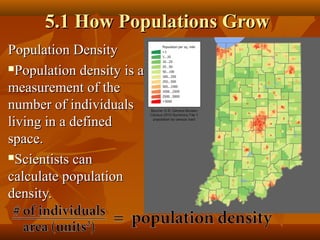
Population Density
Population density is a
measurement of the
number of individuals
living in a defined
space.
Scientists can
calculate population
density.


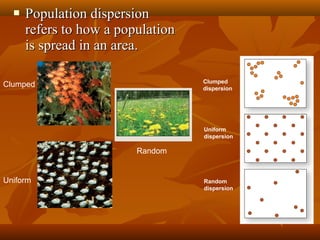
Population dispersion
refers to how a population
is spread in an area.
Clumped
dispersion

Clumped

Uniform
dispersion

Random

Uniform

Random
dispersion
Population Growth




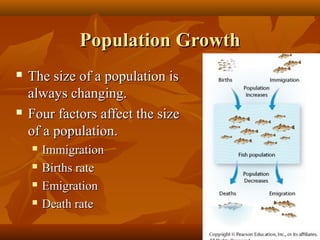
The size of a population is
always changing.
Four factors affect the size
of a population.





Immigration
Births rate
Emigration
Death rate


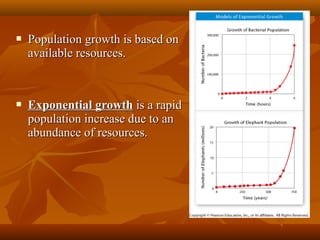
Population growth is based on
available resources.



Exponential growth is a rapid
population increase due to an
abundance of resources.
However,


Most populations are regulated by predators,
disease, and the availability of resources.




Because of this population will not exceed the
environmental carrying capacity
As a population grows, limited resources become
depleted and the growth of the population slows.




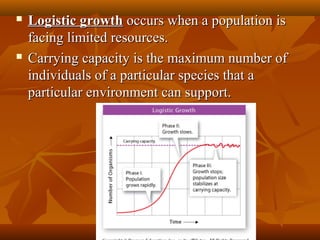
Logistic growth occurs when a population is
facing limited resources.
Carrying capacity is the maximum number of
individuals of a particular species that a
particular environment can support.
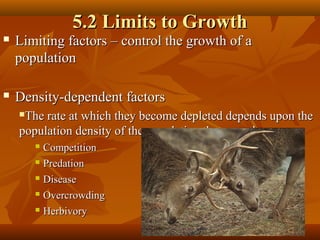
5.2 Limits to Growth



Limiting factors – control the growth of a
population



Density-dependent factors
The rate at which they become depleted depends upon the
population density of the population that uses them.


Competition
 Predation
 Disease
 Overcrowding
 Herbivory

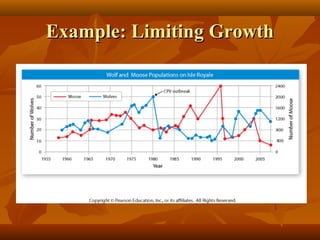
Example: Limiting Growth


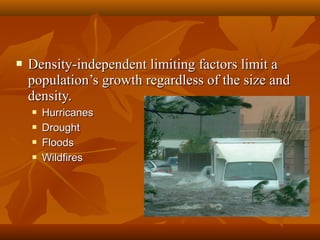
Density-independent limiting factors limit a
population’s growth regardless of the size and
density.





Hurricanes
Drought
Floods
Wildfires
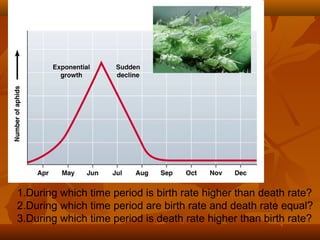
1.During which time period is birth rate higher than death rate?
2.During which time period are birth rate and death rate equal?
3.During which time period is death rate higher than birth rate?
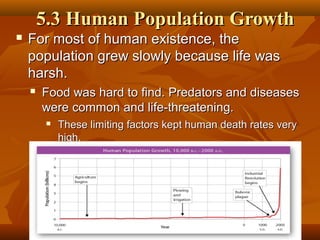
5.3 Human Population Growth


For most of human existence, the
population grew slowly because life was
harsh.


Food was hard to find. Predators and diseases
were common and life-threatening.


These limiting factors kept human death rates very
high.


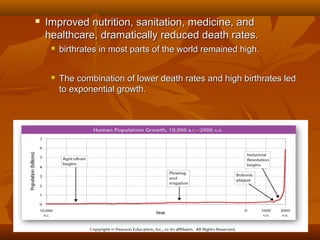
Improved nutrition, sanitation, medicine, and
healthcare, dramatically reduced death rates.


birthrates in most parts of the world remained high.



The combination of lower death rates and high birthrates led
to exponential growth.
6.2 Using Resources Wisely


How do we obtain what we need from local and
global environments without destroying those
environments?

Environmental Resources we affect:
 Soil
 Freshwater
 Air
Soil Resources


Healthy soil supports both agriculture and
forestry.





Topsoil – rich in organic matter and nutrients
Loss of fertile soil can have dire consequences.
Erosion – removal of soil by water or wind
Desertification
 Deforestation

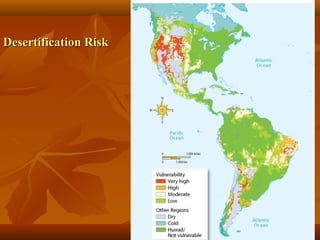
Desertification Risk
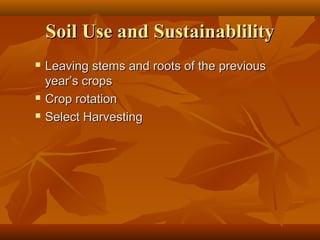
Soil Use and Sustainablility





Leaving stems and roots of the previous
year’s crops
Crop rotation
Select Harvesting
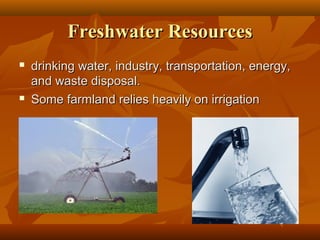
Freshwater Resources




drinking water, industry, transportation, energy,
and waste disposal.
Some farmland relies heavily on irrigation
Water Pollution
Many serious environmental problems
occur in our own backyard.
 Agriculture introduces large amounts of
chemicals into the global ecosystem.


Including: pesticides, herbicides, and
fertilizers


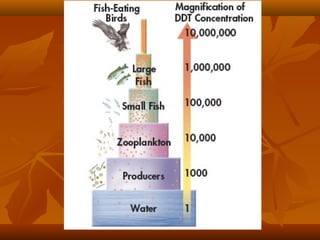
Many chemicals, such as DDT, have been banned in the
US, but the effects of their use still circulate.
Causes biological magnification

Water Quality and Sustainability




Protecting the water cycle
Clean up pollution
Conserve water
Atmospheric Resources


Air quality has a direct impact on health.




Pollution

Global temperature
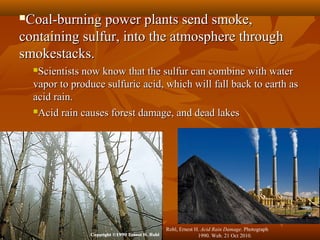
Coal-burning power plants send smoke,
containing sulfur, into the atmosphere through
smokestacks.


Scientists now know that the sulfur can combine with water
vapor to produce sulfuric acid, which will fall back to earth as
acid rain.
Acid rain causes forest damage, and dead lakes


Robl, Ernest H. Acid Rain Damage. Photograph
1990. Web. 21 Oct 2010.
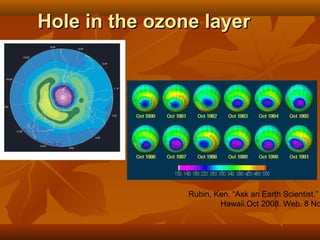
Decrease in the amount of ozone (O3) in the
atmosphere allows more UV radiation to reach
the earth’s surface.


This can cause an increase in diseases related to UV
exposure such as cancer and cataracts.
The major cause is chlorofluorocarbons (CFCs) commonly
used in refrigerators, air conditioners, and in aerosols.
As a result CFCs have been banned in the US.

Hole in the ozone layer

Rubin, Ken. “Ask an Earth Scientist.”
Hawaii.Oct 2008. Web. 8 No
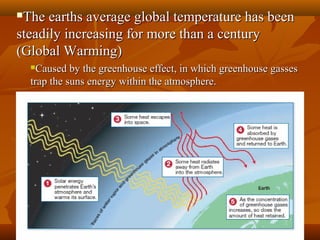
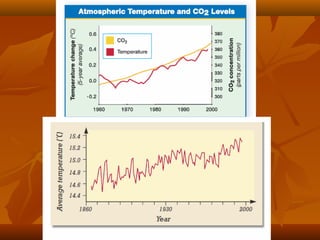
The earths average global temperature has been
steadily increasing for more than a century
(Global Warming)


Caused by the greenhouse effect, in which greenhouse gasses
trap the suns energy within the atmosphere.



Earth’s resources must be used responsibly.






Careless use of resources makes them unavailable to
future generations.

An ecological footprint is the amount of land
needed to support a person.
The land must produce and maintain
enough





food and water
shelter
energy
Room for waste
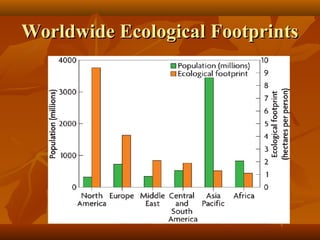
Worldwide Ecological Footprints
Determine your ecological
footprint


Go to www.footprintnetwork.org/calculator to
determine how many planet Earths it would
take to support everyone if they lived like you.
6.3 Biodiversity


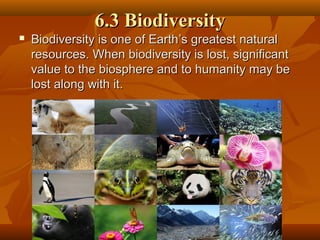
Biodiversity is one of Earth’s greatest natural
resources. When biodiversity is lost, significant
value to the biosphere and to humanity may be
lost along with it.
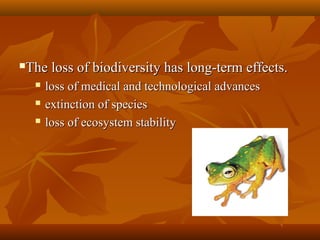
The loss of biodiversity has long-term effects.







loss of medical and technological advances
extinction of species
loss of ecosystem stability


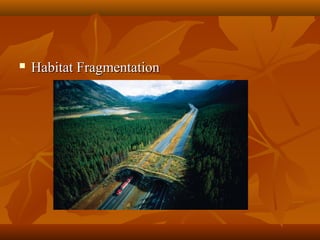
Habitat Fragmentation
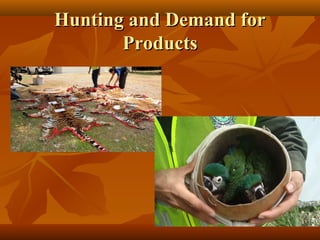
Hunting and Demand for
Products


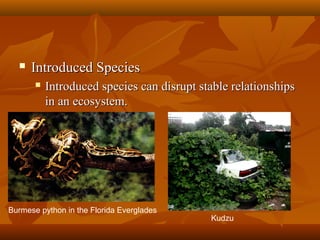
Introduced Species


Introduced species can disrupt stable relationships
in an ecosystem.

Burmese python in the Florida Everglades

Kudzu
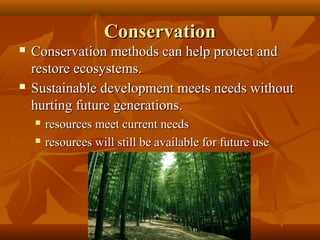
Conservation




Conservation methods can help protect and
restore ecosystems.
Sustainable development meets needs without
hurting future generations.



resources meet current needs
resources will still be available for future use


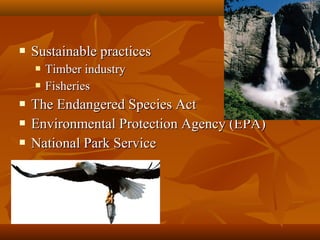
Sustainable practices







Timber industry
Fisheries

The Endangered Species Act
Environmental Protection Agency (EPA)
National Park Service

Chapter 5 notes

  • 1.
  • 2.
    5.1 How PopulationsGrow Population Density Population density is a measurement of the number of individuals living in a defined space. Scientists can calculate population density.
  • 3.
     Population dispersion refers tohow a population is spread in an area. Clumped dispersion Clumped Uniform dispersion Random Uniform Random dispersion
  • 4.
    Population Growth   The sizeof a population is always changing. Four factors affect the size of a population.     Immigration Births rate Emigration Death rate
  • 5.
     Population growth isbased on available resources.  Exponential growth is a rapid population increase due to an abundance of resources.
  • 6.
    However,  Most populations areregulated by predators, disease, and the availability of resources.   Because of this population will not exceed the environmental carrying capacity As a population grows, limited resources become depleted and the growth of the population slows.
  • 7.
      Logistic growth occurswhen a population is facing limited resources. Carrying capacity is the maximum number of individuals of a particular species that a particular environment can support.
  • 8.
    5.2 Limits toGrowth  Limiting factors – control the growth of a population  Density-dependent factors The rate at which they become depleted depends upon the population density of the population that uses them.  Competition  Predation  Disease  Overcrowding  Herbivory 
  • 9.
  • 10.
     Density-independent limiting factorslimit a population’s growth regardless of the size and density.     Hurricanes Drought Floods Wildfires
  • 11.
    1.During which timeperiod is birth rate higher than death rate? 2.During which time period are birth rate and death rate equal? 3.During which time period is death rate higher than birth rate?
  • 12.
    5.3 Human PopulationGrowth  For most of human existence, the population grew slowly because life was harsh.  Food was hard to find. Predators and diseases were common and life-threatening.  These limiting factors kept human death rates very high.
  • 13.
     Improved nutrition, sanitation,medicine, and healthcare, dramatically reduced death rates.  birthrates in most parts of the world remained high.  The combination of lower death rates and high birthrates led to exponential growth.
  • 14.
    6.2 Using ResourcesWisely  How do we obtain what we need from local and global environments without destroying those environments? Environmental Resources we affect:  Soil  Freshwater  Air
  • 15.
    Soil Resources  Healthy soilsupports both agriculture and forestry.    Topsoil – rich in organic matter and nutrients Loss of fertile soil can have dire consequences. Erosion – removal of soil by water or wind Desertification  Deforestation 
  • 16.
  • 17.
    Soil Use andSustainablility    Leaving stems and roots of the previous year’s crops Crop rotation Select Harvesting
  • 18.
    Freshwater Resources   drinking water,industry, transportation, energy, and waste disposal. Some farmland relies heavily on irrigation
  • 19.
    Water Pollution Many seriousenvironmental problems occur in our own backyard.  Agriculture introduces large amounts of chemicals into the global ecosystem.  Including: pesticides, herbicides, and fertilizers  Many chemicals, such as DDT, have been banned in the US, but the effects of their use still circulate. Causes biological magnification 
  • 21.
    Water Quality andSustainability    Protecting the water cycle Clean up pollution Conserve water
  • 22.
    Atmospheric Resources  Air qualityhas a direct impact on health.   Pollution Global temperature
  • 23.
    Coal-burning power plantssend smoke, containing sulfur, into the atmosphere through smokestacks.  Scientists now know that the sulfur can combine with water vapor to produce sulfuric acid, which will fall back to earth as acid rain. Acid rain causes forest damage, and dead lakes  Robl, Ernest H. Acid Rain Damage. Photograph 1990. Web. 21 Oct 2010.
  • 24.
    Decrease in theamount of ozone (O3) in the atmosphere allows more UV radiation to reach the earth’s surface.  This can cause an increase in diseases related to UV exposure such as cancer and cataracts. The major cause is chlorofluorocarbons (CFCs) commonly used in refrigerators, air conditioners, and in aerosols. As a result CFCs have been banned in the US. 
  • 25.
    Hole in theozone layer Rubin, Ken. “Ask an Earth Scientist.” Hawaii.Oct 2008. Web. 8 No
  • 26.
    The earths averageglobal temperature has been steadily increasing for more than a century (Global Warming)  Caused by the greenhouse effect, in which greenhouse gasses trap the suns energy within the atmosphere. 
  • 28.
     Earth’s resources mustbe used responsibly.    Careless use of resources makes them unavailable to future generations. An ecological footprint is the amount of land needed to support a person. The land must produce and maintain enough     food and water shelter energy Room for waste
  • 29.
  • 30.
    Determine your ecological footprint  Goto www.footprintnetwork.org/calculator to determine how many planet Earths it would take to support everyone if they lived like you.
  • 31.
    6.3 Biodiversity  Biodiversity isone of Earth’s greatest natural resources. When biodiversity is lost, significant value to the biosphere and to humanity may be lost along with it.
  • 32.
    The loss ofbiodiversity has long-term effects.     loss of medical and technological advances extinction of species loss of ecosystem stability
  • 33.
  • 34.
    Hunting and Demandfor Products
  • 35.
     Introduced Species  Introduced speciescan disrupt stable relationships in an ecosystem. Burmese python in the Florida Everglades Kudzu
  • 36.
    Conservation   Conservation methods canhelp protect and restore ecosystems. Sustainable development meets needs without hurting future generations.   resources meet current needs resources will still be available for future use
  • 37.
     Sustainable practices      Timber industry Fisheries TheEndangered Species Act Environmental Protection Agency (EPA) National Park Service