S
Darwin’s Theory of
Evolution
Chapter 16
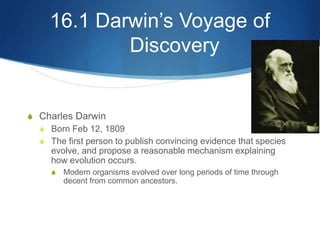
16.1 Darwin’s Voyage of
Discovery
S Charles Darwin
S Born Feb 12, 1809
S The first person to publish convincing evidence that species
evolve, and propose a reasonable mechanism explaining
how evolution occurs.
S Modern organisms evolved over long periods of time through
decent from common ancestors.
Science Before Darwin
S In Darwin’s time, most people and scientists believed that
each species exists, unchanged as it has for all time.
S However, views were beginning to change dramatically
S The Earth had changed along with all living things on Earth
S With the discovery of more and more fossils scientists
began to propose various mechanisms to explain how
these species change over time.
S Jean Baptiste Lamarck, in 1809, proposed a
hypothesis of the inheritance of acquired
characteristics.
S This hypothesis stated that by use or disuse of a
body part could cause change in that feature
within the lifetime of the organism.
S These changes would then be passed on to
offspring.
S Lamarck’s hypothesis is now known to be
incorrect.
Darwin’s Epic Journey
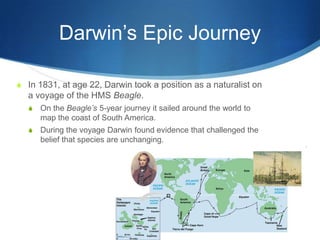
S In 1831, at age 22, Darwin took a position as a naturalist on
a voyage of the HMS Beagle.
S On the Beagle’s 5-year journey it sailed around the world to
map the coast of South America.
S During the voyage Darwin found evidence that challenged the
belief that species are unchanging.
Observations
S Three patterns of biological diversity:
1. Species vary globally
2. Species vary locally
3. Species vary over time
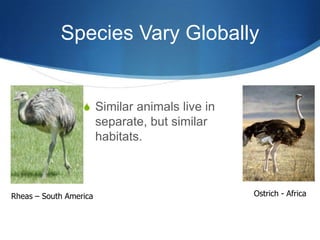
Species Vary Globally
S Similar animals live in
separate, but similar
habitats.
Rheas – South America Ostrich - Africa
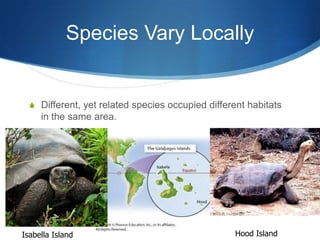
Species Vary Locally
S Different, yet related species occupied different habitats
in the same area.
Isabella Island Hood Island
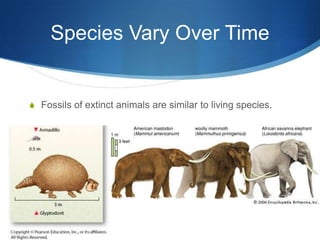
Species Vary Over Time
S Fossils of extinct animals are similar to living species.
Putting it Together
S Darwin noticed that the finches on each of the Galápagos
islands had differently shaped beaks, and were similar to
those in South America.
S He spent years researching his ideas after he returned.
S He began to wonder if the animals living on the different
islands had come from a common ancestor.
16.3 Darwin Presents His
Case
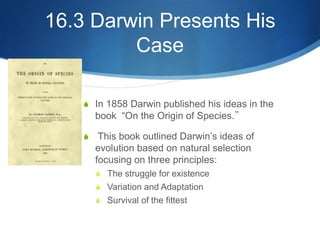
S In 1858 Darwin published his ideas in the
book “On the Origin of Species.”
S This book outlined Darwin’s ideas of
evolution based on natural selection
focusing on three principles:
S The struggle for existence
S Variation and Adaptation
S Survival of the fittest
Struggle for Existence
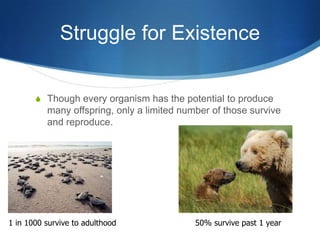
S Though every organism has the potential to produce
many offspring, only a limited number of those survive
and reproduce.
1 in 1000 survive to adulthood 50% survive past 1 year
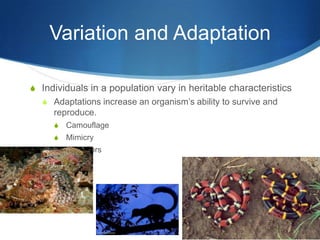
Variation and Adaptation
S Individuals in a population vary in heritable characteristics
S Adaptations increase an organism’s ability to survive and
reproduce.
S Camouflage
S Mimicry
S Behaviors
Survival of the Fittest
S Fitness is how well an organism can survive and
reproduce in its environment.
S Individuals with a high fitness are well suited for their
environment and are more likely to survive and reproduce.
S Individuals with low fitness are not as well suited to their
environment therefore will either die or leave few offspring.
Natural Selection
S These mechanisms allow for natural selection to occur.
S Each generation populations continue to change as more
individuals are born with favorable traits for the environment.
S It is important to remember that if environmental
conditions change faster than a species can adapt to the
changes, the species may become extinct.
S Example p. 462
16.4 Evidence of Evolution
The Age of the Earth and The Fossil Record
S Earth is 4.5 billion years old
S Fossils provide the most direct evidence that evolution
takes place.
S Fossils are preserved or mineralized remains or imprint of
an organism that lived long ago.
S Fossils provide an actual record of Earth’s past life
forms.
S Fossils are used to trace the evolution of modern
species from extinct species.
S Although the fossil record is not, and will never, be
complete it presents strong evidence that evolution
has taken place.
S Paleontologists analyze fossils by dating the rocks
and minerals around it.
S They can arrange the fossils from oldest to
youngest, and in this, orderly patterns of evolution
can be seen.
Comparing Anatomy and Embryology
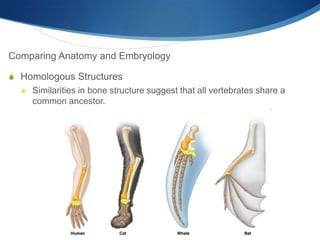
S Homologous Structures
S Similarities in bone structure suggest that all vertebrates share a
common ancestor.
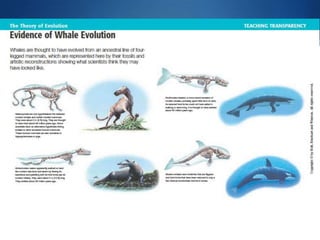
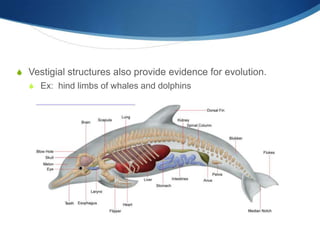
S Vestigial structures also provide evidence for evolution.
S Ex: hind limbs of whales and dolphins
Embryology
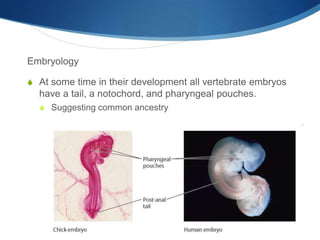
S At some time in their development all vertebrate embryos
have a tail, a notochord, and pharyngeal pouches.
S Suggesting common ancestry
Genetics and Molecular
Evidence
S Similarities in gene sequences can be linked to common
ancestry.
S Today we now know that genes are responsible for
inherited traits.
S Traits become more common in a population because more
individuals in the population carry the alleles for those forms.
S Mutations and the recombination of alleles that occurs during
sexual reproduction provide endless sources of new variations
for natural selection to act upon.
S Analyzing Data p.470
Examples of Evolution
Natural Selection at Work
S The key lesson scientists have learned about evolution by
natural selection is that the environment dictated the direction
and amount of change.
S Ex: The polar bear’s white fur enables it to hunt successfully
in its snowy environment. In a warmer environment, having
white fur would no longer be an advantage.
Examples of Natural Selection
S Bacteria that cause disease evolve to have resistance to
antibiotics.
S Ex: TB, Staff

Notes ch16

  • 1.
  • 2.
    16.1 Darwin’s Voyageof Discovery S Charles Darwin S Born Feb 12, 1809 S The first person to publish convincing evidence that species evolve, and propose a reasonable mechanism explaining how evolution occurs. S Modern organisms evolved over long periods of time through decent from common ancestors.
  • 3.
    Science Before Darwin SIn Darwin’s time, most people and scientists believed that each species exists, unchanged as it has for all time. S However, views were beginning to change dramatically S The Earth had changed along with all living things on Earth S With the discovery of more and more fossils scientists began to propose various mechanisms to explain how these species change over time.
  • 4.
    S Jean BaptisteLamarck, in 1809, proposed a hypothesis of the inheritance of acquired characteristics. S This hypothesis stated that by use or disuse of a body part could cause change in that feature within the lifetime of the organism. S These changes would then be passed on to offspring. S Lamarck’s hypothesis is now known to be incorrect.
  • 5.
    Darwin’s Epic Journey SIn 1831, at age 22, Darwin took a position as a naturalist on a voyage of the HMS Beagle. S On the Beagle’s 5-year journey it sailed around the world to map the coast of South America. S During the voyage Darwin found evidence that challenged the belief that species are unchanging.
  • 6.
    Observations S Three patternsof biological diversity: 1. Species vary globally 2. Species vary locally 3. Species vary over time
  • 7.
    Species Vary Globally SSimilar animals live in separate, but similar habitats. Rheas – South America Ostrich - Africa
  • 8.
    Species Vary Locally SDifferent, yet related species occupied different habitats in the same area. Isabella Island Hood Island
  • 9.
    Species Vary OverTime S Fossils of extinct animals are similar to living species.
  • 10.
    Putting it Together SDarwin noticed that the finches on each of the Galápagos islands had differently shaped beaks, and were similar to those in South America. S He spent years researching his ideas after he returned. S He began to wonder if the animals living on the different islands had come from a common ancestor.
  • 11.
    16.3 Darwin PresentsHis Case S In 1858 Darwin published his ideas in the book “On the Origin of Species.” S This book outlined Darwin’s ideas of evolution based on natural selection focusing on three principles: S The struggle for existence S Variation and Adaptation S Survival of the fittest
  • 12.
    Struggle for Existence SThough every organism has the potential to produce many offspring, only a limited number of those survive and reproduce. 1 in 1000 survive to adulthood 50% survive past 1 year
  • 13.
    Variation and Adaptation SIndividuals in a population vary in heritable characteristics S Adaptations increase an organism’s ability to survive and reproduce. S Camouflage S Mimicry S Behaviors
  • 14.
    Survival of theFittest S Fitness is how well an organism can survive and reproduce in its environment. S Individuals with a high fitness are well suited for their environment and are more likely to survive and reproduce. S Individuals with low fitness are not as well suited to their environment therefore will either die or leave few offspring.
  • 15.
    Natural Selection S Thesemechanisms allow for natural selection to occur. S Each generation populations continue to change as more individuals are born with favorable traits for the environment. S It is important to remember that if environmental conditions change faster than a species can adapt to the changes, the species may become extinct. S Example p. 462
  • 16.
    16.4 Evidence ofEvolution The Age of the Earth and The Fossil Record S Earth is 4.5 billion years old S Fossils provide the most direct evidence that evolution takes place. S Fossils are preserved or mineralized remains or imprint of an organism that lived long ago. S Fossils provide an actual record of Earth’s past life forms. S Fossils are used to trace the evolution of modern species from extinct species.
  • 17.
    S Although thefossil record is not, and will never, be complete it presents strong evidence that evolution has taken place. S Paleontologists analyze fossils by dating the rocks and minerals around it. S They can arrange the fossils from oldest to youngest, and in this, orderly patterns of evolution can be seen.
  • 19.
    Comparing Anatomy andEmbryology S Homologous Structures S Similarities in bone structure suggest that all vertebrates share a common ancestor.
  • 20.
    S Vestigial structuresalso provide evidence for evolution. S Ex: hind limbs of whales and dolphins
  • 21.
    Embryology S At sometime in their development all vertebrate embryos have a tail, a notochord, and pharyngeal pouches. S Suggesting common ancestry
  • 22.
    Genetics and Molecular Evidence SSimilarities in gene sequences can be linked to common ancestry. S Today we now know that genes are responsible for inherited traits. S Traits become more common in a population because more individuals in the population carry the alleles for those forms. S Mutations and the recombination of alleles that occurs during sexual reproduction provide endless sources of new variations for natural selection to act upon. S Analyzing Data p.470
  • 23.
    Examples of Evolution NaturalSelection at Work S The key lesson scientists have learned about evolution by natural selection is that the environment dictated the direction and amount of change. S Ex: The polar bear’s white fur enables it to hunt successfully in its snowy environment. In a warmer environment, having white fur would no longer be an advantage. Examples of Natural Selection S Bacteria that cause disease evolve to have resistance to antibiotics. S Ex: TB, Staff