Chapter 2
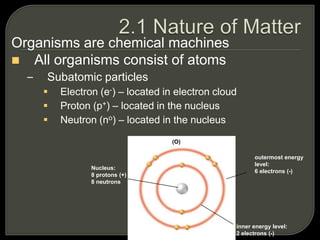
Organisms are chemical machines
 All organisms consist of atoms
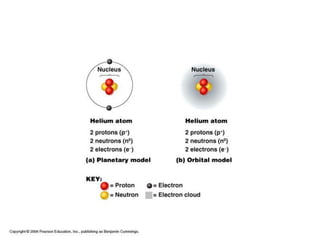
– Subatomic particles
 Electron (e-) – located in electron cloud
 Proton (p+) – located in the nucleus
 Neutron (no) – located in the nucleus
Oxygen atom (O)
Nucleus:
8 protons (+)
8 neutrons
outermost energy
level:
6 electrons (-)
inner energy level:
2 electrons (-)
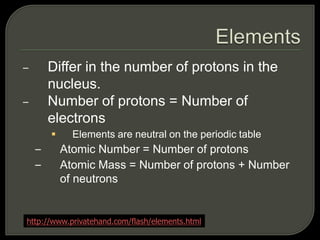
– Differ in the number of protons in the
nucleus.
– Number of protons = Number of
electrons
 Elements are neutral on the periodic table
– Atomic Number = Number of protons
– Atomic Mass = Number of protons + Number
of neutrons
http://www.privatehand.com/flash/elements.html
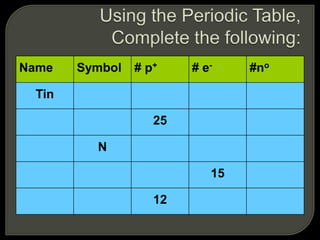
Name Symbol # p+ # e- #no
Tin
25
N
15
12
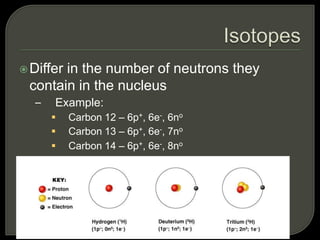
Differ in the number of neutrons they
contain in the nucleus
– Example:
 Carbon 12 – 6p+, 6e-, 6no
 Carbon 13 – 6p+, 6e-, 7no
 Carbon 14 – 6p+, 6e-, 8no
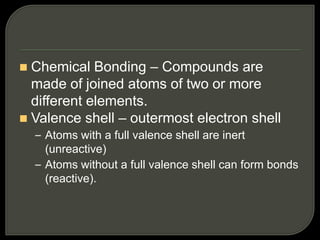
 Chemical Bonding – Compounds are
made of joined atoms of two or more
different elements.
 Valence shell – outermost electron shell
– Atoms with a full valence shell are inert
(unreactive)
– Atoms without a full valence shell can form bonds
(reactive).
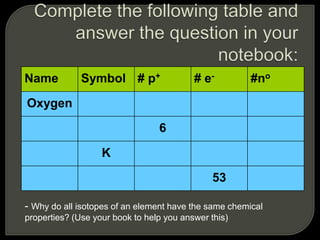
Name Symbol # p+ # e- #no
Oxygen
6
K
53
- Why do all isotopes of an element have the same chemical
properties? (Use your book to help you answer this)
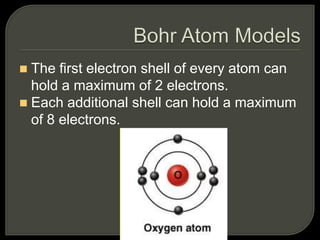
 The first electron shell of every atom can
hold a maximum of 2 electrons.
 Each additional shell can hold a maximum
of 8 electrons.
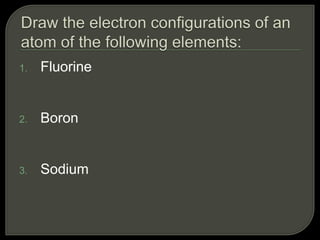
1. Fluorine
2. Boron
3. Sodium
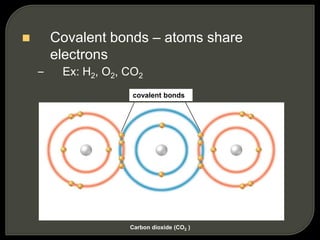
 Covalent bonds – atoms share
electrons
– Ex: H2, O2, CO2
covalent bonds
Oxygen atom (O) Carbon atom (C) Oxygen atom (O)
Carbon dioxide (CO2 )
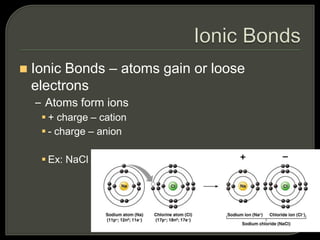
 Ionic Bonds – atoms gain or loose
electrons
– Atoms form ions
 + charge – cation
 - charge – anion
 Ex: NaCl
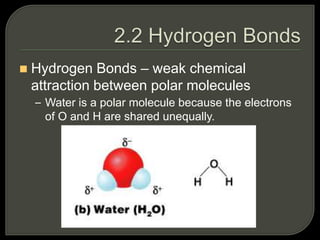
 Hydrogen Bonds – weak chemical
attraction between polar molecules
– Water is a polar molecule because the electrons
of O and H are shared unequally.
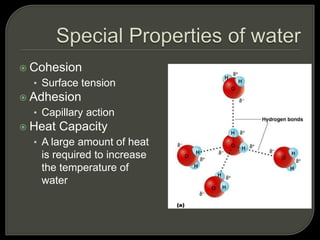
 Cohesion
• Surface tension
 Adhesion
• Capillary action
 Heat Capacity
• A large amount of heat
is required to increase
the temperature of
water
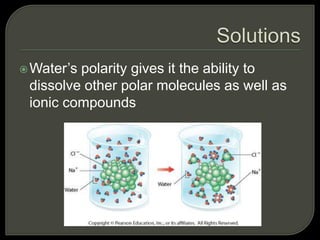
Water’s polarity gives it the ability to
dissolve other polar molecules as well as
ionic compounds
H2O H+ + OH-
The pH scale indicates the concentration
of H+ ions in a solution.
• Acids – contain more H+ ions therefore have a pH
below 7
 The lower the pH the greater the acidity
• Bases – contain more OH- ions therefore have a
pH above 7
 The higher the pH the more basic
• Neutral – contain equal OH- and H+ ions
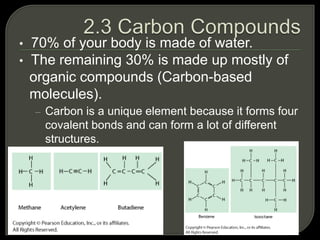
• 70% of your body is made of water.
• The remaining 30% is made up mostly of
organic compounds (Carbon-based
molecules).
– Carbon is a unique element because it forms four
covalent bonds and can form a lot of different
structures.
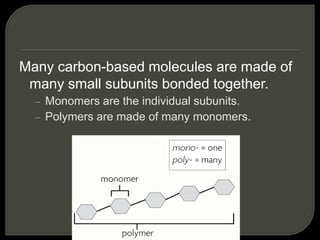
Many carbon-based molecules are made of
many small subunits bonded together.
– Monomers are the individual subunits.
– Polymers are made of many monomers.
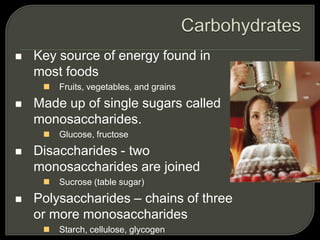
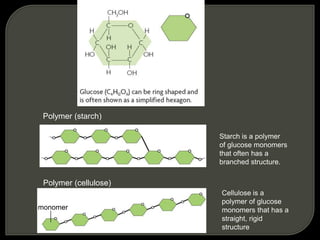
 Key source of energy found in
most foods
 Fruits, vegetables, and grains
 Made up of single sugars called
monosaccharides.
 Glucose, fructose
 Disaccharides - two
monosaccharides are joined
 Sucrose (table sugar)
 Polysaccharides – chains of three
or more monosaccharides
 Starch, cellulose, glycogen
Polymer (starch)
Starch is a polymer
of glucose monomers
that often has a
branched structure.
Polymer (cellulose)
Cellulose is a
polymer of glucose
monomers that has a
straight, rigid
structure
monomer
 Nonpolar molecules not soluble in water
 Fats, phospholipids (make up the cell membrane),
steroids (cholesterol), waxes
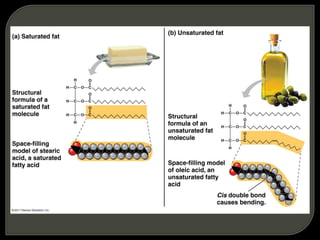
 Saturated fatty acids
 Solid at room temperature
 Butter, lard, grease
 Unsaturated fatty acids
 Liquid at room temperature
 Olive oil, fish oil
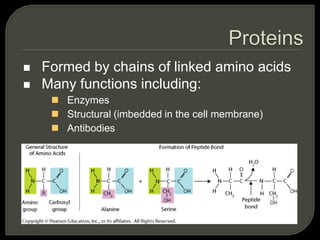
 Formed by chains of linked amino acids
 Many functions including:
 Enzymes
 Structural (imbedded in the cell membrane)
 Antibodies
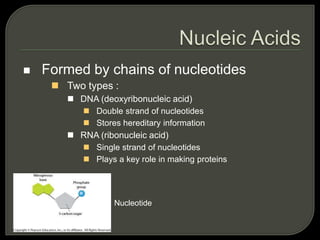
 Formed by chains of nucleotides
 Two types :
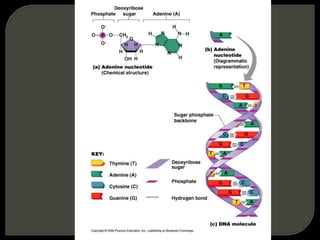
 DNA (deoxyribonucleic acid)
 Double strand of nucleotides
 Stores hereditary information
 RNA (ribonucleic acid)
 Single strand of nucleotides
 Plays a key role in making proteins
Nucleotide
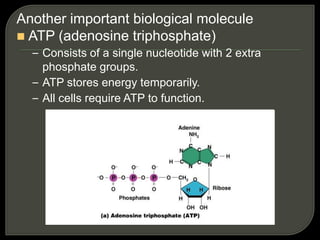
Another important biological molecule
 ATP (adenosine triphosphate)
– Consists of a single nucleotide with 2 extra
phosphate groups.
– ATP stores energy temporarily.
– All cells require ATP to function.
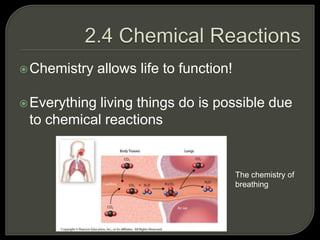
Chemistry allows life to function!
Everything living things do is possible due
to chemical reactions
The chemistry of
breathing
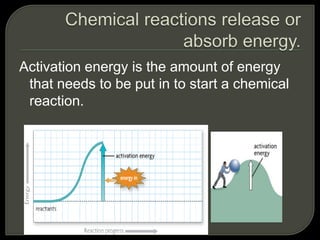
Activation energy is the amount of energy
that needs to be put in to start a chemical
reaction.
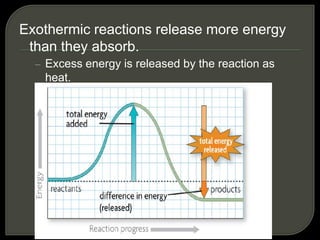
Exothermic reactions release more energy
than they absorb.
– Excess energy is released by the reaction as
heat.
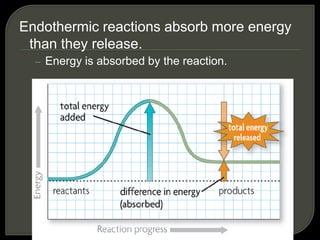
Endothermic reactions absorb more energy
than they release.
– Energy is absorbed by the reaction.
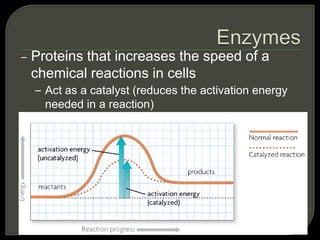
– Proteins that increases the speed of a
chemical reactions in cells
– Act as a catalyst (reduces the activation energy
needed in a reaction)
 Any factor that changes the shape of an
enzyme can affect the enzyme’s activity.
– An enzyme’s function depends on its structure.
– Denaturing (changing the structure) the protein by
changes in temperature or pH
– Example: pepsin

Honors ch2 notes 2013

  • 1.
  • 2.
    Organisms are chemicalmachines  All organisms consist of atoms – Subatomic particles  Electron (e-) – located in electron cloud  Proton (p+) – located in the nucleus  Neutron (no) – located in the nucleus Oxygen atom (O) Nucleus: 8 protons (+) 8 neutrons outermost energy level: 6 electrons (-) inner energy level: 2 electrons (-)
  • 4.
    – Differ inthe number of protons in the nucleus. – Number of protons = Number of electrons  Elements are neutral on the periodic table – Atomic Number = Number of protons – Atomic Mass = Number of protons + Number of neutrons http://www.privatehand.com/flash/elements.html
  • 5.
    Name Symbol #p+ # e- #no Tin 25 N 15 12
  • 6.
    Differ in thenumber of neutrons they contain in the nucleus – Example:  Carbon 12 – 6p+, 6e-, 6no  Carbon 13 – 6p+, 6e-, 7no  Carbon 14 – 6p+, 6e-, 8no
  • 7.
     Chemical Bonding– Compounds are made of joined atoms of two or more different elements.  Valence shell – outermost electron shell – Atoms with a full valence shell are inert (unreactive) – Atoms without a full valence shell can form bonds (reactive).
  • 8.
    Name Symbol #p+ # e- #no Oxygen 6 K 53 - Why do all isotopes of an element have the same chemical properties? (Use your book to help you answer this)
  • 9.
     The firstelectron shell of every atom can hold a maximum of 2 electrons.  Each additional shell can hold a maximum of 8 electrons.
  • 10.
  • 11.
     Covalent bonds– atoms share electrons – Ex: H2, O2, CO2 covalent bonds Oxygen atom (O) Carbon atom (C) Oxygen atom (O) Carbon dioxide (CO2 )
  • 12.
     Ionic Bonds– atoms gain or loose electrons – Atoms form ions  + charge – cation  - charge – anion  Ex: NaCl
  • 13.
     Hydrogen Bonds– weak chemical attraction between polar molecules – Water is a polar molecule because the electrons of O and H are shared unequally.
  • 14.
     Cohesion • Surfacetension  Adhesion • Capillary action  Heat Capacity • A large amount of heat is required to increase the temperature of water
  • 15.
    Water’s polarity givesit the ability to dissolve other polar molecules as well as ionic compounds
  • 16.
    H2O H+ +OH- The pH scale indicates the concentration of H+ ions in a solution. • Acids – contain more H+ ions therefore have a pH below 7  The lower the pH the greater the acidity • Bases – contain more OH- ions therefore have a pH above 7  The higher the pH the more basic • Neutral – contain equal OH- and H+ ions
  • 17.
    • 70% ofyour body is made of water. • The remaining 30% is made up mostly of organic compounds (Carbon-based molecules). – Carbon is a unique element because it forms four covalent bonds and can form a lot of different structures.
  • 18.
    Many carbon-based moleculesare made of many small subunits bonded together. – Monomers are the individual subunits. – Polymers are made of many monomers.
  • 19.
     Key sourceof energy found in most foods  Fruits, vegetables, and grains  Made up of single sugars called monosaccharides.  Glucose, fructose  Disaccharides - two monosaccharides are joined  Sucrose (table sugar)  Polysaccharides – chains of three or more monosaccharides  Starch, cellulose, glycogen
  • 20.
    Polymer (starch) Starch isa polymer of glucose monomers that often has a branched structure. Polymer (cellulose) Cellulose is a polymer of glucose monomers that has a straight, rigid structure monomer
  • 21.
     Nonpolar moleculesnot soluble in water  Fats, phospholipids (make up the cell membrane), steroids (cholesterol), waxes  Saturated fatty acids  Solid at room temperature  Butter, lard, grease  Unsaturated fatty acids  Liquid at room temperature  Olive oil, fish oil
  • 23.
     Formed bychains of linked amino acids  Many functions including:  Enzymes  Structural (imbedded in the cell membrane)  Antibodies
  • 24.
     Formed bychains of nucleotides  Two types :  DNA (deoxyribonucleic acid)  Double strand of nucleotides  Stores hereditary information  RNA (ribonucleic acid)  Single strand of nucleotides  Plays a key role in making proteins Nucleotide
  • 26.
    Another important biologicalmolecule  ATP (adenosine triphosphate) – Consists of a single nucleotide with 2 extra phosphate groups. – ATP stores energy temporarily. – All cells require ATP to function.
  • 27.
    Chemistry allows lifeto function! Everything living things do is possible due to chemical reactions The chemistry of breathing
  • 28.
    Activation energy isthe amount of energy that needs to be put in to start a chemical reaction.
  • 29.
    Exothermic reactions releasemore energy than they absorb. – Excess energy is released by the reaction as heat.
  • 30.
    Endothermic reactions absorbmore energy than they release. – Energy is absorbed by the reaction.
  • 31.
    – Proteins thatincreases the speed of a chemical reactions in cells – Act as a catalyst (reduces the activation energy needed in a reaction)
  • 32.
     Any factorthat changes the shape of an enzyme can affect the enzyme’s activity. – An enzyme’s function depends on its structure. – Denaturing (changing the structure) the protein by changes in temperature or pH – Example: pepsin