Modulation and Demodulation                    2459
66.28. Demodulation or Detection
    When the RF modulated waves, radiated out from the transmitter antenna, after travelling through
space, strike the receiving aerials, they induce very weak RF currents and voltages in them. If these
high-frequency currents are passed through headphones or loudspeakers, they produce no effect on
them because all such sound-producing devices are unable to respond to such high frequencies due
to large inertia of their vibrating discs etc. Neither will such RF currents produce any effect on
human ear because their frequencies are much beyond the audible frequencies (20 to 20,000 Hz
approximately). Hence, it is necessary to demodulate them first in order that the sound-producing
devices may be actuated by audio-frequency current similar to that used for modulating the carrier
wave at the broadcasting station.
    This process of recovering AF signal from the modulated carrier wave is known as demodu-
lation or detection.
    The demodulation of an AM wave involves two operations :


                                                                                 m )
    (i) rectification of the modulated wave and


                                                                              co
    (ii) elimination of the RF component of the modulated wave.
    However, demodulation of an FM wave involves three operations (i) conversion of frequency


                                                                          er.
changes produced by modulating signal into corresponding amplitude changes, (ii) rectification of

                                                                      erg
the modulating signal and (iii) elimination of RF component of the modulated wave.
                                                                 litm
66.29. Essentials of AM Detection
    For recovering the AF waveform from modulated
                                                             fsp


wave (a mixture of AF wave and RF carrier), it is
                                                        .pd


essential to find some way of reducing (or better, elimi-
nating) one half of the modulated wave. The result of
                                                    ww


this elimination (or rectification) would be that the
average value of the wave would not be zero because,
                                                /w


now, the impulse would be all in one direction as shown
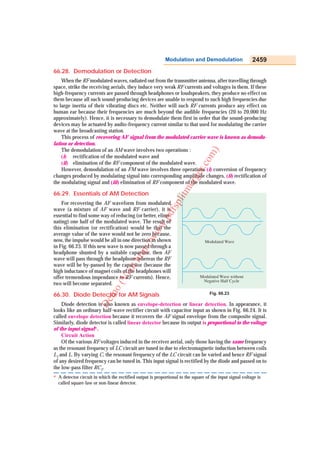
in Fig. 66.23. If this new wave is now passed through a
                                             p:/


headphone shunted by a suitable capacitor, then AF
                                         htt


wave will pass through the headphone whereas the RF
wave will be by-passed by the capacitor (because the
                                     sit


high inductance of magnet coils of the headphones will
                                  Vi


offer tremendous impendance to RF currents). Hence,
two will become separated.
                              o(


66.30. Diode Detector for AM Signals
                           m


                                                                                   Fig. 66.23
                        De


    Diode detection is also known as envelope-detection or linear detection. In appearance, it
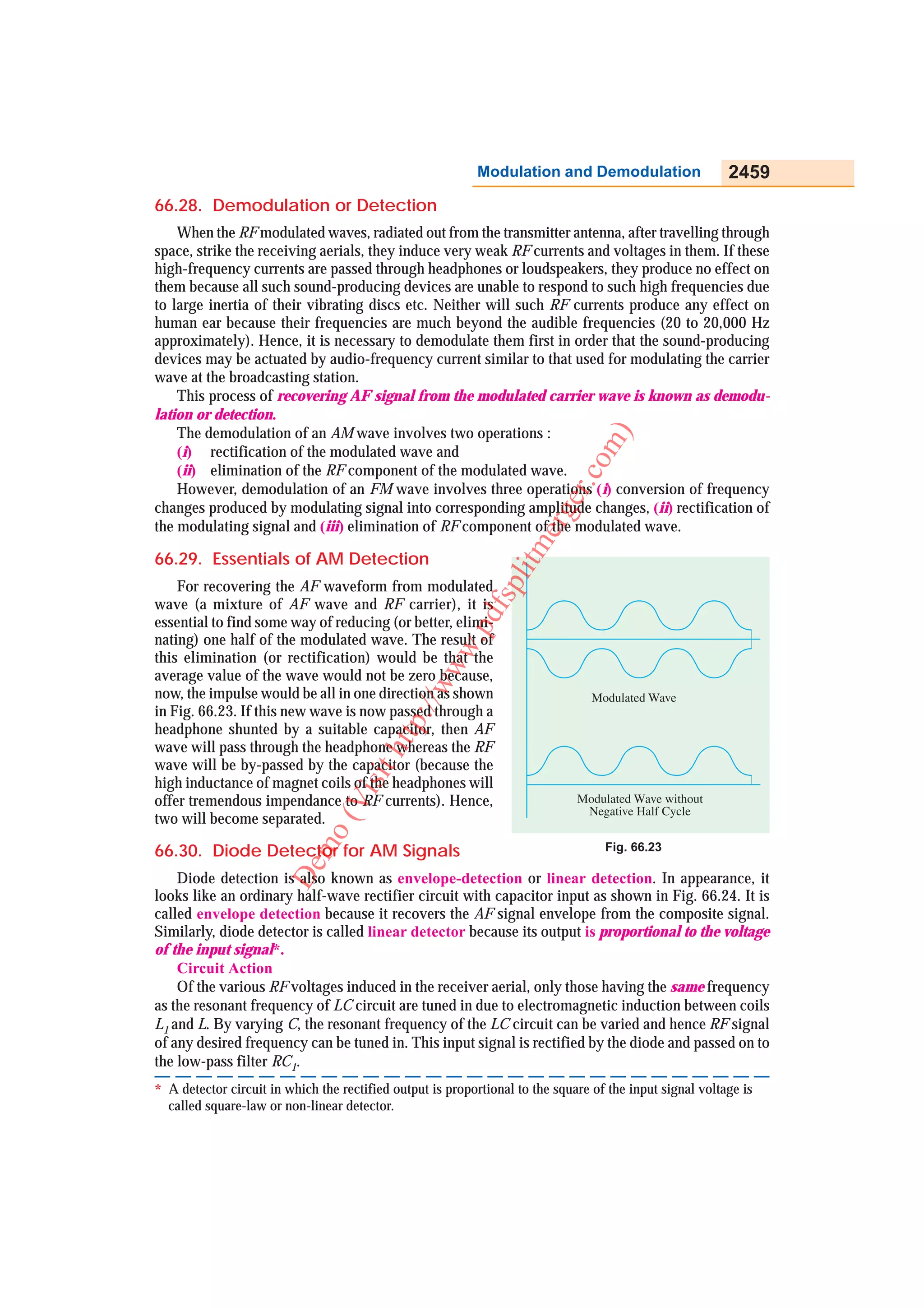
looks like an ordinary half-wave rectifier circuit with capacitor input as shown in Fig. 66.24. It is
called envelope detection because it recovers the AF signal envelope from the composite signal.
Similarly, diode detector is called linear detector because its output is proportional to the voltage
of the input signal*.
    Circuit Action
    Of the various RF voltages induced in the receiver aerial, only those having the same frequency
as the resonant frequency of LC circuit are tuned in due to electromagnetic induction between coils
L1 and L. By varying C, the resonant frequency of the LC circuit can be varied and hence RF signal
of any desired frequency can be tuned in. This input signal is rectified by the diode and passed on to
the low-pass filter RC1.
* A detector circuit in which the rectified output is proportional to the square of the input signal voltage is
  called square-law or non-linear detector.
2460       Electrical Technology


                                                                       DC & AF         AF
                                                                        Signal        Signal


                                    Modulated
                                     Selected            Rectified
                                      Signal              Signal
                                                                                 CB

                                                 Diode                                Output
                       L1                              RF
                             L        C               Waves           C1 R   DC


                                                                             )
                                                Fig. 66.24


                                                                           m
    The RF carrier wave is filtered out by low-reactance capacitor C1 which is called RF filter


                                                                        co
capacitor or RF by-pass capacitor. The dc component of the remaining signal is shunted out through


                                                                      er.
R because it cannot pass through blocking capacitor CB. But the low, frequency AF signal can easily
get through CB and becomes available across the output. When passed through a suitable device,

                                                                     erg
say, a headphone, the original sound can be heard.             litm
    Advantages
    Diode detectors are extensively used in AM broadcast receivers because they have the following
advantages :
                                                           fsp


      1. They can handle comparatively large input signals;
                                                    .pd


      2. They can be operated as linear or power detectors;
      3. They rectify with negligible distortion and, hence, have good linearity;
                                                ww


      4. They are well-adopted for use in simple automatic-gain control circuits.
    Disadvantages
                                           /w


    However, the disadvantages are that
                                          p:/


       1. they do not have the ability to amplify the rectified signal by themselves as is done by a
          transistor detector (Art. 66.31). However, it is not a very serious drawback since signal
                                    htt


          amplification can be affected both before and after rectification;
                                 sit


       2. while conducting, the diode consumes some power which reduces the Q of its tuned circuit
          as well as its gain and selectivity.
                              Vi
                            o(


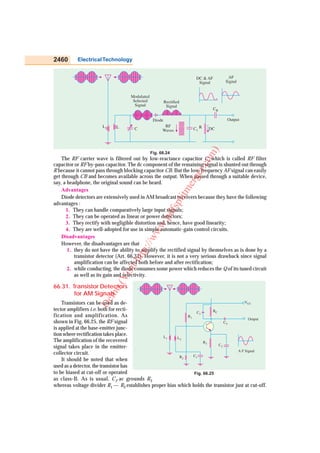
66.31. Transistor Detectors
        for AM Signals
                        m
                     De


    Transistors can be used as de-                                                      VCC
tector amplifiers i.e. both for recti-                                   RC
                                                                 C3
fication and amplification. As                              R1
                                                                                          Output
shown in Fig. 66.25, the RF signal                                             C4
is applied at the base-emitter junc-
tion where rectification takes place.            L1     L2
The amplification of the recovered                                  R3
signal takes place in the emitter-                                          C2
                                                                                    A F Signal
collector circuit.                                             C1
                                                         R2
    It should be noted that when
used as a detector, the transistor has
to be biased at cut-off or operated                            Fig. 66.25
as class-B. As is usual, C2 ac grounds R 3
whereas voltage divider R1 — R2 establishes proper bias which holds the transistor just at cut-off.
Modulation and Demodulation                2461
Obviously, only positive half-cycles of the modulated RF input signal will drive the transistor into
conduction, whereas negative half-cycles would be cut-off. Thus, rectification of the input signal
takes place in the base-emitter circuit. The small variations in base current produced by the positive
half-cycle of the input signal produce large (β time ) variations in the collector current. Hence, an
amplified version of the rectified signal appears across RC – C3 combination. C3 eliminates RF
component so that only AF signal voltage drops across RC. The capacitor C4 permits AF signal to
pass through but blocks its dc component.

66.32. FM Detection
    As discussed earlier, an FM carrier signal contains information (or intelligence we wish to con-
vey) in the form of frequency variations above and below the centre frequency of the carrier. For
recovering the information, we must first convert the FM signal in such a way that it appears as a
modulated RF voltage across the diode. A simple method of converting frequency variations into


                                                                          m )
voltage variations is to make use of the principle that reactance (of coil or capacitor) varies with


                                                                       co
frequency. When an FM signal is applied to an inductor, the current flowing through it varies in
amplitude according to the changes in frequency of the applied signal. Now, changes in frequency of


                                                                    er.
the FM signal depend on the amplitude of the modulating AF signal. Hence, the current in the

                                                                erg
inductor varies as per the amplitude of the original modulating signal. In this way, frequency changes
in FM signal are converted into amplitude changes in current. These changes in current when passed
                                                           litm
through a resistor produce corresponding changes in voltage.
    Hence, we find that, ultimately, frequency variations in FM signal are converted into voltage
                                                       fsp


changes. Also, there exists a linear relation between the two – something essential for distortion-less
demodulation.
                                                   .pd


    FM demodulation may be carried out with the help of (i) ratio detector and (ii) quadrature detector.
                                               ww


66.33. Quadrature Detector
                                            /w


    This detector depends on the frequency/phase relationship of a tuned circuit. It uses only one
                                         p:/


tuned circuit and is becoming increasingly popular in the integrated FM strips.
    Theory
                                      htt


    Let us first consider the general principle. A sinusoidal current is given by the equation
                   i = Im sin θ = Im sin ωt
                                  sit


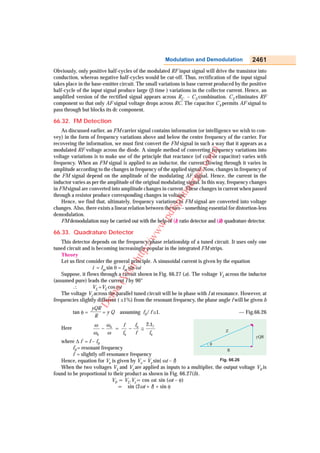
    Suppose, it flows through a circuit shown in Fig. 66.27 (a). The voltage VL across the inductor
                               Vi


(assumed pure) leads the current I by 90°
                            o(


         ∴         VL =VL cos ωt
    The voltage Vz across the parallel tuned circuit will be in phase with I at resonance. However, at
                         m


frequencies slightly different ( ±1%) from the resonant frequency, the phase angle f will be given b
                      De


                    yQR
          tan φ =       =yQ     assuming f0 / f ≅1.                                       — Fig.66.26
                     R
                    ω   ω    f    f   2∆ f
   Here                − 0 =    − 0 ≅
                    ω0  ω    f0   f    f0
   where ∆ f = f – f0
         f0 = resonant frequency
         f = slightly off-resonance frequency
   Hence, equation for Vz is given by Vz = Vz sin( ωt – f)                  Fig. 66.26
   When the two voltages VL and Vz are applied as inputs to a multiplier, the output voltage V0 is
found to be proportional to their product as shown in Fig. 66.27(b).
                            V0 ∝ VL.Vz ∝ cos ωt. sin (ωt – φ)
                               ∝ sin (2ωt + f) + sin φ

Demodulation

  • 1.
    Modulation and Demodulation 2459 66.28. Demodulation or Detection When the RF modulated waves, radiated out from the transmitter antenna, after travelling through space, strike the receiving aerials, they induce very weak RF currents and voltages in them. If these high-frequency currents are passed through headphones or loudspeakers, they produce no effect on them because all such sound-producing devices are unable to respond to such high frequencies due to large inertia of their vibrating discs etc. Neither will such RF currents produce any effect on human ear because their frequencies are much beyond the audible frequencies (20 to 20,000 Hz approximately). Hence, it is necessary to demodulate them first in order that the sound-producing devices may be actuated by audio-frequency current similar to that used for modulating the carrier wave at the broadcasting station. This process of recovering AF signal from the modulated carrier wave is known as demodu- lation or detection. The demodulation of an AM wave involves two operations : m ) (i) rectification of the modulated wave and co (ii) elimination of the RF component of the modulated wave. However, demodulation of an FM wave involves three operations (i) conversion of frequency er. changes produced by modulating signal into corresponding amplitude changes, (ii) rectification of erg the modulating signal and (iii) elimination of RF component of the modulated wave. litm 66.29. Essentials of AM Detection For recovering the AF waveform from modulated fsp wave (a mixture of AF wave and RF carrier), it is .pd essential to find some way of reducing (or better, elimi- nating) one half of the modulated wave. The result of ww this elimination (or rectification) would be that the average value of the wave would not be zero because, /w now, the impulse would be all in one direction as shown in Fig. 66.23. If this new wave is now passed through a p:/ headphone shunted by a suitable capacitor, then AF htt wave will pass through the headphone whereas the RF wave will be by-passed by the capacitor (because the sit high inductance of magnet coils of the headphones will Vi offer tremendous impendance to RF currents). Hence, two will become separated. o( 66.30. Diode Detector for AM Signals m Fig. 66.23 De Diode detection is also known as envelope-detection or linear detection. In appearance, it looks like an ordinary half-wave rectifier circuit with capacitor input as shown in Fig. 66.24. It is called envelope detection because it recovers the AF signal envelope from the composite signal. Similarly, diode detector is called linear detector because its output is proportional to the voltage of the input signal*. Circuit Action Of the various RF voltages induced in the receiver aerial, only those having the same frequency as the resonant frequency of LC circuit are tuned in due to electromagnetic induction between coils L1 and L. By varying C, the resonant frequency of the LC circuit can be varied and hence RF signal of any desired frequency can be tuned in. This input signal is rectified by the diode and passed on to the low-pass filter RC1. * A detector circuit in which the rectified output is proportional to the square of the input signal voltage is called square-law or non-linear detector.
  • 2.
    2460 Electrical Technology DC & AF AF Signal Signal Modulated Selected Rectified Signal Signal CB Diode Output L1 RF L C Waves C1 R DC ) Fig. 66.24 m The RF carrier wave is filtered out by low-reactance capacitor C1 which is called RF filter co capacitor or RF by-pass capacitor. The dc component of the remaining signal is shunted out through er. R because it cannot pass through blocking capacitor CB. But the low, frequency AF signal can easily get through CB and becomes available across the output. When passed through a suitable device, erg say, a headphone, the original sound can be heard. litm Advantages Diode detectors are extensively used in AM broadcast receivers because they have the following advantages : fsp 1. They can handle comparatively large input signals; .pd 2. They can be operated as linear or power detectors; 3. They rectify with negligible distortion and, hence, have good linearity; ww 4. They are well-adopted for use in simple automatic-gain control circuits. Disadvantages /w However, the disadvantages are that p:/ 1. they do not have the ability to amplify the rectified signal by themselves as is done by a transistor detector (Art. 66.31). However, it is not a very serious drawback since signal htt amplification can be affected both before and after rectification; sit 2. while conducting, the diode consumes some power which reduces the Q of its tuned circuit as well as its gain and selectivity. Vi o( 66.31. Transistor Detectors for AM Signals m De Transistors can be used as de- VCC tector amplifiers i.e. both for recti- RC C3 fication and amplification. As R1 Output shown in Fig. 66.25, the RF signal C4 is applied at the base-emitter junc- tion where rectification takes place. L1 L2 The amplification of the recovered R3 signal takes place in the emitter- C2 A F Signal collector circuit. C1 R2 It should be noted that when used as a detector, the transistor has to be biased at cut-off or operated Fig. 66.25 as class-B. As is usual, C2 ac grounds R 3 whereas voltage divider R1 — R2 establishes proper bias which holds the transistor just at cut-off.
  • 3.
    Modulation and Demodulation 2461 Obviously, only positive half-cycles of the modulated RF input signal will drive the transistor into conduction, whereas negative half-cycles would be cut-off. Thus, rectification of the input signal takes place in the base-emitter circuit. The small variations in base current produced by the positive half-cycle of the input signal produce large (β time ) variations in the collector current. Hence, an amplified version of the rectified signal appears across RC – C3 combination. C3 eliminates RF component so that only AF signal voltage drops across RC. The capacitor C4 permits AF signal to pass through but blocks its dc component. 66.32. FM Detection As discussed earlier, an FM carrier signal contains information (or intelligence we wish to con- vey) in the form of frequency variations above and below the centre frequency of the carrier. For recovering the information, we must first convert the FM signal in such a way that it appears as a modulated RF voltage across the diode. A simple method of converting frequency variations into m ) voltage variations is to make use of the principle that reactance (of coil or capacitor) varies with co frequency. When an FM signal is applied to an inductor, the current flowing through it varies in amplitude according to the changes in frequency of the applied signal. Now, changes in frequency of er. the FM signal depend on the amplitude of the modulating AF signal. Hence, the current in the erg inductor varies as per the amplitude of the original modulating signal. In this way, frequency changes in FM signal are converted into amplitude changes in current. These changes in current when passed litm through a resistor produce corresponding changes in voltage. Hence, we find that, ultimately, frequency variations in FM signal are converted into voltage fsp changes. Also, there exists a linear relation between the two – something essential for distortion-less demodulation. .pd FM demodulation may be carried out with the help of (i) ratio detector and (ii) quadrature detector. ww 66.33. Quadrature Detector /w This detector depends on the frequency/phase relationship of a tuned circuit. It uses only one p:/ tuned circuit and is becoming increasingly popular in the integrated FM strips. Theory htt Let us first consider the general principle. A sinusoidal current is given by the equation i = Im sin θ = Im sin ωt sit Suppose, it flows through a circuit shown in Fig. 66.27 (a). The voltage VL across the inductor Vi (assumed pure) leads the current I by 90° o( ∴ VL =VL cos ωt The voltage Vz across the parallel tuned circuit will be in phase with I at resonance. However, at m frequencies slightly different ( ±1%) from the resonant frequency, the phase angle f will be given b De yQR tan φ = =yQ assuming f0 / f ≅1. — Fig.66.26 R ω ω f f 2∆ f Here − 0 = − 0 ≅ ω0 ω f0 f f0 where ∆ f = f – f0 f0 = resonant frequency f = slightly off-resonance frequency Hence, equation for Vz is given by Vz = Vz sin( ωt – f) Fig. 66.26 When the two voltages VL and Vz are applied as inputs to a multiplier, the output voltage V0 is found to be proportional to their product as shown in Fig. 66.27(b). V0 ∝ VL.Vz ∝ cos ωt. sin (ωt – φ) ∝ sin (2ωt + f) + sin φ