Downloaded 249 times

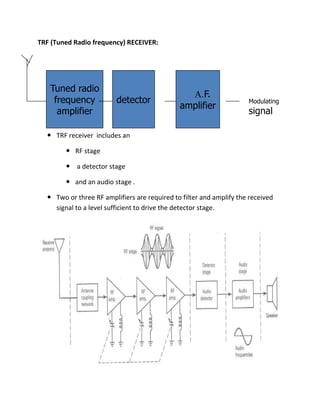

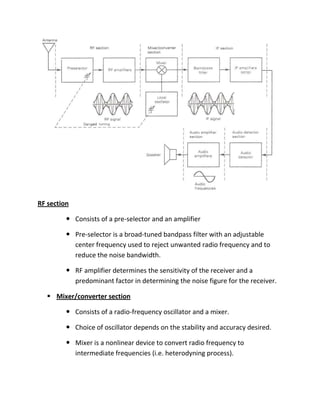
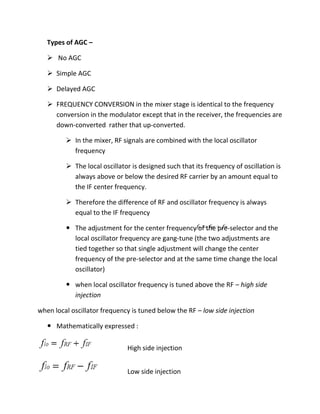



The document discusses radio receivers and their components and design. It describes the functions of radio receivers as intercepting modulated signals, selecting the desired signal, amplifying it, and demodulating it to recover the original signal. It explains the key components of receivers, including the RF amplifier, mixer, local oscillator, IF amplifier, and detector. It compares tuned radio frequency (TRF) receivers and superheterodyne receivers, noting that superheterodyne receivers overcome issues of TRF receivers like instability, bandwidth variation, and poor selectivity by downconverting RF signals to a lower intermediate frequency (IF). It also discusses characteristics of receivers like sensitivity, selectivity, and fidelity.


