SUPPRESSION OF UNWANTED
SIDEBAND (SSB-SC)
Mr.Patel J.H
• Three main systems are employed for the generation of SSB;
• The filter Method,
• The phase Shift Method
• The “Third method."
• They differ are from one another in the way of suppressing the
unwanted sideband, but all use some
form of balanced modulator to suppress the carrier.
• The balanced modulator is the key circuit in single-sideband
generation but each uses a different method of removing the
unwanted sideband.
• All three systems will' remove either the upper or the lower
sideband with equal ease, depending on the specific circuit
arrangement
1.The Filter System
• The filter system is the simplest system of the
three-
• After the balanced modulator the unwanted
sideband is removed by a filter.
• The filter may be LC, crystal, ceramic or
mechanical, depending on the carrier
frequency and other requirements.
• The key circuits in this transmitter are the
balanced modulator and the sideband-
suppression filter.
Block diagram of Filter method
Block diagram description
1. A crystal oscillator produces a stable carrier frequency fc (say 100 KHz)
2. This carrier frequency is then fed to the balanced modulator through a
buffer amplifier.
3. The audio signal having frequency range from 300 to 2800 Hz. is applied
to balanced modulator through audio amplifier .
4. The output of balance modulator is DSB –SC i.e The carrier is suppressed
in this stage but allows only to pass the both side bands. (USB & LSB).
5. A side band suppression filter is band pass filter (BPF) allows only a single
band either USB or LSB to pass through it depending on requirements.
6. This side band is then heterodyned in the balanced mixer stage with 12
MHz frequency produced by crystal oscillator or synthesizer depends upon
7. the requirements of transmission. So in mixer stage, the frequency of the
crystal oscillator or synthersizer is added to SSB signal.
8. The output frequency thus being raised to the value desired for
transmission.
Advantages
The advantages of single side band SSB transmission are as
follows.
1. It allows better management of the frequency spectrum.
more transmission can fit into a given frequency range
than would be possible with double side band DSB signals.
2. All of the transmitted power is message power none is
dissipate as carrier power.
3. The noise content of a signal is an exponential function of
the bandwidth: the noise will decrease by 3dB when the
bandwidth is reduced by half.
4. There fore, single side band SSB signals have less noise
contamination than DSB double side band.
Disadvantages
1. The cost of a single side band SSB receiver is higher than
the double side band DSB counterpart be a ratio of about
3:1.
2. The average radio user wants only to flip a power switch
and dial a station. Single side band SSB receivers require
several precise frequency contro lsettings to minimize
distortion and may require continual readjustment during
the use of the system.
DisadvantagesDisadvantages
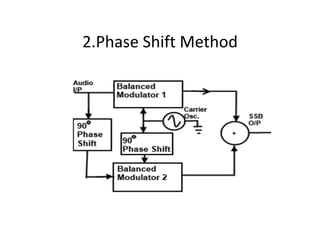
2.Phase Shift Method
Block diagram description
1. The phase shift method of SSB generation causes one of the side
bands to be canceled out.
2. It uses two balanced modulators instead of one balanced
modulator1 & balanced modulator2 respectively . The balanced
modulators effectively eliminate the carrier.
3. The carrier oscillator is applied directly to the upper balanced
modulator along with the audio modulating signal.
4. Then both the carrier and modulating signal are shifted in phase
by 90o and applied to the second or lower, balanced modulator.
5. The two balanced modulator output are then added together
algebraically.
6. The phase shifting action causes one side band to be canceled out
when the two balanced modulator outputs are combined.
• Let carrier signal is EcSinωct & Modulating signal (Audio Signal) EmSinωmt .
• Balanced modulator 1 produces the product of these two signals.
• Applying a trigonometric identity we get
EcSinωct * EmSinωmt = 1/2 [cos (ωc – ωm ) t - cos (ωc + ωm ) t] --- (1)
Similarly for Balanced modulator 2 carrier signal ( EcSinωct - 90o )= EcCos ωct
and Modulationg signal is applied with 90o phase shift (EmSinωmt - 90o )=
EmCos ωmt .
EcCos ωct * EmCos ωmt = 1/2 [cos (ωc – ωm ) t + cos (ωc + ωm ) t ] ----- (2)
Add (1) & (2)
The output of Adder is
V0= Cos (ωc – ωm ) t .
i.e Lower Side band only .
Advantages
1. It can generate the SSB signal at any frequency, so the frequency up converter
stage is not required .
2. It can use the low audio frequencies as modulating signal .(In filter method, this
is not possible ) .
3. It is easy to switch from one sideband to other .
Disadvantages
1. The main drawback is that the design of the 90o phase shifting network for the
modulating signal is extremely critical .
2. This network has to provide a correct phase shift of 90o at all the modulating
frequencies which is practically difficult to achieve .
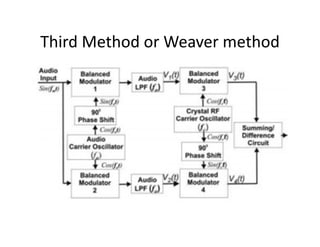
Third Method or Weaver method
• It consists of four balanced modulators, two carrier signal generators , two audio
low-pass filters, and two 90 phase-shift networks.
• The low pass filter having center frequency f0.
• The filter output is
• This output is applied to balance modulator 3 & 4 along with RF crystal Oscillator .
• The output of balance modulator 3 & 4 is
• an addition operation will yield the upper
sideband, while a subtraction will yield the
lower sideband .
Advantages
• The third method requires neither a sideband-
suppression filter nor a wideband audio
phase-shift network.
• Correct output can be maintained simply
without critical parts or adjustments
Disadvantages
• Dc coupling may be needed to avoid the loss
of signal components close to the audio
carrier frequency.
• Whistle will exist at that frequency if the
balance of the low-frequency balanced
modulators deteriorates.
• This system is the most complex of the three

Ssb generation method

  • 1.
    SUPPRESSION OF UNWANTED SIDEBAND(SSB-SC) Mr.Patel J.H
  • 2.
    • Three mainsystems are employed for the generation of SSB; • The filter Method, • The phase Shift Method • The “Third method." • They differ are from one another in the way of suppressing the unwanted sideband, but all use some form of balanced modulator to suppress the carrier. • The balanced modulator is the key circuit in single-sideband generation but each uses a different method of removing the unwanted sideband. • All three systems will' remove either the upper or the lower sideband with equal ease, depending on the specific circuit arrangement
  • 3.
    1.The Filter System •The filter system is the simplest system of the three- • After the balanced modulator the unwanted sideband is removed by a filter. • The filter may be LC, crystal, ceramic or mechanical, depending on the carrier frequency and other requirements. • The key circuits in this transmitter are the balanced modulator and the sideband- suppression filter.
  • 4.
    Block diagram ofFilter method
  • 5.
    Block diagram description 1.A crystal oscillator produces a stable carrier frequency fc (say 100 KHz) 2. This carrier frequency is then fed to the balanced modulator through a buffer amplifier. 3. The audio signal having frequency range from 300 to 2800 Hz. is applied to balanced modulator through audio amplifier . 4. The output of balance modulator is DSB –SC i.e The carrier is suppressed in this stage but allows only to pass the both side bands. (USB & LSB). 5. A side band suppression filter is band pass filter (BPF) allows only a single band either USB or LSB to pass through it depending on requirements. 6. This side band is then heterodyned in the balanced mixer stage with 12 MHz frequency produced by crystal oscillator or synthesizer depends upon 7. the requirements of transmission. So in mixer stage, the frequency of the crystal oscillator or synthersizer is added to SSB signal. 8. The output frequency thus being raised to the value desired for transmission.
  • 6.
    Advantages The advantages ofsingle side band SSB transmission are as follows. 1. It allows better management of the frequency spectrum. more transmission can fit into a given frequency range than would be possible with double side band DSB signals. 2. All of the transmitted power is message power none is dissipate as carrier power. 3. The noise content of a signal is an exponential function of the bandwidth: the noise will decrease by 3dB when the bandwidth is reduced by half. 4. There fore, single side band SSB signals have less noise contamination than DSB double side band.
  • 7.
    Disadvantages 1. The costof a single side band SSB receiver is higher than the double side band DSB counterpart be a ratio of about 3:1. 2. The average radio user wants only to flip a power switch and dial a station. Single side band SSB receivers require several precise frequency contro lsettings to minimize distortion and may require continual readjustment during the use of the system. DisadvantagesDisadvantages
  • 8.
  • 9.
    Block diagram description 1.The phase shift method of SSB generation causes one of the side bands to be canceled out. 2. It uses two balanced modulators instead of one balanced modulator1 & balanced modulator2 respectively . The balanced modulators effectively eliminate the carrier. 3. The carrier oscillator is applied directly to the upper balanced modulator along with the audio modulating signal. 4. Then both the carrier and modulating signal are shifted in phase by 90o and applied to the second or lower, balanced modulator. 5. The two balanced modulator output are then added together algebraically. 6. The phase shifting action causes one side band to be canceled out when the two balanced modulator outputs are combined.
  • 10.
    • Let carriersignal is EcSinωct & Modulating signal (Audio Signal) EmSinωmt . • Balanced modulator 1 produces the product of these two signals. • Applying a trigonometric identity we get EcSinωct * EmSinωmt = 1/2 [cos (ωc – ωm ) t - cos (ωc + ωm ) t] --- (1) Similarly for Balanced modulator 2 carrier signal ( EcSinωct - 90o )= EcCos ωct and Modulationg signal is applied with 90o phase shift (EmSinωmt - 90o )= EmCos ωmt . EcCos ωct * EmCos ωmt = 1/2 [cos (ωc – ωm ) t + cos (ωc + ωm ) t ] ----- (2) Add (1) & (2) The output of Adder is V0= Cos (ωc – ωm ) t . i.e Lower Side band only .
  • 11.
    Advantages 1. It cangenerate the SSB signal at any frequency, so the frequency up converter stage is not required . 2. It can use the low audio frequencies as modulating signal .(In filter method, this is not possible ) . 3. It is easy to switch from one sideband to other .
  • 12.
    Disadvantages 1. The maindrawback is that the design of the 90o phase shifting network for the modulating signal is extremely critical . 2. This network has to provide a correct phase shift of 90o at all the modulating frequencies which is practically difficult to achieve .
  • 13.
    Third Method orWeaver method
  • 14.
    • It consistsof four balanced modulators, two carrier signal generators , two audio low-pass filters, and two 90 phase-shift networks. • The low pass filter having center frequency f0. • The filter output is • This output is applied to balance modulator 3 & 4 along with RF crystal Oscillator . • The output of balance modulator 3 & 4 is
  • 15.
    • an additionoperation will yield the upper sideband, while a subtraction will yield the lower sideband .
  • 16.
    Advantages • The thirdmethod requires neither a sideband- suppression filter nor a wideband audio phase-shift network. • Correct output can be maintained simply without critical parts or adjustments
  • 17.
    Disadvantages • Dc couplingmay be needed to avoid the loss of signal components close to the audio carrier frequency. • Whistle will exist at that frequency if the balance of the low-frequency balanced modulators deteriorates. • This system is the most complex of the three